
The Hungarian Historical Review The Hungarian Historical Review The Hungarian Historical Review

Login

  • HOME
  • Journal Info
    • Journal Description
    • Editors & Boards
    • Publication ethics statement
    • Open access policy
    • For Publishers
    • Copyright
    • Submission Guidelines
    • Subscribe
    • Recommend to Library
    • Contact
  • Current Issue
  • All Issues
  • Call for Articles
  • Submissions
  • For Authors
  • Facebook

Volume 14 Issue 4 2025

Central European Perspectives on the History of PsychiatryHHR 2025 4 borito1

Janka Kovács and Daniela Tinková
Special Editors of the Thematic Issue

Contents

Articles

Carlos Watzka
Centralizing Custody and Curing by Chance: Early Austrian Madhouses under Medical Supervision and State Constraint, c. 1780–1830   493

Abstract Full Text (HTML) and Full Text (PDF)

Helena Chalupová
The Beginnings of Pediatric Psychiatry in the Czech Lands   537

Abstract Full Text (HTML) and Full Text (PDF)

Monique Palma
On Mad Dogs and Their Relation to Human Medicine: The Discourse on Canines in Nineteenth-Century Medical Studies in Porto   563

Abstract Full Text (HTML) and Full Text (PDF)

Gergely Magos
Discipline and Superiority: Neurasthenia and Masculinity in the Hungarian Medical Discourse   588

Abstract Full Text (HTML) and Full Text (PDF)

Francesco Toncich
“We Cannot See Ourselves Reflected in All Italian Institutions”: Reform Psychiatry, Habsburg Legacies, and Identity-Making in the Upper Adriatic Area   615

Abstract Full Text (HTML) and Full Text (PDF)

Book Review

Der Wiener Narrenturm. Die Geschichte der niederösterreichischen Psychiatrie von 1784 bis 1870. By Daniel Vitecek. Reviewed by Janka Kovács  655

Full Text (PDF)

Notes on Contributors
Full Text (HTML)
Volume 14 Issue 3 2025

International Networks of Women’s Activism 2025 3 borito11
and Mobility in East Central Europe and
South Eastern Europe, 1848–1945

Dóra Fedeles-Czeferner
Special Editor of the Thematic Issue

Contents

Introduction

Dóra Fedeles-Czeferner
International Networks of Women’s Activism and Mobility in East Central Europe and
South Eastern Europe, 1848–1945   311

Full Text (HTML) and Full Text (PDF)

Articles

Marina Bantiou
Women’s History in Greece through The Ladies’ Journal of Kallirhoe Siganou-Parren:
Class, National Identity, and Reformist Activism in the Formation of Women’s Associations (1887–1917)   317

Abstract Full Text (HTML) and Full Text (PDF)

Agatha Schwartz
Austro-Hungarian Women’s Activism from the Southern “Periphery” Across Ethnic Lines   351

Abstract Full Text (HTML) and Full Text (PDF)

Paula Lange
Phantom Borders and Nostalgia: German Women’s Associations in the Second Polish Republic after 1918   373

Abstract Full Text (HTML) and Full Text (PDF)

Zsuzsa Bokor
Adrift on the Periphery: The Alternative Development of Hungarian Women’s Organizations in Interwar Transylvania   402

Abstract Full Text (HTML) and Full Text (PDF)

Anna Veronica Pobbe
“Terror against Women.” The Struggle of “Red” Women at the Beginning of the Nazi Era: Between Invisibility and Solidarity   443

Abstract Full Text (HTML) and Full Text (PDF)

Dóra Fedeles-Czeferner
The Journalistic Activity of Rosika Schwimmer: from the 1890s until her Death in a Transnational Perspective   459

Abstract Full Text (HTML) and Full Text (PDF)

Book Review

Full Text (PDF)

Straßen im 16. Jahrhundert: Erhalt – Nutzung – Wahrnehmung. Ding, Materialität, Geschichte 5. By Alexander Denzler. Reviewed by Daniel Pfitzer   491
Full Text (PDF)

Fiume hosszú árnyéka – A városi modernizáció kritikája a 19. század második felében [The long shadow of Fiume: Criticisms of urban modernization in the second half of the nineteenth century]. By Veronika Eszik. Reviewed by Catharine Horel   496
Full Text (PDF)

Intellectuals and the Crisis of Politics in the Interwar Period and Beyond: A Transnational History. By Balázs Trencsényi. Reviewed by Paul Hanebrink   499
Full Text (PDF)

Notes on Contributors
Full Text (HTML)
Volume 14 Issue 2 2025

Contexts of Premodern Translations

Special editor of the thematic issue Péter Bara

Contents

Introduction

Péter Bara
Coherence of Translation Programs and the Contexts of Translation Movements, ca. 1000–1700 AD 155

Full Text (HTML) and Full Text (PDF)

Articles

Péter Bara
What Factors Are Conducive to Coherence? Translation Activity in Late Medieval Western Europe: A Sketch of a Research Program 158

Abstract Full Text (HTML) and Full Text (PDF)

Hiram Kümper
Translating Popular Wisdom into Learned Language and Practice: Egbert of Liège’s Fecunda ratis and the Changing World of the Eleventh Century 186

Abstract Full Text (HTML) and Full Text (PDF)

Gohar Muradyan
Fourteenth-Century Developments in Armenian Grammatical Theory through Borrowing and Translation: Contexts and Models of Yovhannes K‘ṛnets‘i’s Grammar Book 214

Abstract Full Text (HTML) and Full Text (PDF)

Daniel Vaucher
From East to West: The Greek Prayer of Cyprian and its Translation into European Vernaculars 247

Abstract Full Text (HTML) and Full Text (PDF)

Alessandro Orengo
Oskan Erewanc‘i as a Translator from and into Latin  274

Abstract Full Text (HTML) and Full Text (PDF)

Book Review

Full Text (PDF)

Jesuits and Islam in Europe. By Paul Shore and Emanuele Colombo. Brill Research Perspectives in Humanities and Social Sciences Series. Reviewed by Dávid Lédig 292
Full Text (PDF)

Önkép és múltkép: A reprezentáció színterei Nádasdy Ferenc és a 17. századi főúri elit műpártolásában [Self-representation and history: The scenes of representation in the art patronage of Ferenc Nádasdy and the aristocracy of the seventeenth-century Hungarian Kingdom]. By Enikő Buzási. Reviewed by Andrea Márton 295
Full Text (PDF)

The Making of Dissidents: Hungary’s Democratic Opposition and its Western Friends, 1973–1998. By Victoria Harms. Reviewed by Szabolcs László 299
Full Text (PDF)

Notes on Contributors
Full Text (HTML)
Volume 14 Issue 1 2025

The Angevins and Central Europe in the Middle Ages HHR 2025 1 borito 11

Special editor of the thematic issue Judit Gál

Contents

Articles

Valentina Šoštarić and Krešimir Baljkas
Emotional Responses to the Beginning and End of the Rule of Louis I in Dalmatia 3

Abstract Full Text (HTML) and Full Text (PDF)

Judit Gál
The Administratve Elite of King Louis I in Croatia-Dalmatia 30

Abstract Full Text (HTML) and Full Text (PDF)

Tomislav Matić
Croatian-Dalmatian Roles in the Organization of the Wedding of King Vladislaus II and Queen Anne 65

Abstract Full Text (HTML) and Full Text (PDF)

Renáta Skorka
Marriages of Convenience, Forced Betrothals: Dynastic Agreements in the Angevin-era Hungary 95

Abstract Full Text (HTML) and Full Text (PDF)

Bálint Ternovácz
The History of the Macsó and Barancs Territories until 1316  127

Abstract Full Text (HTML) and Full Text (PDF)

Book Review

Servants of Culture: Paternalism, Policing, and Identity Politics in Vienna, 1700–1914. By Ambika Natarajan. Reviewed by Dóra Fedeles-Czeferner 147
Full Text (PDF)

Notes on Contributors
Full Text (HTML)
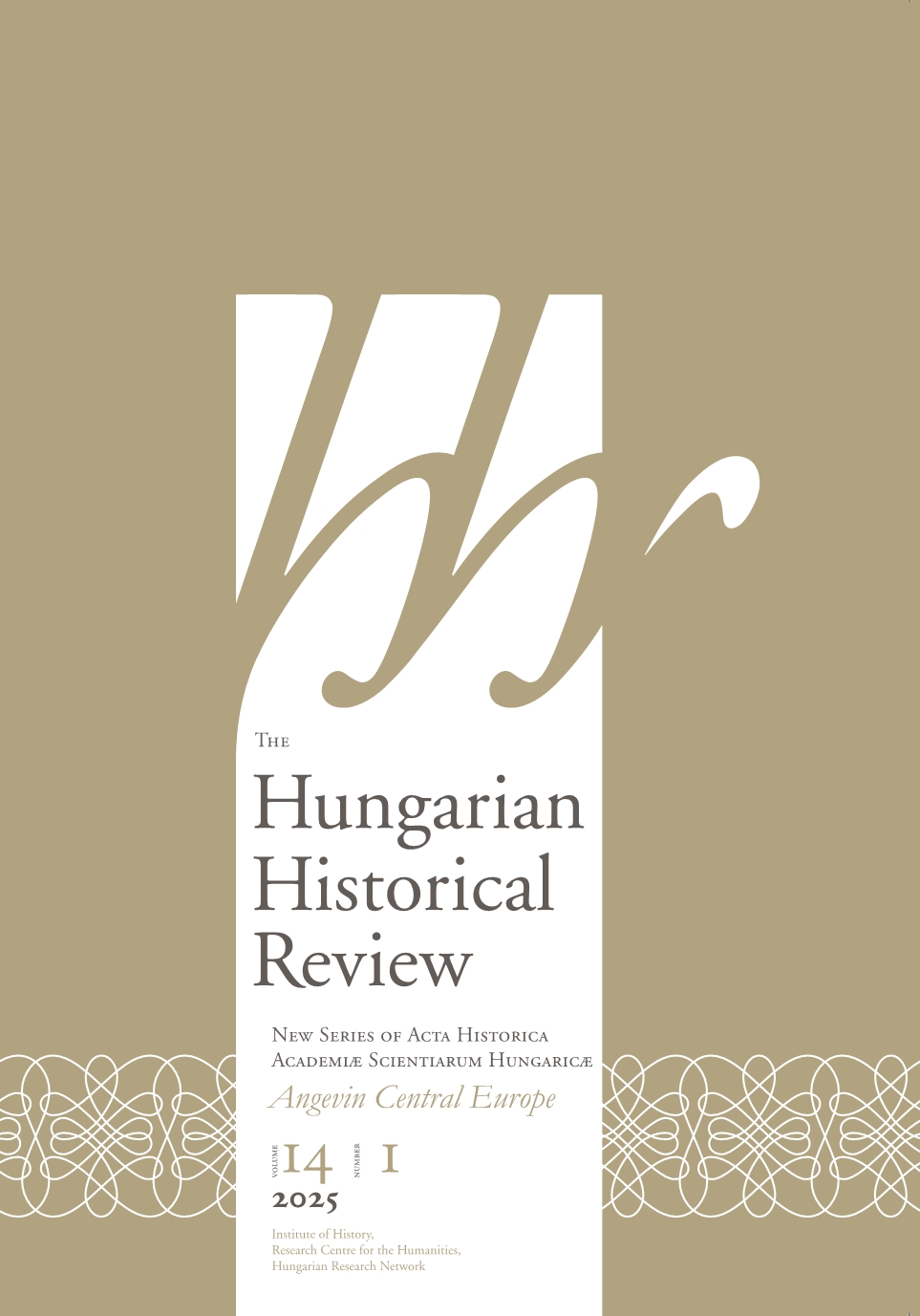
Volume 13 Issue 4 2024

Business Cooperations and Economic Connections HHR 2024 4 borito 11

Special editors of the thematic bloc: Judit Klement and Ágnes Pogány 

Contents

Thematic bloc: Business Cooperations and Economic Connections

Eduard Kubů and Barbora Štolleová
Živnostenská Banka (Trades Bank) and Its Participation in the Banking Consortia/Syndicates of Interwar Czechoslovakia* 533

Abstract Full Text (HTML) and Full Text (PDF)

Ivan Smiljanić 
The Politics of Business: (Failed) Economic Initiatives of Slovene Liberals in the First Decades of the Twentieth Century 559

Abstract Full Text (HTML) and Full Text (PDF)

Gyula Horváth
A Unique Path to Monopoly: The Case of the Hungarian Insurance Sector, 1945–1952 575

Abstract Full Text (HTML) and Full Text (PDF)

Walter M. Iber and Christoph Huber
From Pioneer to Latecomer: Relations between Austria and the Soviet Union (Russia) in the Oil and Gas Sector 596

Abstract Full Text (HTML) and Full Text (PDF)

Article

Ábel Bede
Fathers of Budapest, Daughters of the Countryside: Recontextualizing Cultural Change in Fin-de-Siècle Hungary 623

Abstract Full Text (HTML) and Full Text (PDF)

BOOK REVIEWS

Full Text (PDF)

Közép-Európa a hosszú 13. században: Magyarország, Csehország és Ausztria hatalmi és dinasztikus kapcsolatai 1196 és 1310 között [Central Europe in the long thirteenth century: Power and dynastic relations among Hungary, Bohemia, and Austria between 1196 and 1310]. By Veronika Rudolf. Reviewed by Sándor Hunyadi 655
Full Text (PDF)

Die Karriere des deutschen Renegaten Hasn Caspar in Ofen (1627–1660) im politischen und kulturellen Kontext. By János Szabados. Reviewed by Olivér Gillich 659
Full Text (PDF)

Nations, privilèges et ethnicité: Le Banat habsbourgeois; Un laboratoire politique aux confins de l’Europe éclairée. By Benjamin Landais. Reviewed by Ágoston Berecz 663
Full Text (PDF)

Anti-Axis Resistance in Southeastern Europe, 1940–1944: Forms and Varieties. Edited by John Paul Newman, Ljubinka Škodrić, and Rade Ristanović. Reviewed by Ákos Bartha 667
Full Text (PDF)

Queer Encounters with Communist Power: Non-Heterosexual Lives and the State in Czechoslovakia, 1948–1989. By Věra Sokolová. Reviewed by Sébastien Tremblay 673
Full Text (PDF)

Notes on Contributors
Full Text (HTML)
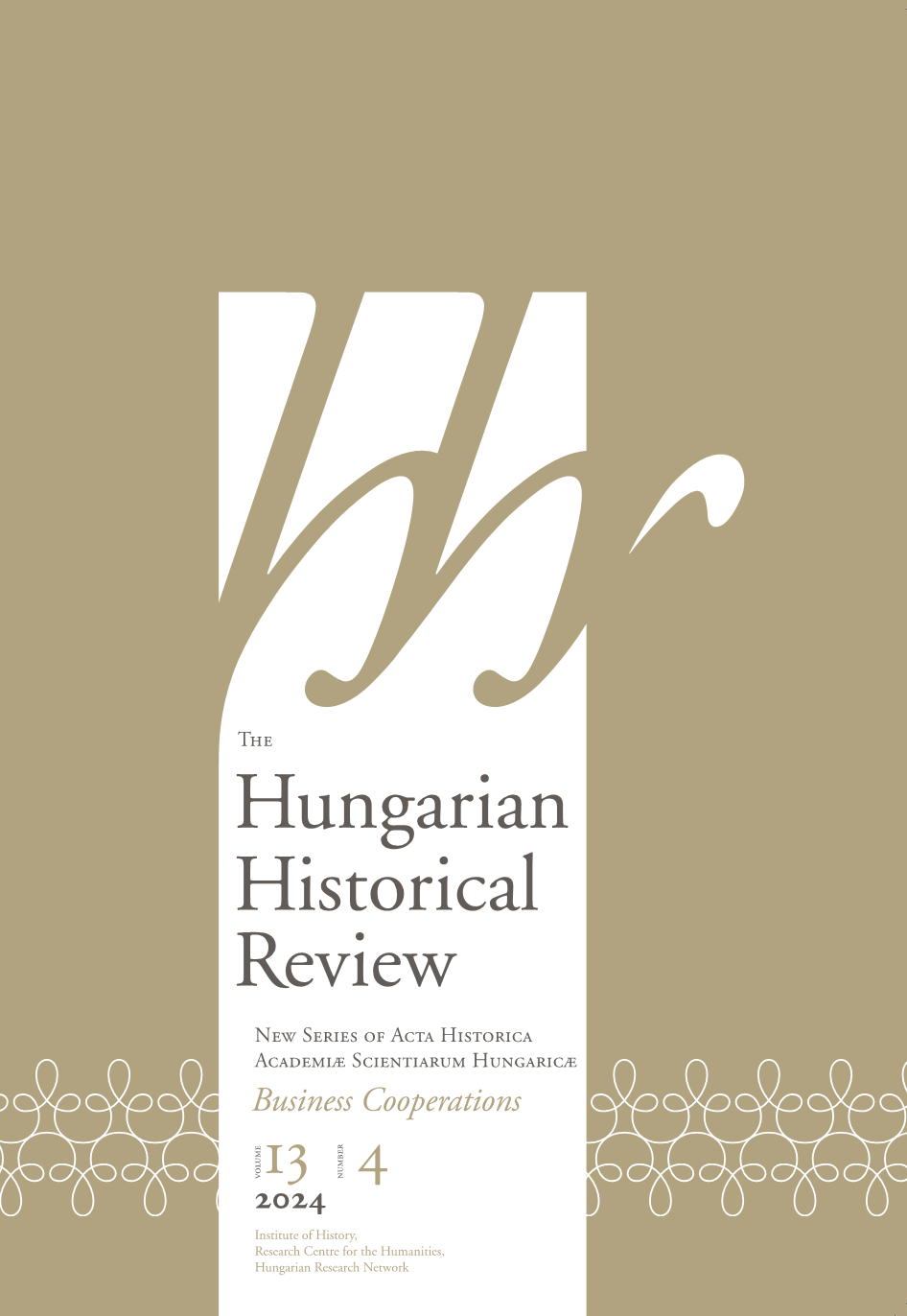
Volume 13 Issue 3 2024

Agrarian Productivity and Efficiency in East Central EuropeHHR 2024 3 borito 11

Special editor of the thematic bloc: Gábor Demeter

Contents

ARTICLES

Beatrix F. Romhányi
Spatial Transformations and Regional Differences in the Medieval Kingdom of Hungary (1000–1500) 339

Abstract Full Text (HTML) and Full Text (PDF)

Gábor Demeter
Differences in Quality of Life and Profitability on Small and Large Farms (1730–1930): A Statistical Approach 361

Abstract Full Text (HTML) and Full Text (PDF)

Géza Hegyi
The Share of Tithe Paid to Parish Priests in Sixteenth-Century Transylvania 403

Abstract Full Text (HTML) and Full Text (PDF)

Maciej Kwiatkowski
Agricultural Productivity in the Western Borderlands of the Grand Duchy of Lithuania (Second Half of the Sixteenth Century) 431

Abstract Full Text (HTML) and Full Text (PDF)

András Schlett
The Export Potential of Hungarian Agriculture and the Issue of Added Value between the two World Wars 446

Abstract Full Text (HTML) and Full Text (PDF)

Róbert Bagdi
The Incomes and Expenditures of Agrarian Family Enterprises in Interwar Hungary 471

Abstract Full Text (HTML) and Full Text (PDF)

BOOK REVIEWS

Full Text (PDF)

Születés és anyaság a régi Magyarországon: 16. század – 20. század [Birth and motherhood in old Hungary: From the sixteenth to the twentieth century]. Written and edited by Lilla Krász.  Reviewed Gábor Koloh 509
Full Text (PDF)

The Shadow of the Empress: Fairy-Tale Opera and the End of the Habsburg Monarchy. By Larry Wolff. Reviewed Imre Tarafás 514
Full Text (PDF)

Re/imaginations of Disability in State Socialism: Visions, Promises, Frustrations. Edited by Kateřina Kolářová and Martina Winkler.  Reviewed Boglárka Kőrösi 517
Full Text (PDF)

Survival Under Dictatorships. Life and Death in Nazi and Communist Regimes. By László Borhi. Reviewed Attila Pók 522
Full Text (PDF)

Notes on Contributors
Full Text (HTML)

Volume 11 Issue 4 2022

Volume 7 Issue 4

After Wars

Contents

ARTICLES

THEMATIC BLOC: World War I – Special editor of the thematic bloc: Béla Tomka 

Béla Tomka
World War I as a Historical Divide 675

Abstract

Abstract

While World War I certainly represents a historical rupture in Europe and many parts of the world, there are diverging views in scholarly literature and broader historical discourse regarding its character as a dividing line between historical periods. The essay identifies three main positions within the debate and elaborates on the broader consequences of these interpretations. Several scholars consider World War I as the end of an earlier, longer historical era. According to another periodization, the two World Wars and the two decades separating them make up an era together, which is distinct from the pre-1914 and post-1945 periods. Finally, a third major current interprets World War I as the overture to a new epoch. Each of the three approaches can be relevant to research on World War I and the twentieth century, but there are considerable divergences between the interpretations thus produced. If we regard World War I as the endpoint of the previous era, then great emphasis should be placed on the road leading up to the war. If we conceive of the two World Wars and the decades between them as a single unit, then we should focus on violence as a defining feature of the periodization, and short-term factors should be highlighted. Finally, if we understand the Great War as the beginning of a new period which lasted until the end of the twentieth century or beyond, World War I will be seen as the Urkatastrophe (primordial catastrophe) that set the stage for World War II and, indirectly, for the Cold War, while also generating seminal long-term processes in politics, society, and the economy.
Full Text (HTML) and Full Text (PDF)

Zsombor Bódy
A World Lifted off Its Hinges: The Social Impact of World War I on Hungary 702

Abstract

Abstract

As was true virtually everywhere, World War I brought about significant social changes in Hungary. As a consequence of the wartime mobilization of the economy, the relationship between employers and workers in industry was transformed, as was the relationship between owners of different sizes of estates and farms and agricultural workers in rural areas. In both spheres, groups emerged which were much better organized than before. Some of them were capable of coordinated political action, and the balance of power between them changed rapidly over time. The wartime government tried to ensure continuous coordination and reconciliation of interests between the various ownership and labor groups in agriculture and industry, but it ultimately failed. Beyond the military defeat, this failure was the primary determining factor of the events of 1918–19 in Hungary. By analyzing the group dynamics of wartime society and the wartime economy in Hungary, this paper seeks to outline the social and historical background of the political struggles that came in the wake of the war. It ventures two core contentions. First, the emergence of various agricultural and industrial interest groups and their coordination with one another and with the government in the aftermath of the war constituted mechanisms of integration that had not existed before the war. As a result, the diverse socio-professional groups in Hungary became more integrated into one society within the framework of the state. The second finding contention is that the counterrevolutionary regime that took over in late 1919 was more successful than previous governments had been in establishing a balance between the different groups of owners and workers and learning from previous experience, and this was why it was able, ultimately, to consolidate its hold on power.
Full Text (HTML) and Full Text (PDF)

Ferenc Erős
War and Revolutions: Trauma and Violence from a Socio-Psychological Approach 733

Abstract

Abstract

World War I, which broke out more than 100 years ago, placed not only a tremendous material and physical burden on the citizens of the participating countries, military and civilians alike, but also a psychological one. The study of the psychological consequences of the war has been pushed somewhat into the background in comparison to the historical and political analyses, though the uses of psychology—and broadly speaking, of the so-called “psy” disciplines, i.e., psychiatry, psychoanalysis, psychotherapy, social psychology, psychotechnics, criminology, pedagogy, etc.—were a crucial part of the history of this war. However, a history of the “psy” disciplines would not be complete without some discussion of the fact that World War I and World War II (and subsequent conflicts) played a fundamental role in the development of these sciences. Arguably, World War led to the emergence—as a kind of “experimental laboratory”—of practices and methods of the application of violence, trauma management, intimidation, terror, manipulation, and propaganda which draw on (and contribute to) insights from these disciplines, not to mention new approaches to the management of subjectivity and the manipulation of sentiments, which proved effective both in times of war and peace.
Full Text (HTML) and Full Text (PDF)

József Takáts
Diverging Language Uses: Political Discourse in Hungary after World War I 764

Abstract

Abstract

Following some introductory notes on methodology, this study analyzes the process of the intensifying militarization, polarization, brutalization, sacralization, saturation with extreme appeals to emotions, and apocalyptic tone of Hungarian political texts after 1918. It also examines the ways in which the National Darwinist political vocabulary, which evolved originally in the last third of the nineteenth century, survived after the World War, and how it created the double languages of nationalist discourse: the historicizing one and the racist one.
Full Text (HTML) and Full Text (PDF)

ARTICLES
Emese Gyimesi
The Urban Space Through the Eyes of Women: The 1849 Siege of Buda in Women’s Ego-documents 789

Abstract

Abstract

This study examines how female city dwellers experienced the siege of Buda Castle, a crucial event of the Revolution and War of Independence of 1848–1849, and the image of the city in their writings. The analysis focuses on three women’s ego-documents: the autobiography of Emília Kánya, the first female editor in the Habsburg Empire, the letters written by a young actress, Lilla Bulyovszky, to her husband and a letter by Anna Glasz, a resident of Buda Castle. I explore the kinds of mental map that emerge in the ego-documents in which the authors reflect on the urban experiences during the siege and the emotions that dominate their writings.
Full Text (HTML) and Full Text (PDF)

Albert Doja
From the Austrian-Hungarian Point of View: An der schönen blauen Donau and the Accursed Black Mountain Wreath in the Balkans 824

Abstract

Abstract

In this paper, I contribute to the debate about hegemonic relations between the West European “core” and southeast European “margins” by showing the links between political institutions and knowledge production in the metropolitan Austrian-Hungarian areas on peripheral southeast European societies, including Albania. In particular, I address new aspects of a continuous resonance in the politically instrumentalized theories of the Illyrian origins of the Albanian language and the traditional tenets of Albanian history, culture, and society. In the course of discussion, I address their promotion in the works of key scholars from Leibniz to Thalloczy and Nopcsa serving the pervasive hegemonic and expansionist interests of Austrian-Hungarian imperial colonialism. Arguably, the effects of methodological imperialism are reproduced later to legitimate other, similar purposes of political, economic, and social control by means of cultural and political engineering in national-communist and post-communist Albania.
Full Text (HTML) and Full Text (PDF)

Dénes Sokcsevits
The Story of Croatian Bosnia: Mythos, Empire-Building Aspirations, or a Failed Attempt at National Integration? 870

Abstract

Abstract

The nineteenth-century processes of “nation-building” and national integration took place in the western regions of southeastern Europe against a distinctive backdrop. The formation of national self-images, the creation of a national self-definition, and indeed the emergence of any clear consensus on who constituted or should constitute a given national community proved daunting tasks for the multi-ethnic and multi-religious populations of southeastern Europe in the provinces of the Habsburg Monarchy and the Ottoman Empire.
The essential contention of this inquiry is that religious and national identities are not clearly interrelated in southeastern Europe (much, indeed, as they are not clearly interrelated elsewhere). I offer, as a clear illustration of the untenability of religious identity as an adequate foundation for nation building, an examination of the case of Bosnia and the development of a sense of identity and national belonging among Bosnian Croats and Muslims. Even the case of the emergence of the modern Serbian and Croatian nations, often cited as archetypes of national identities which developed along religious fault lines, is not as clear as it often seems to be in the public mind. It was not the only possibility, but rather was merely one alternative, an alternative that was shaped as much by internal circumstances as by the prevailing foreign political situation: the emergence, meaning, and “content” of the nation can be interpreted as a response to these factors.
Full Text (HTML) and Full Text (PDF)

Gusztáv D. Kecskés
A Cold War Humanitarian Action: The Western Admission of 1956 Hungarian Refugees 913

Abstract

Abstract

The story of the refugees who fled Hungary following the Soviet suppression of the 1956 Revolution and the coordinated international humanitarian operation launched to receive them is an outstanding chapter in the history of emigration. These refugees received far more favorable treatment than earlier Hungarian expatriates or other European refugees had been given. With a total of 200,000 refugees, their successful transportation to host countries and their subsequent integration represented an exceptional success for international aid efforts. How can this efficiency be explained? Trends in humanitarian sentiment in world public opinion, influenced in part by the horrors of World War II, and the increasingly precise formulation of the rights of the refugees were just as important, as factors, as the supportive attitude of the populations of Western countries, who empathized with the suppressed revolution. The exceptionally favorable composition, from the perspective of the labor market, of the mass of people who fled in 1956 coincided with Western economic prosperity, producing economic “miracles.” However, even these favorable initial conditions would not have led to such a swift and successful settlement in the West of nearly 200,000 Hungarians had it not been for the Cold War rivalry between the Eastern and the Western blocs. As a consequence of the ideological and propaganda conflict with the Soviets, the NATO governments had the necessary political will to give effective support for a resolution to the Hungarian refugee problem, even after emotional support among the public opinion had waned.
Full Text (HTML) and Full Text (PDF)

BOOK REVIEWS

Egy határfolyó környezettörténete: Háború és vízgazdálkodás a kora újkori Rába-völgyben [Environmental history of a boundary river: War and water management in the early modern Rába Valley]. By András Vadas.
Reviewed Márton Simonkay 936

Full Text (PDF)

Aufklärung habsburgisch: Staatsbildung, Wissenskultur und Geschichtspolitik in Zentraleuropa 1750–1850. By Franz Leander Fillafer.
Reviewed Ágoston Nagy 940

Full Text (PDF)

More Than Mere Spectacle: Coronations and Inaugurations in the Habsburg Monarchy during the Eighteenth and Nineteenth Centuries. Edited by Klaas Van Gelder. Reviewed Benedek M. Varga 946

Full Text (PDF)

“Nekünk nincsenek gyarmataink és hódítási szándékaink”: Magyar részvétel a Monarchia gyarmatosítási törekvéseiben a Balkánon, 1867–1914 [“We have neither colonies nor intentions of conquest”: Hungarian participation in the Monarchy’s colonial ambitions in the Balkans, 1867–1914]. By Krisztián Csaplár-Degovics. Reviewed Imre Tarafás 950

Full Text (PDF)

Emotions and Everyday Nationalism in Modern European History. Edited by Andreas Stynen, Maarten Van Ginderachter, and Xosé M. Núñez Seixas. Reviewed Tuomas Tepora 954

Full Text (PDF)

Beyond Camps and Forced Labour: Proceedings of the Sixth International Conference (The Holocaust and its Contexts). Edited by Suzanne Bardgett, Christine Schmidt, and Dan Stone. Reviewed András Szécsényi 957

Full Text (PDF)

Notes on Contributors
Full Text (HTML)


More Articles ...

  1. Volume 11 Issue 1 2022
  2. Volume 11 Issue 2 2022
  3. Volume 11 Issue 3 2022
  4. Volume 12 Issue 1 2023
  5. Volume 12 Issue 2 2023
  6. Volume 12 Issue 3 2023
  1. You are here:  
  2. Home
  3. All Issues
  4. HHR issue

IH | RCH | HAS

Copyright © 2013–2025.
All Rights Reserved.

Bootstrap is a front-end framework of Twitter, Inc. Code licensed under Apache License v2.0. Font Awesome font licensed under SIL OFL 1.1.