

Scholars as Agents: The Influence of Hungarian Explorers, Felix Kanitz, 
Adolf Strausz, and Lajos Thallóczy on Austria–Hungary’s Policy
Towards the Balkan Peninsula (1870–1904)*
Gábor Demeter
ELTE Research Centre for the Humanities
This email address is being protected from spambots. You need JavaScript enabled to view it.
Hungarian Historical Review Volume 15 Issue 2 (2026): 348-388 DOI 10.38145/2026.2.348
Drawing on unpublished Austrian (Haus- Hof- und Staatsarchiv) and Hungarian archival sources and also a comparative analysis of the diaries and published scholarly works of travelers, this paper examines how Austro-Hungarian scholars exploring the Balkans contributed to diplomatic intelligence activities between the 1870s and 1900s.
Fundamentally, it considers the extent to which the scholars were able to influence diplomatic actions and foreign policy of the Dual Monarchy. Focusing, as case studies, on Felix Kanitz, Adolf Strausz, and Lajos Thallóczy, it places special emphasis on the ways in which national and imperial directives provoked rivalries (or cooperation) between the two major political entities of Austria–Hungary. Additionally, the paper examines whether these scholars acted as intermediaries for Balkan countries while serving their home government.
Keywords: scholars, agents, travels, Austria–Hungary, Balkan Peninsula, economic penetration, intelligence services
Scholars, Travelers, and Agents
Drawing on unpublished Austrian (Haus- Hof- und Staatsarchiv) and Hungarian archival sources and also a comparative analysis of passages from diaries and published scholarly works of travelers, this paper examines how Austro-Hungarian scholars exploring the Balkans contributed to diplomatic intelligence activities between the 1870s and 1900s. It considers the extent to which these figures were able to influence diplomacy, tactics, and even the geopolitical strategies of the Dual Monarchy. Focusing, as case studies, on Felix Kanitz, Adolf Strausz, and Lajos Thallóczy, the paper places special emphasis on the ways in which national and imperial directives provoked rivalries (or cooperation) between the two major political entities of Austria–Hungary. The article also assesses the extent to which these scholars promoted the interests of Balkan states, while reporting to their mother country.
The exploration of the Balkans in the nineteenth century was neither inexpensive nor without risk, so travelers often needed patronage to provide protection, local contacts, or financial resources. While wealthy aristocrats, such as Count István Széchenyi, had no difficulty (self-)financing his 1820 trip to the east, less prestigious or “freelance” explorers, traveling at their own initiative, faced more daunting challenges. A prospective adventurer who did not have substantial scientific or personal resources often had to rely on (state) support, which was rarely granted without conditions. From the perspective of state interests, traveler-explorers had certain advantages over other agents working in the service of the state. They were more mobile than consuls, who were tied to specific towns or cities, or local agents. They were especially valuable, furthermore, if they were able to supplement the information they provided (which could always be gleaned from local informants) with sketches, itineraries, or even maps. Even simple descriptions of a route could serve intelligence purposes, as they offered details concerning bridges, river crossings, and mountain passes, as well as the customs of the local populations and their attitudes towards foreign influence. Unlike railway engineers, who were real professionals in mapping, scholars were not strictly bound to predetermined routes.
Of course, one has to draw a distinction between individuals who traveled to the Balkans in the service of the state and used science only as pretext and travelers who actually had a scientific commitment. There were even journeys undertaken at personal initiative that nevertheless served state interests, such as István Széchenyi’s expedition along the Danube in the 1830s, which aimed to promote trade through the proposed regulation of the Lower Danube in Serbian and Ottoman territories. Széchenyi was accompanied during the trip by an engineer named Beszédes (who later took part in the regulation of the Tisza River) and a younger fellow aristocrat, Waldstein. Both Széchenyi and Waldstein, future vice-president of the Institute for Historical Studies, Bulgarian Academy of Science), kept diaries during the trip, and it is particularly interesting to compare their views on the same event or landscape, or the behaviors and customs of the locals. Széchenyi, for example, was amazed by the “liberty” recently won by Serbia at the cost of considerable bloodshed, even viewing the Skull Tower, a historical monument near the city of Niš, as powerful memorial for future generations of Serbs to remember the costs of freedom and to appreciate liberty. (His reflections were influenced in part by his own interest in mobilizing Hungarian society toward reform and modernization.) Waldstein, in contrast, adopted a more pragmatic stance and responded with sadness to the violence.1 During this travels, Széchenyi pretended to be a merchant (who wanted to trade in wine and horses—good horses were essential for transportation and for the army) and a future government functionary (he was soon assigned the task of regulating Hungarian rivers by the Viennese Court). He did not receive any financial support from the state during his travels, but his goals (as usual) extended beyond personal interest and aligned closely with broader state priorities. This is one of the key differences between his voyage and the travels of the scholars a generation later, analyzed here.
The second difference is that neither Széchenyi nor those in his circles ever considered him a scholar (despite his numerous treatises on economics). His trip was only partly driven by scientific interest, unless we assign scientific character to economic goals (he did visit and mention historical places, and he saw the Roman inscriptions near Turnu Severin, for instance).
From the methodological point of view, this double travelogue of Waldstein and Széchenyi referring to the same route is especially valuable because the rare parallel descriptions can be used both to confirm the events and to show how subjective the attitude and feelings of the travelers toward their environ was. In this study, the parallel travelogues of Felix Kanitz and Benjámin Kállay on their joint trip around Vidin in 1868 will be exploited to reconstruct the events behind the officially published text of Kanitz’s scholarly work, Donau-Bulgarien. 2
There were many ways in which a scholar could come to be considered an agent by later generations. Austria–Hungary’s list of confidants (paid agents) included such names as Jovan Cvijić.3 A Serbian passport was hardly life insurance for someone traveling in Ottoman Albanian territories. The agents of Austria–Hungary, which was seen as the cult protector of the Catholic Albanians, were regarded with less suspicion by the people of this mountain region, so Cvijić did not hesitate to exploit this possibility. This proved a wise choice under the circumstances into consideration. Cvijić was on a field trip during the opening of a Serbian consulate, apparently not coincidentally. Nevertheless, this does not necessarily mean that Cvijić became a permanent deep agent of Austria–Hungary or that the information he provided was ever useful.
The Czech František Zach, born an Austrian citizen, fled after the failure of the 1848 revolutions. Zach served not only as the head of the Belgrade Military Academy and a fellow traveler of the Austrian consul Johann von Hahn (the father of Albanology, who created an ethnic map of Morava valley which was, however, ultimately useful for the Serbian cause too), but was also a revolutionary agent of Czartoryski and the Hôtel Lambert (a political faction of Polish émigrés in nineteenth-century Paris).4
Sometimes scientific activity was utilized by political circles only decades later, when the significance of previous activities increased. The Viennese chemist engineer-photographer Dr. József Székely (born Hungarian), a companion of the aforementioned von Hahn, photographed the Ottoman Balkans’ new military facilities accurately, built in the 1840s, with the consent of the authorities in 1863 (he needed a two-hour exposure time to make the photographs).5 A mere 30 years later, border signs were set along the Montenegrin–Austrian border prohibiting such activities.6 However Székely’s pictures were published only decades later, in 1889, in Spiridon Gopčević’s famous (and not impartial) work, Makedonien und Alt-Serbien, a book advertising Serbian national goals.7 This work is a clear example of the secondary political uses of scientific activities. The question naturally arises how Gopčević could get free access to materials kept in the archives of the Austrian Academy of Sciences if he was working in the service of Serbian interests, as supposed by many. The answer is that his work also promoted Austrian interests: it is not a coincidence that the book was published in 1889, at the five-hundredth anniversary of the battle of Kosovo, when the annex of the secret 1889 treaty between Austria–Hungary and Serbia allowed free propaganda for the latter in Macedonia, as long as no similar activities were undertaken in Bosnia. Gopčević, then serving as a Serbian diplomat in Vienna was supplied with material from Austrian circles.
The Case of Felix Kanitz
Why did the government of Austria–Hungary use travelers as agents, even in the 1870s (setting aside the minor advantages mentioned above)? Although the Austrians acknowledged the interest and primacy of the Hungarian side in Balkan affairs, the Foreign Ministry led by Gyula Andrássy did not have a network of trained agents in the late 1860s, only occasional informers who lived in the host society as locals or immigrants. These people were primarily the (former) 1848–1849 emigrants, who by then had a good network of contacts and who themselves propagated a more active Hungarian policy in the Balkans.8 They were organized as a network before the 1870s, when Andrássy was merely the prime minister of Hungary and not was not responsible for imperial foreign affairs. The influence of these agents, whose activities were organized by Gedeon Ráday (a nineteenth-century Hungarian aristocrat and politician associated with informal political and intelligence networks tied to Hungarian interests in the Balkans), was usually small, however, as they were often settled people with families. One such reliable figure in the Balkans was István Mácsay, a Hungarian doctor practicing in Knjazevac who was mentioned both by Kanitz9 and Kállay (then consul general in Belgrade).10 As a doctor at the military hospital, Mácsay regularly reported, as an “informal” agent, on officers of the Serbian army who had originally come from Austria–Hungary11 (e.g., the Horvatović affair).12
Beyond the settled lifestyles of local agents and agents who had become part of the communities in which they were active, another problem was, as Kállay wrote, that Austria–Hungary’s foreign agents did not always report the facts, but rather what they thought Vienna wanted to hear.13 Compared to Russian agents, whose commitment, enthusiasm,14 and knowledge of the local communities15 was recognized and appreciated by Kállay, “the Austrian agents are not guided by ideals, not by a sense of the Empire’s destiny; for the most part, they are only concerned to lead as quiet a life as possible and to win promotion when the time comes.”16 Kállay himself also noted the need for diplomatic training in 1873 (part of which would be provided by the future Oriental Commercial Academy in the Hungarian part of the Empire, alongside the Imperial and Royal Consular Academy in Vienna), because Austro-Hungarian officials were so ill-informed and lacking in motivation.17 The question of training was also raised in 1885 during an informal meeting of Hungarian government officials, when it turned out that the consuls were so overburdened in their efforts to gain a diverse array of information that they were failing to address their original task: promoting Austria–Hungary’s economic interests and representing the interests of Austro-Hungarian citizens residing in foreign lands.
Other informers and agents of the Hungarian part of the new Dualist state, like György Klapka, a former general in the 1848–1849 Revolution and War of Independence, were more mobile and proved to be good organizers too. At the same time, however, they were recognizable figures, and thus certain tasks could not be assigned to them, as this would have been too suspicious. No matter how freely a diplomat could move18 (Kállay himself traveled around Serbia to gain knowledge of the region), official agents had only limited access to information for a number of reasons. As people who were given special attention and treatment, for instance, they could hardly move around in rural areas without being noticed or monitored. As Kállay noted on one occasion,
At one point when I was alone with Mácsay, he told me in Hungarian, so that no one around us would understand, that the nachalniks [local administrative authorities] had received an order from the ministry to receive me in the most friendly way… Mácsay read the decree and, when I asked him whether the nachalniks were not also allowed to keep an eye on me in a nice way, he replied that they were not, that all they were doing was to show me the special courtesy and hospitality which the ministerial decree had asked for. Thank you very much! I am now in the clutches of the third nachalnik, and I know no way of escape.19
As assigned consul in Serbia, Kállay had to travel to the Ottoman Empire to move more freely,20 but even language problems hindered the transmission of proper information.21
These difficulties and circumstances brought travelers into the picture and made them useful figures later too. The use of a traveler-scholar as an “agent” seemed promising, as the given individual’s mobility and quasi-protected status (as a foreign citizen under the stipulations of the capitulations) gave him access to layers of information. In the case of Kanitz, as a trained lithographer, he was also able to draw maps, which immensely important.22
When Kanitz met Kállay in 1868 in Vidin (in Ottoman territory), the scholar had already visited Bosnia and Montenegro in 1858, made a trip to Serbia in 1860, and ventured to Ottoman Bulgaria in 1862. Kállay had already given him minor scientific tasks in connection with the Slavonia-Bosnia and Adriatic railway project (to trace the possible routes).23 Kállay only knew him as a famous “archaeologist,” and since Kanitz was already familiar with Bulgaria, Kállay approached him and accompanied him on his way to Vidin.24 During the trip, he tested Kanitz’s skills and willingness. According to Kállay, Kanitz was not interested in politics at that time. Kanitz usually remained silent during the conversations between Kállay and the politicians he visited (three pashas and the Russian consul).25
Interestingly, however, a few months later, Kállay mentions in his diary that Kanitz, who, unlike Kállay, traveled beyond Vidin, had given him detailed information about Russian political activity and the likelihood of Bulgarian uprisings.26 Kanitz continued to report to Kállay months later and after his stay in Romania,27 and his scholarly work (Donau-Bulgarien und der Balkan: Historisch-geographisch-ethnographische Reisestudien aus den Jahren 1860–1878)28 also reflects a gradual change in tone after their meeting in Vidin. Thoughts on the political situation became very frequent compared to previous chapters of his work.29 Kanitz showed pro-Bulgarian tendencies in his book, though the Monarchy was not united at the time in its stance towards Bulgaria and Ottoman Turkey. One need merely think of another (Hungarian) explorer, the pro-Turkish Béla Erődi (originally Harrach, a Transylvanian Saxon), who served among railway engineers in the 1860 in the Balkans, learned Turkish, and became an official interpreter in 1876, when the sultan returned the famous manuscripts of the Bibliotheca Corviniana (the Renaissance library of the Hungarian king Matthias Corvinus), which had been stolen in 1541 when Ottoman forces had captured Buda.30 Kanitz, despite or because of his pro-Bulgarian sentiments, propagated Andrássy’s Russophobe views in his scholarly works,31 and his argumentation became a bit controversial during the Russo-Turkish War in 1877–1878. However, this controversy offers another hidden clue that he echoed Kállay’s (and thus Andrássy’s) views. When this trip took place in 1868, Kállay was already in imperial service as consul, and Andrássy was the prime minister of Hungary, but they had close ties and a jointly elaborated action plan for the Balkans.
It was not Kállay, in the end, who decided to use Kanitz as an agent. Rather, Kanitz himself turned later to Kállay for support because of the difficulties of his trip to Bulgaria. As Kállay wrote,
Kanitz confessed that he had not had a very favorable opinion of me before our trip, after what he had heard of me in Vienna, but he is now pleasantly surprised to see how disappointed he is, in the positive sense. I wondered if he had understood all I had said to him. I was speaking of ideas which will probably only concern future generations, but he is an archaeologist of the past, and so, in spite of his intelligence, we are far apart.32
Kállay forwarded Kanitz’s application to József Eötvös (a minister under Andrássy and a former member of the revolutionary Hungarian government in 1848), and after May 20, 1869, as we know from the writings of Imre Ress, Kanitz received a yearly grant of 6,000 forints from a secret discretionary fund of the Hungarian government (this kind of solution was not peculiar to Hungary; it was also common practice in England)33 for the purpose of describing and mapping the Danube Vilaet (an administrative province of the Ottoman Empire).34 This was not a small sum. At that time, the annual salary of Benjámin Kállay, consul in Belgrade, was 7,000 forints.35 Since any official spending always required governmental approval, and since Andrássy himself did not like paperwork, his intelligence officers never made written reports,36 so there is little trace of their actual activities. In the absence of documents, Andrássy could only obtain information by personal consultation. Kanitz thus had the opportunity to meet the Monarchy’s joint foreign minister on several occasions. Kanitz made use of this tighter connection at least once, when he asked the foreign minister to receive the Bulgarian delegates Tsankov and Balabanov from the (non-existing) Bulgarian state during the Great Eastern Crisis.37 This offers clear proof of scholarly influence on politics, as acting foreign ministers (Andrássy was Joint Minister of Foreign Affairs then) usually do not host unofficial envoys of non-existing political entities in their office. Thus, Kanitz was influenced by the instructions he received, but he was also able to exert an influence on politics.
This raises two questions: to what extent were Kanitz’s findings reliable and to what extent were Kanitz’s findings and ideas used in politics? The historian Lajos Thallóczy, who later served as Kállay’s secretary, describes Kanitz as a dilettante but also as a “generally useful geographer.”38 Making maps of a region with science as one’s explanation (or pretext) was far more suspicions, even if one was engaged in archeological research,39 than the work of railway engineers who were doing the same thing. The local district administrator of Pirot (or Şarköy by its name at the time), having learned that Kanitz was “making a topographic survey,” banned him from the area, despite the fact that Kanitz had held a permit given by the sultan since 1864. The administrator, the müdir, even denounced Kanitz to the Pasha of Niš as a spy, and he was not wrong. The topographical maps that Kanitz and his later companions (who were also informers) created and collected were of top quality, despite the difficulties and the controversies in ethnic data. Kanitz’s corrections (he made corrections to the map made by Heinrich Kiepert in several places, deleting extreme altitude values assigned earlier to Cherni Vrh, and he also made revisions to the older, inaccurate map of the Balkans produced by the Austrian geographer and cartographer Franz von Schéda (Schedius), for instance altering a mountain which, according to von Schéda, was 5,000 meters high)40 clearly played an important role in Russian operations during the Great Eastern Crisis. In 1878, the Russian General Totleben complained that they did not have a good map of the region to the south of the Balkan Mountains, because Kanitz had not gone there, while where he had gone, the Russians could rely on maps with a scale of 1:300, 000.41
The maps that Kanitz created for Austria–Hungary were also sold to Russia in 1877 in 1,000 copies for 20,000 rubles, despite the fact that earlier, Count Ignatieff also organized an expedition (the Russian Artamonov-expedition) under a scientific pretext to map the peninsula. The high number of copies bought by the Russians suggests that the Austrian authorities must have been aware of what was going on.42 Kanitz was also decorated by a Russian medal after 1877. (This makes his character even more interesting, since his writings published in more widespread forums on political issues were overtly anti-Russian).
Table 1. Examples concerning the data accuracy in Kanitz’s works (a comparison)
|
Data used in different publications of Kanitz |
Muslim |
Bulgarian |
Greek |
Jew |
Total |
Muslim |
Tartar |
Bulgarian |
Greek |
Jewish |
|
Varna, 1871 |
8,000 |
6,100 |
|
|
|
1,392 |
|
1,154 |
|
20 |
|
Varna, 1872 |
|
|
|
|
18,000 |
1,000 |
|
200 |
1,300 |
|
|
Varna, 1880 |
4,600 |
4,000 |
8,600 |
|
|
|
|
|
|
|
|
Balchik, 1855 |
3,000 |
500 |
|
|
|
|
|
|
|
|
|
Balchik, 1868 |
|
|
|
|
|
200 |
100 |
600 |
|
|
|
Balchik, 1872 |
|
|
|
|
|
800 |
400 |
150 |
50 |
|
Kanitz defined a “household” as consisting of at least six individuals in the case of Christian “households,” whereas only four was used for other ethnographic groups. This method was often used in contemporary statistics, but it was not reliable. In contrast, Kanitz’s lithographic images of mountains and his maps were highly accurate.
Table 2. Ethnic changes according to Kanitz between 1870 and 1878
|
Settlement |
Total |
Muslim |
Bulgarian |
Gypsy |
|
Lovech, 1871 |
12,000, including 1,200 soldiers * |
1,200 |
800 |
|
|
Lovech, 1879 |
|
150 |
930 |
300 |
(With a Christian household defined as consisting of at least six people and a Muslim household as consisting of five)
Thus, in the first case study, Kállay’s diary and Kanitz’s aforementioned book on the Bulgarians living along the banks of the Danube River offer two different angles on the same topic and same route and thus enable us to reconstruct the “unofficial” and “irregular” relations of a scholar-traveler and a diplomat involved in high-politics in 1868.43 This in turn sheds light on the ways in which scientific interests exerted an influence on political affairs. It is important to emphasize that Kanitz’s former travels in the semi-independent and allied Serbia also received financial support from Francis Joseph, but this was official (he was even awarded a medal). What is interesting in his case is, first, that his Bulgarian travels were supported discretely from state funds (the so-called discretionary fund was not supervised by the Parliaments).44 And second, Kállay acted as an imperial official of Austria–Hungary, whereas the financial support (the yearly 6,000 forints) came partially from Hungarian sources and encouraged by Count Gyula Andrássy, who was just the prime minister of Hungary and not an imperial official. The conflict of interest between national and imperial goals is a crucial question in the subsequent parts of this study.
Adolf Strausz and Lajos Thallóczy
In the discussion below, which focuses on the Bulgarian crisis in 1885–1887, I examine two specific examples of intertwining interests and scholars acting as agents, one a Hungarian scholar in imperial service (Lajos Thallóczy), the other (Adolf Strausz) a Hungarian in Hungarian service. They knew each other well and their lives intersected several times, even in this early period. Their parallel undertakings, the backgrounds of which were very different, will be highlighted through a recently found report by Thallóczy from 1887 concerning Serbia and Bulgaria, the unpublished diary of István Burián (the only official source mentioning their stay in Sofia), and the writings of Strausz on economic issues (overshadowed by his popular Balkan travelogues from 1888), as well as some of Strausz’s reports (deposited in Vienna at Presseleitung or Nachlass Coburg), which shed further light on his personal activity.
Explorers and travelers in the nineteenth century often claimed that they were carrying out scientific research, and they tended to publish their works as scientific writings. This does not mean, however, that their work did not have other motivations and aims. Such was the case with the young Hungarian historian and archivist Lajos Thallóczy (born Strommer), who later became one of the most esteemed historians of his era (as an expert on the Albanian people, Bosnia and Dalmatia)45 and who was also active as an imperial high-commissioner, as instructor at the Theresianum who also taught at the Consular Academy, and he also served as the secretary of Benjámin Kállay in Bosnia, as Head of Department in the Joint Ministry of Finances in István Burián’s government in Bosnia, 1903–1912, responsible for education and culture, and then as civil governor of occupied Serbia in 1915–1916. During his 1882 trip to Albania, while writing a history of Levantine trade (a narrative which covertly also propagates Hungarian economic penetration)46 under the name Lemaics, he provoked an Albanian uprising to test the local peoples’ attitudes toward Austria (which was the protector of Catholics in the Ottoman Empire).47 This confronts us with the question of the rivalry between Austria and Hungary and Hungary’s separate Balkan policy and distinct Balkan aspirations. As noted above, Count Andrássy organized the secret service in the Balkans using the émigré 1848–1849 officers, who had field experience there, and he did this as Hungarian prime minister, well before his appointment as joint minister of foreign affairs.48 Thallóczy’s aforementioned journey was also considered by Austrian scholars as an initiative of the Hungarian government (Thallóczy was mentioned in the documents as “Konzipist im Landesarchiv, Budapest”). However, as research in the Haus-, Hof- und Staatsarchiv in Vienna has revealed, Thallóczy reported to Kállay, who had then only recently been appointed governor of Bosnia who was thus an imperial official, and Thallóczy’s trip was financed by Gustav von Kálnoky, joint minister of foreign affairs (see Fig. 1 and 2). One may well ask whom did Kállay represent? Hungary? The Habsburg House? Or Dualist Austria–Hungary? Since the governor of Bosnia was the joint minister of finance, Kállay officially acted in the name of the Dual Monarchy (regardless of his personal pro-Hungarian stance), as did Kálnoky.
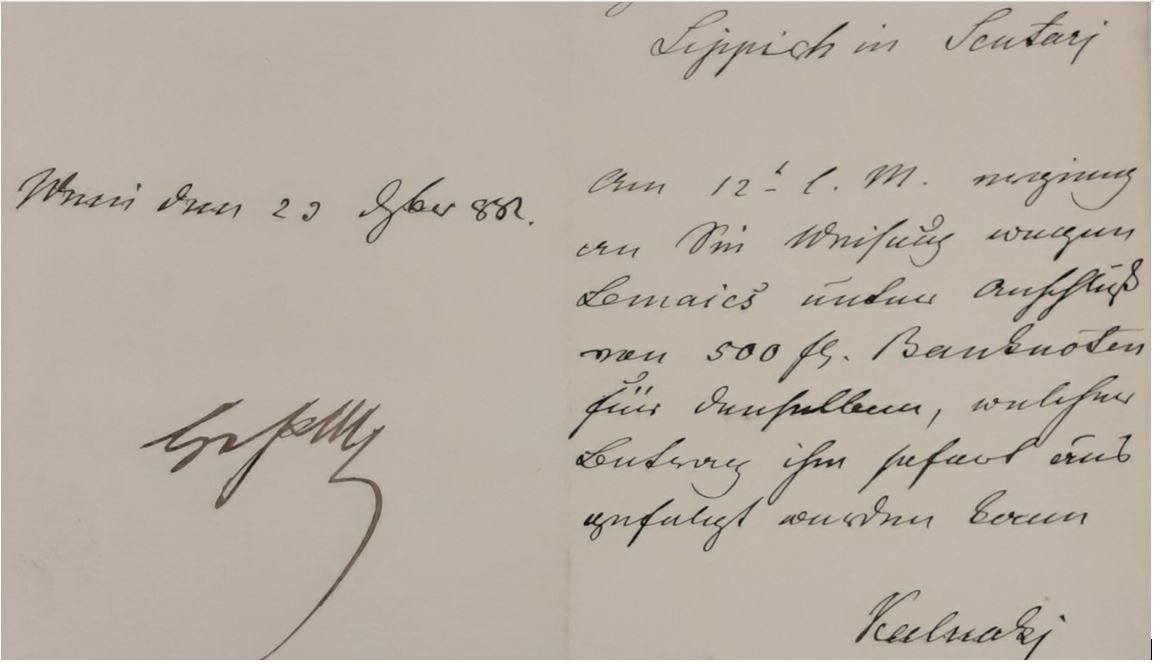
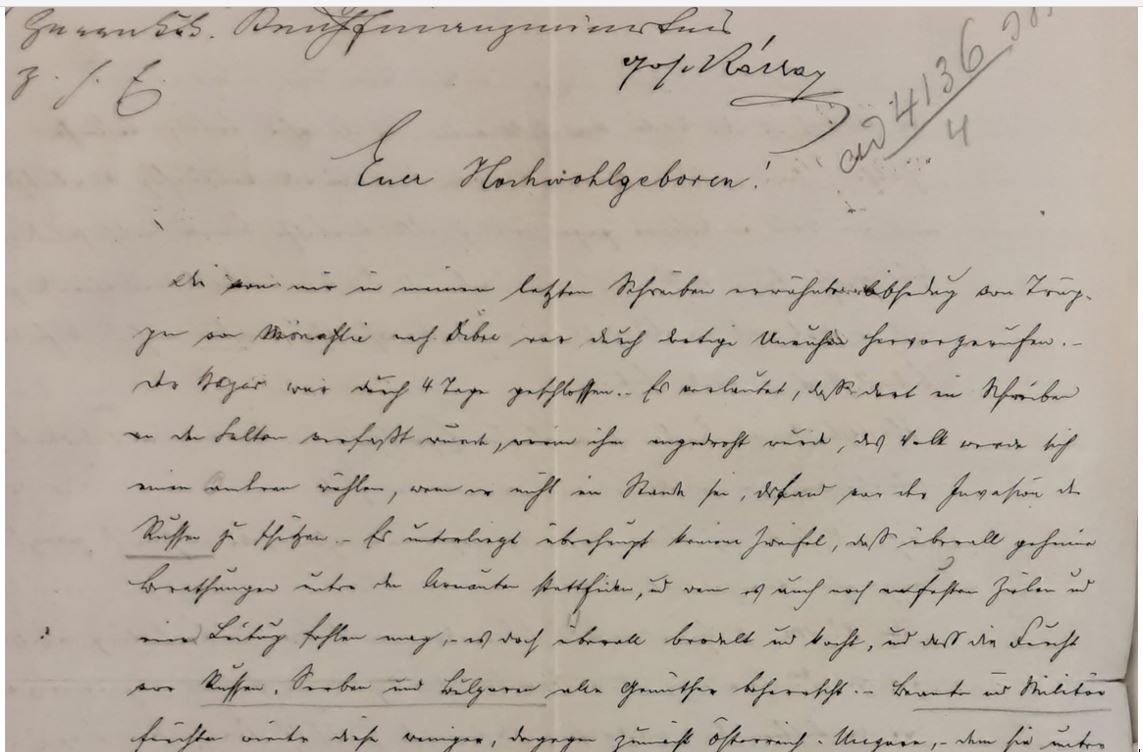
Figures 1–2. Documents from the Mission Lemaics proving that Thallóczy acted as an imperial agent and not a Hungarian one.
Source: HHStA MdÄ IB Akten 172-4136 = Mission Lemaics, Stjeva = Mission des Dr. Ludwig Thallóczy,
Konzipist im Landesarchiv in Budapest, Reise nach Albanien, 1882.
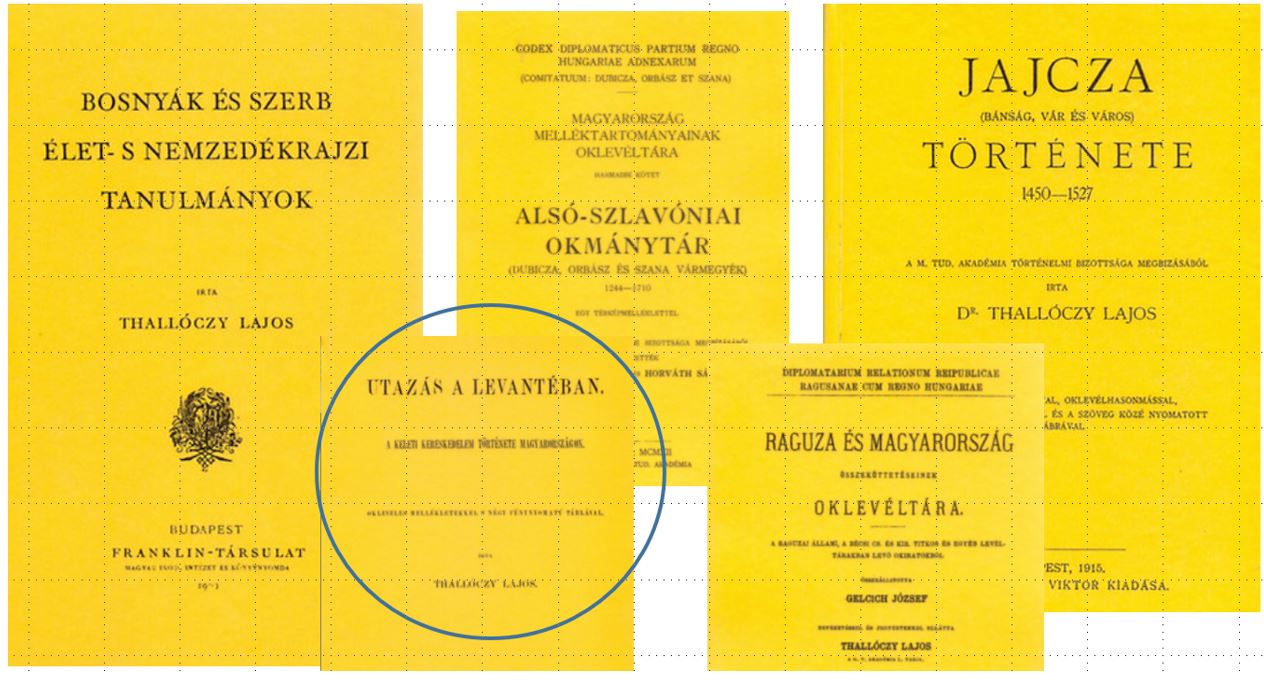
Figure 3. Scholarly works by Thallóczy including his work on Levantine trade, which served as a disguise for his secret mission in 1882 and which covertly gave advice in support of Hungarian penetration into the Balkans.
That there was a Hungarian rivalry with Austria is confirmed by the fact that, after the 1881 Balkan-expedition of Hochstetter and Suess, in 1885, during a discussion, Hungarians also articulated the idea of launching an own expedition, and resolved to do the following: (1) send an expedition to the Balkans, (2) collect artifacts, (3) deposit them in a museum for easier access for Hungarian entrepreneurs to copy them and export the copies to the Balkans, (4) copy the existing Austrian institutions and thus increase the infrastructural background of Hungarian penetration into the Peninsula.
These resolutions were recorded by Adolf Strausz, who took part in the discussions before the expedition49 on the pages of Nemzetgazdasági Szemle
(National Economic Review),50 edited by György Endre, an economic theoretician close to Kállay and later minister of agriculture in Hungary. Other participants in the expedition included Berchtold Weisz, banker, a brother of Manfred Weiss (a famous industrial entrepreneur) and Béla Inkey, a geologist who earlier had refused to take part in mapping Bosnia after its occupation in 1878, as he considered it an imperial goal and not a national goal of Hungary (and he participated willingly in the Hungarian expedition). Finally, László Réthy, an ethnographer-archaeologist, was also among the participants. Réthy became a well-known erotic poet under the name Árpád Lőwy. He was a close friend of Thallóczy, and both participated later in the Büzértanya circles.51 Thallóczy himself did not participate in the expedition, but he did participate in the discussions leading up to it, as Strausz noted,52 and thus he had precise knowledge of its goals, which included the establishment of a pavilion for the 1885 exhibition to present artifacts from the Balkans. In fact, both Strausz and Thallóczy were members in the industrial committee chaired by Count Jenő Zichy, who in 1886 became one of the candidates to the Bulgarian throne, then led expeditions to the Caucasus in the 1890s. Both traveled to the Balkans even prior to the 1885 expedition under the aegis of this committee to search for business opportunities.53
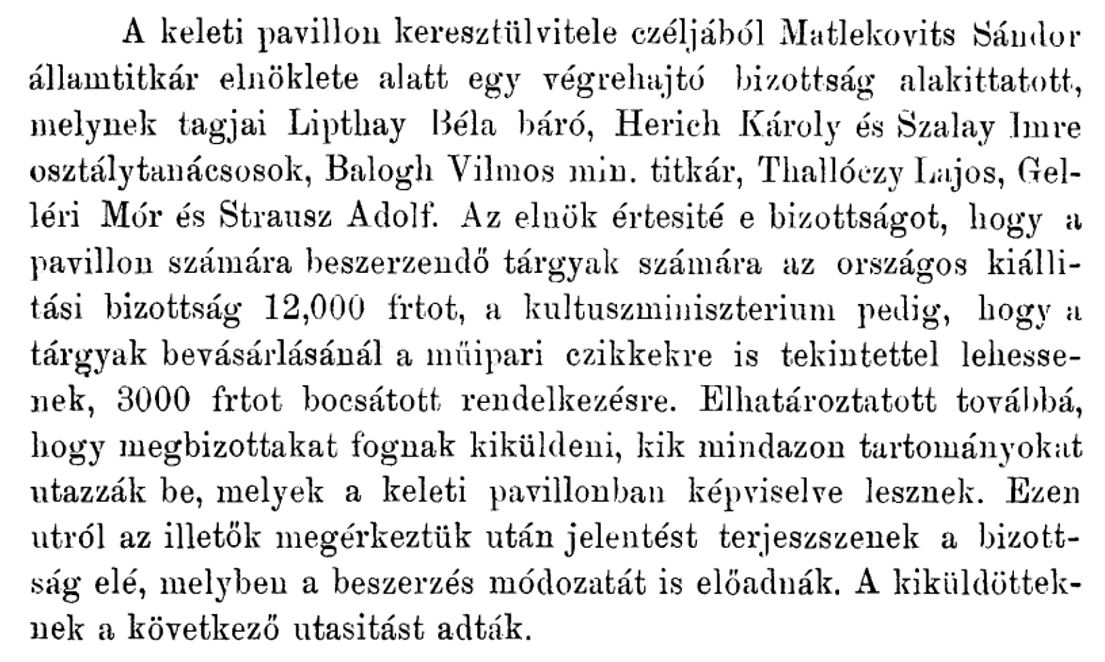
Figure 4. Government committee and sources allocated to the Eastern Pavillion.
Strausz, “A keleti pavillon” (The Eastern Pavillion), 737–56.
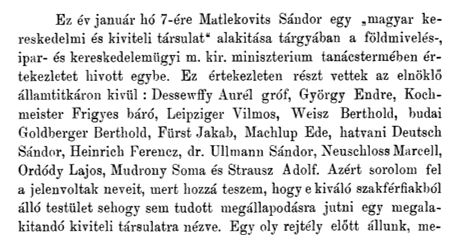
Figure 5. Strausz’s account of the discussion of the necessity of an expedition to
the Balkans and a Pavilion (1885, in Hungarian).
Strausz, “Keleti Kereskedelmünk és egy Magyar Kereskedelmi Muzeum”
(Our eastern trade and a Hungarian Commercial Museum), 233–67.
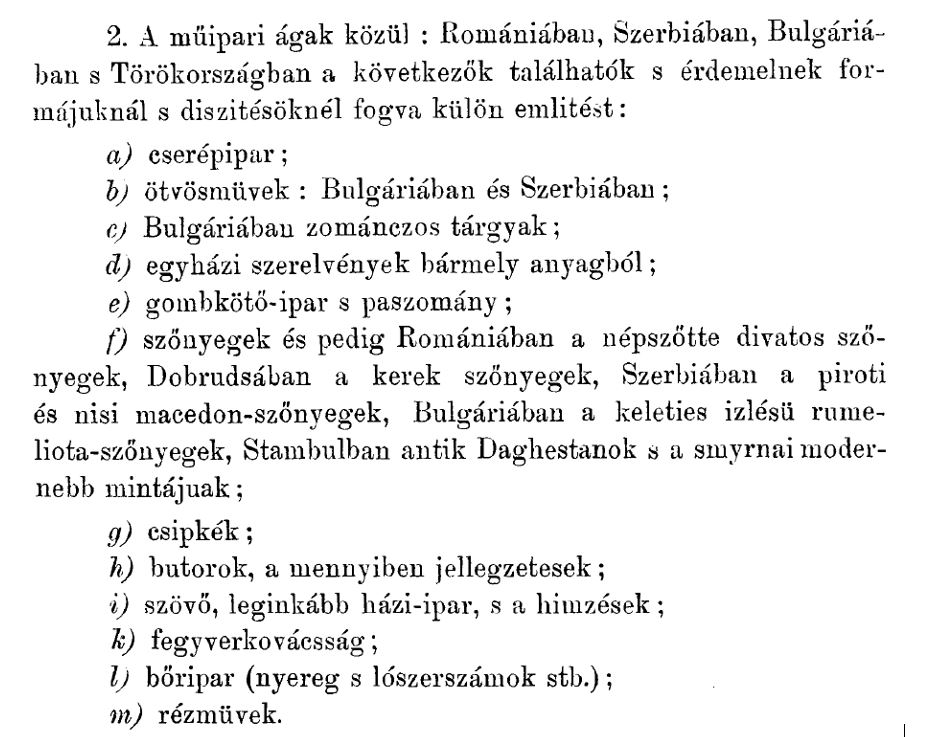
Figure 6. Excerpt from official instructions of the Hungarian government concerning
which artifacts to collect during the expedition.
Source: Strausz, “Keleti Kereskedelmünk és egy Magyar Kereskedelmi Muzeum,” 261.
It is evident that the discussion in 1885 was not simply about launching a single expedition. Other topics were also discussed, such as the renewal of the consular system, which focused too much on diplomacy and hardly engaged in any economic activity, according to Strausz. This is not surprising, considering the origins of the latter in the Balkans (as noted above, Andrássy used the 1848–1849 émigrés to establish an intelligence service in the 1860s). Strausz also saw it as problematic that there were no institutions in Hungary to preserve Balkan industrial samples and thus to compete economically with Vienna. The Pavillion in 1885 and the Oriental Commercial Academy (which was founded in 1892), where later Strausz became a professor, were also among the Hungarian institutions that had already existed in Vienna.54
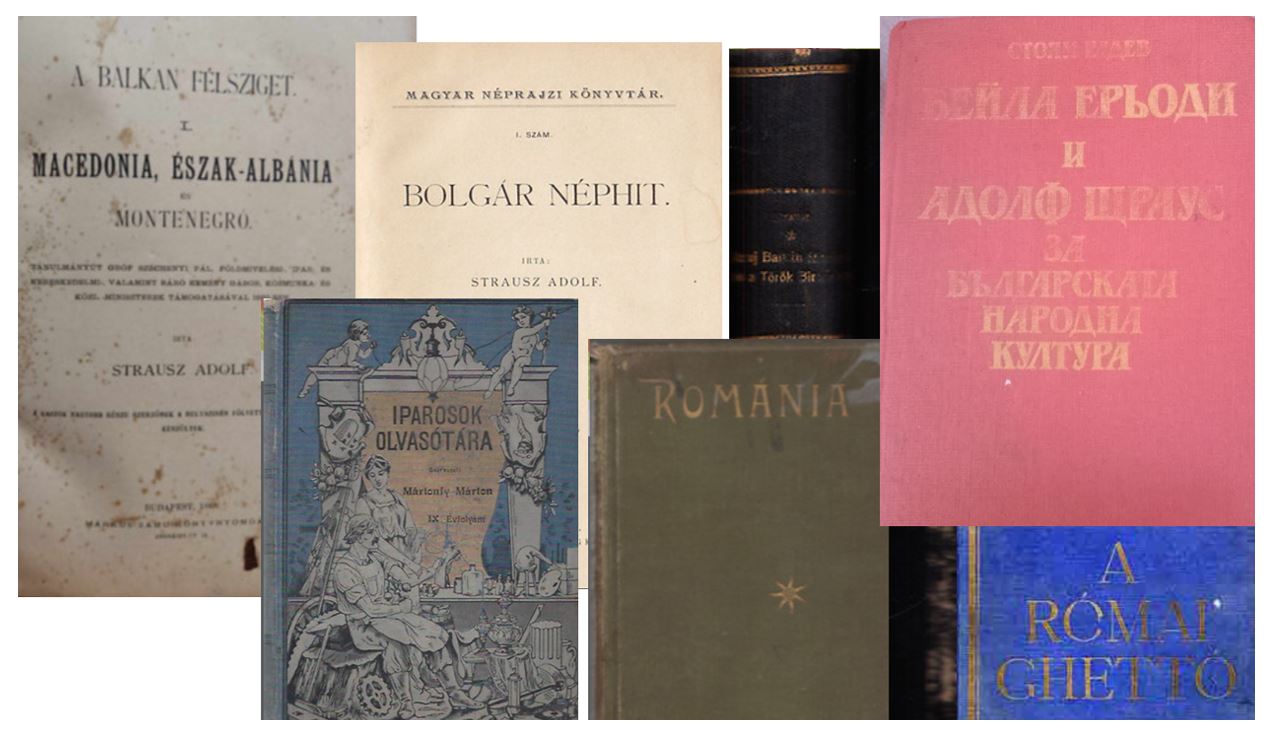
Figure 7. Images of the covers of the scientific works of (and on) Adolf Strausz
Returning from the 1885 expedition, Strausz wrote a scientific (and still popular) book on the Balkans (1888) and some articles.55 His activity, however, went far beyond scholarship, much as in the case of Thallóczy. We know from the documents in the Haus- Hof- und Staatsarchiv that he reported to Prince Ferdinand of Bulgaria for years (see the analysis below concerning who would be better minister of foreign affairs, Kállay or Gołuchowski). As a journalist (editor of the periodical Donauländer), he was often serving the Hungarian opposition parties in the 1880s, and he was also involved in business. Disguising himself as an ethnologist who collected folk songs (the Bulgarian secondary literature still considers this as his main merit),56 he managed to provoke a revolt in Macedonia in 1904 (as Thallóczy had done in 1882 in Albania, without money and without permission or authority), thanks to his close connections to Bulgarian chetās (small, organized bands of armed fighters active during the period of Ottoman rule in Bulgaria) and enthusiastic articles pushing the idea of the unification of Macedonia and Bulgaria.57 The main problem with his efforts was that he was going against the official policy of Austria–Hungary at the time, which considered peacekeeping as a key task of the Mürzsteg Agreement (1903). The foreign ministry wrote him a letter instructing him to halt his activity, to which he replied in a sharp tone written in Hungarian on an official paper with yellow-black ribbon, mentioning that he had been traveling across the Balkans as scholar for 30 years, but no one had ever asked him what to do with the peninsula. He did not understand why he was being disturbed by politicians with orders concerning his daily business. He must have been convincing, because from then on, he also reported to Vienna, as the materials in the Presseleitung (state press propaganda) show. In the end, he became a follower of the ideas of Friedrich Nauman, a German political thinker who felt that Germany should create and lead a Central European bloc known as “Mitteleuropa” (see Strausz’s book Grossbulgarien).58 So, was he a scholar, agent or propagandist?
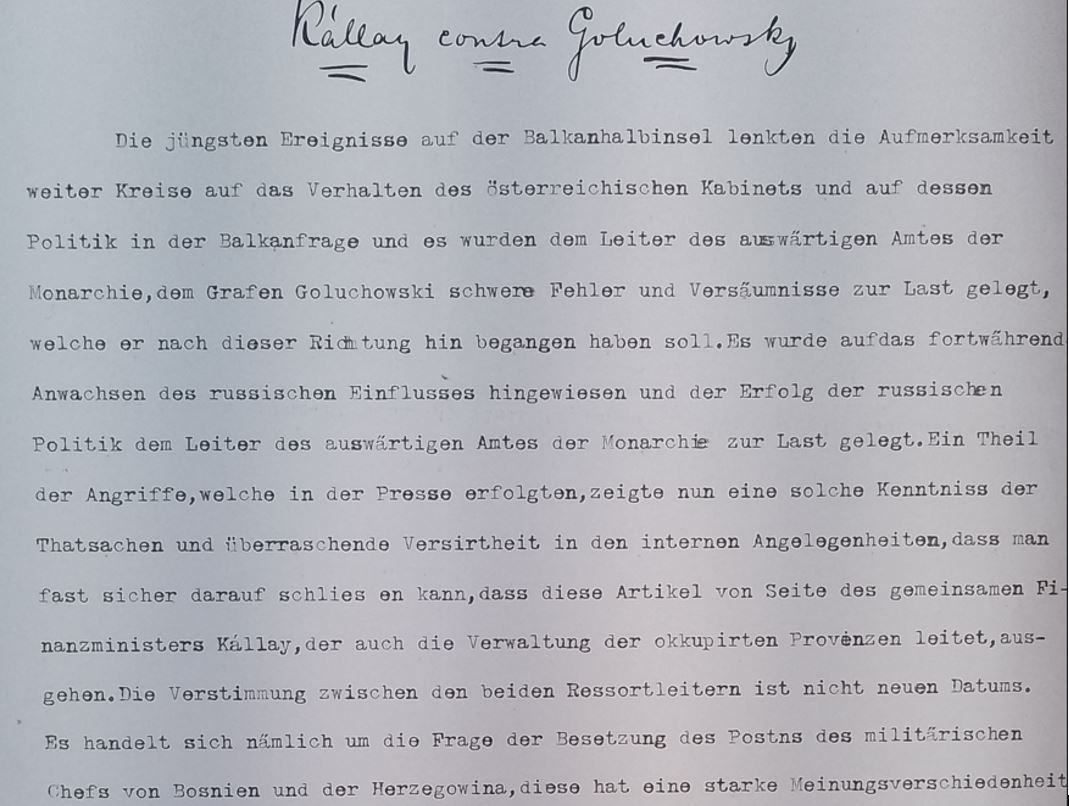
Figure 8. A report from Strausz to Prince Ferdinand regarding
the future joint minister of foreign affairs. Source: HHStA SB, Nachlass Coburg
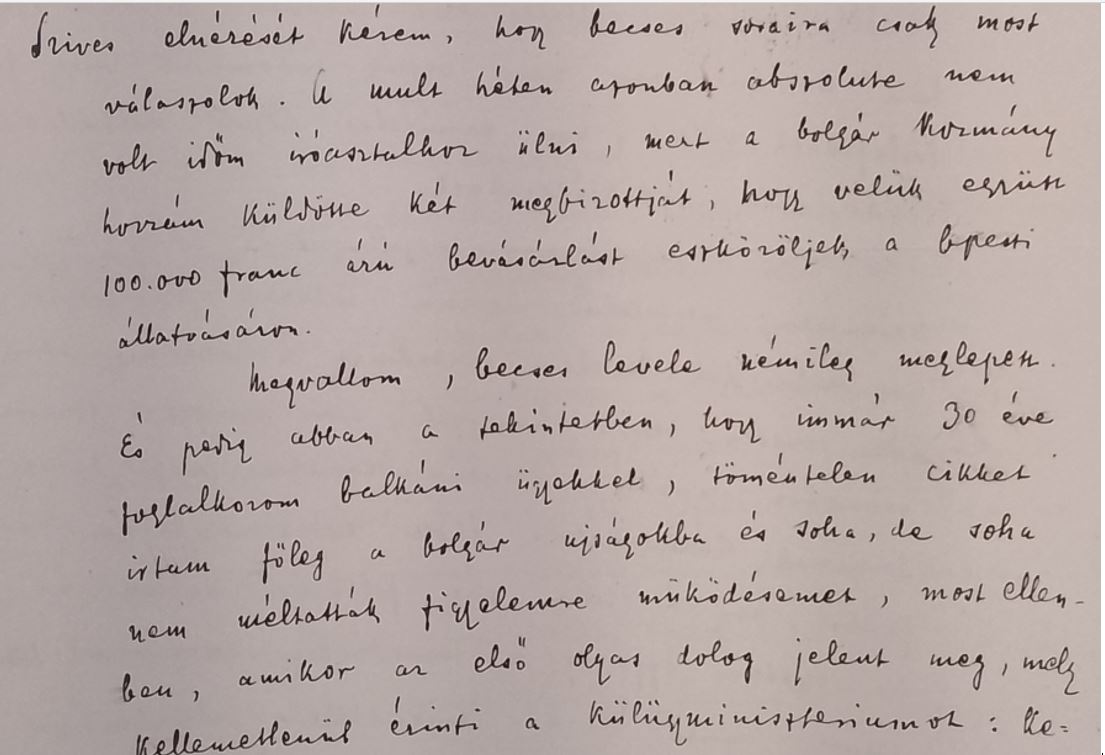
Figure 9. A letter from Adolf Strausz to the Foreign Ministry, before his permanent
occupation as agent of the Presseleitung. Source: HHStA PL Kt. 271. Akten Strausz
Thallóczy’s journey in 1882 under the pseudonym Lemaics was not his only such undertaking. Though he did not participate in the Hungarian expedition in 1885 exploring the Balkans (partly because he earned his first “imperial” office), only in the discussions that were held before the venture, he visited Bulgaria in 1881, participated in the Zichy-commission’s explorations (in Serbia) in 1884, and then in 1888 he traveled to Serbia and again to Bulgaria.59 In 1889, Thallóczy was again in Serbia as an “observer” at the renewal of the Austro-Hungarian–Serbian agreement of 1881. He reported on the public mood during the commemorations of five-hundredth anniversary of the Battle of Kosovo.60 This is the trip (probably together with his travels in 1882) which most scholars have studied.61 Meanwhile, the creator of the modern Albanian national consciousness, who made the Skanderbeg myth (the national-hero narrative built around Skanderbeg, or Gjergj Kastrioti by his name, an Albanian leader who resisted Ottoman rule in the fifteenth century) part of Albanian national history as author of a schoolbook on Albanian history with Zef Zurani,62 was also observed by other informers in 1889, as the reports in the Informationsbüro reveal.
Thallóczy’s scholarly work (for instance, his books on Ragusa, Dalmatia, and Jajca) served as a pretext for other activities as well or served actual imperial or national political aims. We see in his writings an effort to appease and intertwine imperial and Hungarian national goals. As an ardent opponent of the Uvac–Mitrovica railway, he wanted to rely on a railway along the Adriatic seashore. The stabilization of the situation in Albania and the fostering of an Albanian national narrative were thus of vital importance for him,63 and he was able to convince the decision-makers to divert Austria–Hungary’s attention to Albania.
There are other—up to now, unknown—documents which shed light on his unknown travels. In 1887, as we learn from István Burián (then consul to Sofia and later governor of Bosnia and joint minister of finance, whose unpublished diary between 1886 and 1903 has just been edited under press), Thallóczy appeared in Sofia “as an imperial-royal mood-detector,”64 as he described himself, and he negotiated with the Bulgarian regents Konstantin Stoilov, Sava Mutkurov, and Stefan Stambolov during the interregnum. Burián writes,
Thallóczy was here by his own admission, as an “imperial and royal mood-detector.” Although Prince Coburg has not yet decided to come, he is working hard to secure recognition. He must hurry, for if he does not come quickly, he would do better to remain at home. He informed Stoiloff the day before yesterday that he would give a definite answer in ten days. In the meantime, the mood here, especially in military circles, is turning cold and even partly against him.65
The report in connection with Thallóczy’s sudden visit was mentioned in Burián’s diary with this single passage, and the document was found accidentally in the dossier of the aforementioned Lemaics mission, together with another report on Serbia. Thus a report from 1887 was deposited with other reports from 1882–1883.66 During his trip to Sofia, Thallóczy also gave accounts of the Serbs in Vojvodina and the government crisis in Serbia in 1887, the dismissal of Milutin Garašanin, and the rise of the Jovan Ristić government.67
To understand the goals of Thallóczy’s venture, it is necessary to know at least the outlines of the political background. In 1887, the Bulgarian National Assembly was searching for a new prince after the successful Russian coup d’etat against Alexander Battenberg in 1886. The Hungarian opposition was frustrated by the Russian intervention in 1886. It considered this act a violation of the Berlin Treaty (and it drew a direct comparison with the intervention in 1849, when the Russian army defeated the Hungarian revolutionary forces).
At the same time, the Hungarian government was dissatisfied with the Dreikaiserbund (the so-called League of the Three Emperors, an alliance between the German Empire, Austria–Hungary, and the Russian Empire) and with Gusztáv Kálnoky’s foreign policy. Kálnoky did not support the unification of Bulgaria and Eastern Rumelia, which Bulgaria had taken in 1885, in direct violation of the 1878 Congress of Berlin, so consul István Burián was moved from Moscow to Sofia by Kálnoky to secure peaceful relationships between Austria–Hungary and Russia. But from the outset, Burián, as consul, supported Bulgarian unification (i.e., the unification of Bulgaria and Eastern Rumelia) and the efforts of the Bulgarian regents against Russian interference.
The Hungarian government used the Hungarian opposition’s sentiments to attack Kálnoky’s policy in the press, in the Hungarian parliament, and at the convention of the Joint Delegates in late 1886. The Hungarian government even threatened internal governmental crisis (because of the increasingly intense efforts of the opposition) unless Kálnoky changed his policy and abandoned Russia.
Kálnoky finally accepted the shift in the political tides and even Bulgarian unification, as he realized that Robert Gascoyne-Cecil, Third Marquess of Salisbury (who led British foreign policy in the late 1880s) shared similar views. (Salisbury thought that Bulgaria turning against Russia after the failure of the Russian coup could be used as a tool to stop Russian advance towards the Straits). This led to cooperation with the British and the establishment of the “Mediterranean entente” (1886–1896) to replace the collapsed Dreikaiserbund.
The increasing significance of Bulgaria also meant that the Serbian alliance became less important for Austria–Hungary. Thallóczy’s report on the governmental crisis in Belgrade in 1887 also gives a thorough account why Serbia lost its significance.
This is the broader diplomatic context or background of Thallóczy’s unknown trip in 1887. Adolf Strausz, the other protagonist of our tale, also arrived in Sofia in late 1886, as a journalist. Despite his presence was noted in Burián’s diary with few words only, this visit of Strausz also had longlasting consequences. Immediately after the successful Russian coup d’etat against Battenberg, Consul Burián reported on the “intensifying traffic of Hungarians”: “Count Jenő Zichy, Count Elemér Batthyány, Baron Zsiga Üchtritz, Count Gábor Pejacsevich, arrived here in the evening followed by Strausz, Barabás and Singer, journalists.”68 Count Batthyány and Baron Üchtritz were horse-tradesmen, representing the Hungarian agrarian lobby, looking for military purchases, Count Pejacsevich was a Hungarian–Croatian aristocrat of Bulgarian origin, a possible candidate for the Bulgarian throne. Count Zichy (1837–1906, mentioned already) was a politician, who led several scientific expeditions to Asia later in the 1890s. From 1878, he served as a liberal (government-party) member of the Hungarian National Assembly. He was also interested in the railway constructions in the Balkans (close to Baron Maurice Hirsch’s circles).69 He became one of the “kingmakers of Bulgaria” under scandalous circumstances: Zichy was accused of serving as the financial supporter of Prince Coburg Ferdinand’s election to the Bulgarian throne through his local agent, the grain and horse merchant and railway commissioner, Fülöp Waldapfel.70 In fact, though Zichy’s action began as a private initiative, it actually took place with the knowledge of the highest circles.71
Adolf Strausz was also involved in these events: he was mentioned among the “kingmakers” even decades after the event and the fall of Coburg Ferdinand (1931).72 Strausz was accompanied by Béla Barabás, a politician of the 48-er Independence Party in opposition, also disguised as a journalist. He too became one of Coburg Ferdinand’s supporters. Finally, the third journalist, Singer was a well-known owner of a publishing house.
The media campaign initiated by these “journalists” served as the informational basis for the Hungarian opposition’s attack against Kálnoky’s foreign policy, which, incidentally, was conducted with the Hungarian government’s knowledge and tacit support. It was not solely the Russophobia that increased Hungarian activity in Bulgaria: the economic interests of those arriving in Sofia suggest other reasons too. It is Strausz again, who overtly gives some clues in his 1886 article (after his return from Sofia, again on the pages of Nemzetgazdasági Szemle) in which he offered practical tools (like establishing a permanent warehouse for Hungarian samples) for Hungarian economic penetration into the Balkans. Due to the loss of market share caused by the customs war with Romania, Hungarian economic policy sought to compensate for these losses in Bulgaria by taking advantage of the weakening of Russian influence—indeed, these Hungarian circles were definitely interested in weakening the Russian influence.73 So there were multiple reasons, both political and economic causes behind Strausz’s arrival, who was not only a scholar and agent, but a businessman too.
Beside the anti-Russian and pro-Bulgarian press-campaign against Kálnoky’s policy, it is also worth mentioning a higher sphere of action, the Hungarian deputies’ activity in November 1886, during the debates of the Joint Delegations.74 After his return from Sofia, the aforementioned Count Zichy spoke in the delegations in favor of a political turn, supporting Bulgaria, and the refusal of the Russian candidate to the throne.75 The sessions of the Joint Delegations coincided with the arrival of the official Bulgarian delegation in Vienna seeking a new candidate for the Bulgarian throne.76 According to Grujić, Serbian ambassador to St. Petersburg, later minister of foreign affairs, Cisleithanian circles felt with certain reservation towards the candidature of Coburg Ferdinand, while the “Hungarians were eager to do anything to have Ferdinand elected, except war.”77 In short, Coburg Ferdinand was rather the candidate of Budapest, than of Vienna.
Though Strausz and Thallóczy knew each other from 1881 and they also cooperated in 1885 before the Hungarian expedition to the Balkans (and were working closely even later: as a teacher at the Consular Academy of Vienna, Thallóczy often visited the Hungarian Oriental Commercial Academy to harmonize their efforts regarding the Balkans),78 Thallóczy arrived as an official observer representing Austria–Hungary but embracing the platform of the Hungarian program. Thallóczy appreciated Burián’s efforts in the rapprochement between Austria and Bulgaria, and he recommended an anti-Russian policy to Austria–Hungary in his 1887 report, as Burián did in his official correspondence and as the Hungarians (Strausz) demanded in the press. Thus, Thallóczy (who knew well Burián from 1881, who stationed in Sofia, when Thallóczy’s first journey on the Balkans took place) confirmed the consul’s stance. Below, I offer excerpts from Thallóczy’s report on his visit in Bulgaria in English translation.
Public mood and changes in the public mood in Bulgaria79
In Bulgaria, there is no public opinion in the modern sense… There are only provincial centers, such as Ruse, Varna, Tirnovo, Sofia, Philippopoli, etc., where an official opinion is formed, which is authoritative for the whole district. People learned to be cautious about speaking under the Turkish regime, and this habit is now backfiring.
At the moment, it seems that the prestigious centers mentioned above are in agreement in their views, as I have seen in Sofia circles and from other official reports.
The Bulgarian people are not so easily impressed. This calm, confident mood can also be observed among the rural population. “Über allen Wipfeln herrscht Ruhe”:80 farmers work, take an interest in politics, listen to what the teacher says, while the word of the priest doesn’t count for much.
The farmers show such calm that if you didn’t read the opposite in the papers, you’d think you were in the most peaceful country.
Only one mood, one feeling has changed completely. Hatred against Russia has grown. You would hardly believe, if you had not seen it with your own eyes, that people are angry with the Russians. There would be a nation in similar circumstances that would desperately fear Russia’s obstinacy, but here, they are hated and not feared. There is much that is true of the people, but they are not desperate.
Russia has lost ground. The oldest generation, which saw Russia as a liberator, even these zealots brought up in Russia, although they support the Russians, do not want to become Russians. The generation now in power is, as events have shown, essentially nationalist, and the generation now growing up is being brought up with a Russophobia that we would not expect from even the most ardent Poles. We are taught that Russia did not liberate us, but that we are victims of its greed. We would have gotten rid of Turkey in the long run without sacrifice, so we owe the Russians nothing: […], we shed blood and tears.
Well, it would be an exaggeration to conclude from these symptoms that Bulgaria has lost all its Russian characteristics.
One thing that remained is the respect for the Tsar, his image is everywhere, but he is a “savior” whose sphere of activity ends with a glorious glow, woe betide him if he wants to be involved in politics. By the way, in more recent times, the images of Our Majesty [Francis Joseph] have become such a relic, his image is also purchased, but only as a relic of a powerful patron saint.
It is possible that the internal turmoil could easily give Russia a foothold again, but Bulgaria has ceased to be under Russian rule forever […] “Sir,” said an old Russophile, “we no longer have a [pro]Russian party, we have only Russian spies.”
This is the result of Russian political passivity: Russia has lost ground and the Bulgarian leaders have sensed this very accurately. We are now the leading power in Bulgaria, it is our diplomatic agent whose behavior is authoritative and serves as a reference point.81
The Bulgarians are not fans of Austria–Hungary, it would be a mistake on our side to think that, they know very well that we will not go to war for them tout prix, but they are not afraid of us and they know very well that our interests are common to theirs and they respect and are consistently benevolent towards us.
We are not compromising their independence and we are not doing business, they sense that, so we have a really solid base there. The attitude of the Bulgarian army since its purge of rebel officers has been admirable. […]
I talked to Stoilov and Mutkurov, the former spoke frankly about the situation and the prospects for the Regency. The question of the Coburg Prince is just a matter of buying time…
This is not to say that they are not serious about it. They hope he is a dashing, youthful man who, if he wants something, will forcefully see it through. […]
Without further ado, I must explain, having met the delegation, that Ferdinand’s behavior has not made a favorable impression here. […]
Stoilov says it is not too late: despite all the diplomatic mistakes on the part of the newly elected [prince], the army will join him, but the situation is very similar to the Russians, that is, his chances are diminishing day by day.
If nothing comes of this combination, the Bulgarians will have done their duty. And the Regency is holding out because they represent the national party. They did their best to encourage Coburg, and they would have liked the Prince to be encouraged directly from Vienna, but they were well aware that Prince Ferdinand refused any solidarity or cooperation with the Viennese cabinet.
The goal of Mr. Kalchev’s mission was to persuade the Porte to give Coburg broad support, but this does not seem to have succeeded.
However, if Coburg does not come, there are two possible outcomes:
1) The Regency is discredited by the failure and is so weakened by the increasing Russian pressure that an internal reorganization takes place and everything collapses. The chances of this happening are probably slim, but the brilliant conspirator Stambolov has included this possibility in his political program.
2) The Regency proclaims independence and the kingdom, with Battenberg, who, although he is fighting with nerves of steel and is far from being the daredevil he is usually considered to be, does his duty at this moment. Then what should come will come.
Turkey is not feared; it is the Macedonian question that holds the Porte at bay. In Üsküb, I have seen and heard that the Bulgarian population is organized into regular associations that receive their orders from Sofia. They are ready to revolt at the first opportunity, in spite of the strong garrison and the Arnauts [armed Albanian fighters in Ottoman service], now loyal to the Sultan.
Fear of the Macedonian question is thus paralyzing Turkey’s every move. The Bulgarians have no fear of Russia. They are convinced that a war against Bulgaria would be unpopular in Russia. The Serbs are treated with great contempt, and in reflecting on Milan’s public candidacy, the chauvinists said:
“Yes, if he would Bulgarianize the Serbs, we would be delighted to accept him,” and I am not joking, because the Serbian–Bulgarian issue in Macedonia is still unresolved.
Of the candidates, Count Hunyady and Peyachevich, the politics-maker Zichy, do not merit mention. Count Peyachevich was a one-day idea, and Count Zichy discredited himself.
3) The third option would be to continue to wait. If the regents could continue to cooperate calmly, because the affairs of Nikolayev and Radoslavov are not serious symptoms, then things would continue as they are. Only trade and credit are wobbling, and those circles which have suffered financial damage as a result of the crisis are pressing for a solution.
This is how Regent Stoilow envisaged the situation, noting that no Russian candidate (not even the opposition—an important moment) wants to see any Russian officials here.
All the Bulgarians are asking us to do is to maintain the benevolent attitude we have had so far. I would like to add, as an innocent opinion, that our policy has had a very good effect, but our restrained attitude must not be seen as hesitation, fear, or retreat. That is why people believe the myth that we are afraid of war.
I can highlight two points in relation to Macedonia and Old Serbia. Since the delegations, the fear of an Austrian advance has faded, and the Turks are not as suspicious as before. Even if Russia has not completely lost its prestige in the Balkans, Austria has undoubtedly achieved more success with its moderate Balkan program than we might think.
Only the Montenegrins remain the same, and war in the Gusinje and Plevje areas could break out at any time if Albanian territory is ceded in the border settlement. Ali, the little despot of Ipek and its environs, is now a great favorite of the Turks. Killings, blood feuds, despite restrictions as before, especially on the Serbian border.
Russian espionage in Bulgaria and Macedonia is mostly based on common lies, people want to earn their money. That is why in Bucharest or Odessa they report that Regent X. J. had five people murdered, and similar lies. Our worst and greatest enemies are the Czechs, who are hated everywhere else and who are openly aligned with the Russians. The Bulgarian towns on the Danube, as indicated in Sofia, are very well controlled by the authorities, and the emigrants are scattered all over Wallachia, who are only important here from the point of view of the police: they do not carry any political weight.
As a curiosity, I enclose a lithographed portrait of Prince Ferdinand in Philippopol,82 which was at first eagerly awaited by the public, and they bought his portraits, but now the story is getting boring.
I will end my report with the words of an old Bulgarian who lived in Russia for many years: “Everything is very beautiful, we are relatives, fellow believers, but God grant that there may be a sea between us.” And this sentence describes the situation exactly.
As previously noted, the diplomatic events in Bulgaria pushed Serbia back in Austria–Hungary’s list of potential client powers. This was in part a consequence of the war lost against the Bulgarian Principality and in part a consequence of growing Russian interference in the eastern part of the Balkans, which urged the Hungarian half of the Dual Monarchy to pursue a more active, even proactive policy in the Balkans, for which neither the Dreikaiserbund nor the defeated Serbia was appropriate. Serbia, as an ally, could have been used only against Bulgaria, but the Hungarian elite how desired a stronger and not a weaker Bulgaria functioning as a barrier to Russia (as Bulgaria was no longer pro-Russian). From this perspective, even certain Serbian political groups became suspicious, as they had good relations with Russia. Another problem with Serbia as a “foothold” was its claims on Bosnia and its relations with the Serbian minority in southern Hungary. Given these considerations, Bulgaria was seen as a better potential ally, as it had no clash of interest with Austria–Hungary. From the economic perspective, however, Serbia was still more important for Austria–Hungary than Bulgaria. The slow pace of railway construction, the reluctance of the Serbian elite to fulfill this point of the Berlin agreement (which put a heavy burden on them and which also did not really serve Serbian economic interests but rather furthered the economic penetration of the Great Powers), and the constant financial crisis because of this obligation all left Serbia in debt and caused internal political tensions and oscillating foreign. This all made Belgrade a less appealing and less promising potential ally after 1885. Thallóczy undertook his trip in part with the task of providing insights into Serbia’s and Bulgaria’s potential usefulness, from the perspective of Austria–Hungary’s interests, and he described the two countries in quite a different tone with regards to this. His report, which he wrote as an imperial official (though not the official emissary), agreed largely with the pro-Bulgarian opposition in Hungary, the Hungarian government, and the views of Burián, who was consul in Sofia. Thallóczy’s remarks thus supported the abandonment of pro-Serbian policy. His venture was also important from the perspective of the sudden government changes. Ristić’s new cabinet was not supposed to follow a friendly and subjective policy towards Austria–Hungary, partly because Ristić had already seen for himself that Austria did not always keep its promises (before 1878, Kállay, had negotiated with Ristić, and he had offered a large part of Bosnia to Serbia, but this had never actually been implemented).
The report, which was written in German, starts with the problem of Serbs in Hungary. Since the focus of the discussion here is on the Balkan networks of agents, I offer below short excerpts from this part of Thallóczy’s report in English translation.
Incidentally, the government’s efforts to move the seat of the Serbian national church from Karlovci to Budapest should be noted […] These ideas are also strongly supported by the younger, pro-government elements. There are no constitutional objections to these ideas, and the result would be that the political center of gravity of the Serbs would be moved from the colorful south of Hungary to Budapest and would be easier to control.
The education of the clergy is bad, they are either undereducated, ignorant people or half-educated strikers, party henchmen. For the near future, even the prospects for the possibly vacant bishoprics are sad, as there is a great lack of capable and acceptable men. This circumstance, and the fact that the divide between the secular and clerical elements is so sharp, takes away any prospect of beneficial autonomous activity.
There is one good thing to be said for the ecclesiastic system of Karlovci. In the parishes and monasteries of Fruška Gora, loyalty to the state gradually grew stronger, and these almost independent parishes, which show many similarities with the Pomak parishes in Rhodope, feel, I claim this from my own conviction, that they belong to the Crown of St. Stephen. It must also be stated that the stability of the Hungarian government has brought about much development that was previously unthinkable […]
Thallóczy then moves to the problem of Serbia’s foreign policy oscillating between Russia and Austria–Hungary. He sees this as natural and even unavoidable.
If one takes diplomatic history as an aid in illuminating the latest crisis, one sees that Serbia is constantly moving between the sphere of Russia and Austria.
This is the general conclusion that anyone familiar with history can draw from the development of this country. The real Serbian policy is to maneuver between the two great powers and to protect its special interests. Ristitsch proclaims this himself in his works on the foreign relations of Serbia. If one great power temporarily dominated due to particularly favorable material or personal circumstances, it was soon displaced by the other, usually through its own direct or indirect mistakes. […]
In my humble opinion, this seemingly doctrinaire statement is confirmed by the recent crisis. Austria’s influence dominated Serbia until the most recent period. And what did this influence consist of? All sorts of businessmen of dubious origin, mostly of the hated Jewish faith, flooded the country. The Länderbank helped worsen state finances, “a railroad was built for the Swabians” (of course Prussian and French entrepreneurs earned the profits83 […] individuals […] enriched themselves at the expense of others, Garašanin bought an estate, the officials stole, Serbia was oppressed in trade, it was pushed into an unfortunate war, of course it was saved by Austria, which everyone has already forgotten); all these things are true, but Austria is blamed for these… this can be given as a characteristic of the transforming public mood. Garašanin and his party allied themselves with the King, who is considered an Austrian, and everything that happened was skillfully exploited by Ristić and his people for their own purposes, and he forced the king to capitulate […]. And this was to happen in a critical economic situation.
The administration does not work, people did not want to pay taxes, even the savings banks were not trusted because it was believed that the government used these funds also for state purposes. Officials united and got rid of dissenting people […] innkeepers were deprived of wine, farmers were imprisoned and beaten without judgement, the most unworthy espionage even penetrated families. This is now being reported by the deputations sent by Ristitsch into the countryside in an egotistically embellished manner, of which, however, the core is true. The growing unpopularity of the king is added to this, whose generosity to Austria is viewed with shady eyes; he is reproached for every ten francs he gives to Swabian beggars. […]
Objective men from Ristitsch’s immediate circles judged him, the King, to be a talented but shallow and unstable man who did very badly politically to govern himself. It was said in the Queen’s circle that the King would do much better if he followed the good advice of Austria and did not govern alone badly himself, a man worthy of trust told me. The army doesn’t love him, because he shows little understanding for the officers… I noticed the quite unnatural Serbian reticence of the officers and the higher civils.
They shut out their own poor, characterize their own leaders with nouns borrowed from the animal kingdom, and in the future have more confidence in diplomacy than in their weapons. The grumbling Horvatović sulks at the parliament and behaves like Cincinnatus by cultivating his property in the countryside. […]
What mattered to Thallóczy, apart from Serbian sentiments towards Austria–Hungary, was that the country not be left alone as Russia’s prey.
Despite the many dissenting voices, the Ristić government does not seem to me to want to become a Russian one. He has Russian sympathies, his son serves in the Russian army, and like every Serbian, he is somewhat slavophile according to the recipe of old Garašanin (but it is only the tie, he remains a Serb who will play off Austria against Russia when the time comes, and vice versa, provided he is able to do so. His courage so far cannot be denied).
In particular, he has appeased the peasants in Negotin and Zaječar […] It must be frankly confessed that the people were fed up with being considered Austria’s slaves, they were glad to be rid of us, he (Ristitsch) did not hide this joy, but he did not particularly encourage the Russians, apart from bringing the ruble into circulation. […]
His policy, as he told Stoilov, is to keep the neighbors away. “That’s why I understand Bulgarians,” he said, “that you hate the Russians.” With regard to the ex-metropolitan, I have been informed that Ristich is not personally in favor of him, this has come to light quite openly in Russia, and neither is the king; but the metropolitan’s supporters, many of whom are also in Ristić’s camp, are pressing for his reinstatement. […]
His relationship with the king is described by his supporters as having no part in the intrigues and gossip in the royal family; everything was done by Garašanin to capture the king through this quarrel, and the king is said to have been convinced of this. He (Ristitsch) acted as a savior in the last hour.
The Serbian attitude towards Bosnia was also important, in Thallóczy’s assessment, as it shaped Serbian feelings towards Austria–Hungary. Thallóczy often use a sarcastic tone in the passages on this topic, for instance in the excerpts translated below.
Serbian public opinion is expressed in the […] general demand that Bosnia should be united with Serbia, “then,” they naively add, “let’s leave Austria alone.”84
Even the more experienced elements regard Bosnia’s occupation as a “hereditary sin” and diligently believe the news spread by the Russians that Catholic propaganda is being carried out among the Orthodox in Bosnia and that this will lead to a revolution; even though Bosnia is now so close to them, they know very little about the
circumstances, and the people of the country, even as far away as Macedonia, suppose that there is a strict military regime in Bosnia.
The name Kallay is very familiar to them. There is no need to fear Serbian agitation for the time being, but Ristić will definitely take a greater interest in the Reichsland. He will play the idea of Greater Serbia as a card, as a skillful player he counts on the inattentiveness of his partners.
Thus, according to Thallóczy, Ristić was not a chauvinistic pan-Slav, but a player playing a diplomatic game. Greater Serbia was a tactical element in his rhetoric, not a goal. However, if he were to see opportunity to realize it, he would not hesitate.
At the end of July, the Serbian government was working on financial reorganization projects; the keywords are maximum thrift, honesty, and the elimination of redundancies in the previous budget. Who knows whether this will help, but one thing is certain: the new officials are hungry. The intimidated progressives, with the now completely silent Garašanin at their head, are expecting Ristić to commit a mistake, for the time being he said: “Let’s just rest and wait,” and he is looking for allies in the press, hoping for the dissatisfaction of the radicals, whom he calls “Cherkessen,” but Ristić knows this just as well, and is trying, if possible, to get along with them. This will be the test of his regime.
If the election campaign is favorable to him, which seems probable judging by the public mood, and if the Cherkessen will be unable to make progress during the great Skupština, then his regime is secure and stable.
Thallóczy observes, ironically again, that in his political game, Ristić came up with unrealistic political plans.
He promises the people a great deal: he wants to enforce the neutralization of Serbia like Switzerland, that way eliminating the desire for war, and averting the danger of Austrian occupation (the Slavic Piedmont as Switzerland, says the Prefect of Zaječar).85
He is also not a stranger to the Balkan Confederation idea, however, it is necessary to settle accounts with Turkey first, because Serbian and Bulgarian interests intersect in Macedonia, then Old Serbia must be annexed, possibly the capital moved to the center of the state, etc.
Thallóczy is optimistic regarding Serbian-Hungarian relations, even comparing them to the Bulgarian–Serbian tensions, which were still an issue.
Relations between Hungarians and Serbs have improved remarkably, and the antipathy between the two nations is on the wane. Not as if an intimacy had developed, but the new generation has forgotten many things, apart from the (1)876 demonstrations and Turkophilism […] which is also expressed by Ristić in his aforementioned work, and he informs reporters concerned in this sense.
The mutual hatred between Bulgarians and Serbs is all the more vivid. From Niš to Caribrod, the Bulgarian population is almost bitterly opposed to the Serbian government that has been established here. This is also noticeable in Macedonia, where a possible solution to the question will encounter great difficulties in its implementation.
Finally, Thallóczy gives an account of the economic possibilities, which were as important for Austria–Hungary as the political situation. He also draws attention to the aspirations and efforts of Germany, Austria–Hungary’s greatest possible rival in the region.
Germany’s prestige is on the rise, its military superiority overwhelms even the most enraging Russophiles, and with the exception of Belgrade, where our trade now dominates, German merchants and their Austrian travelers (who naturally grumble about our consuls) are working quite efficiently.
It is significant for the situation that the Serbian tradesmen in Niš, Pirot, and Zaječar became active again after the demise of Garašanin’s cabinet, confidence returned and the fear of occupation vanished, everyone says and confirms this, everyone promises themselves golden days of freedom.
Thallóczy was also observed by agents of other powers during his long journey, but he did not consider these agents well trained or skilled (as he was able to recognize some of them).
In conclusion, I take the liberty of noting that over the course of the last seven months, I was joined by a Russian emissary in southern and eastern Serbia, with little success. Mr. Jastrebov in Salonik and the new Russian consul in Prizrend, are, I am assured, very cumbersome people.
Finally, Thallóczy insists that Austria–Hungary has no need to fear the Serbian political turn of events, even if cooperation between Russia and Serbia was about to deepen.
The fact that the Russians, by their very nature, cannot achieve anything86 and that the Serbs are not really a successful people makes the situation not entirely hopeless, even if Ristitsch was to govern with the most pronounced anti-Austrian program.
The lines cited above do not sound like regular scientific research. The journalist-orientalist Strausz, the semi-official envoy historian, Thallóczy, and the consul Burián (the only non-scholar), i.e., scholars and diplomats of Hungarian origin who were working for the opposition in Hungary or in imperial service, all supported the same policy, despite their different background. They all felt that the policy of Foreign Minister Gustav von Kalnoky was misguided. The historian Thallóczy tried to secure purely Hungarian interests, when he tried to promote Coburg Ferdinand’s election, who was considered the candidate of Budapest and not of Vienna, even though he was working as an imperial bureaucrat. Later, in Bosnia, he tried to further purely Hungarian interests concerning the railway connections. Lajos Lóczy, a leading Hungarian geologist, was commissioned by Thallóczy to search for iron and coal in Bosnia and Serbia for Hungarian (not for Austro-Hungarian) industry, as Thallóczy clearly noted in his diary.87 Lóczy repeated his research in 1916 during the occupation of Serbia, and his diary, sketches, and geological cross-sections are still held (unpublished) in the Hungarian Geological Institute. The fact that research material from World War I is deposited in Budapest and not in Vienna (despite the fact that Thallóczy was then civil governor of occupied Serbia, again an imperial agent) highlights the existence of Hungarian imperialist aspirations and the scholarship strongly intertwined with these aspirations.88
Archival Sources
Haus- Hof- und Staatsarchiv, Vienna (ÖStA HHStA)
Politisches Archiv (PA)
I Allgemeines, 9 Personalia, Kt. 766
XV Bulgarien. Kt. 24, Kt. 107, Kt. 113
XL Interna Kt. 145
Ministerium des Äussern. Informationsbüro (MdÄ IB)
Akten 172-4136 = Mission Lemaics, Stjeva = Mission des Dr. Ludwig Thallóczy, Konzipist im Landesarchiv in Budapest, Reise nach Albanien, 1882
Akten 258/259-3423 = Reise des Archivars Dr. Ludwig von Thallóczy nach Serbien und Bulgarien, Ausweis über Steuerrückstände in Serbien = 1888
Sonderbestände, Nachlässe [SB]
Nachlass Coburg
Presseleitung [PL]
Kt. 271. Akten Strausz
Hadtörténeti Levéltár, Budapest [Archives and Museum of the Military History] (HL)
Personalia, VII, fond 76 Burián István naplói [The diaries of István Burián] – 1887
Magyar Bányászati és Földtani Szolgálat, Gyűjteményi Osztály [Hungarian Mining and Geological Service, Collections Department]
Tudománytörténeti Gyűjtemény 1917 [History of Science Collection 1917]
Országos Széchényi Könyvtár Kézirattár [National Széchényi Library] (OSZK)
Fol. Hung. 1677. Thallóczy diaries, Bosniaca, VIII/7
Elsie, Robert. Early photography in Albania. https://albanianphotography.net (last download February 2, 2026)
Bibliography
Primary sources
Budapesti Hírlap, 1887
Bordás, Győző, ed. Széchenyi Szerbiában – 1830 [Széchenyi in Serbia – 1830]. Novi Sad: Forum, 2010.
Egyetértés, 1884, 1885.
Maszák, Hugó, ed. A közös ügyek tárgyalására a magyar országgyűlés által kiküldött s Ő Felsége által 1886. évi november hó 4-ére Budapestre összehivott bizottság naplója [The minutes of the committee dispatched by the Hungarian National Assembly and convened by His Majesty in Budapest on November 4, 1886, to discuss matters on common interest]. Budapest: Pesti Könyvnyomda-Részvénytársaság, 1886.
Посланство Краљевине Србије у Петрограду / Poslanstvo Kraljevine Srbije u Petrogradu, 1879–1888 [The Embassy of the Serbian Kingdom in St. Petersburg]. Vol. 1. Edited by Aleksej Miloradović, and Goran Timofejev. Beograd: Arhiv Srbije, 2018.
Secondary literature
Burián István naplói: A szófiai konzulátustól a közös pénzügyminiszterségig (1886–1903) [The diaries of István Burián: From the consulate in Sofia to the Joint Ministry of Finances]. Budapest: ELTE Humán Tudományok Kutatóközpontja, 2026 (forthcoming).
Conway, Agnes Ethel. A Ride through the Balkans: on Classic Ground with a Camera. London: Robert Scott Roxburghe House, 1917.
Csaplár-Degovics, Krisztián. “Ludwig von Thallóczy und die Albanologie: Skizzen eines Experiments zur Nationsbildung.” In Lajos Thallóczy, der Historiker und Politiker, edited by Dževad Juzbašić and Imre Ress, 141–64. Sarajevo–Budapest: MTA Történettudományi Intézet, 2010.
Demeter, Gábor. A modernizációtól az expanziós törekvésekig, a liberalizmustól a turanizmusig: A balkáni behatolás gazdasági és ideológiai alapjai [From modernization to expansionist ambitions, from liberalism to Turanism: The economic and ideological foundations of the Balkan penetration]. Sofia: Institute for Historical Studies, BAS; Budapest: Institute of History HAS RCH, 2018.
Demeter, Gábor. Diplomatic Struggle for Supremacy over the Balkan Peninsula. Budapest: Institute of History HAS RCH; Sofia: Institute for Historical Studies, BAS, 2017.
Erődi, Béla. “Kartografia: Ethnographische Übersichtskarte des Europäischen Orients.” Földrajzi Közlemények 4 (1876): 341–44.
Fehér, Géza. Kanitz Fülöp Félix, “a Balkán Kolombusa” élete és munkássága 1829–1904 [Kanitz Fülöp Félix, the Colombus of the Balkans’ life and activity]. Budapest: Franklin társulat, 1932.
Gopčević, Spiridon. Makedonien und Alt-Serbien. Vienna: L. W. Seidel, 1889.
Grunwald, Kurt. Türkenhirsch: A Study of Baron Maurice de Hirsch Enterpreneur and Philantropist. New York: Daniel Davey & Co., 1966.
Heppner, Harald. “Serbien im Jahre 1889 nach einem Bericht Ludwig von Thallóczy’s.” Mitteilungen des Österreichischen Staatsarchivs 41 (1990): 156–93.
Kállay, Béni. “Kállay Béni utazásai Szerbiában és Boszniában” [The travels of Kállay in Serbia and Bosnia]. In A szerb felkelés története, 1807–1810, vol. 2 [The history of the Serbian Uprising, 1807–1810, vol. 2], edited by Lajos Thallóczy. Budapest: MTA, 1909.
Kanitz, Fülöp. Das Königreich Serbien und das Serbenfolk von Römerzeit bis zur Gegenwart. Leipzig, 1864.
Kanitz, Fülöp Felix. Donau-Bulgarien und der Balkan: Historisch-geographisch-etnographische Reisestudien aus den Jahren 1860-1879. Leipzig: Renger’sche Buchhandlung, 1882. (Vol. 1 1875)
Peykovska, Penka: “Hungarian–Bulgarian Relations in Education from 1880s until the 1940s.” In An der Schwelle der Europäischen Union, edited by Ferenc Glatz, 233–39. Begegnungen. Schriftenreihe des Europa Instituts 10. Budapest: Europa Institute Budapest, 2000.
Radenić, Andrija. Dnevnik Benjamina Kalaja 1868–1875 [The diary of Benjámin Kállay, 1868–1875]. Belgrade–Novi Sad: Istorijski institut, 1976.
Ress, Imre. “Andrássy Gyula és a közös külügyminisztérium hírszolgálatának változásai 1867–1872” [Gyula Andrássy and the changes in the intelligence service of the Joint Ministry of Foreign Affairs, 1867–1872]. Történelmi Szemle 52, no. 4 (2010): 543–58.
Ress, Imre. “A kormányzati hírszolgálat átalakulása az Osztrák-Magyar Monarchiában a kiegyezés után” [The changes in the intelligence service of the Joint Ministry of Foreign Affairs after the Appeasement]. In Ress, Imre. Nemzet, birodalom, identitás: Válogatott tanulmányok, 47–78. Budapest: HUN-REN Bölcsészettudományi Kutatóközpont, 2024.
Ress, Imre. “Felix Kanitz; Ansichten zur Balkanpolitik der Donaumonarchie nach dem Ausgleich.“ Mitteilungen des Bulgarischen Forschungsinstitutes in Österreich 7, no. 2 (1985): 23–36.
Roberts, Andrew. Salisbury – a Victorian Titan. 2nd ed. London: Orion Books, 2000.
Simov, Mihail. “Mapping Enemy’s Land: Russian Military-Topographic Intelligence on 19th Century European Turkey.” Journal of Balkan and Black Sea Studies 3, no. 3 (2019): 45–70.
Szontágh, Tamás dr. “A M. K. Földtani Intézet szerbiai tanulmányútja 1916. október 1-től november 8-ig” [The Serbian field trip of the Royal Geological Institute from Oct. 1 to Nov. 8, 1916]. In A Magyar Állami Földtani Intézet évi jelentése, 36–39. Budapest: Magyar Állami Földtani Intézet, 1916.
Strausz, Adolf. Bosnyákföld és népe [The land of Bosnia and its folk]. Vols. 1–2. Budapest: Tettey Nándor és társa, 1881–1882.
Strausz, Adolf. “Keleti Kereskedelmünk és egy Magyar Kereskedelmi Muzeum” [Our eastern trade and a Hungarian Museum of Trade and Commerce]. Nemzetgazdasági Szemle 9 (1885): 233–67.
Strausz, Adolf. “A keleti pavillon” [The eastern pavilion]. Nemzetgazdasági Szemle 9, no. 10 (1885): 737–56.
Strausz, Adolf. “Magyar mintaraktárt Bulgáriának” [Hungarian sample stock to Bulgaria]. Nemzetgazdasági Szemle 10, no. 9 (1886): 633–43.
Strausz, Adolf. “Cettinje.” Földrajzi Közlemények 14 (1886): 216–33.
Strausz, Adolf. A Balkán félsziget: tanulmányút 1885-ben. Macedónia, Észak-Albánia és Montenegro [The Balkan Peninsula: field trip in 1885. Macedonia, North Albania and Montenegro]. Budapest: Márkus Nyomda, 1888.
Senga Toru. “Strausz Adolf japán kapcsolataihoz az I. világháború előtt” [Remarks to the Japanese links of Adolf Strausz before the First World War]. Századok 133, no. 5 (1999): 1011–26.
Szabó, Dániel. “Lajos Thallóczy als Zivillandeskomissär im besetzten Serbien.” In Lajos Thallóczy, der Historiker und Politiker, edited by Dževad Juzbašić and Imre Ress, 171–80. Sarajevo–Budapest: MTA TTI, 2010.
Thallóczy, Lajos. Utazás a Levantéban: A keleti kereskedelem története Magyarországon [A travel to Levante: The history of Eastern trade in Hungary]. Budapest, 1882.
Балабанов, Марко Димитров. Страница от политическото ни възраждане [A page from our political revival]. София: Българско книжовно дружество в София от фонда Напръдък, 1904.
Радев, Стoян. Бейла Ерьоди и Адолф Щраус за българската народна култура [Béla Erődi and Adolf Strausz on Bulgarian folk culuture]. София: Унив. изд. “Св. Климент Охридски,” 1990.
Фон Хан [von Hahn] Йохан. Стари текстове за българските земи: Албания, Македония, Поморавието. Пътеписи и карти от 1858 и 1863 година [Old texts on Bulgarian lands. Albania, Macedonia and the Morava Valley]. Поморавието в коментар на Александър Теодоров-Балан. София: Арх и Арт, 2020.
-
1 See the descriptions of his travels in Bordás, Széchenyi Szerbiában, 12–47 and 49–59.
-
2 Kanitz, Donau-Bulgarien und der Balkan: Historisch-geographisch-ethnographische Reisestudien aus den Jahren 1860–1878.
-
3 ÖStA HHStA, PA I Allgemeines, 9 Personalia, Kt. 766.
-
4 See the articles of Katalin Schrek and Aleksandar Zlatanov in this volume.
-
5 Фон Хан, Стари текстове за българските земи; For Székely’s collection, see Elsie, Early photography in Albania. https://albanianphotography.net (last downloaded February 2, 2026).
-
6 Conway, A Ride Through the Balkans, 166–67.
-
7 Gopčević, Makedonien und Alt-Serbien.
-
8 Ress, “Andrássy Gyula és a közös külügyminisztérium,” and Ress, “A kormányzati hírszolgálat átalakulása.”
-
9 Kanitz, Das Königreich Serbien, 300.
-
10 Fehér, Kanitz Fülöp Félix, “a Balkán Kolombusa,” 42.
-
11 As Kállay writes, “I had the opportunity to spend a few minutes alone with him here, and during this time I inquired about the atmosphere here. According to him, the people here are at the lowest possible level of education … they are obedient and respect the government, and therefore, until the government asks, they will do nothing.” Kállay, “Kállay Béni utazásai Szerbiában és Boszniában,” 296.
-
12 Horvatović joined the Serbian Army in 1862 from the Austrian army with the rank of lieutenant. He distinguished himself in the First Serbian–Ottoman War (1876–1877). From 1881 to 1885, he was a deputy in St. Petersburg, then commander of the active Army and Minister of War (1886–1887). See “Horvatović Đurai,” in Vojni leksikon (Belgrade: Vojnoizdavački zavod, 1981), 880.
-
13 As Kállay wrote, Pinkas, the Austrian consul in Vidin, for example, was a local Jewish merchant, an Ottoman subject at the same time, who was also an employee of the Ottoman state (serving as dragoman, or interpreter), and therefore should be considered a “double agent,” and could only provide vague gossips beyond the economic situation, with less relevant information on high politics.
-
14 “He is completely and sincerely imbued with the greatness and destiny of Russia and the idea of pan-Slavism. He would like to destroy all obstacles hindering the spread of this ideal, and because he cannot do so, he is relentless in his abuse and vilification of everything that seems to hinder Russia in the fulfilment of its destiny. … It is a great credit to the Russian Government that it can select its agents so skillfully, and it is remarkable that a subordinate agent should be so much imbued with the destiny of his country. The Austrian agents are neither guided by ideals, nor by a sense of the greatness of the empire.” Kállay, “Kállay Béni utazásai Szerbiában és Boszniában,” 257.
-
15 “At last, I told him how inadequate this kind of kind reception from the Serbian nachalniks was for me, all the more so because I did not know how to repay them, not daring to give them money. To this, Mácsay cited the example of a Russian general, who, while travelling here, was a guest of the nachalnik, and later sent jewels to his wife, which were very kindly received.” Kállay, “Kállay Béni utazásai Szerbiában és Boszniában,” 296.
-
16 Ibid., 258.
-
17 Peykovska, “Hungarian–Bulgarian Relations in Education.”
-
18 “I was met at the bridge by the steamship company’s agent, Jovanović, and so the Turkish zaptie did not demand a passport or search my luggage through customs. My official capacity, which was let known through Jovanovics, saved me from this inconvenience.” Kállay, “Kállay Béni utazásai Szerbiában és Boszniában,” 251.
-
19 Ibid., 256.
-
20 There are a few relevant details concerning the background to Kállay’s venture into the field. In 1868, the Serbian Prince Mihály was assassinated, who had good relations with the Hungarian elite and who at the same time had anti-Ottoman ambitions, which were realized in part with the establishment of the first Balkan Alliance (Bulgaria would have been part of the emerging Balkan state). He did not dare go further, however, because he feared the reaction of Austria–Hungary. After the murder, Milivoje Blaznavac took power as regent. During his trip, Kállay was curious to know what the Serbian–Bulgarian relationship was like, how strong the links were between the Bulgarian revolutionaries (Georgi Rakovski, Stefan Karadzha) and the Serbs, what the Ottoman power knew about the movement (Bulgarian rebels were rumored to have crossed the Danube into Bulgaria, see Kállay, “Kállay Béni utazásai Szerbiában és Boszniában,” 267), and how stable Ottoman power was. His focus, thus, was mainly on information gathering. The local barmaid, a tobacco merchant, the Austrian consul in charge of trade, the Russian consul (as a professional diplomat), the agent of the Austrian steam shipping company, and an Ottoman pasha (whom Kállay all visited) represented different levels and layers of access to information.
-
21 “To characterize the multilingualism of the East, I would point out that what the müdir said in Turkish was explained by the Albanian kavas in Romanian to his Russian master of Tartar origin, who translated it into French for me, the Hungarian, and for Kanitz, who is German, but we understood each other.” Kállay, “Kállay Béni utazásai Szerbiában és Boszniában,” 253.
-
22 “Mácsay has finally given me the map of the district of Knjazevac, which will doubtless be of service on my journey tomorrow.” Kállay, “Kállay Béni utazásai Szerbiában és Boszniában,” 256. The military mapping of the Balkans had not been completed by then.
-
23 Radenić, Dnevnik Benjamina Kalaja, 704–7.
-
24 “Luckily for me, Kanitz arrived to Zemun, and of course he visited me, saying that he was going to Viddin, and from there, he intended to make a little tour of the interior of Bulgaria. I took the opportunity and decided to go with him.” Kállay, “Kállay Béni utazásai Szerbiában és Boszniában,” 247. See also Radenić, Dnevnik Benjamina Kalaja, 39.
-
25 “The Russian agent Kira-Dinjan soon began his attack by asking why the Austrian and Hungarian newspapers were writing in such an anti-Russian spirit. Naturally, I gave him an answer, and I remarked that we were only defending ourselves against the lovable exclamations which the Russian papers contained, and whose quite openly declared aim was the dismemberment of Austria… Kanitz, who was tired and not particularly interested in this discussion, listened to it half asleep, occasionally interjecting an innocent remark… [The Russian] did not speak of the Bulgarians in favorable terms … I expressed my concern as to what would become of Bulgaria in that case [if Turkey falls]. I had to repeat the question several times before he replied that he would enter into confederation, but with whom and against what he was reluctant to say more definitely. As far as Austria was concerned, he at last openly expressed the view that if it wants to survive, it should strengthen its Slavic character, as the only way to avoid final collapse.” Kállay, “Kállay Béni utazásai Szerbiában és Boszniában,” 257.
Or another example:
“Kanitz left the konak [residence of the pasha] for half an hour to win the bujuruldi [asylum letter, passport] of Sabri pasha. When he came back, we sat down to table… Kanitz soon left us alone to play politics at our leisure. Aziz Pasha, however, did not seem to have much inclination for politics today. Hence, dropping the subject altogether, he preferred to praise hunting games in the Balkans.” Kállay, “Kállay Béni utazásai Szerbiában és Boszniában,” 267–68.
-
26 Radenić, Dnevnik Benjamina Kalaja, 120–21.
-
27 Ibid., 120–21, 335.
-
28 Kanitz, Donau-Bulgarien und der Balkan.
-
29 Kanitz reported on the reduction of the tithe, a main problem mentioned by Kállay, and he also recounted the fate of Aziz, pasha of Vidin, with whom Kállay had many conversations. His opponents accused the pasha of supporting the Kossuth emigrants and the Danube Confederation. Kállay also mentioned that he had friends among émigrés, and Kállay’s visit, as well as the arrival of a Hungarian agent named Takácsy in Vidin, aroused suspicion in Istanbul. The Pro-Bulgarian Aziz was accused of conspiring during his favorite passion, hunting in the countryside, that he wanted to make Vidin independent of the center and become king of Bulgaria, as did Pazvandoğlu at the end of the eighteenth century. For this, he was deposed from his position.
-
30 Erődi sharply criticized the language-based ethnic cartography of the 1870s, specifically Heinrich Kiepert’s maps, which were used by decisionmakers at the Berlin Congress of 1878. Erődi, “Kartografia. Ethnographische Übersichtskarte,” 341–44. Erődi believed that religion was a more important identity-builder in the Balkans than language, thus the few hundred thousand Muslim Slavs (Gorani, Torbeš, Pomaks), who in many cases tipped the balance, should be seen, he felt, rather as Muslim than as Bulgarians or Serbs.
-
31 Among the Hungarian travelers in the Balkans, Russophobia was a general phenomenon, a sentiment partly inspired by the experiences of 1849. This feeling gained political significance between 1875 and 1878, during the Great Eastern Crisis.
-
32 Kállay, “Kállay Béni utazásai Szerbiában és Boszniában,” 266–67.
-
33 England had allocated £15,000 extraordinary spending without any governmental authorization. Roberts states, this would not have been enough to finance a counter coup d’etat after the Russian dethroning of Bulgarian Prince Alexander Battenberg. Roberts, Salisbury – a Victorian Titan, 398. However, a successful revolt could be sparked there with even less financial aid, as proven twice by Hungarian scholar-agents (see later).
-
34 Radenić, Dnevnik Benjamina Kalaja, May 20, 1869. See also Ress, “A kormányzati hírszolgálat átalakulása.”
-
35 Ress, “A kormányzati hírszolgálat átalakulása.”, 60.
-
36 Ress (1985) found two reports (1871) and one memorandum (1870) from Kanitz, in the Beust era.
-
37 Balabanov, Stranitsa ot politicheskoto ni v’zrazdanie, 106.
-
38 Kanitz could only rely initially on Schmettau’s description of 1742, Schweigger’s description of 1613, Ami Boué’s descriptions, the analyses by the military engineer Marsigli (held in the Kriegsarchiv), the work of Consul Guillaume Lejean, and the 1861 journey by Hahn, who was then in Serbian service, so the ethnic data are certainly quite hectic. See Table 1. Fehér, Kanitz Fülöp Félix, “a Balkán Kolombusa,” 91. At the time, Serbia was an ally of the Monarchy.
-
39 Fehér, Kanitz Fülöp Félix, “a Balkán Kolombusa,” 76.
-
40 Ibid., 94.
-
41 Ibid., 121.
-
42 Simov, “Mapping Enemy’s Land,” 45–70, esp. 63–65.
-
43 Fehér, Kanitz Fülöp Félix, “a Balkán Kolombusa,” 31.
-
44 Ress, “A kormányzati hírszolgálat átalakulása”, 60.
-
45 From 1877 an official at the Hungarian National Archives. Between 1874 and 1884, assistant editor of the journal Századok (Centuries). Between 1876 and 1880, assistant editor of Archaeologiai Értesítő (The Archaeological Bulletin), and in 1877–1878 of Magyar Gyorsíró (Hungarian Stenographer). From 1885 to 1914, director of the Court Archives of the Viennese Court Chamber of the Joint Ministry of Finance, teacher of Hungarian history and constitutional law at the Theresianum, teacher of Hungarian public law at the Consular Academy. Corresponding member of the Hungarian Academy of Sciences (HAS) from 1883. In 1913, President of the Hungarian Historical Society. From 1901, Head of Department (Sektionschef) of the Joint Ministry of Finance (under Kállay, then under Burián), responsible for education and culture in occupied Bosnia and Herzegovina. See Csaplár-Degovics, “Ludwig von Thallóczy und die Albanologie,” 141–64. Also Szabó, “Lajos Thallóczy als Zivillandeskomissär im besetzten Serbien,” 171–80.
-
46 Thallóczy, Utazás a Levantéban.
-
47 HHStA MdÄ IB Akten 172–4136 = Mission Lemaics, Stjeva = Mission des Dr. Ludwig Thallóczy, Konzipist im Landesarchiv in Budapest, Reise nach Albanien, 1882.
-
48 Ress, “A kormányzati hírszolgálat átalakulása.”
-
49 Adolf Strausz (1853–1944) was born in a well-to-do Jewish family. He studied at the Ludovika Academy, served in the General Staff, then studied law at the University of Budapest, where he focused on the ethnography of the Balkan countries. During the occupation of Bosnia in 1878, he served in a Hussar regiment with the future Bulgarian ruler Coburg Ferdinand, with whom he became friends and who later hired him as an adviser. He was a friend of Bulgarian Prime Minister Stambolov. From 1892, he taught at the Oriental Commercial Academy (Budapest) and became one of the first initiators of the Zionist movement in Hungary. He fulfilled government missions during World War I in Romania. During the Russo-Japanese War, as an official envoy of the Japanese government, his task (together with Ármin Vámbéry) was to persuade the Ottoman leadership not to allow Russian ships to cross the Dardanelles. He was successful and received a medal from the Emperor of Japan. Senga Toru, “Strausz Adolf japán kapcsolataihoz,” 1011–26.
-
50 Strausz, “Keleti Kereskedelmünk és egy Magyar Kereskedelmi Muzeum,” 233–67. See also Egyetértés, 28 January 1885, 6.
-
51 An informal group of Hungarian nationalists supporting Thallócy’s circles and Hungarian predominance within Austria–Hungary.
-
52 They knew each other from 1881, Thallóczy was the reviewer of Strausz’ first scientific book on Bosnia. Strausz, Bosnyákföld és népe.
-
53 Egyetértés, 5 October 1885, 5.
-
54 See articles by Strausz, “Keleti Kereskedelmünk és egy Magyar Kereskedelmi Muzeum,” 233–67, and Strausz, “A keleti pavillon,” 737–56.
-
55 Strausz, A Balkán félsziget; Strausz, “Cettinje”, 216–33.
-
56 See the title of Stojan Radev’s volume on Erődi and Strausz from 1990: Радев, Бейла Ерьоди и Адолф Щраус за българската народна културa.
-
57 HHStA Presseleitung [PL] Kt. 271. Akten Strausz.
-
58 Adolf Strauss, Grossbulgarien (Posen–Leipzig–Budapest–Warschau–Kontantinopel–Sofia, 1917).
-
59 Serbian and Bulgarian travels from 1888: HHStA MdÄ IB Akten 258/259-3423. = Reise des Archivars Dr. Ludwig von Thallóczy nach Serbien und Bulgarien, Ausweis über Steuerrückstände in Serbien =1888.
-
60 See HHStA PA XL Interna Kt. 145 1888–1889. Text published by: Heppner, “Serbien im Jahre 1889 nach einem Bericht Ludwig von Thallóczy’s,” 156–93.
-
61 His activity was similar to Gopčević’s. He gave council concerning new Austro-Hungarian policy towards Serbia, encouraged the creation of a new Serbian history by favoring emphasis on the so-called Velika Seoba, or “Great Migration,” i.e., a major movement of Serbs in the late seventeenth century (as a new basis of historical memory and national consciousness) instead of the Battle of Kosovo, which to this day remains the pivotal even in Serbian national history. This resembled efforts concerning the creation of a revised Hungarian national identity centered around the conquest of the Carpathian Basin. The huge panoramic painting Honfoglalás, or Hungarian Conquest, by painter Árpád Feszty offers a clear example of cultural efforts to foster this narrative.
-
62 See Csaplár-Degovics, “Ludwig von Thallóczy und die Albanologie.”
-
63 Demeter, Diplomatic Struggle for Supremacy, 113–39, 139–54.
-
64 July 23–26, 1887. See Burián István naplói: A szófiai konzulátustól a közös pénzügyminiszterségig (1886–1903).
-
65 Parts of his diary are deposited in the Archives and Museum of the Military History [Hadtörténeti Levéltár =HL] Personalia, VII / Personalia / 76. fond, Burián István naplói). For official reports from Burián see HHStA, PA XV Bulgarien. Kt. 113, fol. 554–557, July 24, 1887, and Kt. 113, fol. 558–561, 562–567. Parts from later period are available at MREZsLt (The Synodic Archives of the Hungarian Reformed Church).
-
66 HHStA MdÄ IB 172 – 4136. = Mission Lemaics, 1882. Report from the travel to Sofia: fol. 320–324 (Bulgarische Stimmungen und Wandlungen).
-
67 For Serbia in 1887, see the record above, fol. 309–319. (Die ungarische Serben…)
-
68 Burián’s diary, August 31, 1886. HL, Personalia VII. f. 76.
-
69 Grunwald, Türkenhirsch, 30.
-
70 For the so-called Waldapfel-affair, see Gábor Demeter, “Forgotten kingmakers–Fülöp Waldapfel, Jenő Zichy, Adolf Strausz and the role of Hungarian politics in the election of Coburg Ferdinand,” and Gábor Demeter “Russian and Austro-Hungarian agents in István Burián’s diary (1886–1895) – the knowledge of consular diplomacy on informal activities” (both in press). The scandal broke out when Waldapfel accused overtly Zichy and Coburg Ferdinand in the press that they did not pay his reward promised for his efforts, then he sued the Count. His indiscretion (he mentioned names) angered the political elite. Budapesti Hírlap, November 5, 1887, 6, and November 15, 1887, 7.
-
71 If we do not believe the press, there is letter from Kálnoky, dated August 8 and addressed to Ischl (i.e., to Francis Joseph), survived in the state archives; and it mentions the Hungarian prime minister, Kálmán Tisza together with Jenő Zichy, and Major Laaba (one of Ferdinand’s trustees), as well as the “prince,” on the same page. HHStA, PA XV Bulgarien. Kt. 24. Varia 1887, fol. 27–28. Even Burián wrote a report on the scandal stirred by Waldapfel’s revenge. Burián confirms, that Waldapfel was Zichy’s agent and he recommended Waldapfel to Prince Ferdinand well before his candidature, as a trustworthy individual with extensive connections in Bulgaria and the most suitable person to organize propaganda. HHStA PA XV Bulgarien, Kt. 24, fol. 4–8 Burián to Kálnoky, October 30, 1887.
-
72 Budapesti Hírlap, September 18, 1931, 13. Article by Endre Aczél. Waldapfel and Zichy were dead by that time, Strausz was alive and did not make any objection.
-
73 Strausz, “Magyar mintaraktárt Bulgáriának,” 633.
-
74 ÖStA HHStA, PA XV Bulgarien. Kt. 107, fol. 989, and fol. 1356 (French), November 29, 1886. Burián to Kálnoky.
-
75 Maszák, A közös ügyek, 6th session, November 29, 1886. The speech of Count Jenő Zichy, 71–72.
-
76 Burián’s diary, November 29, 1886. HL, Personalia VII. f. 76.
-
77 Poslanstvo Kraljevine Srbije u Petrogradu, 1879–1888, vol. 1, no. 302. December 15/27, 1886, 439–44.
-
78 Demeter, A modernizációtól az expanziós törekvésekig, 114–15.
-
79 German title Bulgarische Stimmungen und Wandlungen.
-
80 Thallóczy is alluding to (though slightly misquoting) the opening lines of Johann Wolfgang von Goethe’s poem “Wandrers Nachtlied II.”
-
81 Here, Thallóczy refers to Burián.
-
82 Plovdiv, Bulgaria.
-
83 End of fol. 315.
-
84 End of fol. 317.
-
85 This is highly implausible, as the sarcastic tone suggests.
-
86 See the situation in Bulgaria.
-
87 “Lóczy is glad that this pending Turkish issue has finally been put to an end. A large area is now being freed up for science and the economy. We only have iron ore for 80 years […] We still have coal, but we also need Bosnian coal. There is still petroleum and potassium salt in Bosnia. Our brave scientist is doing a very good job.” OSZK Kézirattár, Thallóczy, Fol. Hung. 1677. Bosniaca, VIII/7, 330–331 (21. 11. 1912).
-
88 Lóczy’s unpublished diary on geographical explorations in occupied Serbia is deposited in the archives of the former Hungarian Institute of Geology (Magyar Bányászati és Földtani Szolgálat, Gyűjteményi Osztály, Tudománytörténeti Gyűjtemény, 1917). Published reports, Szontágh, “A M. K. Földtani Intézet szerbiai tanulmányútja 1916. Október 1-töl november 8-ig”, 36–39, online at http://epa.oszk.hu/02900/02934/00070/pdf/EPA02934_mafi_evi_jel_1916_036-039.pdf.

* The present study is a result of the project STARTING 150326 “Geopolitical Tendencies and Balkan Strategy of the Austro-Hungarian Empire: Individual Sources and Foreign Policy Actors (1878–1918).” Project no. 150326 has been implemented with the support provided by the Ministry of Culture and Innovation of Hungary from the National Research, Development and Innovation Fund, financed under the STARTING 24 funding scheme.