
The Hungarian Historical Review The Hungarian Historical Review The Hungarian Historical Review

Login

  • HOME
  • Journal Info
    • Journal Description
    • Editors & Boards
    • Publication ethics statement
    • Open access policy
    • For Publishers
    • Copyright
    • Submission Guidelines
    • Subscribe
    • Recommend to Library
    • Contact
  • Current Issue
  • All Issues
  • Call for Articles
  • Submissions
  • For Authors
  • Facebook

HHR_2026_2_Vasileva

Sir Henry Drummond Wolff and British Strategy in Eastern Rumelia (1878–1879)* pdf

Nadezhda Vasileva

Institute for Historical Studies, Bulgarian Academy of Sciences

This email address is being protected from spambots. You need JavaScript enabled to view it.

Hungarian Historical Review Volume 15 Issue 2 (2026): 389-416 DOI 10.38145/2026.2.389

This article examines Sir Henry Drummond Wolff’s diplomatic mission to Eastern Rumelia between 1878 and 1879 as a calculated instrument of British foreign policy in the aftermath of the Russo-Turkish War 1877–1878. Appointed as Britain’s representative to the European Commission for the organization of Eastern Rumelia established by the Treaty of Berlin, Wolff played a central role in drafting the Organic Statute and shaping the administrative structure of the newly formed Ottoman province in Southern Bulgaria. His mission had a broader geostrategic objective: to safeguard British interests in the region and contain the growing influence of the Russian Empire in the Near East. The study argues that Wolff’s involvement in the European Commission was not merely technical but deeply political, anchored in Britain’s determination to preserve its imperial interests near the Straits and to prevent the disintegration of the Ottoman Empire as a buffer against Russian expansion. Eastern Rumelia thus emerges in this context as a focal point of British–Russian rivalry during a critical moment in the reordering of south­eastern Europe under the Berlin settlement.

Keywords: Eastern Rumelia, Wolff, Salisbury, Anglo-Russian rivalry, Ottoman Empire, Treaty of Berlin, Near East, Eastern Question

Introduction

The second half of the nineteenth century was marked by growing geopolitical rivalry between Britain and Russia, as both powers sought to expand their imperial influence in the Near East and Central Asia. For Britain, the primary concern was the defense of India and the security of the communication routes connecting it to the imperial metropole. For Russia, the strategic priority lay in consolidating control over the Black Sea region and securing access to the Mediterranean.

Russia’s steady territorial expansion in Central Asia following its defeat in the Crimean War brought it ever closer to the frontiers of Persia and Afghanistan, causing growing anxiety in Britain.1 The authorities in London regarded both Persia and Afghanistan as essential buffer states, intended to serve as protective barriers against Russian advance toward India. Consequently, the ensuing Anglo-Russian rivalry centered on control over two strategic corridors, the Straits and their natural hinterland, the Balkans and the Khyber Pass, along with Afghanistan in Central Asia.2 Both regions were vital to the defense of British India, as well as to limiting points from which Russia could project a threat to India. They were also essential to the broader projection of British and Russian imperial power across Eurasia.3

British concerns were further intensified during the Eastern Crisis of 1875–1878 and, more significantly, in the aftermath of the Russo-Turkish War of 1877–1878. Russian military gains in the Balkans raised fears that Istanbul itself might fall under Russian control. The Treaty of San Stefano, which expanded Russian influence in the Balkans through the creation of a large Bulgarian state, made these concerns increasingly dire and seemingly imminent in the perception of British authorities and prompted a decisive diplomatic response.

In reaction to Russia’s growing presence, Britain adopted a policy aimed at curbing further Russian advancement in the Balkans and establishing a barrier against its penetration toward the Straits and the Mediterranean Sea. Within this strategic framework, the southern part of the Bulgaria entity created by the Treaty of San Stefano emerged as a pivotal piece on the chessboard of British–Russian rivalry due to its proximity to the Straits and its role as a geopolitical hinterland. Britain moved swiftly to defend its interests by seeking to preserve the territorial integrity of the Ottoman Empire, which it did by imposing the division of the Bulgarian state and the establishment of an autonomous province under Ottoman suzerainty in the region to the south of the Balkan Mountains, subsequently named Eastern Rumelia.

This arrangement was largely orchestrated by the newly appointed foreign secretary, Lord Salisbury, whose objective was to prevent the emergence of any Russian-aligned authority in the immediate vicinity of the Straits. Accordingly, Eastern Rumelia was designed to function as a strategic buffer zone, which would serve British interests by containing Russian expansion in the Balkans and preserving the geopolitical status quo in the Balkans.

In this context, the mission of Sir Henry Drummond Wolff to the European Commission for the organization of Eastern Rumelia played a significant yet underexplored role in shaping British policy in the Near East. His mission in the Balkans represents an important episode in the broader framework of British strategic objectives in the region, particularly as part of its geopolitical rivalry with the Russian Empire. While much of the existing historiography has focused on other aspects of Wolff’s diplomatic career, particularly his assignment in Istanbul in 1885,4 his earlier involvement in the establishment of Eastern Rumelia has received comparatively little attention. This study seeks to address this gap by examining Wolff’s diplomatic activities in the Ottoman province of Eastern Rumelia, with particular focus on the elaboration of the Organic Statute and the establishment of the province’s administrative structure as instruments of British foreign policy objectives. In doing so, the study highlights Eastern Rumelia’s role as a contested space within the British–Russian imperial con­front­ation and contributes to a more nuanced understanding of the geopolitical rivalry that shaped historical developments in the Balkans and the wider Near East.

Eastern Rumelia as a Contested Imperial Space

The establishment of Eastern Rumelia must be understood as a project spearheaded by British Foreign Secretary Lord Salisbury, who assumed office in April 1878. It formed part of a carefully devised political strategy to be implemented at the 1878 Congress of Berlin. In the diplomatic lead up to the Congress, Salisbury outlined Britain’s position in a letter to the British аmbassador to Germany, Lord Odo Russell. He identified four primary concerns stemming from the Treaty of San Stefano and growing Russian presence in the Near East: (1) the ever larger influence of the Slavic state along the Aegean coast; (2) the proximity of this Slavic state to Istanbul, which might place Russia in a position to dominate the Ottoman Empire and, by extension, Asia Minor, Syria, and Mesopotamia; (3) Russia’s territorial gains in Asia; and (4) the potential threat to Britain’s maritime rights, particularly its ability to impose a blockade in the Black Sea. To address these threats, Salisbury proposed specific measures. The first of these was the division of the Slavic state (Bulgaria) into two separate entities, including the creation of a province with a Greek character along the southern border, which would mitigate threats posed by points (1) and (2). The second was to curtail Russian territorial gains in Asia either through the voluntary cession by Russia of territory or through diplomatic agreement concerning the boundaries of the new Slavic state.5

Later in May, during the negotiations preceding the Congress between Lord Salisbury and Count Shuvalov, the Russian Ambassador in London, the establishment of Eastern Rumelia emerged as a key point of contention. The province’s creation was formally sanctioned by the Salisbury–Shuvalov Memorandum, signed on May 30, 1878.6 This agreement represented a major compromise between British and Russian strategic goals, and it strongly influenced the outcome of the Congress of Berlin. With respect to the province to be established to the south of the Balkan Mountains, the Russian authorities conceded to Britain’s view that this province should be granted broad administrative autonomy, comparable to that found in British colonies, with a Christian governor appointed for a term of five to ten years, subjected to the approval of the European powers.7 At the same time, Salisbury strongly insisted on the necessity of the political and military subordination of Eastern Rumelia to the Ottoman Empire, as he considered this an essential precondition to ensure the Empire’s resilience against external invasion and diplomatic coercion.8 Salisbury’s political vision rested on the idea that, although Eastern Rumelia had to be subordinated to the ultimate authority to the sultan, at the same time, the province was to enjoy a degree of autonomy sufficient to conduct its relations with Russia. In this way, the province would play a strong role as a strategic buffer and guardian of the Straits, while also indirectly supporting the stability of the Ottoman Empire’s vast Asian territories.9

Salisbury’s policy thus defined the framework within which Eastern Rumelia was to be organized to fulfil its intended geopolitical function. According to Article XVIII of the Treaty of Berlin, a commission composed of the representatives of the Great Powers was to be established for the purpose of drafting an Organic Statute. This law would define the rights of the governor general and regulate the administrative, judicial, and financial organization of the province, as well as the regulations and functions of the local militia, all within a three-month period.10

To advance Britain’s interests in the region, in July 1878, Lord Salisbury appointed Sir Henry Drummond Wolff as Britain’s delegate to the European Commission for Eastern Rumelia. Wolff quickly became a key figure in shaping and executing British policy in the region. He played a central role not only in strengthening British influence in the Balkans but also in implementing Salisbury’s broader Near Eastern strategy. Following the Congress of Berlin, the struggle to realize Salisbury’s vision shifted from the diplomatic arena to the local political stage within the Province itself. Thus, a new phase began in the British–Russian rivalry in the form of a “chess game” over the administrative organization of Eastern Rumelia. Due to the continued Russian military occupation of the province, which was settled for nine months, Russia maintained a stronger bargaining position.11 This constrained Britain’s ability to implement fully its political objectives and exert control over developments on the ground. And exactly here lay the significance of Wolff’s mission. As a figure on the ground, he was uniquely positioned to observe the political dynamics, assess Russian intentions, gauge the Ottoman reaction, and adjust British policy in real time to achieve its objectives.

As part of his diplomatic mission, Wolff traveled to Vienna and Budapest on his way to Istanbul. He held a meeting in the capitals with Count Nesselrode, Caratheodory Pasha12 (an Ottoman representative at Congress of Berlin), and various Hungarian politicians. These meetings were essential, as they offered Wolff an opportunity to assess the positions of other regional actors on Eastern Rumelia. His conversation with Caratheodory Pasha revealed Ottoman anxieties about the future organization of the province, anxieties which indeed were similar to those of Britain and the rest of the Great Powers. As Wolff reported,

the rights of the province, he [Caratheodory Pasha] thought, should be first established, and then the rest should be left to the sultan. If too much liberty were given to the Slav race the result would be the reproduction of the Treaty of San Stefano: Bulgaria south of the Balkans would be united to Bulgaria north of the Balkans; Eastern Rumelia and Constantinople would be threatened by a hostile State, compassing the Russians; Bulgarians under Russia had at first proposed to which…13

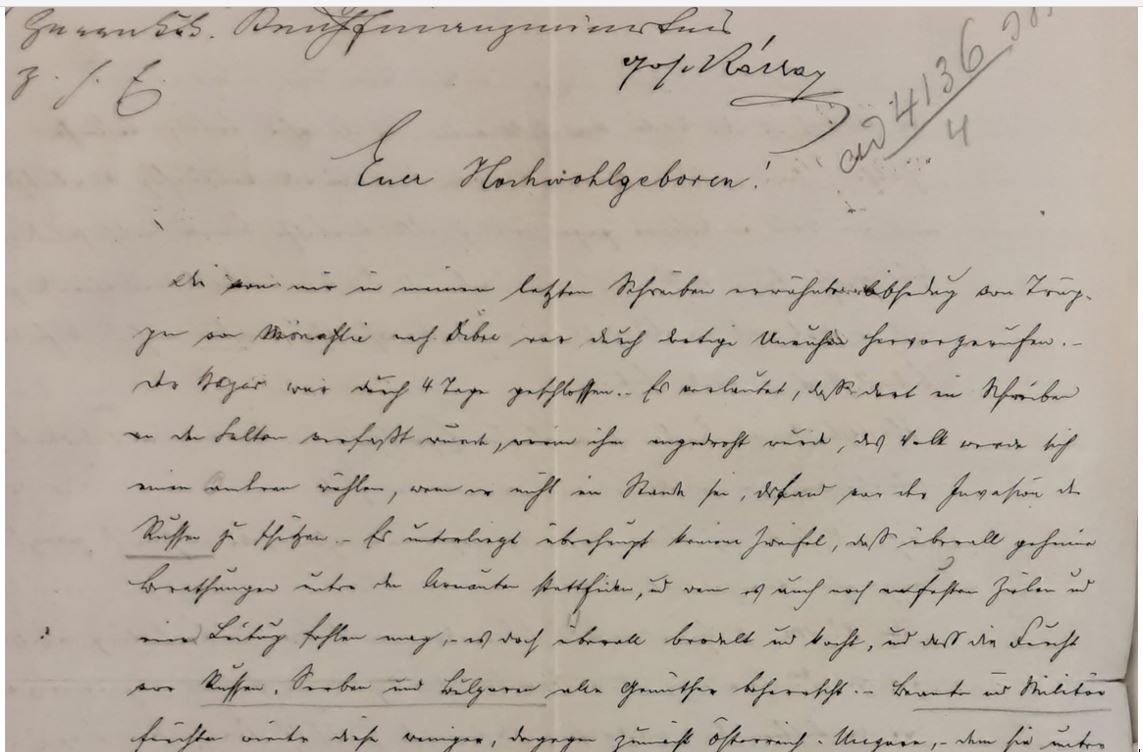
During his visit, Wolff also met with Benjámin Kállay, who was the Austro-Hungarian Empire’s appointed representative on the commission. Their discussions proved highly productive. Kállay proposed that the Serbian con­stitution, with which he was familiar, could serve as a model for the constitution of Eastern Rumelia. This suggestion had a significant influence on Wolff. The collaboration with Kállay and the exposure to the Serbian constitutional framework helped shape his approach to the administrative structure of the province. Reflecting on the challenges ahead, Wolff described the complexity of the task facing the commission:

What is wanted is this. A good government adapted to the people of the province. The essentials of such government are a strong Executive in the hands of the sultan on his representation and representative institutions strong enough to protect the people from misrule and oppression but not to control the executive especially in the point necessary for the maintenance of the sultan authority.14

A crucial early challenge for the commission involved determining the nature of the authority to be established in Eastern Rumelia. Many had assumed that the province would be restored to the status of a regular Ottoman vilayet. However, Wolff strongly opposed this idea. He argued that such a step was both impracticable and politically regressive:

Such a course was evidently impracticable; for, while it was the determination of the Power at Berlin to prevent Rumelia from becoming part of a semi-independent principality like Bulgaria, it was not intended to restore abuses which certainly had previously existed.15

In this matter, Wolff found support in Kállay. At the state level, cooperation between Britain and Austria–Hungary was established early during the Congress of Berlin and proved fruitful. The Balkan policy of the Dual Monarchy largely coincided with that of Britain in seeking to limit Russian expansion in the region. Vienna pursued this objective through a strategy aimed at weakening Russian ties to the Slavic peoples of the Balkans. This was clearly demonstrated by Austria–Hungary’s involvement in the European Commission.16 Before his departure, Kállay was instructed by the foreign minister, Count Gyula Andrássy, to cooperate with Britain and the Ottoman Empire to prevent the Russian authorities from obstructing the implementation of the provisions of the Treaty for Eastern Rumelia.17 When this broader state-level cooperation is considered alongside the personal relationship that developed between Wolff and Kállay, the alignment becomes even clearer. According to Wolff, Kállay expressed a clear willingness to cooperate in shaping the resolutions of the Commission. It is evident that the two statesmen influenced each other’s views regarding the organization of Eastern Rumelia.18 Kállay later recalled that during the Congress of Berlin the British authorities had considered it necessary to grant specific rights to the province to provide safeguards against the reemergence of previous abuses, but he had maintained and openly stated that any substantial divergence between the administrative organization of Eastern Rumelia and that of the other Ottoman provinces would risk fostering separatist tendencies and the eventual unification of the two Bulgarian entities.19 However, during the later work of the Commission, István Diószegi argues that not only Austria–Hungary’s strategic concept but even Kállay’s personal views were consistent with the British position, and he appeared to cooperate with British political aims in Eastern Rumelia. As a result, strategic Anglo-Austrian collaboration emerged. Both parties sought, through careful institutional design, to establish an Eastern Rumelia the liberal constitutional framework of which would serve as a safeguard against union with Bulgaria.20 Kállay essentially adopted Wolff’s attitude toward the future organization of Eastern Rumelia, maintaining that a barrier against Russian influence and unionist propaganda could be created only through a government framework that would establish “truly modern institutions that promote civilization.”21 His position was regarded as “too liberal,” and it was not approved by Andrassy, who felt that “the greater the difference between the conditions in Turkey and Eastern Rumelia, the stronger the incentive for the union of Eastern Rumelia and Bulgaria.”22

Wolff’s political stance regarding the organization of Eastern Rumelia favored the establishment of an institution with a significant degree of autonomy. He felt that a carefully structured system of self-government would act as a barrier against pro-unification agitations, which would emanate from the Principality of Bulgarian and have the support of Russian influence.23 However, on August 27, 1878, Lord Salisbury expressed opposition to this stance, describing it as unwise and particularly susceptible to risk. In a formal instruction sent to Wolff, Salisbury articulated his concerns regarding the delicate balance of power between the legislative and executive branches within the projected constitutional framework of Eastern Rumelia. His warning was particularly rooted in the region’s complex ethnic nature. Salisbury feared that the Bulgarian majority in the province might seek to assert dominance through the legislature, while the executive, remaining loyal to the Ottoman Empire, could become politically isolated. The underlying fear was that excessive political autonomy, particularly in the hands of a nationalist-leaning legislature, could lead to instability and threaten the strategic balance in the region. While Salisbury acknowledged the importance of civil liberties, he advised caution in extending political freedoms, arguing that such measures risked encouraging factionalism, corruption, and a breakdown of order.24 His concerns reflected a broader imperial dilemma about how to grant sufficient autonomy to satisfy local aspirations while maintaining centralized control in multiethnic regions vulnerable to nationalist movements and external interference.

Wolff and the European Commission

The European Commission officially commenced its work in Istanbul with its first formal meeting on September 18, 1878. To assist Sir H. Drummond Wolff in his duties, the Earl of Donoughmore was appointed assistant commissioner.25 The other members of the commission included Le Baron de Ring (the delegate from France), Kállay (the delegate from Austria–Hungary), Colonel Schepelew

and Prince Tzertelew (the delegates from Russia), Assim Pasha and Abro Effendi (the delegates from the Ottoman Empire), and Chevalier Veroni (as a re­present­ative of Italy).26 Short thereafter, the commission relocated to Plovdiv, the capital of the province. The first session there took place on October 21, 1878.27 Although the commission’s work was initially intended to be completed within three months, the complexity of the issues necessitated an extension of its mandate. The Organic Statute was finally drafted and signed on April 26, 1879.

Despite the diplomatic investment in the issue of Eastern Rumelia, Lord Salisbury expressed early skepticism regarding the prospects of the commission’s chance of success. In a letter to Wolff dated September 18, he wrote the following: “The general appearance of the prospect of commission are gloomy. It is a work which, of course, can only succeed, if undertaken by all with a wish to make it succeed.” Salisbury advised Wolff to act on the assumption that opposition would come consistently from two members, those representing Russia and Germany, and therefore to build consensus among the remaining majority. However, this posed a significant procedural challenge, as the commission was structured to operate based on unanimity, requiring all decisions to be approved collectively. For the mission to succeed, Salisbury outlined four principal conditions:

It should be, if possible, combine these—somewhat—characteristics: 1. It should take Austria with you. 2. It should be on something which the Turks value highly, so that after the breach has taken place you may be able to say them, “See what I saved you from.” 3. It should not be sufficiently anti-liberal to enable Gladstone to call you a second Metternich. 4. It should not urge the Greek population against you. That you should conciliate the Bulgars of course we must give up as Utopian.28

It was evident that Salisbury’s strategy relied heavily on Austria to counter­balance Russian influence and, ultimately, push Russia out of Eastern Rumelia, an objective that formed the central purpose of this diplomatic enterprise, as Wolff himself admitted in his memoirs.29 Furthermore, the role of the Greek population as a political instrument against Bulgarian influence was once again acknowledged. The internal political context, particularly the potential reaction of British liberal opinion, was also taken into account in shaping the course of action.

The Russian position became unequivocally clear shortly after the com­mission began its work. On September 21, Earl of Donoghmore reported on his first meeting with the Russian imperial commissioner, Prince Dondukov Korsakov.30 In this encounter, the Russian authorities made it explicitly clear that they would oppose the implementation of the British program for Eastern Rumelia, “whatever it might be.” Prince Dondukov declared his refusal to re­linquish control over the Province’s finances and raised concerns regarding the proposed organization of the militia. He warned that the local militia would not accept the officers nominated by the sultan, as stipulated in Article XV of the Treaty, and he cautioned that any attempt to impose such appointments could lead to violence. Furthermore, Dondukov urged the commission to adopt the existing constitution already introduced by the Russian administration, stating that it could be revised, if necessary, but that all government arrangements should remain in their current form until such revisions had been agreed upon.31

Upon its relocation to Plovdiv, the European commission soon revealed that the situation in the province was quite different from what the British authorities had anticipated. Russian influence in the region remained deeply entrenched, and there was widespread opposition among the Bulgarian population to the implementation of the Berlin Treaty’s provisions, particularly those aimed at the restoration of Ottoman authority in the region. Demonstrations, petitions, and press articles expressed the population’s readiness to defend its freedom and reject any attempt to reassert the sultan’s authority. These expressions of dissent were accompanied and reinforced by military displays, making it clear that the commission’s efforts would be met with organized resistance.32

The task of drafting the Organic Statute was divided among the members of the European commission, with each commissioner assigned responsibilities for specific chapters. The Russian commissioners refused to participate actively in the overall preparation of the statute. They contributed only to the sections concerning provisions for the militia and the gendarmerie.33 Wolff was tasked with preparing the sections concerning “Public Law” and “Provincial Assembly,” arguably the most politically sensitive components of the statute.34 Recognizing the importance of this assignment, Salisbury wrote to Wolff on October 1, emphasizing the importance of distinguishing between civil and political liberties. He maintained that fundamental civil rights such as public order, the safety of life and property, access to fair justice, and protection against excessive taxation were essential components of governance. These, he argued, should not be sacrificed in the name of preserving the Ottoman Empire. However, he cautioned that the real threat to the sultan’s supremacy did not lie in these civil rights, but in the unchecked expansion of political rights. He insisted that the true threat to stability was posed by political liberties such as the freedom to agitate, plot, and use a parliamentary position for treason and thus bring the government to a standstill. In his view, Wolff’s task was to strike a careful balance, granting enough political liberties to safeguard civil rights but not so many so as to empower pro-Russian factions or destabilize the provincial administration. Salisbury also warned against placing excessive faith in the loyalty or gratitude of the local population, remarking pointedly that gratitude “is a chimera, whose habitat is after dinner speech” and that people are only content when they “don’t see their way of anything better by stirring.” As the Bulgarians still had national aspirations, Salisbury concluded that any institutions built on the presumed satisfaction of the local population would likely prove ephemeral.35

The first draft of the Organic Statute was presented in early November by the Austro-Hungarian delegate, the aforementioned Kállay.36 It was accepted “tacitly and expressly” by all the European delegates, and it became a basis for the further work of the commission.37 According to this proposal, if the European commission could successfully implement the program in Eastern Rumelia, it would guarantee the rights and freedoms of the population, establish a modern financial and judicial administration, develop an advanced educational system, and create a strong executive authority alongside a capable civil administration devoted to the province’s prosperity.38 Salisbury welcomed the proposal, stating, “[t]he scheme appears to afford a very clear and comprehensive sketch of the framework of such a constitution as the commission is desired to prepare, and of the principles by which they should be guided in the task.”39

Britain sought to reduce Russian dominance in Eastern Rumelia, and if that objective could not be achieved by the subordination of the province to strong Ottoman authority, it could be perhaps be reached by giving extensive rights of self-government to the Bulgarians, which would also mean a chance for the population to free itself from Russian influence. This was the position that Wolff defends at length in his work, endeavoring to persuade Salisbury. Despite this shift in the British strategy, however, the commission’s work proved difficult. In December, Wolff reported that nearly two months after the commission had begun its work in Plovdiv, no meaningful progress had been made. He attributed the delay to Russia’s persistent unwillingness to cooperate.40

Significant disagreement emerged between the Russian and British delegates during the discussion of the chapter of the Organic Statute on “Public Law,” particularly on the provisions that were crucial to the defense of the future governance of the province. The initial draft prepared by Wolff stipulated that, with the exception of the governor general and the governor general’s secretary, all senior officials, officers, and judges were to be appointed by the sultan.41 Russians delegates strongly objected to this clause, viewing it as a limitation of the province’s administrative autonomy. A compromise was eventually reached. The directors of departments, the judges of the High Court, and the local governments would be appointed by the governor general, but these appointments would be subject to the approval of the sultan. Additionally, the governor general was granted the authority to appoint military officers up to the rank of captain.42

Another contentious issue was the Sultan’s right to approve laws passed by the Provincial Assembly, a provision that effectively placed all legislative authority under the control of the Porte. To address this concern, another compromise was reached. The sultan retained the right to approve the legislation, but if no formal rejection was issued within two months, the law would automatically be considered passed.43 Although this arrangement undermined Ottoman authority, Wolff considered it a necessary measure to prevent legislative deadlock and facilitate the administrative development of the province. He defended his view in front of Salisbury:

It will be seen that by our proposals the sultan’s sanction is necessary for the confirmation of every law and that in this respect the governor general has no power of sanction apart from the sultan. I fear it will be unavoidable in the first instance that the Porte will look unfavorably on the legislation of the province, and it is therefore very desirable that as little opening as possible should be left for any (unreadable word) proceedings, either on one side or the other, caused either by ill will or dilatoriness. It is also desirable that any modifications to a law, desired by the sultan, should be communicated if possible during the session of the assembly, which is not likely to last more than two months.44

Initially, Salisbury rejected the measure proposed by Wolff. He expressed concern over its political implications. “[D]o you propose,” he asked, “to deprive sultan of all veto on legislation? Is not that rather dangerous? Might is not result in event of a weak or corrupt governor in laws being passed which would practically unite Rumelia and Bulgaria.”45 Despite Salisbury’s reservations, Wolff remained acutely aware of the obstacles that could arise from the side of the Porte. Specifically, he recognized the risk that the sultan might reject provincial legislation or delay its approval for extended periods, thereby obstructing the work of the governor general and hindering the development of the province. As a result, Wolff succeeded in persuading Salisbury to accept a compromise that introduced an institutional safeguard as a mechanism by which the government of Eastern Rumelia could continue to function even in the absence of timely imperial approval. Wolff’s anxiety regarding the inefficiency and obstructionism of the sultan’s administration was soon vindicated. During the seven years of the province’s existence, out of twelve laws submitted to the sultan for approval, only three received sanctions. Moreover, of the five annual budgets, not a single one was approved by the sultan.46 The record confirmed Wolff’s fears that excessive dependence on the Porte would paralyze the province’s legislative and financial administration.

The greatest difficulties arose during the discussions concerning the chapter on the “Provincial Assembly,” which was also drafted by Wolff. According to the project, the Provincial Assembly of Eastern Rumelia was to be composed of three distinct categories of members: (1) members by right; (2) elected members; and (3) members appointed by the governor general.47 The category of members by right was to include the religious heads of the recognized communities, the chief justices, and the financial inspector of the province. The appointed members were subject to a property qualification and were to be selected from among the hundred wealthiest factory owners and landholding farmers. As for the elected members, eligibility was limited to individuals who owned real property within the province.48 In this form, the proposal tended to concentrate extensive powers in the hands of the governor general, while considerably restricting the population’s right to participate in the governance of the province. The suffrage provisions imposed various limitations, including property and educational qualifications. Furthermore, many members of the Assembly were to be appointed by right or directly selected by the governor general. Had the assembly been established on this model, it would have functioned as a body entirely dependent on the executive authority, thereby rendering its role as a representative and supervisory organ ineffective. In addition, the participation of the Bulgarian population was significantly curtailed.49

The Russian commissioners strongly opposed the British proposal. The sharp disagreement between British and Russian delegations over this issue threatened to derail the commission’s work, as neither side was initially willing to compromise.50 The discussions lasted 39 days. Ultimately, however, a negotiated settlement was reached. The Russian side accepted that the governor general would retain the right to appoint members to the provincial assembly, but this number was limited to ten.51 This compromise granted the population greater opportunity to participate actively in the governance of the province, giving a relatively liberal character to the regime and creating conditions for political self-development. At the same time, the considerable powers retained by the governor general ensured that the influence of the Ottoman Empire would remain limited in practice, even as formal sovereignty was preserved.

Wolff’s efforts contributed to the drafting of an Organic Statute that diverged significantly from the Law of Vilayets,52 granting Eastern Rumelia a semi-independent status. Initially, Salisbury aimed to reinforce the authority of the Ottoman Empire and explicitly sought to prevent the emergence of any form of provincial autonomy that might resemble independence. Throughout the drafting process, he remained skeptical, and he repeatedly cautioned Wolff against adopting what he perceived as an overly liberal constitutional model. In one such warning, Salisbury wrote, “[f]or the purpose of getting a fair amount of money; in order to quell sedition or conspiracy, in order to keep the Russians out, and to protect such Mohamedans and Greeks as remain, the sultan ought to have powers such as no constitutional or parliamentary action can impede. These postulates granted, be as liberal as you please.”53 Nevertheless, Wolff succeeded in modifying Salisbury’s view regarding Eastern Rumelia to some extent, prompting a shift in British policy, particularly as it became increasingly apparent that certain rights granted to Eastern Rumelia were gradually undermining the sultan’s authority in the region. One notable provision of the Organic Statute was the formal recognition of the “indigenous” identity, which conferred a form of local nationality and granted citizenship within the Province. In Wolff’s view, this provision was valuable not as a safeguard against the Ottoman government but rather as a means of preventing interference by the Principality of Bulgaria in the internal affairs of Eastern Rumelia.54 Additionally, it was established that Bulgarian would serve as the official language of Eastern Rumelia, while Turkish and Greek could be used only in regions where at least one-third of the population spoke one of those languages. These provisions were seen by some British statesmen, most notably Sir Henry Layard, as steps towards the eventual full independence of Eastern Rumelia.55

Wolff also defended his position regarding the administration of the province by emphasizing the economic opportunities that it could offer. According to him, “a certain sort of confidence is growing in the minds of traders and moneyed men in the future prosperity of the province.” He argued that the key to sustaining this economic optimism was the establishment of a stable and just administration, one that would leave no room for intrigue. Such governance, he maintained, would serve as the strongest guarantee for the security of the sultan’s rule. As Wolff firmly argued, “[i]f the Bulgarians of Eastern Rumelia are rendered satisfied and prosperous under the government of the sultan they will remain quiet under this rule. If they are governed as before they will intrigue with Russia, and Europe will still be kept in the state of permanent anxiety.” 56

British Policy and the Balkan “Chessboard”

On January 25, 1879, Wolff submitted a detailed report on the progress of the commission’s work and the prevailing situation in Eastern Rumelia. According to his assessment, after four months of meetings, only four chapters of the Organic Statute had been completed, while ten remained to be drafted. The financial administration of the province had not yet been brought under the authority of the European commission. Wolff expressed his view concerning the most significant obstacles stemming from Russian policy:

I am convinced that they do not want war. But as a matter of pride, they have flourished before the Bulgarians—a flag of defiance to the Berlin Treaty. They have produced an agitation which has assumed dimensions beyond their control and which they now find themselves obliged to follow, at the risk of incurring the hostility of the Panslavist organisation both in Russia and abroad.

Their army is fatigued and anxious to return home, and the generals are worried by the complication of their duties. But knowing the feelings they have fostered if not created, they are determined to be able to say to the Bulgarians: “Europe has prevented us from doing all we wished in your favor; but at all events we have secured you a fairly good government, and safety from Turkish misrule. You may therefore bide your time.”57

The Provisional Russian Administration in Bulgaria represented a significant obstacle to the implementation of British policy in Eastern Rumelia.58 Even after the signing of the Treaty of Berlin, the provisional governments of Bulgaria and Eastern Rumelia were not formally separated. The general administration of the province had remained under the authority of the governor general of Bulgaria rather than having been placed under an independent provincial governor. Administrative acts and directives continued to be issued from Sofia, reinforcing the perception of a unified governance structure. These circumstances fostered among the Bulgarian population the hope and, indeed, the expectation of a future unification with the Principality of Bulgaria.59 The continued overlap in administration not only contravened the spirit of the Treaty of Berlin but also undermined British efforts to preserve Eastern Rumelia’s autonomous status within the Ottoman Empire and to limit Russian influence in the region.

During the work of the European commission, Wolff was compelled to contend not only with persistent Russian opposition on nearly every point but also with the ongoing passivity of the Ottoman representatives. As Sir Henry Layard protested to Caratheodory Pasha, the Ottoman minister of foreign affairs, the Ottoman delegates consistently failed to take an active role in the commission’s deliberations. Layard made the following remark: “in consequence of proper instructions not having been given to the Turkish commissioners, who, unwilling to take upon themselves the responsibility of decision on any question of importance, accept the decisions of their colleagues almost in every case with a ‘reserve.’”60 The failure of the sultan’s government to take active steps to fulfil their obligations and assert effective control in Eastern Rumelia was another factor that shaped Wolff’s considerations and forced changes to the British political course. Even three months before the end of the Russian occupation, the Ottoman government had taken no concrete measures to preserve order in the province. As Wolff observed, the Ottoman officials maintained that the Bulgarians would offer no resistance to the Ottoman troops, while ignoring the reality that, should Russians withdraw without appropriate precautionary arrangements, they would be leaving “the seeds of immediate disorder,” having already armed and trained the Bulgarian population.61 Furthermore, almost all administrative posts were occupied by Bulgarians, an arrangement facilitated by the Russian delegate Tzeretelew.62 Wolff was firmly convinced of the influence of pan-Slav agitation, which, in his view, could prompt Russian authorities to intervene in Eastern Rumelia under the pretext of defending the local population. On this issue, Wolff’s concerns were shared by Lord Salisbury, who feared that pan-Slav movements could entangle Britain in a broader conflict, reflecting a growing sense of unease within British political circles.63 However, the two statesmen were divided on the appropriate measures to prevent such a development.

Another contentious issue of significant importance was the establishment of the rights and status of the various nationalities within the province, to be arranged in an appropriately balanced proportion to diminish the threat of a future union with the Principality of Bulgaria. One particularly sensitive matter concerned the authority responsible for appointing bishops in Eastern Rumelia. The Russian delegates argued that the ecclesiastical appointments should fall under the jurisdiction of the local government. However, this proposal met with strong opposition from Salisbury, as conveyed in the instructions sent to Wolff. The rationale was clearly stated: “The policy of England is to sustain the Greeks against the Slavs: and we could not support any proposal in an opposite sense.”64 Salisbury’s concerns stemmed from his belief that, if the provincial authorities were granted independent control over clerical appointments, free from Ottoman oversight, this could lead to the dominance of the Bulgarian Exarchate at the expense of the Greek Patriarchate. In the event of a schism between the two ecclesiastical institutions, the Bulgarian population might come to dominate over the Greek community within the Province. Such an outcome could result in Eastern Rumelia acquiring an exclusively Bulgarian character, thereby en­hanc­ing Russian influence and undermining the province’s status within the Ottoman Empire. The issue remained unresolved and was deferred until the concluding sessions of the European commission. Additionally, alongside the provision for the recognition of three official languages (Bulgarian, Turkish, and Greek), these measures were designed not only to reflect the multiethnic character of the province but also to limit the political and cultural dominance of the Slav (Bulgarian) population and to facilitate the creation of a real barrier against Slavism, which was Lord Salisbury’s most fundamental goal.65 Despite Salisbury’s strong support for the Greek population, Wolff acknowledged that it was unrealistic to grant them widespread official privileges, given their relatively small numbers and concentration in only a few larger towns. As he explained, this posed a significant obstacle for the commission in justifying the extension of broader rights to them. Nevertheless, he made credible efforts and succeeded in securing “what was feasible for the Greeks.”66

In this context, the liberal organization of Eastern Rumelia was not merely an expression of ideological commitment to representative governance. Rather, it functioned as a calculated instrument of geopolitical containment. From the outset, Salisbury pursued the establishment of a multiethnic provincial model in Eastern Rumelia as a strategic response to the Ottoman Empire’s diminishing capacity to assert effective authority over its European territories. By the implementation of a multiethnic administrative framework, he sought to preserve Ottoman suzerainty, creating a buffer against further Russian penetration into and advancement towards the Straits. However, the unchecked predominance of the Bulgarian population, combined with the ongoing migration of the Muslim population, threatened to transform Eastern Rumelia into a political entity with a distinctly Bulgarian character, situated in threatening proximity to Istanbul. This kind of demographic and political shift posed two major threats from the British perspective: the unification of Eastern Rumelia with the Principality of Bulgaria and the extension of Russian influence into the Balkans. While the British authorities accepted the introduction of a liberal constitutional framework in the province, their underlying objective was to use that system as an instrument for the political and cultural reinforcement of the Muslim and Greek populations.67

Although Britain’s foreign policy projected firmness, it was nonetheless subject to periodic adjustments in response to shifting geopolitical realities. The Greeks were generally viewed by British policymakers as a useful counterbalance to the growing momentum of pan-Slavism across the Balkans. However, Wolff felt that a more nuanced approach towards the Bulgarians was necessary, particularly concerning their churches in Eastern Rumelia and in other Ottoman-controlled territories inhabited by Bulgarians. The Greek Patriarch sought to diminish the influence of the Bulgarian Exarch by demanding that the Exarch be confined to the Principality of Bulgaria and that Bulgarian churches in Macedonia, Thrace, and other Ottoman provinces be dissolved or placed under the jurisdiction of the Patriarch. Such a move, however, would effectively revoke the religious liberties already granted to the Bulgarian church community, and in Wolff’s view, it would inevitably push the Bulgarian population to seek protection and support from Russia. Wolff argued that it would be more advantageous for the Ottoman Empire to adopt a more conciliatory stance toward the Exarchate:

The Bulgarians from Turkey should look to Constantinople for their ecclesiastical authority, and the Exarch should govern his churches under a supervision which can only be exercised by the Capital. It is impossible to do away with his authority by artificial means, or permanently to subject the Bulgarian majority to the Greek minority by some quibble of ecclesiastical law which pretends to do away with the existing schism. Excommunication has terrors only so long as it is not pronounced.68

Wolff’s position reflects a pragmatic understanding of the religious and national dynamics in the region. Rather than attempting to suppress the Bulgarian church through coercive means (a scheme which probably would have backfired and led to an increase in Russian influence), he advocated a model of ecclesiastical oversight centered in Istanbul, thereby preserving Ottoman authority while accommodating Bulgarian religious identity.

Had this proposal been accepted, it would have preserved a degree of authority for the sultan over the Bulgarian population and would have given no further justification for or momentum to pan-Slav propaganda concerning the Bulgarian question. From Wolff’s perspective, the most effective way to counter the influence of pan-Slavism among the Bulgarians was not through repressive measures, but rather by strategically dividing the movement into separate centers of influence and thus undermining its cohesion.69

One of the principal concerns of the British authorities regarding Eastern Rumelia was the preservation of public order and stability in the province following the withdrawal of Russian troops. Britain feared that any outbreak of unrest could provide the Russian authorities with a pretext to extend their military occupation beyond the agreed period.70 In this context, the question of establishing of Ottoman garrisons to secure the military defense of Eastern Rumelia became a matter of primary importance for Salisbury. Article XV of the Treaty of Berlin gave the Ottoman Empire the right to station troops in the province.71 From the outset, this provision was effectively ignored by the Russian authorities. However, Salisbury insisted that “Britain cannot abandon in any degree the right of Turkey to garrison the Balkans.”72 For Britain, the presence of Ottoman military forces in Eastern Rumelia was essential, not only as а guarantee for the sultan’s authority but also as a safeguard against the province’s potential detachment from the empire and its transformation into a dominantly Bulgarian-administered territory. Such a development would have created favorable conditions for unification of the province with the Principality of Bulgaria, an outcome Britain sought to avoid. In the proceedings of the European commission, the issue of Ottoman garrisons was repeatedly raised. Salisbury consistently reaffirmed Britain’s opposition to any modification of the Treaty of Berlin clause permitting an Ottoman military presence.73

Indeed, once the British government became fully acquainted with the conditions in Eastern Rumelia through Wolff’s reports, it recognized the threat posed by the deployment of Ottoman garrisons that might operate independently of the governor general’s control. There was particular concern that such forces could mistreat the local Bulgarian population, especially in the initial phase of transferring administrative authority back to the sultan. The risk was not over­looked. In fact, it was explicitly acknowledged by Salisbury, who stressed the need for preventive measures.74

In response to the growing complexity of the situation, British authorities began to consider alternative strategies. During a meeting between Wolff and the Bulgarian exarch, the latter insisted that the Bulgarian population expected Ottoman garrisons to be prohibited from entering the Balkans.75 Reflecting these concerns, Wolff addressed an observation to Salisbury in which he outlined a potential compromise regarding the Porte’s right to station and fortify troops in the region. Specifically, he proposed restricting Ottoman troops to the coastal frontier at Bourgas, while retaining a substantial military force at Adrianople and approximately 5,000 troops in Djuma, Mustapha Pasha (nowadays the region of Svilengrad), and the Rhodope region. Furthermore, Wolff recommended that any garrisons stationed near the frontier should, at least initially, be accompanied by British officers as well as representatives from other signatory powers willing to participate.76 This strategic arrangement was viewed by British officials as a key advantage. It allowed the Ottoman government to retain control over the maritime entry point in Eastern Rumelia while concentrating its forces in a central location from which it could rapidly respond to threats and, if necessary, reassert control over the Balkan interior. Additionally, this disposition provided the Ottoman Empire with leverage in negotiating the construction of a strategic railway route along the Balkan mountain range, further strengthening its logistical and military position in the province.

The negotiations failed to produce a satisfactory resolution, and by April, just one month before the expiration of the Russian occupation, an impasse had been reached on the question of the entry of Ottoman garrisons into Eastern Rumelia. The Russian authorities strenuously opposed the deployment of Ottoman military forces in Eastern Rumelia, as Wolff reported his observations:

The chief aim which the Russians have had in view when exiting and arming the Bulgarians and recently proposing the mixed occupation, has been to postpone and ultimately prevent altogether the execution of that clause of the Berlin Treaty which provides that the Balkans shall be garrisoned by Ottoman troops without the necessity of undertaking a new war for the purpose.77

As a result, Salisbury was forced to yield on this issue. The Ottoman Empire was permanently denied the opportunity to reestablish a standing military presence in Eastern Rumelia, and this outcome effectively undermined Salisbury’s project for the establishment of Eastern Rumelia as a military bulwark for the defense of Istanbul. Nevertheless, Article XVI of the Treaty of Berlin, which granted the governor general the right to summon Ottoman troops in the event of internal or external threat, remained a valuable strategic instrument with which to maintain British influence in the region. By vesting this authority in the governor general, British policymakers secured an indirect mechanism of control over the internal security of the province. The mere power potentially to invoke this right served as a strong deterrent against rebellion and a tool with which to enforce political discipline. This strategic leverage was exercised from the earliest moments of Eastern Rumelia’s autonomous days. The British consul recounted having offered a warning, for instance, to a delegation of Bulgarian notables: “although the Turks might not be in occupation of the Balkans, yet their troops could certainly be brought into the province at the slightest symptom of disorder or rebellion. I impressed them with the necessity of respecting the law.”78 In this way, Britain managed to preserve a key element of leverage in Eastern Rumelia, even if the prospect of direct Ottoman military control had been foreclosed.

The outcome of the European commission’s work was critically assessed by Count Andrassy, who made the following remarks:

The European commission proceeded in a contrary direction, and the Organic Statute now about to be put in force leaves scarcely a vestige of direct authority to the sultan, who, except as regards one or two superior officers of militia, can neither appoint nor dismiss a civil or military functionary in the province, and the whole executive authority is permanently delegated to an irremovable governor general, who necessarily has to be selected less for any supposed aptitude for the post than with a view to secure the requisite unanimous sanction of the Powers.79

In practice, the modifications introduced, primarily under the British influence, significantly deviated from the initial objective of reinforcing Ottoman sovereignty, as originally outlined in the Treaty of Berlin. Instead, they contributed to the broader strategic aim of British policy to limit Russia’s influence in the Balkans, while simultaneously offering the Bulgarian population an opportunity to pursue a distinct path of political administrative development within the framework of formal suzerainty.

Although the British authorities introduced several significant modifications to the administrative framework, their fundamental policy objectives, formulated during the Eastern Crisis, remained unchanged. Chief among them was the determination to prevent Russia from gaining access to the Mediterranean.80 Throughout the drafting of the Organic Statute and the creation of the province’s governing system, Salisbury’s policy was constantly shaped by the fear that the Tsarist authorities were laying the groundwork for annexation. There was persistent concern in London that, following the withdrawal of Russian troops, Britain might be confronted with a fait accompli, wherein Russia would proclaim control over Eastern Rumelia, rendering diplomatic resistance both difficult and potentially futile. 81

In the initial phase of the diplomatic project, amid frequent clashes between the Russian and British delegates, Wolff made the following observation: “We could not expect the Russian authorities and functionaries to obey us, nor could we entirely supersede them before having formed a system to take their

place.”82 This statement encapsulated Wolff’s central objective with regards to his mission in Eastern Rumelia to establish an Organic Statute and administrative framework capable of replacing the existing Russian provisional administration. Reflecting further on his mission, Wolff made the remark: “My anxiety has always been to maintain the Treaty, but to see how far its existing provisions could be carried out without provoking the insurrection prepared by the Russians.”83

Conclusion

The Bulgarian historian Milko Palangurski argues that Eastern Rumelia occupied an inherently ambiguous position, lacking both the degree of autonomy and self-governance enjoyed by the Principality of Bulgaria and the formal status of a traditional Ottoman vilayet. Situated between two spheres of influence, it was only natural for the province to gravitate either toward Sofia, aligning with the movement to unify with the Principality of Bulgarian, or toward Istanbul, reaffirming its ties with the Ottoman Empire. 84

Ultimately, Eastern Rumelia chose the path of unification with the Principality of Bulgaria, an outcome that Lord Salisbury had explicitly sought to prevent through the commission’s work and the establishment of the administrative structure and governmental authorities of the autonomous province. However, the proclamation of unification on September 6, 1885 did not represent a sudden failure or collapse of British policy. Rather, it constituted the culmination and paradoxical fulfilment of Britain’s longer-term strategic vision for the province. Salisbury’s primary objective had been the gradual dismantling of Russian influence in the Balkans. Ironically, this objective was realized through the very act of Union that violated the legal framework of the Treaty of Berlin and contradicted Salisbury’s publicly stated views. The unification effectively terminated Russian leverage in Bulgaria by precipitating a rupture in diplomatic relations between the Russian Empire and its satellite in 1886.

Therefore, Sir Henry Drummond Wolff’s mission to Eastern Rumelia must be recognized as a lasting diplomatic success. The commission’s final product, the Organic Statute, embodied a delicate balancing act. It granted sufficient local autonomy to satisfy internal demands while preserving mechanisms of external oversight, embedded safeguards for Ottoman sovereignty, and subtly reinforced British leverage within the province. Viewed in this light, Eastern Rumelia was not merely an administrative experiment, but a strategically engineered geopolitical construction designed as a buffer zone to resist further Russian encroachment and postpone Bulgarian unification until it served British interests.

Wolff’s mission thus illustrates how Britain adapted liberal constitutional principles to serve imperial goals. Eastern Rumelia stands as a compelling example of how nineteenth-century Great Power’s diplomacy translated legal frameworks into instruments of strategic control, blurring the lines between governance and geopolitics.

Archival Sources

The National Archives, London (TNA)

Foreign Office (FO)

The National Archives, Hatfield House Library and Archives

NRA 9226 Gascoyne-Cecil

Централен Държавен Aрхив [Bulgarian State Archives], Sofia (CDA)

Bibliography

Primary sources

Great Britain, Foreign Office. Correspondence respecting the proceedings of the European Commission for the Organization of Eastern Rumelia: Presented to Both Houses of Parliament by Command of Her Majesty. London: Harrison and sons, 1879.

Secondary literature

Akpınar, Mahmut. “Bir Tanzimat Bürokratı ve Diplomatı Olarak Aleksandır Karatodori Paşa” [Aleksandır Karatodori Pasha: A bureaucrat and diplomat of the Tanzimat era]. PhD diss., Selçuk Üniversitesi, Konya, 2010.

Davison, Roderic H. Reform in the Ottoman Empire, 1856–1876. Princeton: Princeton University Press, 1963.

Diószegi, István. Ausztria–Magyarország és Bulgária a San Stefanó-i béke után (1878–1879) [Austria–Hungary and Bulgaria after the Treaty of San Stefano, 1878–1879]. Budapest: Akadémiai Kiadó, 1961.

Efe, Peri. “Bir Osmanlı Bürokratı: Aleksandır Karatodori Paşa: Millet-i Rum’dan Bir Münevver Aleksandros Karatheodoris” [An Ottoman bureaucrat: Aleksandır Kara­todori Pasha: A scholar from the Greek community: Aleksandros Kara­theodoris]. Toplumsal Tarih, no. 193 (2010): 83–93.

Geyer, Dietrich. Russian Imperialism: The Interaction of Domestic and Foreign Policy, 1860–1914. Leamington Spa: Berg, 1987.

Hauner, Milan. “The Last Great Game.” Middle East Journal 38, no. 1 (Winter 1984): 72–84.

Hornik, M. P. “The Mission of Sir Henry Drummond Wolff to Constantinople, 1885–1887.” The English Historical Review 55, no. 220 (1940): 598–623.

LeDonne, John P. The Russian Empire and the World, 1700–1917: The Geopolitics of Expansion and Containment. Oxford: Oxford University Press, 1997.

Owen, Roger. “Surviving the Drummond Wolff Mission and the ‘Race against Bankruptcy,’ 1885–1887.” In Lord Cromer: Victorian Imperialist, Edwardian Proconsul, edited by Roger Owen, 215–35. Oxford: Oxford University Press, 2004.

Weeks Jr., Richard G. “Peter Shuvalov and the Congress of Berlin: A Reinterpretation.” The Journal of Modern History 51, no. 1 (1979): D1056–D1070.

Yapp, Malcolm. “The Legend of the Great Game.” Proceedings of the British Academy 111 (2001): 178–98.

Wasti, Syed Tanvir. “Three Ottoman Pashas at the Congress of Berlin, 1878.” Middle Eastern Studies 52, no. 6 (2016): 938–51.

Wolff, Sir Henry Drummond. Rambling Recollections. Vol. 2. London: Macmillan and Co., 1908.

Дюрастел, А. Международен алманах за България 1898 г. [International Almanac for Bulgaria]. София: Придворна печ Братя Прошекови, 1897.

Икономов, Тодор, ред. Протоколите на Берлинский конгрес [Protocols of the proceedings of the Berlin Congress]. София: Книгопечатница Янко С. Ковачев, 1885.

Каменов, Петър. Граф Андраши и Балканите 1867–1890 [Count Andrássy and the Balkans, 1867–1890]. София: Фондация изкуство срещу насилието, 2001.

Козименко, Иван В. Сборник договоров России с другими государствами, 1856–1917 [Collection of treaties of Russia with other states, 1856–1917]. Москва: Госполитиздат, 1952.

Маджаров, Михаил. Източна Румелия [Eastern Rumelia]. София: Печатница С. М. Стайков, 1925.

Манолова, Мария. Русия и конституционното устройство на Източна Румелия [Russia and the constitutional structure of Eastern Rumelia]. София: БАН, 1976.

Манолова, Мария. Нормотворческа дейност на временното руско управление в България (1877–1879) [The normative activity of the Provisional Russian Government in Bulgaria]. София: Sofia: Сиела, 2003.

Муратов, Александар. Документи за дейността на русите по уредбата на гражданското управление в България, 1877–1879 [Documents on the activities of the Russians in the organization of civil administration in Bulgaria, 1877–1879]. София: Министерство на народното просвещение, Държавна печатница, 1905.

Палангурски, Милко. Нова история на България I. Княжеството [New history of Bulgaria I: Principality]. София: Сиела, 2013.

Сергеев, E. Ю. Большая игра, 1856–1907: Мифы и реалии российско-британских отношений в Сентральной и Восточной Азии. Москва: Товаришество научных изданий КМК, 2012.

Стателова, Eлена. Източна Румелива (1879–1885): Иконокика, политика [Eastern Rumelia (1879–1885): Economics, politics]. София: Култура, 1983.

Стоянов, Манио. “Изработване на Органическия устав на Източна Румелия” [Preparation of the Organic Law of Eastern Rumelia]. Исторически преглед 11, no. 2 (1955): 54–87.


  1. 1 Geyer, Russian Imperialism, 86; Сергеев, Большая игра, 18.

  2. 2 LeDonne, The Russian Empire, 327.

  3. 3 Hauner, “The Last Great Game,” 74–75; Yapp, “The Legend,” 189–90.

  4. 4 Hornik, “The Mission of Sir Henry”; Roger, “Surviving the Drummond Wolff.”

  5. 5 NRA 9226 Gascoyne-Cecil A27, Marquis of Salisbury to Lord Odo Russel, April 19, no. 2, 3–8.

  6. 6 Weeks, “Peter Shuvalov,” D1056; Козименко, Сборник договор России, 176–79.

  7. 7 TNA, F.O. 93/81/47, Memorandum communicated to the Marquis of Salisbury by Count Schouvaloff, May 23, 1878, 41–42.

  8. 8 NRA 9226 Gascoyne-Cecil, A 20, Marquis of Salisbury to the Queen, May 6, 1878, no. 22, 66–68.

  9. 9 NRA 9226 Gascoyne-Cecil A31, Marquis of Salisbury to Lord August Loftus, May 7 1878, no. 4, 9–10.

  10. 10 Стателова, Източна Румелия, 13.

  11. 11 Икономов, Протоколите на Берлинскии конгрес, 54–55.

  12. 12 For more information: Efe, “Bir Osmanlı Bükratı,” 83–93; Akpınar, “Bir Tanzimat Burokratı”; Syed Wasti, “Three Ottoman Pashas,” 938–51.

  13. 13 TNA, F.O. 901/1, from Sir H. Drummond Wolff to the Marquis of Salisbury, Vienna, August 24, 1878.

  14. 14 TNA, F.O. 901/1, from Sir H. Drummond Wolff to the Marquis of Salisbury, Pesth, September 1, 1878.

  15. 15 Wolff, Rambling Recollections, 201.

  16. 16 Diószegi, Ausztria-Magyarország, 40.

  17. 17 Каменов, Граф Андраши, 148.

  18. 18 TNA, F.O. 901/1, from Sir H. Drummond Wolff to the Marquis of Salisbury, Pesth, August 31, 1878.

  19. 19 Diószegi, Ausztria-Magyarország, 52.

  20. 20 Ibid., 49.

  21. 21 Ibid., 52.

  22. 22 Ibid., 62.

  23. 23 Correspondence respecting the proceedings of the European Commission for the Organization of Eastern Rumelia, from Sir H. Drummond Wolff to the Marquis of Salisbury, Vienna, August 24, 1878. Turkey No. 9 (1879), 8–9.

  24. 24 NRA 9226 Gascoyne-Cecil A34, Marquis of Salisbury to Sir H. Drummond Wolff, August 27, 1878, 1–4, no. 1.

  25. 25 Correspondence respecting the proceedings of the European Commission for the Organization of Eastern Rumelia, from Marquis of Salisbury to Sir H. Drummond Wolff, Foreign Office, August 10, 1878. Turkey No. 9 (1879), 2.

  26. 26 Wolff, Rambling Collection, 198–200.

  27. 27 Стоянов, “Изработване на Органическия устав,” 66.

  28. 28 NRA 9226 Gascoyne-Cecil A34, Marquis of Salisbury to Sir H. Drummond Wolff, September 18, 1878, no. 2, 5–7.

  29. 29 Wolff, Rambling collection, 197.

  30. 30 A Provisional Russian Administration with civil functions was established in the territories occupied by the Russian army during the Russo-Turkish War of 1877–1878. Following the Treaty of San Stefano, Prince Dondukov was appointed imperial commissioner of Bulgaria. See Манолова, Нормотворческа дейност, 31–39; Муратов, Документи за дейността.

  31. 31 TNA, F.O. 901/ 9, from the Marquis of Salisbury to Lord A. Loftus, Foreign Office, October 15, 1878, no. 533.

  32. 32 Манолова, Русия и конституционното, 68–75.

  33. 33 Correspondence respecting the proceedings of the European Commission for the Organization of Eastern Rumelia, from Sir H. Drummond Wolff to Marquis of Salisbury, Philippopolis, November 7, 1878. Turkey No. 9 (1879), 118–19.

  34. 34 Стателова, Източна Румелива, 24.

  35. 35 NRA 9226 Gascoyne-Cecil A34, from the Marquis of Salisbury to Sir H. Drummond Wolff, October 1, 1878, 9–12, no. 3. “I would not rely too much on the contentment or gratitude of the people. The second is a chimera, whose habitat is an after dinner speech. The first only keeps a people quiet, when they don’t see their way of anything better by stirring.”

  36. 36 Correspondence respecting the proceedings of the European Commission for the Organization of Eastern Rumelia, from Sir H. Drummond Wolff to Marquis of Salisbury, Philippopolis, November 3, 1878. Turkey No. 9 (1979), 111.

  37. 37 TNA, F.O. 78/3034, from Sir H. Drummond Wolff to the Marquis of Salisbury, Philippopolis, January 3, 1879. 131–34.

  38. 38 Манолова, Русия и конституционното, 83.

  39. 39 TNA, F.O. 901/9, Marquis of Salisbury to Sir H. Drummond Wolff, Foreign Office, November 21, 1878, no. 114.

  40. 40 TNA, F.O. 881/3910, Sir H. Drummond Wolff to the Marquis of Salisbury, Philippopolis, December 25, 1878, 105–6.

  41. 41 Манолова, Русия и конституционното, 87.

  42. 42 Стателова, Източна Румелива, 26.

  43. 43 Ibid., 26–27, Манолова, Русия и конституционното, 92–108.

  44. 44 TNA, F.O. 78/3034, from Sir H. Drummond Wolff the Marquis of Salisbury, Philippopolis, January 2, 1879, 25–27.

  45. 45 TNA, F.O. 901/9, from Marquis of Salisbury to Sir H. Drummond Wolff, Foreign Office, December 16, 1878, no. 160.

  46. 46 Маджаров, Източна Румелия, 50; Стоянов, “Изработване на Органическия устав,” 229.

  47. 47 TNA, F.O.78/3035 from Sir H. Drummond Wolff to the Marquis of Salisbury, Philippopolis, February 9, 1879, 145–47.

  48. 48 Стоянов, “Изработване на Органическия устав,” 75.

  49. 49 Манолова, Русия и конституционното, 171–74; Стателова, Източна Румелия, 30–31.

  50. 50 TNA, F.O. 78/3035 from Sir H. Drummond Wolff to the Marquis of Salisbury, Philippopolis, February 9, 1879, 145–47.

  51. 51 Стоянов, “Изработване на Органическия устав,” 78–79.

  52. 52 A new Vilayet Law was issued in 1867. This law was based on the French administrative system for provinces and was first implemented in 1864 in the Danubian Province. The Vilayet reform aimed to centralize the provincial government and strengthen the connection between the center and the periphery of the empire. A new administrative division of Ottoman territories was established, and the number of provinces was reduced. Davison, Reform in the Ottoman Empire, 136–71

  53. 53 NRA 9226 Gascoyne-Cecil A34, Marquis of Salisbury to Sir H. Drummond Wolff, November 21 1878, 41–43, no. 14.

  54. 54 TNA, F.O. 78/3035, from Sir H. Drummond Wolff to the Marquis of Salisbury, Philippopolis, February 12, 1879, 149–51.

  55. 55 TNA, F.O. 881/3910, from Sir A.H. Layard to the Marquis of Salisbury, Constantinople, January 6, 1879, 267–70.

  56. 56 TNA, F.O. 78/3034, from Sir H. Drummond Wolff to the Marquis of Salisbury, Philippopolis, January 9, 1879, 131–34.

  57. 57 TNA, F.O. 78/3034, form Sir H. Drummond Wolff to the Marquis of Salisbury, Philippopolis, January 25, 1879, 351–53.

  58. 58 TNA, F.O. 78/3035, form Sir H. Drummond Wolff to the Marquis of Salisbury, Philippopolis, February 8, 1879, 57–73.

  59. 59 TNA, F.O. 78/3034, from Sir H. Drummond Wolff to the Marquis of Salisbury, Philippopolis, January 30, 1879, 374–75.

  60. 60 TNA, F.O. 195/1220, from Sir A. H. Layard to the Marquis of Salisbury, Constantinople, December 28, 1878.

  61. 61 TNA, F.O. 78/3034, from Sir H. Drummond Wolff to the Marquis of Salisbury, Philippopolis, January 25, 1879, 351–53.

  62. 62 TNA, F.O. 881/3910, from Sir H. Drummond Wolff to the Marquis of Salisbury, Philippopolis, December 31, 1878, 203.

  63. 63 TNA, F.O. 901/11, from Marquis of Salisbury to Sir H. Drummond Wolff, Foreign Office, February 6, 1879.

  64. 64 TNA, F.O. 901/11, from Marquis of Salisbury to Sir H. Drummond Wolff, Foreign Office, February 25, 1879; TNA, F.O.78/3033, from Marquis of Salisbury to Sir H. Drummond Wolff, Foreign Office, February 25, 1879, 164–69.

  65. 65 Correspondence respecting the proceedings of the European Commission for the Organization of Eastern Rumelia, from Sir H. Drummond Wolff to the Marquis of Salisbury, Philippopolis, Desember 2, 1878. Turkey No. 9 (1979), 241–42.

  66. 66 TNA, F.O. 78/3035, from Sir H. Drummond Wolff to the Marquis of Salisbury, Philippopolis, December 16, 1878, 149–51.

  67. 67 Манолова, Русия и конституционното, 39–40.

  68. 68 TNA, F.O. 78/3039, from Sir H. Drummond Wolff to the Marquis of Salisbury, Constantinople, May 19, 1879, no. 221, 57–62.

  69. 69 TNA, F.O. 78/3039, from Sir H. Drummond Wolff to the Marquis of Salisbury, Constantinople, May 19, 1879, no. 221, 57–62.

  70. 70 TNA, F.O. 195/1215, from Sir Henry Elliot to the Marquis of Salisbury, Vienna, January 3, 1879.

  71. 71 Дюрастел, Международен алманах, 25–47.

  72. 72 TNA, F.O.195/1215, from Marquis of Salisbury to Sir H. Drummond Wolff, Foreign Office, January 31, 1879.

  73. 73 TNA, F.O. 901/9, from Marquis of Salisbury to Sir H. Drummond Wolff, Foreign Office, December 16, 1878, no. 160.

  74. 74 TNA, F.O. 901/9, from Marquis of Salisbury to Sir H. Drummond Wolff, Foreign Office, December 14, 1878, no. 161.

  75. 75 TNA, F.O.195/1215, from Sir H. Drummond Wolff to the Marquis of Salisbury, Philippopolis, January 29, 1879.

  76. 76 TNA, F.O. 78/3036, from Sir H. Drummond Wolff to the Marquis of Salisbury, Philippopolis, March 9, 1879, no. 106, 140–43.

  77. 77 TNA, F.O. 78/3037, Memorandum from Sir H. Drummond Wolff, April 11, 1879, no. 163, 284–85.

  78. 78 CDA, KMF 04, inv. no. 106/1, l. 43–54.

  79. 79 TNA, F.O. 195/1220, from Sir H. Elliot to the Marquis of Salisbury, Vienna, June 18, 1879.

  80. 80 TNA, F.O. 78/3041, from Sir H. Drummond Wolff to the Marquis Salisbury, Philippopolis, Feb­ruary 14, 1879, 107–9.

  81. 81 TNA, F.O. 78/ 3041, from Sir H. Drummond Wolff to the Marquis Salisbury, Constantinople, April 4, 1879, no. 132, 283–84.

  82. 82 Correspondence respecting the proceedings of the European Commission for the Organization of Eastern Rumelia, from Sir H. Drummond Wolff to Marquise of Salisbury, Therapia, October 8, 1878. Turkey No. 9 (1979), 43–44.

  83. 83 TNA, F.O. 78/3041, from Sir H. Drummond Wolff to the Marquis of Salisbury, March 12, 1879, Philippopolis, 205–26.

  84. 84 Палангурски, Нова история на България I, 98.

* This research was supported by the European Union – NextGenerationEU through the National Recovery and Resilience Plan of the Republic of Bulgaria under the project Geopolitics in Pixels: Digital Visualisation of the Eastern Crisis (1875–1878) (Programme Contract No. BG-RRP-2.024-0001-C01/19.01.2026).
HHR_2026_2_Demeter

Scholars as Agents: The Influence of Hungarian Explorers, Felix Kanitz, pdf
Adolf Strausz, and Lajos Thallóczy on Austria–Hungary’s Policy
Towards the Balkan Peninsula (1870–1904)*

Gábor Demeter

ELTE Research Centre for the Humanities

This email address is being protected from spambots. You need JavaScript enabled to view it.

Hungarian Historical Review Volume 15 Issue 2 (2026): 348-388 DOI 10.38145/2026.2.348

Drawing on unpublished Austrian (Haus- Hof- und Staatsarchiv) and Hungarian archival sources and also a comparative analysis of the diaries and published scholarly works of travelers, this paper examines how Austro-Hungarian scholars exploring the Balkans contributed to diplomatic intelligence activities between the 1870s and 1900s.

Fundamentally, it considers the extent to which the scholars were able to influence diplomatic actions and foreign policy of the Dual Monarchy. Focusing, as case studies, on Felix Kanitz, Adolf Strausz, and Lajos Thallóczy, it places special emphasis on the ways in which national and imperial directives provoked rivalries (or cooperation) between the two major political entities of Austria–Hungary. Additionally, the paper examines whether these scholars acted as intermediaries for Balkan countries while serving their home government.

Keywords: scholars, agents, travels, Austria–Hungary, Balkan Peninsula, economic penetration, intelligence services

Scholars, Travelers, and Agents

Drawing on unpublished Austrian (Haus- Hof- und Staatsarchiv) and Hungarian archival sources and also a comparative analysis of passages from diaries and published scholarly works of travelers, this paper examines how Austro-Hungarian scholars exploring the Balkans contributed to diplomatic intelligence activities between the 1870s and 1900s. It considers the extent to which these figures were able to influence diplomacy, tactics, and even the geopolitical strategies of the Dual Monarchy. Focusing, as case studies, on Felix Kanitz, Adolf Strausz, and Lajos Thallóczy, the paper places special emphasis on the ways in which national and imperial directives provoked rivalries (or cooperation) between the two major political entities of Austria–Hungary. The article also assesses the extent to which these scholars promoted the interests of Balkan states, while reporting to their mother country.

The exploration of the Balkans in the nineteenth century was neither inexpensive nor without risk, so travelers often needed patronage to provide protection, local contacts, or financial resources. While wealthy aristocrats, such as Count István Széchenyi, had no difficulty (self-)financing his 1820 trip to the east, less prestigious or “freelance” explorers, traveling at their own initiative, faced more daunting challenges. A prospective adventurer who did not have substantial scientific or personal resources often had to rely on (state) support, which was rarely granted without conditions. From the perspective of state interests, traveler-explorers had certain advantages over other agents working in the service of the state. They were more mobile than consuls, who were tied to specific towns or cities, or local agents. They were especially valuable, furthermore, if they were able to supplement the information they provided (which could always be gleaned from local informants) with sketches, itineraries, or even maps. Even simple descriptions of a route could serve intelligence purposes, as they offered details concerning bridges, river crossings, and mountain passes, as well as the customs of the local populations and their attitudes towards foreign influence. Unlike railway engineers, who were real professionals in mapping, scholars were not strictly bound to predetermined routes.

Of course, one has to draw a distinction between individuals who traveled to the Balkans in the service of the state and used science only as pretext and travelers who actually had a scientific commitment. There were even journeys undertaken at personal initiative that nevertheless served state interests, such as István Széchenyi’s expedition along the Danube in the 1830s, which aimed to promote trade through the proposed regulation of the Lower Danube in Serbian and Ottoman territories. Széchenyi was accompanied during the trip by an engineer named Beszédes (who later took part in the regulation of the Tisza River) and a younger fellow aristocrat, Waldstein. Both Széchenyi and Waldstein, future vice-president of the Institute for Historical Studies, Bulgarian Academy of Science), kept diaries during the trip, and it is particularly interesting to compare their views on the same event or landscape, or the behaviors and customs of the locals. Széchenyi, for example, was amazed by the “liberty” recently won by Serbia at the cost of considerable bloodshed, even viewing the Skull Tower, a historical monument near the city of Niš, as powerful memorial for future generations of Serbs to remember the costs of freedom and to appreciate liberty. (His reflections were influenced in part by his own interest in mobilizing Hungarian society toward reform and modernization.) Waldstein, in contrast, adopted a more pragmatic stance and responded with sadness to the violence.1 During this travels, Széchenyi pretended to be a merchant (who wanted to trade in wine and horses—good horses were essential for transportation and for the army) and a future government functionary (he was soon assigned the task of regulating Hungarian rivers by the Viennese Court). He did not receive any financial support from the state during his travels, but his goals (as usual) extended beyond personal interest and aligned closely with broader state priorities. This is one of the key differences between his voyage and the travels of the scholars a generation later, analyzed here.

The second difference is that neither Széchenyi nor those in his circles ever considered him a scholar (despite his numerous treatises on economics). His trip was only partly driven by scientific interest, unless we assign scientific character to economic goals (he did visit and mention historical places, and he saw the Roman inscriptions near Turnu Severin, for instance).

From the methodological point of view, this double travelogue of Waldstein and Széchenyi referring to the same route is especially valuable because the rare parallel descriptions can be used both to confirm the events and to show how subjective the attitude and feelings of the travelers toward their environ was. In this study, the parallel travelogues of Felix Kanitz and Benjámin Kállay on their joint trip around Vidin in 1868 will be exploited to reconstruct the events behind the officially published text of Kanitz’s scholarly work, Donau-Bulgarien. 2

There were many ways in which a scholar could come to be considered an agent by later generations. Austria–Hungary’s list of confidants (paid agents) included such names as Jovan Cvijić.3 A Serbian passport was hardly life insurance for someone traveling in Ottoman Albanian territories. The agents of Austria–Hungary, which was seen as the cult protector of the Catholic Albanians, were regarded with less suspicion by the people of this mountain region, so Cvijić did not hesitate to exploit this possibility. This proved a wise choice under the circumstances into consideration. Cvijić was on a field trip during the opening of a Serbian consulate, apparently not coincidentally. Nevertheless, this does not necessarily mean that Cvijić became a permanent deep agent of Austria–Hungary or that the information he provided was ever useful.

The Czech František Zach, born an Austrian citizen, fled after the failure of the 1848 revolutions. Zach served not only as the head of the Belgrade Military Academy and a fellow traveler of the Austrian consul Johann von Hahn (the father of Albanology, who created an ethnic map of Morava valley which was, however, ultimately useful for the Serbian cause too), but was also a revolutionary agent of Czartoryski and the Hôtel Lambert (a political faction of Polish émigrés in nineteenth-century Paris).4

Sometimes scientific activity was utilized by political circles only decades later, when the significance of previous activities increased. The Viennese chemist engineer-photographer Dr. József Székely (born Hungarian), a com­panion of the aforementioned von Hahn, photographed the Ottoman Balkans’ new military facilities accurately, built in the 1840s, with the consent of the authorities in 1863 (he needed a two-hour exposure time to make the photo­graphs).5 A mere 30 years later, border signs were set along the Montenegrin–Austrian border prohibiting such activities.6 However Székely’s pictures were published only decades later, in 1889, in Spiridon Gopčević’s famous (and not impartial) work, Makedonien und Alt-Serbien, a book advertising Serbian national goals.7 This work is a clear example of the secondary political uses of scientific activities. The question naturally arises how Gopčević could get free access to materials kept in the archives of the Austrian Academy of Sciences if he was working in the service of Serbian interests, as supposed by many. The answer is that his work also promoted Austrian interests: it is not a coincidence that the book was published in 1889, at the five-hundredth anniversary of the battle of Kosovo, when the annex of the secret 1889 treaty between Austria–Hungary and Serbia allowed free propaganda for the latter in Macedonia, as long as no similar activities were undertaken in Bosnia. Gopčević, then serving as a Serbian diplomat in Vienna was supplied with material from Austrian circles.

The Case of Felix Kanitz

Why did the government of Austria–Hungary use travelers as agents, even in the 1870s (setting aside the minor advantages mentioned above)? Although the Austrians acknowledged the interest and primacy of the Hungarian side in Balkan affairs, the Foreign Ministry led by Gyula Andrássy did not have a network of trained agents in the late 1860s, only occasional informers who lived in the host society as locals or immigrants. These people were primarily the (former) 1848–1849 emigrants, who by then had a good network of contacts and who themselves propagated a more active Hungarian policy in the Balkans.8 They were organized as a network before the 1870s, when Andrássy was merely the prime minister of Hungary and not was not responsible for imperial foreign affairs. The influence of these agents, whose activities were organized by Gedeon Ráday (a nineteenth-century Hungarian aristocrat and politician associated with informal political and intelligence networks tied to Hungarian interests in the Balkans), was usually small, however, as they were often settled people with families. One such reliable figure in the Balkans was István Mácsay, a Hungarian doctor practicing in Knjazevac who was mentioned both by Kanitz9 and Kállay (then consul general in Belgrade).10 As a doctor at the military hospital, Mácsay regularly reported, as an “informal” agent, on officers of the Serbian army who had originally come from Austria–Hungary11 (e.g., the Horvatović affair).12

Beyond the settled lifestyles of local agents and agents who had become part of the communities in which they were active, another problem was, as Kállay wrote, that Austria–Hungary’s foreign agents did not always report the facts, but rather what they thought Vienna wanted to hear.13 Compared to Russian agents, whose commitment, enthusiasm,14 and knowledge of the local communities15 was recognized and appreciated by Kállay, “the Austrian agents are not guided by ideals, not by a sense of the Empire’s destiny; for the most part, they are only concerned to lead as quiet a life as possible and to win promotion when the time comes.”16 Kállay himself also noted the need for diplomatic training in 1873 (part of which would be provided by the future Oriental Commercial Academy in the Hungarian part of the Empire, alongside the Imperial and Royal Consular Academy in Vienna), because Austro-Hungarian officials were so ill-informed and lacking in motivation.17 The question of training was also raised in 1885 during an informal meeting of Hungarian government officials, when it turned out that the consuls were so overburdened in their efforts to gain a diverse array of information that they were failing to address their original task: promoting Austria–Hungary’s economic interests and representing the interests of Austro-Hungarian citizens residing in foreign lands.

Other informers and agents of the Hungarian part of the new Dualist state, like György Klapka, a former general in the 1848–1849 Revolution and War of Independence, were more mobile and proved to be good organizers too. At the same time, however, they were recognizable figures, and thus certain tasks could not be assigned to them, as this would have been too suspicious. No matter how freely a diplomat could move18 (Kállay himself traveled around Serbia to gain knowledge of the region), official agents had only limited access to information for a number of reasons. As people who were given special attention and treatment, for instance, they could hardly move around in rural areas without being noticed or monitored. As Kállay noted on one occasion,

At one point when I was alone with Mácsay, he told me in Hungarian, so that no one around us would understand, that the nachalniks [local administrative authorities] had received an order from the ministry to receive me in the most friendly way… Mácsay read the decree and, when I asked him whether the nachalniks were not also allowed to keep an eye on me in a nice way, he replied that they were not, that all they were doing was to show me the special courtesy and hospitality which the ministerial decree had asked for. Thank you very much! I am now in the clutches of the third nachalnik, and I know no way of escape.19

As assigned consul in Serbia, Kállay had to travel to the Ottoman Empire to move more freely,20 but even language problems hindered the transmission of proper information.21

These difficulties and circumstances brought travelers into the picture and made them useful figures later too. The use of a traveler-scholar as an “agent” seemed promising, as the given individual’s mobility and quasi-protected status (as a foreign citizen under the stipulations of the capitulations) gave him access to layers of information. In the case of Kanitz, as a trained lithographer, he was also able to draw maps, which immensely important.22

When Kanitz met Kállay in 1868 in Vidin (in Ottoman territory), the scholar had already visited Bosnia and Montenegro in 1858, made a trip to Serbia in 1860, and ventured to Ottoman Bulgaria in 1862. Kállay had already given him minor scientific tasks in connection with the Slavonia-Bosnia and Adriatic railway project (to trace the possible routes).23 Kállay only knew him as a famous “archaeologist,” and since Kanitz was already familiar with Bulgaria, Kállay approached him and accompanied him on his way to Vidin.24 During the trip, he tested Kanitz’s skills and willingness. According to Kállay, Kanitz was not interested in politics at that time. Kanitz usually remained silent during the conversations between Kállay and the politicians he visited (three pashas and the Russian consul).25

Interestingly, however, a few months later, Kállay mentions in his diary that Kanitz, who, unlike Kállay, traveled beyond Vidin, had given him detailed information about Russian political activity and the likelihood of Bulgarian uprisings.26 Kanitz continued to report to Kállay months later and after his stay in Romania,27 and his scholarly work (Donau-Bulgarien und der Balkan: Historisch-geographisch-ethnographische Reisestudien aus den Jahren 1860–1878)28 also reflects a gradual change in tone after their meeting in Vidin. Thoughts on the political situation became very frequent compared to previous chapters of his work.29 Kanitz showed pro-Bulgarian tendencies in his book, though the Monarchy was not united at the time in its stance towards Bulgaria and Ottoman Turkey. One need merely think of another (Hungarian) explorer, the pro-Turkish Béla Erődi (originally Harrach, a Transylvanian Saxon), who served among railway engineers in the 1860 in the Balkans, learned Turkish, and became an official interpreter in 1876, when the sultan returned the famous manuscripts of the Bibliotheca Corviniana (the Renaissance library of the Hungarian king Matthias Corvinus), which had been stolen in 1541 when Ottoman forces had captured Buda.30 Kanitz, despite or because of his pro-Bulgarian sentiments, propagated Andrássy’s Russophobe views in his scholarly works,31 and his argumentation became a bit controversial during the Russo-Turkish War in 1877–1878. However, this controversy offers another hidden clue that he echoed Kállay’s (and thus Andrássy’s) views. When this trip took place in 1868, Kállay was already in imperial service as consul, and Andrássy was the prime minister of Hungary, but they had close ties and a jointly elaborated action plan for the Balkans.

It was not Kállay, in the end, who decided to use Kanitz as an agent. Rather, Kanitz himself turned later to Kállay for support because of the difficulties of his trip to Bulgaria. As Kállay wrote,

Kanitz confessed that he had not had a very favorable opinion of me before our trip, after what he had heard of me in Vienna, but he is now pleasantly surprised to see how disappointed he is, in the positive sense. I wondered if he had understood all I had said to him. I was speaking of ideas which will probably only concern future generations, but he is an archaeologist of the past, and so, in spite of his intelligence, we are far apart.32

Kállay forwarded Kanitz’s application to József Eötvös (a minister under Andrássy and a former member of the revolutionary Hungarian government in 1848), and after May 20, 1869, as we know from the writings of Imre Ress, Kanitz received a yearly grant of 6,000 forints from a secret discretionary fund of the Hungarian government (this kind of solution was not peculiar to Hungary; it was also common practice in England)33 for the purpose of describing and mapping the Danube Vilaet (an administrative province of the Ottoman Empire).34 This was not a small sum. At that time, the annual salary of Benjámin Kállay, consul in Belgrade, was 7,000 forints.35 Since any official spending always required governmental approval, and since Andrássy himself did not like paperwork, his intelligence officers never made written reports,36 so there is little trace of their actual activities. In the absence of documents, Andrássy could only obtain information by personal consultation. Kanitz thus had the opportunity to meet the Monarchy’s joint foreign minister on several occasions. Kanitz made use of this tighter connection at least once, when he asked the foreign minister to receive the Bulgarian delegates Tsankov and Balabanov from the (non-existing) Bulgarian state during the Great Eastern Crisis.37 This offers clear proof of scholarly influence on politics, as acting foreign ministers (Andrássy was Joint Minister of Foreign Affairs then) usually do not host unofficial envoys of non-existing political entities in their office. Thus, Kanitz was influenced by the instructions he received, but he was also able to exert an influence on politics.

This raises two questions: to what extent were Kanitz’s findings reliable and to what extent were Kanitz’s findings and ideas used in politics? The historian Lajos Thallóczy, who later served as Kállay’s secretary, describes Kanitz as a dilettante but also as a “generally useful geographer.”38 Making maps of a region with science as one’s explanation (or pretext) was far more suspicions, even if one was engaged in archeological research,39 than the work of railway engineers who were doing the same thing. The local district administrator of Pirot (or Şarköy by its name at the time), having learned that Kanitz was “making a topographic survey,” banned him from the area, despite the fact that Kanitz had held a permit given by the sultan since 1864. The administrator, the müdir, even denounced Kanitz to the Pasha of Niš as a spy, and he was not wrong. The topographical maps that Kanitz and his later companions (who were also informers) created and collected were of top quality, despite the difficulties and the controversies in ethnic data. Kanitz’s corrections (he made corrections to the map made by Heinrich Kiepert in several places, deleting extreme altitude values assigned earlier to Cherni Vrh, and he also made revisions to the older, inaccurate map of the Balkans produced by the Austrian geographer and cartographer Franz von Schéda (Schedius), for instance altering a mountain which, according to von Schéda, was 5,000 meters high)40 clearly played an important role in Russian operations during the Great Eastern Crisis. In 1878, the Russian General Totleben complained that they did not have a good map of the region to the south of the Balkan Mountains, because Kanitz had not gone there, while where he had gone, the Russians could rely on maps with a scale of 1:300, 000.41

The maps that Kanitz created for Austria–Hungary were also sold to Russia in 1877 in 1,000 copies for 20,000 rubles, despite the fact that earlier, Count Ignatieff also organized an expedition (the Russian Artamonov-expedition) under a scientific pretext to map the peninsula. The high number of copies bought by the Russians suggests that the Austrian authorities must have been aware of what was going on.42 Kanitz was also decorated by a Russian medal after 1877. (This makes his character even more interesting, since his writings published in more widespread forums on political issues were overtly anti-Russian).

Table 1. Examples concerning the data accuracy in Kanitz’s works (a comparison)

Data used in different publications of Kanitz

Muslim

Bulgarian

Greek

Jew

Total

Muslim
house­holds

Tartar
houses

Bulgarian
houses

Greek
houses

Jewish
houses

Varna, 1871

8,000

6,100


1,392


1,154


20

Varna, 1872


18,000

1,000


200

1,300


Varna, 1880

4,600

4,000

8,600


Balchik, 1855

3,000

500


Balchik, 1868


200

100

600


Balchik, 1872


800

400

150

50


Kanitz defined a “household” as consisting of at least six individuals in the case of Christian “households,” whereas only four was used for other ethnographic groups. This method was often used in contemporary statistics, but it was not reliable. In contrast, Kanitz’s lithographic images of mountains and his maps were highly accurate.

Table 2. Ethnic changes according to Kanitz between 1870 and 1878

Settlement

Total
households

Muslim
households

Bulgarian
households

Gypsy
households

Lovech, 1871

12,000, including 1,200 soldiers *

1,200

800


Lovech, 1879


150

930

300

(With a Christian household defined as consisting of at least six people and a Muslim household as consisting of five)

Thus, in the first case study, Kállay’s diary and Kanitz’s aforementioned book on the Bulgarians living along the banks of the Danube River offer two different angles on the same topic and same route and thus enable us to reconstruct the “unofficial” and “irregular” relations of a scholar-traveler and a diplomat involved in high-politics in 1868.43 This in turn sheds light on the ways in which scientific interests exerted an influence on political affairs. It is important to emphasize that Kanitz’s former travels in the semi-independent and allied Serbia also received financial support from Francis Joseph, but this was official (he was even awarded a medal). What is interesting in his case is, first, that his Bulgarian travels were supported discretely from state funds (the so-called discretionary fund was not supervised by the Parliaments).44 And second, Kállay acted as an imperial official of Austria–Hungary, whereas the financial support (the yearly 6,000 forints) came partially from Hungarian sources and encouraged by Count Gyula Andrássy, who was just the prime minister of Hungary and not an imperial official. The conflict of interest between national and imperial goals is a crucial question in the subsequent parts of this study.

Adolf Strausz and Lajos Thallóczy

In the discussion below, which focuses on the Bulgarian crisis in 1885–1887, I examine two specific examples of intertwining interests and scholars acting as agents, one a Hungarian scholar in imperial service (Lajos Thallóczy), the other (Adolf Strausz) a Hungarian in Hungarian service. They knew each other well and their lives intersected several times, even in this early period. Their parallel undertakings, the backgrounds of which were very different, will be highlighted through a recently found report by Thallóczy from 1887 concerning Serbia and Bulgaria, the unpublished diary of István Burián (the only official source mentioning their stay in Sofia), and the writings of Strausz on economic issues (overshadowed by his popular Balkan travelogues from 1888), as well as some of Strausz’s reports (deposited in Vienna at Presseleitung or Nachlass Coburg), which shed further light on his personal activity.

Explorers and travelers in the nineteenth century often claimed that they were carrying out scientific research, and they tended to publish their works as scientific writings. This does not mean, however, that their work did not have other motivations and aims. Such was the case with the young Hungarian historian and archivist Lajos Thallóczy (born Strommer), who later became one of the most esteemed historians of his era (as an expert on the Albanian people, Bosnia and Dalmatia)45 and who was also active as an imperial high-commissioner, as instructor at the Theresianum who also taught at the Consular Academy, and he also served as the secretary of Benjámin Kállay in Bosnia, as Head of Department in the Joint Ministry of Finances in István Burián’s government in Bosnia, 1903–1912, responsible for education and culture, and then as civil governor of occupied Serbia in 1915–1916. During his 1882 trip to Albania, while writing a history of Levantine trade (a narrative which covertly also propagates Hungarian economic penetration)46 under the name Lemaics, he provoked an Albanian uprising to test the local peoples’ attitudes toward Austria (which was the protector of Catholics in the Ottoman Empire).47 This confronts us with the question of the rivalry between Austria and Hungary and Hungary’s separate Balkan policy and distinct Balkan aspirations. As noted above, Count Andrássy organized the secret service in the Balkans using the émigré 1848–1849 officers, who had field experience there, and he did this as Hungarian prime minister, well before his appointment as joint minister of foreign affairs.48 Thallóczy’s aforementioned journey was also considered by Austrian scholars as an initiative of the Hungarian government (Thallóczy was mentioned in the documents as “Konzipist im Landesarchiv, Budapest”). However, as research in the Haus-, Hof- und Staatsarchiv in Vienna has revealed, Thallóczy reported to Kállay, who had then only recently been appointed governor of Bosnia who was thus an imperial official, and Thallóczy’s trip was financed by Gustav von Kálnoky, joint minister of foreign affairs (see Fig. 1 and 2). One may well ask whom did Kállay represent? Hungary? The Habsburg House? Or Dualist Austria–Hungary? Since the governor of Bosnia was the joint minister of finance, Kállay officially acted in the name of the Dual Monarchy (regardless of his personal pro-Hungarian stance), as did Kálnoky.

fig 01

fig 02

Figures 1–2. Documents from the Mission Lemaics proving that Thallóczy acted as an imperial agent and not a Hungarian one.
Source: HHStA MdÄ IB Akten 172-4136 = Mission Lemaics, Stjeva = Mission des Dr. Ludwig Thallóczy,
Konzipist im Landesarchiv in Budapest, Reise nach Albanien, 1882.

fig 03 thalloczy

Figure 3. Scholarly works by Thallóczy including his work on Levantine trade, which served as a disguise for his secret mission in 1882 and which covertly gave advice in support of Hungarian penetration into the Balkans.

That there was a Hungarian rivalry with Austria is confirmed by the fact that, after the 1881 Balkan-expedition of Hochstetter and Suess, in 1885, during a discussion, Hungarians also articulated the idea of launching an own expedition, and resolved to do the following: (1) send an expedition to the Balkans, (2) collect artifacts, (3) deposit them in a museum for easier access for Hungarian entrepreneurs to copy them and export the copies to the Balkans, (4) copy the existing Austrian institutions and thus increase the infrastructural background of Hungarian penetration into the Peninsula.

These resolutions were recorded by Adolf Strausz, who took part in the discussions before the expedition49 on the pages of Nemzetgazdasági Szemle

(National Economic Review),50 edited by György Endre, an economic theoretician close to Kállay and later minister of agriculture in Hungary. Other participants in the expedition included Berchtold Weisz, banker, a brother of Manfred Weiss (a famous industrial entrepreneur) and Béla Inkey, a geologist who earlier had refused to take part in mapping Bosnia after its occupation in 1878, as he considered it an imperial goal and not a national goal of Hungary (and he participated willingly in the Hungarian expedition). Finally, László Réthy, an ethnographer-archaeologist, was also among the participants. Réthy became a well-known erotic poet under the name Árpád Lőwy. He was a close friend of Thallóczy, and both participated later in the Büzértanya circles.51 Thallóczy himself did not participate in the expedition, but he did participate in the discussions leading up to it, as Strausz noted,52 and thus he had precise knowledge of its goals, which included the establishment of a pavilion for the 1885 exhibition to present artifacts from the Balkans. In fact, both Strausz and Thallóczy were members in the industrial committee chaired by Count Jenő Zichy, who in 1886 became one of the candidates to the Bulgarian throne, then led expeditions to the Caucasus in the 1890s. Both traveled to the Balkans even prior to the 1885 expedition under the aegis of this committee to search for business opportunities.53

fig 04

Figure 4. Government committee and sources allocated to the Eastern Pavillion.
Strausz, “A keleti pavillon” (The Eastern Pavillion), 737–56.

Fig 5 corr

Figure 5. Strausz’s account of the discussion of the necessity of an expedition to
the Balkans and a Pavilion (1885, in Hungarian).
Strausz, “Keleti Kereskedelmünk és egy Magyar Kereskedelmi Muzeum”
(Our eastern trade and a Hungarian Commercial Museum), 233–67.

figure 06

Figure 6. Excerpt from official instructions of the Hungarian government concerning
which artifacts to collect during the expedition.
Source: Strausz, “Keleti Kereskedelmünk és egy Magyar Kereskedelmi Muzeum,” 261.

It is evident that the discussion in 1885 was not simply about launching a single expedition. Other topics were also discussed, such as the renewal of the consular system, which focused too much on diplomacy and hardly engaged in any economic activity, according to Strausz. This is not surprising, considering the origins of the latter in the Balkans (as noted above, Andrássy used the 1848–1849 émigrés to establish an intelligence service in the 1860s). Strausz also saw it as problematic that there were no institutions in Hungary to preserve Balkan industrial samples and thus to compete economically with Vienna. The Pavillion in 1885 and the Oriental Commercial Academy (which was founded in 1892), where later Strausz became a professor, were also among the Hungarian institutions that had already existed in Vienna.54

figure 07 strausz

Figure 7. Images of the covers of the scientific works of (and on) Adolf Strausz

Returning from the 1885 expedition, Strausz wrote a scientific (and still popular) book on the Balkans (1888) and some articles.55 His activity, however, went far beyond scholarship, much as in the case of Thallóczy. We know from the documents in the Haus- Hof- und Staatsarchiv that he reported to Prince Ferdinand of Bulgaria for years (see the analysis below concerning who would be better minister of foreign affairs, Kállay or Gołuchowski). As a journalist (editor of the periodical Donauländer), he was often serving the Hungarian opposition parties in the 1880s, and he was also involved in business. Disguising himself as an ethnologist who collected folk songs (the Bulgarian secondary literature still considers this as his main merit),56 he managed to provoke a revolt in Macedonia in 1904 (as Thallóczy had done in 1882 in Albania, without money and without permission or authority), thanks to his close connections to Bulgarian chetās (small, organized bands of armed fighters active during the period of Ottoman rule in Bulgaria) and enthusiastic articles pushing the idea of the unification of Macedonia and Bulgaria.57 The main problem with his efforts was that he was going against the official policy of Austria–Hungary at the time, which considered peacekeeping as a key task of the Mürzsteg Agreement (1903). The foreign ministry wrote him a letter instructing him to halt his activity, to which he replied in a sharp tone written in Hungarian on an official paper with yellow-black ribbon, mentioning that he had been traveling across the Balkans as scholar for 30 years, but no one had ever asked him what to do with the peninsula. He did not understand why he was being disturbed by politicians with orders concerning his daily business. He must have been convincing, because from then on, he also reported to Vienna, as the materials in the Presseleitung (state press propaganda) show. In the end, he became a follower of the ideas of Friedrich Nauman, a German political thinker who felt that Germany should create and lead a Central European bloc known as “Mitteleuropa” (see Strausz’s book Grossbulgarien).58 So, was he a scholar, agent or propagandist?

figure 8

Figure 8. A report from Strausz to Prince Ferdinand regarding
the future joint minister of foreign affairs. Source: HHStA SB, Nachlass Coburg

figure 09a

Figure 9. A letter from Adolf Strausz to the Foreign Ministry, before his permanent
occupation as agent of the Presseleitung. Source: HHStA PL Kt. 271. Akten Strausz

Thallóczy’s journey in 1882 under the pseudonym Lemaics was not his only such undertaking. Though he did not participate in the Hungarian expedition in 1885 exploring the Balkans (partly because he earned his first “imperial” office), only in the discussions that were held before the venture, he visited Bulgaria in 1881, participated in the Zichy-commission’s explorations (in Serbia) in 1884, and then in 1888 he traveled to Serbia and again to Bulgaria.59 In 1889, Thallóczy was again in Serbia as an “observer” at the renewal of the Austro-Hungarian–Serbian agreement of 1881. He reported on the public mood during the commemorations of five-hundredth anniversary of the Battle of Kosovo.60 This is the trip (probably together with his travels in 1882) which most scholars have studied.61 Meanwhile, the creator of the modern Albanian national consciousness, who made the Skanderbeg myth (the national-hero narrative built around Skanderbeg, or Gjergj Kastrioti by his name, an Albanian leader who resisted Ottoman rule in the fifteenth century) part of Albanian national history as author of a schoolbook on Albanian history with Zef Zurani,62 was also observed by other informers in 1889, as the reports in the Informationsbüro reveal.

Thallóczy’s scholarly work (for instance, his books on Ragusa, Dalmatia, and Jajca) served as a pretext for other activities as well or served actual imperial or national political aims. We see in his writings an effort to appease and intertwine imperial and Hungarian national goals. As an ardent opponent of the Uvac–Mitrovica railway, he wanted to rely on a railway along the Adriatic seashore. The stabilization of the situation in Albania and the fostering of an Albanian national narrative were thus of vital importance for him,63 and he was able to convince the decision-makers to divert Austria–Hungary’s attention to Albania.

There are other—up to now, unknown—documents which shed light on his unknown travels. In 1887, as we learn from István Burián (then consul to Sofia and later governor of Bosnia and joint minister of finance, whose unpublished diary between 1886 and 1903 has just been edited under press), Thallóczy appeared in Sofia “as an imperial-royal mood-detector,”64 as he described himself, and he negotiated with the Bulgarian regents Konstantin Stoilov, Sava Mutkurov, and Stefan Stambolov during the interregnum. Burián writes,

Thallóczy was here by his own admission, as an “imperial and royal mood-detector.” Although Prince Coburg has not yet decided to come, he is working hard to secure recognition. He must hurry, for if he does not come quickly, he would do better to remain at home. He informed Stoiloff the day before yesterday that he would give a definite answer in ten days. In the meantime, the mood here, especially in military circles, is turning cold and even partly against him.65

The report in connection with Thallóczy’s sudden visit was mentioned in Burián’s diary with this single passage, and the document was found accidentally in the dossier of the aforementioned Lemaics mission, together with another report on Serbia. Thus a report from 1887 was deposited with other reports from 1882–1883.66 During his trip to Sofia, Thallóczy also gave accounts of the Serbs in Vojvodina and the government crisis in Serbia in 1887, the dismissal of Milutin Garašanin, and the rise of the Jovan Ristić government.67

To understand the goals of Thallóczy’s venture, it is necessary to know at least the outlines of the political background. In 1887, the Bulgarian National Assembly was searching for a new prince after the successful Russian coup d’etat against Alexander Battenberg in 1886. The Hungarian opposition was frustrated by the Russian intervention in 1886. It considered this act a violation of the Berlin Treaty (and it drew a direct comparison with the intervention in 1849, when the Russian army defeated the Hungarian revolutionary forces).

At the same time, the Hungarian government was dissatisfied with the Dreikaiserbund (the so-called League of the Three Emperors, an alliance between the German Empire, Austria–Hungary, and the Russian Empire) and with Gusztáv Kálnoky’s foreign policy. Kálnoky did not support the unification of Bulgaria and Eastern Rumelia, which Bulgaria had taken in 1885, in direct violation of the 1878 Congress of Berlin, so consul István Burián was moved from Moscow to Sofia by Kálnoky to secure peaceful relationships between Austria–Hungary and Russia. But from the outset, Burián, as consul, supported Bulgarian unification (i.e., the unification of Bulgaria and Eastern Rumelia) and the efforts of the Bulgarian regents against Russian interference.

The Hungarian government used the Hungarian opposition’s sentiments to attack Kálnoky’s policy in the press, in the Hungarian parliament, and at the convention of the Joint Delegates in late 1886. The Hungarian government even threatened internal governmental crisis (because of the increasingly intense efforts of the opposition) unless Kálnoky changed his policy and abandoned Russia.

Kálnoky finally accepted the shift in the political tides and even Bulgarian unification, as he realized that Robert Gascoyne-Cecil, Third Marquess of Salisbury (who led British foreign policy in the late 1880s) shared similar views. (Salisbury thought that Bulgaria turning against Russia after the failure of the Russian coup could be used as a tool to stop Russian advance towards the Straits). This led to cooperation with the British and the establishment of the “Mediterranean entente” (1886–1896) to replace the collapsed Dreikaiserbund.

The increasing significance of Bulgaria also meant that the Serbian alliance became less important for Austria–Hungary. Thallóczy’s report on the governmental crisis in Belgrade in 1887 also gives a thorough account why Serbia lost its significance.

This is the broader diplomatic context or background of Thallóczy’s unknown trip in 1887. Adolf Strausz, the other protagonist of our tale, also arrived in Sofia in late 1886, as a journalist. Despite his presence was noted in Burián’s diary with few words only, this visit of Strausz also had longlasting consequences. Immediately after the successful Russian coup d’etat against Battenberg, Consul Burián reported on the “intensifying traffic of Hungarians”: “Count Jenő Zichy, Count Elemér Batthyány, Baron Zsiga Üchtritz, Count Gábor Pejacsevich, arrived here in the evening followed by Strausz, Barabás and Singer, journalists.”68 Count Batthyány and Baron Üchtritz were horse-tradesmen, representing the Hungarian agrarian lobby, looking for military purchases, Count Pejacsevich was a Hungarian–Croatian aristocrat of Bulgarian origin, a possible candidate for the Bulgarian throne. Count Zichy (1837–1906, mentioned already) was a politician, who led several scientific expeditions to Asia later in the 1890s. From 1878, he served as a liberal (government-party) member of the Hungarian National Assembly. He was also interested in the railway constructions in the Balkans (close to Baron Maurice Hirsch’s circles).69 He became one of the “kingmakers of Bulgaria” under scandalous circumstances: Zichy was accused of serving as the financial supporter of Prince Coburg Ferdinand’s election to the Bulgarian throne through his local agent, the grain and horse merchant and railway commissioner, Fülöp Waldapfel.70 In fact, though Zichy’s action began as a private initiative, it actually took place with the knowledge of the highest circles.71

Adolf Strausz was also involved in these events: he was mentioned among the “kingmakers” even decades after the event and the fall of Coburg Ferdinand (1931).72 Strausz was accompanied by Béla Barabás, a politician of the 48-er Independence Party in opposition, also disguised as a journalist. He too became one of Coburg Ferdinand’s supporters. Finally, the third journalist, Singer was a well-known owner of a publishing house.

The media campaign initiated by these “journalists” served as the informa­tional basis for the Hungarian opposition’s attack against Kálnoky’s foreign policy, which, incidentally, was conducted with the Hungarian government’s knowledge and tacit support. It was not solely the Russophobia that increased Hungarian activity in Bulgaria: the economic interests of those arriving in Sofia suggest other reasons too. It is Strausz again, who overtly gives some clues in his 1886 article (after his return from Sofia, again on the pages of Nemzetgazdasági Szemle) in which he offered practical tools (like establishing a permanent ware­house for Hungarian samples) for Hungarian economic penetration into the Balkans. Due to the loss of market share caused by the customs war with Romania, Hungarian economic policy sought to compensate for these losses in Bulgaria by taking advantage of the weakening of Russian influence—indeed, these Hungarian circles were definitely interested in weakening the Russian influence.73 So there were multiple reasons, both political and economic causes behind Strausz’s arrival, who was not only a scholar and agent, but a businessman too.

Beside the anti-Russian and pro-Bulgarian press-campaign against Kálnoky’s policy, it is also worth mentioning a higher sphere of action, the Hungarian deputies’ activity in November 1886, during the debates of the Joint Delegations.74 After his return from Sofia, the aforementioned Count Zichy spoke in the delegations in favor of a political turn, supporting Bulgaria, and the refusal of the Russian candidate to the throne.75 The sessions of the Joint Delegations coincided with the arrival of the official Bulgarian delegation in Vienna seeking a new candidate for the Bulgarian throne.76 According to Grujić, Serbian ambassador to St. Petersburg, later minister of foreign affairs, Cisleithanian circles felt with certain reservation towards the candidature of Coburg Ferdinand, while the “Hungarians were eager to do anything to have Ferdinand elected, except war.”77 In short, Coburg Ferdinand was rather the candidate of Budapest, than of Vienna.

Though Strausz and Thallóczy knew each other from 1881 and they also cooperated in 1885 before the Hungarian expedition to the Balkans (and were working closely even later: as a teacher at the Consular Academy of Vienna, Thallóczy often visited the Hungarian Oriental Commercial Academy to harmonize their efforts regarding the Balkans),78 Thallóczy arrived as an official observer representing Austria–Hungary but embracing the platform of the Hungarian program. Thallóczy appreciated Burián’s efforts in the rapprochement between Austria and Bulgaria, and he recommended an anti-Russian policy to Austria–Hungary in his 1887 report, as Burián did in his official correspondence and as the Hungarians (Strausz) demanded in the press. Thus, Thallóczy (who knew well Burián from 1881, who stationed in Sofia, when Thallóczy’s first journey on the Balkans took place) confirmed the consul’s stance. Below, I offer excerpts from Thallóczy’s report on his visit in Bulgaria in English translation.

Public mood and changes in the public mood in Bulgaria79

In Bulgaria, there is no public opinion in the modern sense… There are only provincial centers, such as Ruse, Varna, Tirnovo, Sofia, Philip­popoli, etc., where an official opinion is formed, which is authoritative for the whole district. People learned to be cautious about speaking under the Turkish regime, and this habit is now backfiring.

At the moment, it seems that the prestigious centers mentioned above are in agreement in their views, as I have seen in Sofia circles and from other official reports.

The Bulgarian people are not so easily impressed. This calm, confident mood can also be observed among the rural population. “Über allen Wipfeln herrscht Ruhe”:80 farmers work, take an interest in politics, listen to what the teacher says, while the word of the priest doesn’t count for much.

The farmers show such calm that if you didn’t read the opposite in the papers, you’d think you were in the most peaceful country.

Only one mood, one feeling has changed completely. Hatred against Russia has grown. You would hardly believe, if you had not seen it with your own eyes, that people are angry with the Russians. There would be a nation in similar circumstances that would desperately fear Russia’s obstinacy, but here, they are hated and not feared. There is much that is true of the people, but they are not desperate.

Russia has lost ground. The oldest generation, which saw Russia as a liberator, even these zealots brought up in Russia, although they support the Russians, do not want to become Russians. The generation now in power is, as events have shown, essentially nationalist, and the generation now growing up is being brought up with a Russophobia that we would not expect from even the most ardent Poles. We are taught that Russia did not liberate us, but that we are victims of its greed. We would have gotten rid of Turkey in the long run without sacrifice, so we owe the Russians nothing: […], we shed blood and tears.

Well, it would be an exaggeration to conclude from these symptoms that Bulgaria has lost all its Russian characteristics.

One thing that remained is the respect for the Tsar, his image is everywhere, but he is a “savior” whose sphere of activity ends with a glorious glow, woe betide him if he wants to be involved in politics. By the way, in more recent times, the images of Our Majesty [Francis Joseph] have become such a relic, his image is also purchased, but only as a relic of a powerful patron saint.

It is possible that the internal turmoil could easily give Russia a foot­hold again, but Bulgaria has ceased to be under Russian rule forever […] “Sir,” said an old Russophile, “we no longer have a [pro]Russian party, we have only Russian spies.”

This is the result of Russian political passivity: Russia has lost ground and the Bulgarian leaders have sensed this very accurately. We are now the leading power in Bulgaria, it is our diplomatic agent whose behavior is authoritative and serves as a reference point.81

The Bulgarians are not fans of Austria–Hungary, it would be a mistake on our side to think that, they know very well that we will not go to war for them tout prix, but they are not afraid of us and they know very well that our interests are common to theirs and they respect and are consistently benevolent towards us.

We are not compromising their independence and we are not doing business, they sense that, so we have a really solid base there. The attitude of the Bulgarian army since its purge of rebel officers has been admirable. […]

I talked to Stoilov and Mutkurov, the former spoke frankly about the situation and the prospects for the Regency. The question of the Coburg Prince is just a matter of buying time…

This is not to say that they are not serious about it. They hope he is a dashing, youthful man who, if he wants something, will forcefully see it through. […]

Without further ado, I must explain, having met the delegation, that Ferdinand’s behavior has not made a favorable impression here. […]

Stoilov says it is not too late: despite all the diplomatic mistakes on the part of the newly elected [prince], the army will join him, but the situation is very similar to the Russians, that is, his chances are diminishing day by day.

If nothing comes of this combination, the Bulgarians will have done their duty. And the Regency is holding out because they represent the national party. They did their best to encourage Coburg, and they would have liked the Prince to be encouraged directly from Vienna, but they were well aware that Prince Ferdinand refused any solidarity or cooperation with the Viennese cabinet.

The goal of Mr. Kalchev’s mission was to persuade the Porte to give Coburg broad support, but this does not seem to have succeeded.

However, if Coburg does not come, there are two possible outcomes:

1) The Regency is discredited by the failure and is so weakened by the increasing Russian pressure that an internal reorganization takes place and everything collapses. The chances of this happening are probably slim, but the brilliant conspirator Stambolov has included this possibility in his political program.

2) The Regency proclaims independence and the kingdom, with Battenberg, who, although he is fighting with nerves of steel and is far from being the daredevil he is usually considered to be, does his duty at this moment. Then what should come will come.

Turkey is not feared; it is the Macedonian question that holds the Porte at bay. In Üsküb, I have seen and heard that the Bulgarian population is organized into regular associations that receive their orders from Sofia. They are ready to revolt at the first opportunity, in spite of the strong garrison and the Arnauts [armed Albanian fighters in Ottoman service], now loyal to the Sultan.

Fear of the Macedonian question is thus paralyzing Turkey’s every move. The Bulgarians have no fear of Russia. They are convinced that a war against Bulgaria would be unpopular in Russia. The Serbs are treated with great contempt, and in reflecting on Milan’s public candidacy, the chauvinists said:

“Yes, if he would Bulgarianize the Serbs, we would be delighted to accept him,” and I am not joking, because the Serbian–Bulgarian issue in Macedonia is still unresolved.

Of the candidates, Count Hunyady and Peyachevich, the politics-maker Zichy, do not merit mention. Count Peyachevich was a one-day idea, and Count Zichy discredited himself.

3) The third option would be to continue to wait. If the regents could continue to cooperate calmly, because the affairs of Nikolayev and Radoslavov are not serious symptoms, then things would continue as they are. Only trade and credit are wobbling, and those circles which have suffered financial damage as a result of the crisis are pressing for a solution.

This is how Regent Stoilow envisaged the situation, noting that no Russian candidate (not even the opposition—an important moment) wants to see any Russian officials here.

All the Bulgarians are asking us to do is to maintain the benevolent attitude we have had so far. I would like to add, as an innocent opinion, that our policy has had a very good effect, but our restrained attitude must not be seen as hesitation, fear, or retreat. That is why people believe the myth that we are afraid of war.

I can highlight two points in relation to Macedonia and Old Serbia. Since the delegations, the fear of an Austrian advance has faded, and the Turks are not as suspicious as before. Even if Russia has not completely lost its prestige in the Balkans, Austria has undoubtedly achieved more success with its moderate Balkan program than we might think.

Only the Montenegrins remain the same, and war in the Gusinje and Plevje areas could break out at any time if Albanian territory is ceded in the border settlement. Ali, the little despot of Ipek and its environs, is now a great favorite of the Turks. Killings, blood feuds, despite restrictions as before, especially on the Serbian border.

Russian espionage in Bulgaria and Macedonia is mostly based on common lies, people want to earn their money. That is why in Bucharest or Odessa they report that Regent X. J. had five people murdered, and similar lies. Our worst and greatest enemies are the Czechs, who are hated everywhere else and who are openly aligned with the Russians. The Bulgarian towns on the Danube, as indicated in Sofia, are very well controlled by the authorities, and the emigrants are scattered all over Wallachia, who are only important here from the point of view of the police: they do not carry any political weight.

As a curiosity, I enclose a lithographed portrait of Prince Ferdinand in Philippopol,82 which was at first eagerly awaited by the public, and they bought his portraits, but now the story is getting boring.

I will end my report with the words of an old Bulgarian who lived in Russia for many years: “Everything is very beautiful, we are relatives, fellow believers, but God grant that there may be a sea between us.” And this sentence describes the situation exactly.

As previously noted, the diplomatic events in Bulgaria pushed Serbia back in Austria–Hungary’s list of potential client powers. This was in part a consequence of the war lost against the Bulgarian Principality and in part a consequence of growing Russian interference in the eastern part of the Balkans, which urged the Hungarian half of the Dual Monarchy to pursue a more active, even proactive policy in the Balkans, for which neither the Dreikaiserbund nor the defeated Serbia was appropriate. Serbia, as an ally, could have been used only against Bulgaria, but the Hungarian elite how desired a stronger and not a weaker Bulgaria functioning as a barrier to Russia (as Bulgaria was no longer pro-Russian). From this perspective, even certain Serbian political groups became suspicious, as they had good relations with Russia. Another problem with Serbia as a “foothold” was its claims on Bosnia and its relations with the Serbian minority in southern Hungary. Given these considerations, Bulgaria was seen as a better potential ally, as it had no clash of interest with Austria–Hungary. From the economic perspective, however, Serbia was still more important for Austria–Hungary than Bulgaria. The slow pace of railway construction, the reluctance of the Serbian elite to fulfill this point of the Berlin agreement (which put a heavy burden on them and which also did not really serve Serbian economic interests but rather furthered the economic penetration of the Great Powers), and the constant financial crisis because of this obligation all left Serbia in debt and caused internal political tensions and oscillating foreign. This all made Belgrade a less appealing and less promising potential ally after 1885. Thallóczy undertook his trip in part with the task of providing insights into Serbia’s and Bulgaria’s potential usefulness, from the perspective of Austria–Hungary’s interests, and he described the two countries in quite a different tone with regards to this. His report, which he wrote as an imperial official (though not the official emissary), agreed largely with the pro-Bulgarian opposition in Hungary, the Hungarian government, and the views of Burián, who was consul in Sofia. Thallóczy’s remarks thus supported the abandonment of pro-Serbian policy. His venture was also important from the perspective of the sudden government changes. Ristić’s new cabinet was not supposed to follow a friendly and subjective policy towards Austria–Hungary, partly because Ristić had already seen for himself that Austria did not always keep its promises (before 1878, Kállay, had negotiated with Ristić, and he had offered a large part of Bosnia to Serbia, but this had never actually been implemented).

The report, which was written in German, starts with the problem of Serbs in Hungary. Since the focus of the discussion here is on the Balkan networks of agents, I offer below short excerpts from this part of Thallóczy’s report in English translation.

Incidentally, the government’s efforts to move the seat of the Serbian national church from Karlovci to Budapest should be noted […] These ideas are also strongly supported by the younger, pro-government elements. There are no constitutional objections to these ideas, and the result would be that the political center of gravity of the Serbs would be moved from the colorful south of Hungary to Budapest and would be easier to control.

The education of the clergy is bad, they are either undereducated, ignorant people or half-educated strikers, party henchmen. For the near future, even the prospects for the possibly vacant bishoprics are sad, as there is a great lack of capable and acceptable men. This circumstance, and the fact that the divide between the secular and clerical elements is so sharp, takes away any prospect of beneficial autonomous activity.

There is one good thing to be said for the ecclesiastic system of Karlovci. In the parishes and monasteries of Fruška Gora, loyalty to the state gradually grew stronger, and these almost independent parishes, which show many similarities with the Pomak parishes in Rhodope, feel, I claim this from my own conviction, that they belong to the Crown of St. Stephen. It must also be stated that the stability of the Hungarian government has brought about much development that was previously unthinkable […]

Thallóczy then moves to the problem of Serbia’s foreign policy oscillating between Russia and Austria–Hungary. He sees this as natural and even unavoidable.

If one takes diplomatic history as an aid in illuminating the latest crisis, one sees that Serbia is constantly moving between the sphere of Russia and Austria.

This is the general conclusion that anyone familiar with history can draw from the development of this country. The real Serbian policy is to maneuver between the two great powers and to protect its special interests. Ristitsch proclaims this himself in his works on the foreign relations of Serbia. If one great power temporarily dominated due to particularly favorable material or personal circumstances, it was soon displaced by the other, usually through its own direct or indirect mistakes. […]

In my humble opinion, this seemingly doctrinaire statement is confirmed by the recent crisis. Austria’s influence dominated Serbia until the most recent period. And what did this influence consist of? All sorts of businessmen of dubious origin, mostly of the hated Jewish faith, flooded the country. The Länderbank helped worsen state finances, “a railroad was built for the Swabians” (of course Prussian and French entrepreneurs earned the profits83 […] individuals […] enriched themselves at the expense of others, Garašanin bought an estate, the officials stole, Serbia was oppressed in trade, it was pushed into an unfortunate war, of course it was saved by Austria, which everyone has already forgotten); all these things are true, but Austria is blamed for these… this can be given as a characteristic of the transforming public mood. Garašanin and his party allied themselves with the King, who is considered an Austrian, and everything that happened was skillfully exploited by Ristić and his people for their own purposes, and he forced the king to capitulate […]. And this was to happen in a critical economic situation.

The administration does not work, people did not want to pay taxes, even the savings banks were not trusted because it was believed that the government used these funds also for state purposes. Officials united and got rid of dissenting people […] innkeepers were deprived of wine, farmers were imprisoned and beaten without judgement, the most unworthy espionage even penetrated families. This is now being reported by the deputations sent by Ristitsch into the countryside in an egotistically embellished manner, of which, however, the core is true. The growing unpopularity of the king is added to this, whose generosity to Austria is viewed with shady eyes; he is reproached for every ten francs he gives to Swabian beggars. […]

Objective men from Ristitsch’s immediate circles judged him, the King, to be a talented but shallow and unstable man who did very badly politically to govern himself. It was said in the Queen’s circle that the King would do much better if he followed the good advice of Austria and did not govern alone badly himself, a man worthy of trust told me. The army doesn’t love him, because he shows little understanding for the officers… I noticed the quite unnatural Serbian reticence of the officers and the higher civils.

They shut out their own poor, characterize their own leaders with nouns borrowed from the animal kingdom, and in the future have more confidence in diplomacy than in their weapons. The grumbling Horvatović sulks at the parliament and behaves like Cincinnatus by cultivating his property in the countryside. […]

What mattered to Thallóczy, apart from Serbian sentiments towards Austria–Hungary, was that the country not be left alone as Russia’s prey.

Despite the many dissenting voices, the Ristić government does not seem to me to want to become a Russian one. He has Russian sympathies, his son serves in the Russian army, and like every Serbian, he is somewhat slavophile according to the recipe of old Garašanin (but it is only the tie, he remains a Serb who will play off Austria against Russia when the time comes, and vice versa, provided he is able to do so. His courage so far cannot be denied).

In particular, he has appeased the peasants in Negotin and Zaječar […] It must be frankly confessed that the people were fed up with being considered Austria’s slaves, they were glad to be rid of us, he (Ristitsch) did not hide this joy, but he did not particularly encourage the Russians, apart from bringing the ruble into circulation. […]

His policy, as he told Stoilov, is to keep the neighbors away. “That’s why I understand Bulgarians,” he said, “that you hate the Russians.” With regard to the ex-metropolitan, I have been informed that Ristich is not personally in favor of him, this has come to light quite openly in Russia, and neither is the king; but the metropolitan’s supporters, many of whom are also in Ristić’s camp, are pressing for his reinstatement. […]

His relationship with the king is described by his supporters as having no part in the intrigues and gossip in the royal family; everything was done by Garašanin to capture the king through this quarrel, and the king is said to have been convinced of this. He (Ristitsch) acted as a savior in the last hour.

The Serbian attitude towards Bosnia was also important, in Thallóczy’s assessment, as it shaped Serbian feelings towards Austria–Hungary. Thallóczy often use a sarcastic tone in the passages on this topic, for instance in the excerpts translated below.

Serbian public opinion is expressed in the […] general demand that Bosnia should be united with Serbia, “then,” they naively add, “let’s leave Austria alone.”84

Even the more experienced elements regard Bosnia’s occupation as a “hereditary sin” and diligently believe the news spread by the Russians that Catholic propaganda is being carried out among the Orthodox in Bosnia and that this will lead to a revolution; even though Bosnia is now so close to them, they know very little about the

circumstances, and the people of the country, even as far away as Macedonia, suppose that there is a strict military regime in Bosnia.

The name Kallay is very familiar to them. There is no need to fear Serbian agitation for the time being, but Ristić will definitely take a greater interest in the Reichsland. He will play the idea of Greater Serbia as a card, as a skillful player he counts on the inattentiveness of his partners.

Thus, according to Thallóczy, Ristić was not a chauvinistic pan-Slav, but a player playing a diplomatic game. Greater Serbia was a tactical element in his rhetoric, not a goal. However, if he were to see opportunity to realize it, he would not hesitate.

At the end of July, the Serbian government was working on financial reorganization projects; the keywords are maximum thrift, honesty, and the elimination of redundancies in the previous budget. Who knows whether this will help, but one thing is certain: the new officials are hungry. The intimidated progressives, with the now completely silent Garašanin at their head, are expecting Ristić to commit a mistake, for the time being he said: “Let’s just rest and wait,” and he is looking for allies in the press, hoping for the dissatisfaction of the radicals, whom he calls “Cherkessen,” but Ristić knows this just as well, and is trying, if possible, to get along with them. This will be the test of his regime.

If the election campaign is favorable to him, which seems probable judging by the public mood, and if the Cherkessen will be unable to make progress during the great Skupština, then his regime is secure and stable.

Thallóczy observes, ironically again, that in his political game, Ristić came up with unrealistic political plans.

He promises the people a great deal: he wants to enforce the neutraliza­tion of Serbia like Switzerland, that way eliminating the desire for war, and averting the danger of Austrian occupation (the Slavic Piedmont as Switzerland, says the Prefect of Zaječar).85

He is also not a stranger to the Balkan Confederation idea, how­ever, it is necessary to settle accounts with Turkey first, because Serbian and Bulgarian interests intersect in Macedonia, then Old Serbia must be annexed, possibly the capital moved to the center of the state, etc.

Thallóczy is optimistic regarding Serbian-Hungarian relations, even comparing them to the Bulgarian–Serbian tensions, which were still an issue.

Relations between Hungarians and Serbs have improved remarkably, and the antipathy between the two nations is on the wane. Not as if an intimacy had developed, but the new generation has forgotten many things, apart from the (1)876 demonstrations and Turkophilism […] which is also expressed by Ristić in his aforementioned work, and he informs reporters concerned in this sense.

The mutual hatred between Bulgarians and Serbs is all the more vivid. From Niš to Caribrod, the Bulgarian population is almost bitterly opposed to the Serbian government that has been established here. This is also noticeable in Macedonia, where a possible solution to the question will encounter great difficulties in its implementation.

Finally, Thallóczy gives an account of the economic possibilities, which were as important for Austria–Hungary as the political situation. He also draws attention to the aspirations and efforts of Germany, Austria–Hungary’s greatest possible rival in the region.

Germany’s prestige is on the rise, its military superiority overwhelms even the most enraging Russophiles, and with the exception of Belgrade, where our trade now dominates, German merchants and their Austrian travelers (who naturally grumble about our consuls) are working quite efficiently.

It is significant for the situation that the Serbian tradesmen in Niš, Pirot, and Zaječar became active again after the demise of Garašanin’s cabinet, confidence returned and the fear of occupation vanished, everyone says and confirms this, everyone promises themselves golden days of freedom.

Thallóczy was also observed by agents of other powers during his long journey, but he did not consider these agents well trained or skilled (as he was able to recognize some of them).

In conclusion, I take the liberty of noting that over the course of the last seven months, I was joined by a Russian emissary in southern and eastern Serbia, with little success. Mr. Jastrebov in Salonik and the new Russian consul in Prizrend, are, I am assured, very cumbersome people.

Finally, Thallóczy insists that Austria–Hungary has no need to fear the Serbian political turn of events, even if cooperation between Russia and Serbia was about to deepen.

The fact that the Russians, by their very nature, cannot achieve anything86 and that the Serbs are not really a successful people makes the situation not entirely hopeless, even if Ristitsch was to govern with the most pronounced anti-Austrian program.

The lines cited above do not sound like regular scientific research. The journalist-orientalist Strausz, the semi-official envoy historian, Thallóczy, and the consul Burián (the only non-scholar), i.e., scholars and diplomats of Hungarian origin who were working for the opposition in Hungary or in imperial service, all supported the same policy, despite their different background. They all felt that the policy of Foreign Minister Gustav von Kalnoky was misguided. The historian Thallóczy tried to secure purely Hungarian interests, when he tried to promote Coburg Ferdinand’s election, who was considered the candidate of Budapest and not of Vienna, even though he was working as an imperial bureaucrat. Later, in Bosnia, he tried to further purely Hungarian interests concerning the railway connections. Lajos Lóczy, a leading Hungarian geologist, was commissioned by Thallóczy to search for iron and coal in Bosnia and Serbia for Hungarian (not for Austro-Hungarian) industry, as Thallóczy clearly noted in his diary.87 Lóczy repeated his research in 1916 during the occupation of Serbia, and his diary, sketches, and geological cross-sections are still held (unpublished) in the Hungarian Geological Institute. The fact that research material from World War I is deposited in Budapest and not in Vienna (despite the fact that Thallóczy was then civil governor of occupied Serbia, again an imperial agent) highlights the existence of Hungarian imperialist aspirations and the scholarship strongly intertwined with these aspirations.88

Archival Sources

Haus- Hof- und Staatsarchiv, Vienna (ÖStA HHStA)

Politisches Archiv (PA)

I Allgemeines, 9 Personalia, Kt. 766

XV Bulgarien. Kt. 24, Kt. 107, Kt. 113

XL Interna Kt. 145

Ministerium des Äussern. Informationsbüro (MdÄ IB)

Akten 172-4136 = Mission Lemaics, Stjeva = Mission des Dr. Ludwig Thallóczy, Konzipist im Landesarchiv in Budapest, Reise nach Albanien, 1882

Akten 258/259-3423 = Reise des Archivars Dr. Ludwig von Thallóczy nach Serbien und Bulgarien, Ausweis über Steuerrückstände in Serbien = 1888

Sonderbestände, Nachlässe [SB]

Nachlass Coburg

Presseleitung [PL]

Kt. 271. Akten Strausz

Hadtörténeti Levéltár, Budapest [Archives and Museum of the Military History] (HL)

Personalia, VII, fond 76 Burián István naplói [The diaries of István Burián] – 1887

Magyar Bányászati és Földtani Szolgálat, Gyűjteményi Osztály [Hungarian Mining and Geological Service, Collections Department]

Tudománytörténeti Gyűjtemény 1917 [History of Science Collection 1917]

Országos Széchényi Könyvtár Kézirattár [National Széchényi Library] (OSZK)

Fol. Hung. 1677. Thallóczy diaries, Bosniaca, VIII/7

Elsie, Robert. Early photography in Albania. https://albanianphotography.net (last down­load February 2, 2026)

Bibliography

Primary sources

Budapesti Hírlap, 1887

Bordás, Győző, ed. Széchenyi Szerbiában – 1830 [Széchenyi in Serbia – 1830]. Novi Sad: Forum, 2010.

Egyetértés, 1884, 1885.

Maszák, Hugó, ed. A közös ügyek tárgyalására a magyar országgyűlés által kiküldött s Ő Felsége által 1886. évi november hó 4-ére Budapestre összehivott bizottság naplója [The minutes of the committee dispatched by the Hungarian National Assembly and convened by His Majesty in Budapest on November 4, 1886, to discuss matters on common interest]. Budapest: Pesti Könyvnyomda-Részvénytársaság, 1886.

Посланство Краљевине Србије у Петрограду / Poslanstvo Kraljevine Srbije u Petrogradu, 1879–1888 [The Embassy of the Serbian Kingdom in St. Petersburg]. Vol. 1. Edited by Aleksej Miloradović, and Goran Timofejev. Beograd: Arhiv Srbije, 2018.

Secondary literature

Burián István naplói: A szófiai konzulátustól a közös pénzügyminiszterségig (1886–1903) [The diaries of István Burián: From the consulate in Sofia to the Joint Ministry of Finances]. Budapest: ELTE Humán Tudományok Kutatóközpontja, 2026 (forth­coming).

Conway, Agnes Ethel. A Ride through the Balkans: on Classic Ground with a Camera. London: Robert Scott Roxburghe House, 1917.

Csaplár-Degovics, Krisztián. “Ludwig von Thallóczy und die Albanologie: Skizzen eines Experiments zur Nationsbildung.” In Lajos Thallóczy, der Historiker und Politiker, edited by Dževad Juzbašić and Imre Ress, 141–64. Sarajevo–Budapest: MTA Történettudományi Intézet, 2010.

Demeter, Gábor. A modernizációtól az expanziós törekvésekig, a liberalizmustól a turanizmusig: A balkáni behatolás gazdasági és ideológiai alapjai [From modernization to expansionist ambitions, from liberalism to Turanism: The economic and ideological foundations of the Balkan penetration]. Sofia: Institute for Historical Studies, BAS; Budapest: Institute of History HAS RCH, 2018.

Demeter, Gábor. Diplomatic Struggle for Supremacy over the Balkan Peninsula. Budapest: Institute of History HAS RCH; Sofia: Institute for Historical Studies, BAS, 2017.

Erődi, Béla. “Kartografia: Ethnographische Übersichtskarte des Europäischen Orients.” Földrajzi Közlemények 4 (1876): 341–44.

Fehér, Géza. Kanitz Fülöp Félix, “a Balkán Kolombusa” élete és munkássága 1829–1904 [Kanitz Fülöp Félix, the Colombus of the Balkans’ life and activity]. Budapest: Franklin társulat, 1932.

Gopčević, Spiridon. Makedonien und Alt-Serbien. Vienna: L. W. Seidel, 1889.

Grunwald, Kurt. Türkenhirsch: A Study of Baron Maurice de Hirsch Enterpreneur and Philantropist. New York: Daniel Davey & Co., 1966.

Heppner, Harald. “Serbien im Jahre 1889 nach einem Bericht Ludwig von Thallóczy’s.” Mitteilungen des Österreichischen Staatsarchivs 41 (1990): 156–93.

Kállay, Béni. “Kállay Béni utazásai Szerbiában és Boszniában” [The travels of Kállay in Serbia and Bosnia]. In A szerb felkelés története, 1807–1810, vol. 2 [The history of the Serbian Uprising, 1807–1810, vol. 2], edited by Lajos Thallóczy. Budapest: MTA, 1909.

Kanitz, Fülöp. Das Königreich Serbien und das Serbenfolk von Römerzeit bis zur Gegenwart. Leipzig, 1864.

Kanitz, Fülöp Felix. Donau-Bulgarien und der Balkan: Historisch-geographisch-etnographische Reisestudien aus den Jahren 1860-1879. Leipzig: Renger’sche Buchhandlung, 1882. (Vol. 1 1875)

Peykovska, Penka: “Hungarian–Bulgarian Relations in Education from 1880s until the 1940s.” In An der Schwelle der Europäischen Union, edited by Ferenc Glatz, 233–39. Begegnungen. Schriftenreihe des Europa Instituts 10. Budapest: Europa Institute Budapest, 2000.

Radenić, Andrija. Dnevnik Benjamina Kalaja 1868–1875 [The diary of Benjámin Kállay, 1868–1875]. Belgrade–Novi Sad: Istorijski institut, 1976.

Ress, Imre. “Andrássy Gyula és a közös külügyminisztérium hírszolgálatának változásai 1867–1872” [Gyula Andrássy and the changes in the intelligence service of the Joint Ministry of Foreign Affairs, 1867–1872]. Történelmi Szemle 52, no. 4 (2010): 543–58.

Ress, Imre. “A kormányzati hírszolgálat átalakulása az Osztrák-Magyar Monarchiában a kiegyezés után” [The changes in the intelligence service of the Joint Ministry of Foreign Affairs after the Appeasement]. In Ress, Imre. Nemzet, birodalom, identitás: Válogatott tanulmányok, 47–78. Budapest: HUN-REN Bölcsészettudományi Kutatóközpont, 2024.

Ress, Imre. “Felix Kanitz; Ansichten zur Balkanpolitik der Donaumonarchie nach dem Ausgleich.“ Mitteilungen des Bulgarischen Forschungsinstitutes in Österreich 7, no. 2 (1985): 23–36.

Roberts, Andrew. Salisbury – a Victorian Titan. 2nd ed. London: Orion Books, 2000.

Simov, Mihail. “Mapping Enemy’s Land: Russian Military-Topographic Intelligence on 19th Century European Turkey.” Journal of Balkan and Black Sea Studies 3, no. 3 (2019): 45–70.

Szontágh, Tamás dr. “A M. K. Földtani Intézet szerbiai tanulmányútja 1916. október 1-től november 8-ig” [The Serbian field trip of the Royal Geological Institute from Oct. 1 to Nov. 8, 1916]. In A Magyar Állami Földtani Intézet évi jelentése, 36–39. Budapest: Magyar Állami Földtani Intézet, 1916.

Strausz, Adolf. Bosnyákföld és népe [The land of Bosnia and its folk]. Vols. 1–2. Budapest: Tettey Nándor és társa, 1881–1882.

Strausz, Adolf. “Keleti Kereskedelmünk és egy Magyar Kereskedelmi Muzeum” [Our eastern trade and a Hungarian Museum of Trade and Commerce]. Nemzetgazdasági Szemle 9 (1885): 233–67.

Strausz, Adolf. “A keleti pavillon” [The eastern pavilion]. Nemzetgazdasági Szemle 9, no. 10 (1885): 737–56.

Strausz, Adolf. “Magyar mintaraktárt Bulgáriának” [Hungarian sample stock to Bulgaria]. Nemzetgazdasági Szemle 10, no. 9 (1886): 633–43.

Strausz, Adolf. “Cettinje.” Földrajzi Közlemények 14 (1886): 216–33.

Strausz, Adolf. A Balkán félsziget: tanulmányút 1885-ben. Macedónia, Észak-Albánia és Montenegro [The Balkan Peninsula: field trip in 1885. Macedonia, North Albania and Montenegro]. Budapest: Márkus Nyomda, 1888.

Senga Toru. “Strausz Adolf japán kapcsolataihoz az I. világháború előtt” [Remarks to the Japanese links of Adolf Strausz before the First World War]. Századok 133, no. 5 (1999): 1011–26.

Szabó, Dániel. “Lajos Thallóczy als Zivillandeskomissär im besetzten Serbien.” In Lajos Thallóczy, der Historiker und Politiker, edited by Dževad Juzbašić and Imre Ress, 171–80. Sarajevo–Budapest: MTA TTI, 2010.

Thallóczy, Lajos. Utazás a Levantéban: A keleti kereskedelem története Magyarországon [A travel to Levante: The history of Eastern trade in Hungary]. Budapest, 1882.

Балабанов, Марко Димитров. Страница от политическото ни възраждане [A page from our political revival]. София: Българско книжовно дружество в София от фонда Напръдък, 1904.

Радев, Стoян. Бейла Ерьоди и Адолф Щраус за българската народна култура [Béla Erődi and Adolf Strausz on Bulgarian folk culuture]. София: Унив. изд. “Св. Климент Охридски,” 1990.

Фон Хан [von Hahn] Йохан. Стари текстове за българските земи: Албания, Македония, Поморавието. Пътеписи и карти от 1858 и 1863 година [Old texts on Bulgarian lands. Albania, Macedonia and the Morava Valley]. Поморавието в коментар на Александър Теодоров-Балан. София: Арх и Арт, 2020.


  1. 1 See the descriptions of his travels in Bordás, Széchenyi Szerbiában, 12–47 and 49–59.

  2. 2 Kanitz, Donau-Bulgarien und der Balkan: Historisch-geographisch-ethnographische Reisestudien aus den Jahren 1860–1878.

  3. 3 ÖStA HHStA, PA I Allgemeines, 9 Personalia, Kt. 766.

  4. 4 See the articles of Katalin Schrek and Aleksandar Zlatanov in this volume.

  5. 5 Фон Хан, Стари текстове за българските земи; For Székely’s collection, see Elsie, Early photography in Albania. https://albanianphotography.net (last downloaded February 2, 2026).

  6. 6 Conway, A Ride Through the Balkans, 166–67.

  7. 7 Gopčević, Makedonien und Alt-Serbien.

  8. 8 Ress, “Andrássy Gyula és a közös külügyminisztérium,” and Ress, “A kormányzati hírszolgálat átalakulása.”

  9. 9 Kanitz, Das Königreich Serbien, 300.

  10. 10 Fehér, Kanitz Fülöp Félix, “a Balkán Kolombusa,” 42.

  11. 11 As Kállay writes, “I had the opportunity to spend a few minutes alone with him here, and during this time I inquired about the atmosphere here. According to him, the people here are at the lowest possible level of education … they are obedient and respect the government, and therefore, until the government asks, they will do nothing.” Kállay, “Kállay Béni utazásai Szerbiában és Boszniában,” 296.

  12. 12 Horvatović joined the Serbian Army in 1862 from the Austrian army with the rank of lieutenant. He distinguished himself in the First Serbian–Ottoman War (1876–1877). From 1881 to 1885, he was a deputy in St. Petersburg, then commander of the active Army and Minister of War (1886–1887). See “Horvatović Đurai,” in Vojni leksikon (Belgrade: Vojnoizdavački zavod, 1981), 880.

  13. 13 As Kállay wrote, Pinkas, the Austrian consul in Vidin, for example, was a local Jewish merchant, an Ottoman subject at the same time, who was also an employee of the Ottoman state (serving as dragoman, or interpreter), and therefore should be considered a “double agent,” and could only provide vague gossips beyond the economic situation, with less relevant information on high politics.

  14. 14 “He is completely and sincerely imbued with the greatness and destiny of Russia and the idea of pan-Slavism. He would like to destroy all obstacles hindering the spread of this ideal, and because he cannot do so, he is relentless in his abuse and vilification of everything that seems to hinder Russia in the fulfilment of its destiny. … It is a great credit to the Russian Government that it can select its agents so skillfully, and it is remarkable that a subordinate agent should be so much imbued with the destiny of his country. The Austrian agents are neither guided by ideals, nor by a sense of the greatness of the empire.” Kállay, “Kállay Béni utazásai Szerbiában és Boszniában,” 257.

  15. 15 “At last, I told him how inadequate this kind of kind reception from the Serbian nachalniks was for me, all the more so because I did not know how to repay them, not daring to give them money. To this, Mácsay cited the example of a Russian general, who, while travelling here, was a guest of the nachalnik, and later sent jewels to his wife, which were very kindly received.” Kállay, “Kállay Béni utazásai Szerbiában és Boszniában,” 296.

  16. 16 Ibid., 258.

  17. 17 Peykovska, “Hungarian–Bulgarian Relations in Education.”

  18. 18 “I was met at the bridge by the steamship company’s agent, Jovanović, and so the Turkish zaptie did not demand a passport or search my luggage through customs. My official capacity, which was let known through Jovanovics, saved me from this inconvenience.” Kállay, “Kállay Béni utazásai Szerbiában és Boszniában,” 251.

  19. 19 Ibid., 256.

  20. 20 There are a few relevant details concerning the background to Kállay’s venture into the field. In 1868, the Serbian Prince Mihály was assassinated, who had good relations with the Hungarian elite and who at the same time had anti-Ottoman ambitions, which were realized in part with the establishment of the first Balkan Alliance (Bulgaria would have been part of the emerging Balkan state). He did not dare go further, however, because he feared the reaction of Austria–Hungary. After the murder, Milivoje Blaznavac took power as regent. During his trip, Kállay was curious to know what the Serbian–Bulgarian relationship was like, how strong the links were between the Bulgarian revolutionaries (Georgi Rakovski, Stefan Karadzha) and the Serbs, what the Ottoman power knew about the movement (Bulgarian rebels were rumored to have crossed the Danube into Bulgaria, see Kállay, “Kállay Béni utazásai Szerbiában és Boszniában,” 267), and how stable Ottoman power was. His focus, thus, was mainly on information gathering. The local barmaid, a tobacco merchant, the Austrian consul in charge of trade, the Russian consul (as a professional diplomat), the agent of the Austrian steam shipping company, and an Ottoman pasha (whom Kállay all visited) represented different levels and layers of access to information.

  21. 21 “To characterize the multilingualism of the East, I would point out that what the müdir said in Turkish was explained by the Albanian kavas in Romanian to his Russian master of Tartar origin, who translated it into French for me, the Hungarian, and for Kanitz, who is German, but we understood each other.” Kállay, “Kállay Béni utazásai Szerbiában és Boszniában,” 253.

  22. 22 “Mácsay has finally given me the map of the district of Knjazevac, which will doubtless be of service on my journey tomorrow.” Kállay, “Kállay Béni utazásai Szerbiában és Boszniában,” 256. The military mapping of the Balkans had not been completed by then.

  23. 23 Radenić, Dnevnik Benjamina Kalaja, 704–7.

  24. 24 “Luckily for me, Kanitz arrived to Zemun, and of course he visited me, saying that he was going to Viddin, and from there, he intended to make a little tour of the interior of Bulgaria. I took the opportunity and decided to go with him.” Kállay, “Kállay Béni utazásai Szerbiában és Boszniában,” 247. See also Radenić, Dnevnik Benjamina Kalaja, 39.

  25. 25 “The Russian agent Kira-Dinjan soon began his attack by asking why the Austrian and Hungarian newspapers were writing in such an anti-Russian spirit. Naturally, I gave him an answer, and I remarked that we were only defending ourselves against the lovable exclamations which the Russian papers contained, and whose quite openly declared aim was the dismemberment of Austria… Kanitz, who was tired and not particularly interested in this discussion, listened to it half asleep, occasionally interjecting an innocent remark… [The Russian] did not speak of the Bulgarians in favorable terms … I expressed my concern as to what would become of Bulgaria in that case [if Turkey falls]. I had to repeat the question several times before he replied that he would enter into confederation, but with whom and against what he was reluctant to say more definitely. As far as Austria was concerned, he at last openly expressed the view that if it wants to survive, it should strengthen its Slavic character, as the only way to avoid final collapse.” Kállay, “Kállay Béni utazásai Szerbiában és Boszniában,” 257.

    Or another example:

    “Kanitz left the konak [residence of the pasha] for half an hour to win the bujuruldi [asylum letter, passport] of Sabri pasha. When he came back, we sat down to table… Kanitz soon left us alone to play politics at our leisure. Aziz Pasha, however, did not seem to have much inclination for politics today. Hence, dropping the subject altogether, he preferred to praise hunting games in the Balkans.” Kállay, “Kállay Béni utazásai Szerbiában és Boszniában,” 267–68.

  26. 26 Radenić, Dnevnik Benjamina Kalaja, 120–21.

  27. 27 Ibid., 120–21, 335.

  28. 28 Kanitz, Donau-Bulgarien und der Balkan.

  29. 29 Kanitz reported on the reduction of the tithe, a main problem mentioned by Kállay, and he also recounted the fate of Aziz, pasha of Vidin, with whom Kállay had many conversations. His opponents accused the pasha of supporting the Kossuth emigrants and the Danube Confederation. Kállay also mentioned that he had friends among émigrés, and Kállay’s visit, as well as the arrival of a Hungarian agent named Takácsy in Vidin, aroused suspicion in Istanbul. The Pro-Bulgarian Aziz was accused of conspiring during his favorite passion, hunting in the countryside, that he wanted to make Vidin independent of the center and become king of Bulgaria, as did Pazvandoğlu at the end of the eighteenth century. For this, he was deposed from his position.

  30. 30 Erődi sharply criticized the language-based ethnic cartography of the 1870s, specifically Heinrich Kiepert’s maps, which were used by decisionmakers at the Berlin Congress of 1878. Erődi, “Kartografia. Ethnographische Übersichtskarte,” 341–44. Erődi believed that religion was a more important identity-builder in the Balkans than language, thus the few hundred thousand Muslim Slavs (Gorani, Torbeš, Pomaks), who in many cases tipped the balance, should be seen, he felt, rather as Muslim than as Bulgarians or Serbs.

  31. 31 Among the Hungarian travelers in the Balkans, Russophobia was a general phenomenon, a sentiment partly inspired by the experiences of 1849. This feeling gained political significance between 1875 and 1878, during the Great Eastern Crisis.

  32. 32 Kállay, “Kállay Béni utazásai Szerbiában és Boszniában,” 266–67.

  33. 33 England had allocated £15,000 extraordinary spending without any governmental authorization. Roberts states, this would not have been enough to finance a counter coup d’etat after the Russian dethroning of Bulgarian Prince Alexander Battenberg. Roberts, Salisbury – a Victorian Titan, 398. However, a successful revolt could be sparked there with even less financial aid, as proven twice by Hungarian scholar-agents (see later).

  34. 34 Radenić, Dnevnik Benjamina Kalaja, May 20, 1869. See also Ress, “A kormányzati hírszolgálat átalakulása.”

  35. 35 Ress, “A kormányzati hírszolgálat átalakulása.”, 60.

  36. 36 Ress (1985) found two reports (1871) and one memorandum (1870) from Kanitz, in the Beust era.

  37. 37 Balabanov, Stranitsa ot politicheskoto ni v’zrazdanie, 106.

  38. 38 Kanitz could only rely initially on Schmettau’s description of 1742, Schweigger’s description of 1613, Ami Boué’s descriptions, the analyses by the military engineer Marsigli (held in the Kriegsarchiv), the work of Consul Guillaume Lejean, and the 1861 journey by Hahn, who was then in Serbian service, so the ethnic data are certainly quite hectic. See Table 1. Fehér, Kanitz Fülöp Félix, “a Balkán Kolombusa,” 91. At the time, Serbia was an ally of the Monarchy.

  39. 39 Fehér, Kanitz Fülöp Félix, “a Balkán Kolombusa,” 76.

  40. 40 Ibid., 94.

  41. 41 Ibid., 121.

  42. 42 Simov, “Mapping Enemy’s Land,” 45–70, esp. 63–65.

  43. 43 Fehér, Kanitz Fülöp Félix, “a Balkán Kolombusa,” 31.

  44. 44 Ress, “A kormányzati hírszolgálat átalakulása”, 60.

  45. 45 From 1877 an official at the Hungarian National Archives. Between 1874 and 1884, assistant editor of the journal Századok (Centuries). Between 1876 and 1880, assistant editor of Archaeologiai Értesítő (The Archaeological Bulletin), and in 1877–1878 of Magyar Gyorsíró (Hungarian Stenographer). From 1885 to 1914, director of the Court Archives of the Viennese Court Chamber of the Joint Ministry of Finance, teacher of Hungarian history and constitutional law at the Theresianum, teacher of Hungarian public law at the Consular Academy. Corresponding member of the Hungarian Academy of Sciences (HAS) from 1883. In 1913, President of the Hungarian Historical Society. From 1901, Head of Department (Sektionschef) of the Joint Ministry of Finance (under Kállay, then under Burián), responsible for education and culture in occupied Bosnia and Herzegovina. See Csaplár-Degovics, “Ludwig von Thallóczy und die Albanologie,” 141–64. Also Szabó, “Lajos Thallóczy als Zivillandeskomissär im besetzten Serbien,” 171–80.

  46. 46 Thallóczy, Utazás a Levantéban.

  47. 47 HHStA MdÄ IB Akten 172–4136 = Mission Lemaics, Stjeva = Mission des Dr. Ludwig Thallóczy, Konzipist im Landesarchiv in Budapest, Reise nach Albanien, 1882.

  48. 48 Ress, “A kormányzati hírszolgálat átalakulása.”

  49. 49 Adolf Strausz (1853–1944) was born in a well-to-do Jewish family. He studied at the Ludovika Academy, served in the General Staff, then studied law at the University of Budapest, where he focused on the ethnography of the Balkan countries. During the occupation of Bosnia in 1878, he served in a Hussar regiment with the future Bulgarian ruler Coburg Ferdinand, with whom he became friends and who later hired him as an adviser. He was a friend of Bulgarian Prime Minister Stambolov. From 1892, he taught at the Oriental Commercial Academy (Budapest) and became one of the first initiators of the Zionist movement in Hungary. He fulfilled government missions during World War I in Romania. During the Russo-Japanese War, as an official envoy of the Japanese government, his task (together with Ármin Vámbéry) was to persuade the Ottoman leadership not to allow Russian ships to cross the Dardanelles. He was successful and received a medal from the Emperor of Japan. Senga Toru, “Strausz Adolf japán kapcsolataihoz,” 1011–26.

  50. 50 Strausz, “Keleti Kereskedelmünk és egy Magyar Kereskedelmi Muzeum,” 233–67. See also Egyetértés, 28 January 1885, 6.

  51. 51 An informal group of Hungarian nationalists supporting Thallócy’s circles and Hungarian predominance within Austria–Hungary.

  52. 52 They knew each other from 1881, Thallóczy was the reviewer of Strausz’ first scientific book on Bosnia. Strausz, Bosnyákföld és népe.

  53. 53 Egyetértés, 5 October 1885, 5.

  54. 54 See articles by Strausz, “Keleti Kereskedelmünk és egy Magyar Kereskedelmi Muzeum,” 233–67, and Strausz, “A keleti pavillon,” 737–56.

  55. 55 Strausz, A Balkán félsziget; Strausz, “Cettinje”, 216–33.

  56. 56 See the title of Stojan Radev’s volume on Erődi and Strausz from 1990: Радев, Бейла Ерьоди и Адолф Щраус за българската народна културa.

  57. 57 HHStA Presseleitung [PL] Kt. 271. Akten Strausz.

  58. 58 Adolf Strauss, Grossbulgarien (Posen–Leipzig–Budapest–Warschau–Kontantinopel–Sofia, 1917).

  59. 59 Serbian and Bulgarian travels from 1888: HHStA MdÄ IB Akten 258/259-3423. = Reise des Archivars Dr. Ludwig von Thallóczy nach Serbien und Bulgarien, Ausweis über Steuerrückstände in Serbien =1888.

  60. 60 See HHStA PA XL Interna Kt. 145 1888–1889. Text published by: Heppner, “Serbien im Jahre 1889 nach einem Bericht Ludwig von Thallóczy’s,” 156–93.

  61. 61 His activity was similar to Gopčević’s. He gave council concerning new Austro-Hungarian policy towards Serbia, encouraged the creation of a new Serbian history by favoring emphasis on the so-called Velika Seoba, or “Great Migration,” i.e., a major movement of Serbs in the late seventeenth century (as a new basis of historical memory and national consciousness) instead of the Battle of Kosovo, which to this day remains the pivotal even in Serbian national history. This resembled efforts concerning the creation of a revised Hungarian national identity centered around the conquest of the Carpathian Basin. The huge panoramic painting Honfoglalás, or Hungarian Conquest, by painter Árpád Feszty offers a clear example of cultural efforts to foster this narrative.

  62. 62 See Csaplár-Degovics, “Ludwig von Thallóczy und die Albanologie.”

  63. 63 Demeter, Diplomatic Struggle for Supremacy, 113–39, 139–54.

  64. 64 July 23–26, 1887. See Burián István naplói: A szófiai konzulátustól a közös pénzügyminiszterségig (1886–1903).

  65. 65 Parts of his diary are deposited in the Archives and Museum of the Military History [Hadtörténeti Levéltár =HL] Personalia, VII / Personalia / 76. fond, Burián István naplói). For official reports from Burián see HHStA, PA XV Bulgarien. Kt. 113, fol. 554–557, July 24, 1887, and Kt. 113, fol. 558–561, 562–567. Parts from later period are available at MREZsLt (The Synodic Archives of the Hungarian Reformed Church).

  66. 66 HHStA MdÄ IB 172 – 4136. = Mission Lemaics, 1882. Report from the travel to Sofia: fol. 320–324 (Bulgarische Stimmungen und Wandlungen).

  67. 67 For Serbia in 1887, see the record above, fol. 309–319. (Die ungarische Serben…)

  68. 68 Burián’s diary, August 31, 1886. HL, Personalia VII. f. 76.

  69. 69 Grunwald, Türkenhirsch, 30.

  70. 70 For the so-called Waldapfel-affair, see Gábor Demeter, “Forgotten kingmakers–Fülöp Waldapfel, Jenő Zichy, Adolf Strausz and the role of Hungarian politics in the election of Coburg Ferdinand,” and Gábor Demeter “Russian and Austro-Hungarian agents in István Burián’s diary (1886–1895) – the knowledge of consular diplomacy on informal activities” (both in press). The scandal broke out when Waldapfel accused overtly Zichy and Coburg Ferdinand in the press that they did not pay his reward promised for his efforts, then he sued the Count. His indiscretion (he mentioned names) angered the political elite. Budapesti Hírlap, November 5, 1887, 6, and November 15, 1887, 7.

  71. 71 If we do not believe the press, there is letter from Kálnoky, dated August 8 and addressed to Ischl (i.e., to Francis Joseph), survived in the state archives; and it mentions the Hungarian prime minister, Kálmán Tisza together with Jenő Zichy, and Major Laaba (one of Ferdinand’s trustees), as well as the “prince,” on the same page. HHStA, PA XV Bulgarien. Kt. 24. Varia 1887, fol. 27–28. Even Burián wrote a report on the scandal stirred by Waldapfel’s revenge. Burián confirms, that Waldapfel was Zichy’s agent and he recommended Waldapfel to Prince Ferdinand well before his candidature, as a trustworthy individual with extensive connections in Bulgaria and the most suitable person to organize propaganda. HHStA PA XV Bulgarien, Kt. 24, fol. 4–8 Burián to Kálnoky, October 30, 1887.

  72. 72 Budapesti Hírlap, September 18, 1931, 13. Article by Endre Aczél. Waldapfel and Zichy were dead by that time, Strausz was alive and did not make any objection.

  73. 73 Strausz, “Magyar mintaraktárt Bulgáriának,” 633.

  74. 74 ÖStA HHStA, PA XV Bulgarien. Kt. 107, fol. 989, and fol. 1356 (French), November 29, 1886. Burián to Kálnoky.

  75. 75 Maszák, A közös ügyek, 6th session, November 29, 1886. The speech of Count Jenő Zichy, 71–72.

  76. 76 Burián’s diary, November 29, 1886. HL, Personalia VII. f. 76.

  77. 77 Poslanstvo Kraljevine Srbije u Petrogradu, 1879–1888, vol. 1, no. 302. December 15/27, 1886, 439–44.

  78. 78 Demeter, A modernizációtól az expanziós törekvésekig, 114–15.

  79. 79 German title Bulgarische Stimmungen und Wandlungen.

  80. 80 Thallóczy is alluding to (though slightly misquoting) the opening lines of Johann Wolfgang von Goethe’s poem “Wandrers Nachtlied II.”

  81. 81 Here, Thallóczy refers to Burián.

  82. 82 Plovdiv, Bulgaria.

  83. 83 End of fol. 315.

  84. 84 End of fol. 317.

  85. 85 This is highly implausible, as the sarcastic tone suggests.

  86. 86 See the situation in Bulgaria.

  87. 87 “Lóczy is glad that this pending Turkish issue has finally been put to an end. A large area is now being freed up for science and the economy. We only have iron ore for 80 years […] We still have coal, but we also need Bosnian coal. There is still petroleum and potassium salt in Bosnia. Our brave scientist is doing a very good job.” OSZK Kézirattár, Thallóczy, Fol. Hung. 1677. Bosniaca, VIII/7, 330–331 (21. 11. 1912).

  88. 88 Lóczy’s unpublished diary on geographical explorations in occupied Serbia is deposited in the archives of the former Hungarian Institute of Geology (Magyar Bányászati és Földtani Szolgálat, Gyűjteményi Osztály, Tudománytörténeti Gyűjtemény, 1917). Published reports, Szontágh, “A M. K. Földtani Intézet szerbiai tanulmányútja 1916. Október 1-töl november 8-ig”, 36–39, online at http://epa.oszk.hu/02900/02934/00070/pdf/EPA02934_mafi_evi_jel_1916_036-039.pdf.

* The present study is a result of the project STARTING 150326 “Geopolitical Tendencies and Balkan Strategy of the Austro-Hungarian Empire: Individual Sources and Foreign Policy Actors (1878–1918).” Project no. 150326 has been implemented with the support provided by the Ministry of Culture and Innovation of Hungary from the National Research, Development and Innovation Fund, financed under the STARTING 24 funding scheme.

HHR_2026_2_Peykovska

From the Hungarian Plains to the Balkans: János Asztalos’s Revolutionary pdf
Exile and  the Idea of a Danubian Confederation (1869–1870)

Penka Peykovska

Institute for Historical Studies, Bulgarian Academy of Sciences

This email address is being protected from spambots. You need JavaScript enabled to view it.

Hungarian Historical Review Volume 15 Issue 2 (2026): 326-347 DOI 10.38145/2026.2.326

The article examines the revolutionary activities of János Asztalos, leader of the 1868 Hungarian peasant movement, during his exile in the Balkans and his efforts to pro­mote a Danubian Confederation. Drawing on archival documents, including Austro-Hungarian consular reports and contemporary press accounts, it reconstructs Asztalos’s initiatives in Vidin, Bucharest, and Constantinople, including the founding of his “Hungarian–Bulgarian Secret Committee” and his attempts to unite Hungarian émigrés, South Slavs, and Romanians in a common struggle against Ottoman and Austro-Hungarian domination. The study situates Asztalos within broader nineteenth-century transnational revolutionary networks, highlighting the circulation of the ideas of Lajos Kossuth and Asztalos’s interaction with émigré movements and local nationalist initiatives. While the committee’s activities were brief and primarily Hungarian in character, they reveal an ambitious attempt to coordinate anti-imperial efforts in the Balkans. Asztalos’s political work, though limited in direct impact, provides valuable insight into the strategies, connections, and ideological exchanges of revolutionary émigrés in Central and Southeastern Europe.

Keywords: Danubian Confederation, agent network, Hungarian revoutionaries in exile, Bulgarian national awakening, Vidin, 19th century

In the late 1860s, the Balkans and the Danubian region entered a period of intensified political mobilization, driven by the aspirations of various peoples for national emancipation and greater political autonomy. The Ottoman Empire continued to dominate most of the Balkan Peninsula, while the Austro-Hungarian Empire controlled large parts of Central Europe and the Danube basin. Within these imperial spaces, however, national and revolutionary movements increasingly sought forms of cooperation that transcended ethnic and state boundaries. At this time, Bulgaria remained under Ottoman rule, yet revolutionary circles inside the country and among the émigrés had already placed the issue of political liberation on the agenda. Serbia and Romania enjoyed broad autonomy and limited statehood, while Hungary, after the Compromise of 1867, obtained the right to internal self-governance, which, for the radical opposition circles, was still an inadequate solution to the question of in­dependence. On a broader European scale, Poland remained partitioned among the Russian, Austrian, and Prussian empires, while newly unified Italy emerged as an important source of republican and federalist ideas circulating among revolutionary émigré networks. Against this backdrop, projects for Danubian or Balkan confederations began to circulate, seeking to combine national in­dependence with political solidarity and joint action against imperial domination. Although such initiatives often remained short-lived or unrealized, they reveal the shared political horizons of revolutionary circles across the region. The activities of the Hungarian émigré János Asztalos and the attempt to establish a Hungarian–Bulgarian revolutionary committee in 1869–1870 should be understood within this transnational context of political exchange and ex­pe­ri­ment­ation. Asztalos’s efforts to organize Hungarian opponents of dualism in coordination with Bulgarian and South Slavic revolutionary networks exemplify this transnational world of political exchange and limited but meaningful cooperation.

The years 1869–1870 marked a turning point not only for the Bulgarian national liberation movement but also for the broader revolutionary and émigré world of the Danubian–Balkan region. In a context of increasing mobility of political activists, émigrés, and revolutionary exiles, national movements reassessed the experience of the previous decade and sought new forms of cooperation that transceded state and ethnic boundaries. In the Bulgarian lands of the Ottoman Empire, this process coincided with the activities of Vasil Levski, the leading organizer and ideologist of the internal revolutionary network, who began constructing a system of clandestine committees. Among the revolutionary émigrés in Romania, it led to the establishment, in the autumn of 1869, of the Bulgarian Revolutionary Central Committee, an attempt to centralize and coordinate the struggle both inside and outside Bulgaria. There are precious few primary sources on the work of this committee from the autumn of 1869 to the spring of 1870 (a moment crucial from the perspective of the development of the Bulgarian national liberation movement and its trans-Balkan dimensions).1 Of particular interest, however, are some documents from the Hungarian National Archives in Budapest, which concern the impact of the Dalmatian (Krivošije) uprising on the Balkan peoples, the possibility of a joint revolutionary action, and the idea of establishing a Danubian Confederation. These sources also reveal previously unknown facts about the political activities of the Hungarian emigrant János Asztalos in Bulgaria and about his “Hungarian–Bulgarian Secret Committee” in Vidin.2 His activities offer insights into the circulation of Kossuth’s ideas among the networks of revolutionary émigrés in the Balkans, illustrating how such initiatives reflected broader patterns of political engagement, ideological dissemination, and transnational connections at the time. The abovementioned archival documents are official reports from the Austro-Hungarian Ministry of Foreign Affairs, intended to inform the then Prime Minister of Hungary, Count Gyula Andrássy, about the interactions of a Hungarian political émigré with revolutionary activities in exile.3 These reports were prepared based on information provided by the Austro-Hungarian consular officials in Vidin, Ruse, Constantinople, and Bucharest during the period from September 13, 1869 to July 24, 1870. Some of them include copies of consular reports addressed to the Austro-Hungarian minister of foreign affairs, Count Friedrich Ferdinand von Beust, and there are documents originating from Asztalos himself. Furthermore, we seek to clarify when and under what circumstances attempts were made to establish the Hungarian–Bulgarian Secret Committee, what its intended goals were, and how Austrian and Hungarian intelligence services monitored Asztalos’s activities abroad, thereby contributing to a more nuanced understanding of the mechanisms through which revolutionary ideas, political initiatives, and émigré networks operated across borders in Central and Southeastern Europe in the nineteenth century. The present study is based on analyses of the aforementioned documents from the Hungarian National Archives,4 supplemented with reports published in the contemporary Hungarian and Bulgarian press.5 Despite the shortcomings of consular reports as historical sources,6 in regard to the activities of Asztalos there is no reason, for the most part, to call the data into question, since they originate from the Hungarian police agent Mihály Takács, who was assigned to Asztalos upon his arrival in Vidin, quickly gained his trust, and subsequently passed information to Baron Adam Schulz, the Austro-Hungarian consul in Vidin.

In Hungarian history, János Asztalos is known as the leader of the movement of poor peasants in the Great Hungarian Plain (Alföld) that broke out in 1868 in protest against the sociopolitical system of the Austro-Hungarian Compromise of 1867. Asztalos’s movement advocated Hungary’s independence. He was born in Pécs in 1822,7 and little is known about his life prior to the Compromise, apart from information derived mainly from the trials conducted by the Hungarian judicial authorities against him and from his 1868 autobiography.8 In his youth, Asztalos traveled abroad extensively and received a higher education. There is no evidence that he participated in the Revolution and War of Independence of 1848–1849. He returned to his homeland after the defeat to work as an independent lawyer. Initially, he worked in Pécs, where in 1851 he came into conflict with the Hungarian judicial system for the first time. In 1858, he served as a lawyer for the orphanages on the outskirts of Buda, but he was later subjected to an official investigation after having filed a lawsuit against a court counselor. In 1861, Asztalos abandoned his practice as a lawyer and settled in Bócsa (in Pest County), where he rented land to cultivate it. However, he was unsuccessful and fell into debt during 1863 crisis.9 In April 1867, he moved to Kecskemét, where, as a lawyer, he defended the urban poor, seeking to expose the city council’s detrimental policies. Asztalos expanded his activities in late 1867 and early 1868, when he became involved in the struggle of the Hungarian radical left against the 1867 Compromise. Following the movement’s initiative, he established democratic clubs through which he organized mass actions under the banner of Lajos Kossuth, who was in exile. His movement called for the democratization of central and local government, the reform of legislation, and the redistribution of municipal lands.10 These efforts were seen as subversive by the authorities, and Asztalos was arrested on April 15, 1868 and taken to Pest on charges of treason. He remained in prison there until May 22, 1869, after which he was transferred to the prison in Vác. With the help of his wife, he escaped on July 17, 1869 together with his ally and the movement’s second-in-command, Vilmos Madarász.11 The three of them fled through Romania to the Ottoman Empire.

According to the documents from the Hungarian National Archives, Asztalos spent seven months in Vidin (from mid-September 1869 until the end of March 1870). Adam Schulz’s report of September 13, 1869 states that “the Hungarian lawyer, known for his revolutionary intentions,” had arrived in Vidin from Wallachia12 (where Asztalos had lived for some time in Turnu Severin).13 Asztalos was accompanied by his wife and Madarász, who, however, departed for Calafat and from there to Craiova, where he settled.

Asztalos immediately set about arranging his life in Vidin, as he intended to settle there permanently. The specific reason for this was likely connected with his revolutionary plans and his earlier activities in Wallachia.14 He introduced himself to the governor of Vidin, Aziz Pasha, to whom he explained that he intended to organize the publication of a “Hungarian newspaper” in Bucharest and that he needed a regular Turkish passport in order to travel without hindrance.15 Vidin was particularly suitable as a place where he could pursue his ambitions, and his choice of the city was certainly not accidental. After the defeat of the Hungarian Revolution and War of Independence of 1848–1849, the town became a center for Polish, Romanian, and Hungarian émigrés and refugees who nurtured revolutionary visions. It was the first stop, after the failed revolution, on the way to the Ottoman Empire for the Hungarian political exiles who followed or supported Lajos Kossuth, some of whom remained in the Bulgarian lands. The governor of Vidin, Aziz Pasha, was known for his sympathy for the Hungarians. The Austro-Hungarian consul in Belgrade, Benjamin Kállay, wrote in his travel diary from his journey along the Serbian-Bulgarian border in September 1868 that Aziz Pasha not only loved the Hungarians but had helped the refugees after the revolution and had continued to maintain contact with some of them later on.16 In the summer of 1869, György Szilágyi, another émigré with ties to Kossuth, was also residing in Vidin, where he worked as a pharmacist in the First Cavalry Dragoon Regiment of the Second Ottoman Army.17 It is very likely that Asztalos was already aware of Szilágyi’s presence in Vidin while staying in Wallachia, where he maintained contacts with Hungarian émigrés. Moreover, Vidin was among the towns visited in the spring and summer of 1869 by Bulgarian revolutionary activists, including Georgi Mirkovich, Vasil Ganchev (known as “the Plevneliya” or “the man from Pleven,” a historically important center in northern Bulgaria), and Brayko Ts. Kofardzhiev. They sought to prepare the population of northwestern Bulgaria for a coordinated uprising against Ottoman rule.18 Concrete steps were taken by the Bulgarian revolutionary émigrés, while within the Tuna Vilaet itself, the efforts of the aforementioned Vasil Levski were soon combined with the organization of an armed (cheta) campaign.19

It is quite possible that Asztalos learned something about the planned uprising20 while in Wallachia. A direct connection to his arrival in Vidin is provided by the figure of György Bogáti. In the reports of the Austro-Hungarian consuls, Bogáti is mentioned as an agent of the Romanian prince Alexandru Cuza, who abdicated in 1866 and had since been living in exile.21 Very little is known about Bogáti.22 In the spring and summer of 1869, his activities were linked to the anti-dynastic campaign in Bucharest against Prince Carol I.23 Bogáti also visited Vidin before Asztalos’s arrival, and he later traveled to the Banat, where the Romanian national-liberation movement was consolidating its ranks. In the Banat, Bogáti sought contact with Romanian politicians who, as supporters of active resistance, were striving to secure their national rights, but within the framework of the existing structure (the unified Hungarian state).24 This allowed them to undertake tactical cooperation with Hungarian parties, and particularly with the Hungarian opposition, which still regarded the national minorities who opposed the Dual Monarchy as potential allies.

Asztalos and Bogáti had known each other from Wallachia. Initially, they had lived together in Vidin in the same house. However, Bogáti intended “to wait [in Ruse] for the imminent removal of Prince Carol.”25 Asztalos, for his part, sought to settle in and establish connections among the local population, particularly the Hungarians living in the area. In Ruse, he met the pharmacist János (or Johan26) Mohos, the name by which Baron Majthényi was known in the local Austro-Hungarian colony.27 Majthényi acted as his guarantor for a teskere (an official permit or identification document issued by the Ottoman authorities that allowed one to travel freely). Asztalos also became involved in two enterprises in Vidin, a sawmill and a small steam-powered mill. In October 1869, he diligently maintained correspondence with acquaintances in Kecskemét, Debrecen, and Turnu Severin and also with Madarasz in Craiova. He was also in contact with János Vidács,28 one of the leaders of the Party of 1848-ers.29 Vidács managed the agricultural machinery factory in Pest founded by his father. From Vidin, he wrote to request two millstones for the aforementioned mill.

At that time, the Vidin consul Schultz described Asztalos’s behavior as “calm.”30 If Asztalos was indeed calm or restrained in his efforts, this was probably due in no small part to the fact that he needed permission from the Austro-Hungarian authorities to travel to Hungary. The forthcoming official visit of Emperor Franz Joseph I of Austria–Hungary to the Ottoman Sultan provided an appropriate opportunity to request such permission. For this purpose, Asztalos drafted a petition in which, explaining the reasons for his escape from the prison in Vác, he asked to be allowed to return “unpunished to Hungary for 14 days to arrange his wife’s property matters.” He promised not to engage in politics while in Hungary.31 He informed Consul Schultz of his intentions, but his request was denied. At the end of 1869, an uprising broke out in southern Dalmatia among the Serbian Krivošije clan.32 The uprising was triggered by widespread discontent over a newly introduced military law and in response to the Austro-Hungarian government’s attempt to introduce military conscription in the region.33 The insurgents, supported by Montenegrins and Herzegovinians, managed to repel imperial troops and extract concessions from Vienna. This event resonated strongly among South Slavic and Hungarian opposition circles. This revolutionary atmosphere gave new impetus to Asztalos’s political activity in Bulgaria, which he intensified in November 1869, after the outbreak of the uprising in Dalmatia against the Austrian authorities. As Hun­garian army units were also sent to fight against the insurgents, Asztalos, who had acquaintances among the officers of the Hungarian “Franz Karl” regiment, sent them a proclamation urging the regiments stationed in Dalmatia not to fight against their “Bokeši brothers.”34 Although the text of this proclamation has not survived, Asztalos later stated that it had the desired effect: the far-left (oppositional) newspaper Magyar Újság (Hungarian News) repeatedly reported in its “Dalmatian Movements” column about the defeats of the imperial troops. On this occasion, Asztalos “expressed great joy” and circulated “the latest battle reports described [in the newspaper] in the darkest possible tones.”35 Then, the Austro-Hungarian consul in Ruse, Karl Wolfart, described him as having a “rowdy” and “scandalous” character. Wolfart suggested that Asztalos should not be extradited from Vidin, since he could be monitored more easily there.36 Asztalos became even more suspicious because of his connections with the Russian vice-consul in Constantinople, Konstantin Arkadyevich Gubastov. Austro-Hungarian foreign policy was particularly sensitive to Russian behavior, Russia being the main regional rival. Although at that time Russia had adopted a policy of temporary reconciliation with the Ottoman Empire and restraint regarding popular independence movements, Austro-Hungarian consuls attributed every revolutionary manifestation in southeastern Europe to Russian influence. Moreover, the Austrian press claimed that the Dalmatian Uprising was the result of “Pan-Slavist intrigues.” At the end of November and the beginning of December 1869, Asztalos founded a secret committee in Vidin. Sources unambiguously confirm that he took this step due to the surge in the South Slavic movement on Austro-Hungarian and Ottoman territory in the wake of the outbreak of the Dalmatian Uprising. The uprising inspired independence fighters in southeastern Europe, including Bulgarians in exile, and rekindled their hopes for a coordinated revolutionary movement in the spring of 1870. In this context, the Bucharest-based newspaper Svoboda (Freedom) reported the following:

We, the Christians living in the Turkish and Austrian empires, today are bound by the same interests and the same ideas… and soon we will show to all the peoples of Europe that we are worthy of being free not only as nations but also as individuals. Thus, we prophesize that 1870 will be a year in which our fallen national rights and our human freedom will be restored.37

The Istanbul-based newspaper Macedonia, edited by Petko Rachev Slaveykov, also reported on preparations for a “general uprising of the Austro-Turkish Slavs.”38 In December 1869, the arrival of the Montenegrin commissioner Nikola Kovačević caused great “excitement” among the Bulgarians in Bucharest. An Austro-Hungarian Foreign Ministry note mentions that, in connection with this visit, a rumor spread about a general uprising of Dalmatian, Montenegrin, Bosnian, Serbian, Bulgarian, and Greek groups that was to take place the following spring.39

Regarding the impact of the Dalmatian Uprising on the Bulgarians, as early as the beginning of December 1869, Magyar Újság reported that in the western parts of Bulgaria people were arming themselves and that “detachments had been formed there which were in close connection with the insurgents.”40 According to the report of a Polish émigré from Ruse,41 at the end of December 1869 and the beginning of January 1870, representatives of twelve Bulgarian committees, including one central committee, gathered in Bucharest to discuss the tasks of the revolutionary movement in the political context of the Balkans following the outbreak of the Dalmatian Uprising. At the meeting, two proposals were formulated: first, to organize armed detachments immediately and send them to Bulgaria and, second, to assess the readiness of the people for an uprising and take preparatory measures. A decision was reached to send four people to Bulgaria, but only the name of “Dyakon [deacon] Levsky” was mentioned, as he was to “prepare the minds and organize the detachments.”42

The reports of the Austro-Hungarian consuls show that Hungarian opponents of Dualism attempted to unite their efforts in the struggle for independence with those of the South Slavs, including the Bulgarian revolutionaries. Judging by the information provided by Consul Schulz, preparations for the uprising had begun as early as December, with the creation of Hungarian–Slav committees. Schulz’s first report concerning such an initiative refers specifically to Vidin and is dated December 10, 1869.43 In his reports to Beust and Kállay, he mentions the imminent establishment of a committee in Vidin under the chairmanship of Asztalos, along with information on the emergence of committees in Bulgaria, Bosnia, Herzegovina, Montenegro, and Serbia.44 In mid-December, Schulz claimed that there already existed a network of Hungarian–Slav revolutionary committees in Dubrovnik, Shkodra, Zvornik, Cetinje, Sarajevo, Derventa, Belgrade, Tulcea, Tarnovo, Niš, Sulina, Dumaleprovac, Gradac, and Kodjes. He also mentioned, albeit vaguely, a central leadership in Cetinje.45 The newspaper La Turquie likewise writes about a “central insurgent committee,” which, as usual, it portrays as Pan-Slavist.46

According to Consul Schulz, the Hungarian radical left (who were opponents of the 1867 Compromise) took an interest in the activities of the early Hungarian–Slav committees. It is known, however, that after the unexpected revolutionary turn of the peasant movement in 1868, the views of the moderates gained predominance within the ranks of the left. As a result, the radicals’ program envisaged as its main goal the further achievement of Hungary’s independence (including an autonomous military, foreign policy, and finances, which were missing from the Compromise of 1867) and the restoration of the laws of 1848, but only through constitutional means.47 In practice, among the members of the radical party there were differences regarding the appropriate methods for the struggle for independence. “The radical left has split into as many factions as it has members,” wrote Lajos Kossuth in a letter from November 1869.48 Thus, if indeed any member of the Party of ’48-ers had been associated with the Hungarian–Slav committees, it must have been János Vidács and his supporters. They are referred to in several sources as the “Vidács Party,” “to which J. Asztalos also belonged.”49 Consul Schulz suspected that Kossuth, living in exile in Turin, may have been directing the preparations for joint revolutionary action, with the start of the operations merely awaiting his signal. Kossuth probably knew of the ongoing activity, as the Hungarian radical left maintained tight connections with him. However, there is still no reliable documentary evidence that he was directly involved in the events surrounding the Dalmatian Uprising. The letter cited reflects Kossuth’s pessimism regarding the effectiveness of the efforts of the Hungarian radical left. Kossuth himself emphasized that, among the political parties in Hungary, the one closest to his views was the Party of ’48-ers, but he underlined a crucial difference between them: while the Party of ’48-ers accepted the personal union (a common ruler for Hungary and Austria as separate states) and opposed only the closer links between the two countries (such as joint ministries and delegations), Kossuth had always advocated full independence for Hungary. These claims, which also appear in Schulz’s reports, were based on statements from Asztalos, who presented himself as an “agent” of Kossuth. Despite the consul’s reports, any possible direct connection between Asztalos in Vidin and Kossuth in Turin appears highly unlikely. First, in 1868, Lajos Kossuth, who had initially hoped that Asztalos’s movement might develop into a national movement and secure Hungary’s independence, later rejected the social demands of the poor peasants for land and forbade any association of his name with the movement of poor peasants.50 Second, Kossuth feared Russian foreign policy and the “Pan-Slavism aligned with Russia.”51 Asztalos himself also expressed concern that Kossuth would hardly approve of his acquaintance with Gubastov.

Contrary to Schulz’s reports, the formation and the very existence of Hungarian–Slav committees in the Balkans was questioned by the aforementioned Wolfart, Austro-Hungarian consul in Ruse.52 In this context, the few documents appended to the reports of the Austro-Hungarian consuls acquire particular significance. The nature and activities of the Vidin committee are illuminated by an impression of the committee’s seal in red wax, as well as copies of four documents produced during its operations: an indictment addressed to the Hungarian government (dated, for unknown reasons, in Istanbul, January 5, 1870), a proclamation to the “people’s leader” Jovo Radanović in Dalmatia (place not indicated, January 12, 1870), an oath to be taken by the members of the committee (Vidin, November 3, 1870), and a letter to the Romanian liberals containing a draft for a Danube Confederation (Shumen, November 4, 1870).53 These documents were undoubtedly drafted by Asztalos, chair of the committee, and, as noted in them, they were approved at meetings of the committee council.

The formation of the committee can be dated to early January 1870. Its headquarters was in Vidin, where the principal agitator resided, though it also had a branch in Shumen. Among its members were the abovementioned Mihály Takács and György Dobrovics (a former lieutenant who had been dismissed from Prince Albrecht’s infantry, in whose name the oath was written).54 The members of the committee were drawn from among the Hungarians living in the Bulgarian towns along the Danube who were either refugees with attachments to Kossuth or his political circle or people who supported his cause. One of the consular reports mentions that in Shumen there was an individual “from Asztalos’s party,” who was “strongly possessed by Kossuth’s fantasies.”55 It is highly likely that this refers to the aforementioned Hungarian revolutionary György Szilágyi, who had taken part, as a companion of Lajos Kossuth in the 1860s, in the Polish uprising, the American Civil War, and Garibaldi’s Italian liberation movement. In August 1869, Szilágyi left the Ottoman army and Vidin and settled in Shumen as a pharmacist.56 The fact that Szilágyi was оn close terms with the aforementioned Mohos,57 the pharmacist in Ruse who acted as guarantor for Asztalos, indirectly confirms his connection with Asztalos.

While in the reports of the Austro-Hungarian consuls the committee founded by Asztalos was referred to as “Hungarian–Slav,” in the four documents mentioned above it appeared under the name “Hungarian Secret Committee in Bulgaria” (Bulgáriai magyar titkos comité). On its seal, however, the inscription read “Seal of the Hungarian–Bulgarian Secret Committee” (A Magyar–bulgár titkos comité pecsétje), which is a bit different. These discrepancies in naming naturally raise the question of what the actual nature, aims, and intended function of this committee were, and to what extent it was connected with the Bulgarians and their revolutionary committee network.

The four documents were written in an anti-Habsburg spirit, in harmony with the ideas of the Hungarian Revolution of 1848, and identified the struggle for Hungary’s independence as the committee’s principal objective. In this respect, there was continuity between the committee’s views and those of the peasant movements in the Great Hungarian Plain in 1868. The negative attitude toward the Compromise was expressed most strongly in the indictment of the Hungarian prime minister Gyula Andrássy and the ministers of his cabinet and in particular of Ferenc Deák, the theoretician and ideologist of the 1867 Settlement. Deák was accused in this indictment of treason against the homeland (having served as a minister in 1848, as Kossuth had) and of having used armed force against the democratic clubs in 1868.58 The oath taken by the members of the committee was intended exclusively for Hungarians. It states that they swear “by the God of the Hungarians” to fight for “the independence of their Hungarian homeland and for the long-awaited restoration of the laws of 1848.”59 In his proclamation to Radanović (the aforementioned leader of the Dalmatian insurgents) raising the banner of freedom, fraternity, and equality, Asztalos summarized the committee’s most immediate task as follows:

In the very near future, we shall place at your disposal several proven, courageous men who will attract under your banners (…) the freedom-loving, valiant soldiers from (…) the army, from neighboring countries, especially from Hungary; who will organize the youth streaming to you in defense (…) of our common freedom; and who, once incorporated into the honvéd60 battalions, will fight under your supreme command for your freedom and, through you, for the freedom of the Hungarian people. (…) Put your faith in Garibaldi, Kossuth, and Mazzini (…) put your faith in the universal European revolution, which is destined to break out in the month of April.61

The sources indicate that the committee over which Asztalos presided as chair was indeed “Hungarian” in character. It was intended to organize Hungarians opposed to Dualism who were residing in the Bulgarian towns along the Danube for participation in a common uprising, together with the South Slavs. The committee was “Hungarian–Slavic” only insofar as it advocated the unification of the efforts of Hungarian and South Slavic fighters for independence. Did Asztalos maintain correspondence with various “Pan-Slavist,” that is, Slavic committees, as claimed by the Polish émigrés?62 He did indeed seek contacts with existing Bulgarian and other Slavic committees. This is also confirmed by a report of the Austro-Hungarian ambassador in Constantinople, Baron Anton von Prokesch-Osten, who noted that when Asztalos arrived there in early April 1870, he immediately met with Josef Pečko, the chair of the Slavic society.63 There is, however, no reliable evidence indicating that Asztalos maintained contacts from Vidin with Bulgarian or other South Slavic committees. Thus, the designation he gave the committee (“Hungarian–Bulgarian”) was more an indication of his intentions and ambitions.

The seal of the Vidin committee was produced some time after its establishment. From a letter bearing an impression of the wax seal and dated November 22, 1870 we learn that it had been received “recently from Bucharest.”64 The design of the seal features a shield with the Hungarian coat of arms but without any image of a crown, divided vertically. On the dexter side appear the alternating horizontal stripes traditionally associated with the Árpád dynasty, while on the sinister side a double cross rising from a triple mound is depicted

beneath the year 1870. The double cross and triple mound are well-established heraldic elements of the Hungarian coat of arms, symbolizing Christian kingship and historical geography, and the striped field refers to the historic Árpád stripes on Hungarian heraldic shields. The inscription itself, “Seal of the Hungarian–Bulgarian Secret Committee,” suggests a dual character. This, however, is not reflected in the iconography itself, which corresponds to the so-called Kossuth coat of arms of 1848, encircled by a laurel wreath with the year 1870 beneath it. Thus, while the sources offer no clear, incontrovertible evidence of this, it is nonetheless quite possible that Asztalos entertained ambitions to have Bulgarian participation on the committee, and he may even have taken some initial efforts in the service of this aim. The available documents allow us to conclude that the committee originated primarily as an organization of Hungarian émigrés, and the inclusion of Bulgarian revolutionaries was either anticipated at a later stage or partially realized.

Although Vasil Levski had not yet established a fully developed secret committee network at that time, revolutionary groups did exist in Bulgaria. These groups included followers of Georgi Rakovski, members of the 1866 Secret Bulgarian Central Committee, and groups that Levski began organizing in 1869. The establishment of “Bulgarian clubs” toward the end of 1869 was also encouraged by Svetoslav Sapunov, secretary of the Bulgarian political committee founded in Constantinople.65 It remains difficult to determine whether Asztalos’s committee in Vidin maintained direct links with revolutionary committees in Bulgaria. It is nevertheless plausible that he was connected, through György Szilágyi, to the so-called “Shumen Private Revolutionary Committee.” This hypothesis rests on the fact that Szilágyi was among the initiators of the revival of the Shumen cultural society Archangel Michael in the autumn of 1869 and was one of its most active members. The founders of the Shumen Committee emerged from among these cultural activists.66

In early 1870, Asztalos intended to travel to Bucharest to establish contact with the “local committees” and arrange for the printing of both the proclamation to the Dalmatian insurgents and the indictment. He himself did not have a passport, however, and thus was unable to undertake the journey, so he decided to entrust the mission to Mihály Takács. Accordingly, Asztalos drafted a letter to the “Romanian democratic party,” or in other words, the liberals associated with Constantin Rosetti and Ion Brătianu, the so-called “Reds.” This letter was accompanied by an “instruction” for Takács outlining a proposal for negotiations concerning the establishment of a Danubian confederation.67 Although the Dalmatian uprising had by then been suppressed, preparations were underway in Bucharest for a meeting of revolutionaries from various Balkan countries, at which the prospects for joint action were to be discussed. In March, through the mediation of Aziz Pasha, Asztalos obtained the necessary travel document, and on March 29, he departed for Ruse, together with his wife. He intended to proceed to Bucharest if the anticipated meeting took place. Otherwise, he planned to travel onward to Constantinople.

Asztalos arrived in Bucharest on April 1, 1870 as a representative of the Hungarian–Bulgarian Secret Committee.68 He remained there for three days. The consular reports provide only fragmentary and sometimes inaccurate information regarding his stay in Bucharest. According to these reports, Asztalos held several meetings with the leaders of the Romanian liberals (“the Reds”) and “especially with Rosetti,” who placed their printing press at his disposal. One report from the Austro-Hungarian Ministry of Foreign Affairs to Prime Minister Count Gyula Andrássy claims that, during Asztalos’s stay in Bucharest, a meeting of “foreign republican emissaries”69 took place, at which it was decided to continue preparations for planned incursions into Transylvania and Bulgaria. The commencement of these actions was allegedly postponed by several months and made contingent upon the possible “assassination” of Prince Carol I of Romania, reportedly to be orchestrated by the “Bucharest emissaries.” In this case, however, it is unclear exactly who sought the “removal”70 of Carol I (and why). At that time, the Romanian liberals with whom Asztalos was in contact supported the prince, whom they had brought to the throne.

The sources do not decisively reveal whether representatives of the Bulgarian revolutionary emigration were present among the “foreign republican emissaries.” According to Wolfart, the above decision was made “by the ‘Reds’ and by the Bulgarians, with Russian approval.”71 If Bulgarians did indeed participate in the meeting, they were most likely representatives of the radical “Young” faction. As early as March 1869, this group, influenced both by Romanian liberals and by the generation of 1848, had formed the organization “Young Bulgaria” in Bucharest.72 The members of this organization embraced republican ideas and maintained close personal ties with the leaders of the “Reds.” In the summer of 1869, two of their representatives, Teofan Raynov and Raycho Grablev, met Giuseppe Mazzini in London. Mazzini advised them to coordinate Bulgarian efforts for an armed uprising with those of the neighboring peoples. Mazzini himself advocated a federal republic including Serbs, Montenegrins, Croats, Dalmatians, Slovenes, and Bulgarians.73

By early April 1870, when the aforementioned events were unfolding, the Bulgarian Revolutionary Central Committee already existed in Bucharest under the leadership of Lyuben Karavelov, and Vasil Levski was also in Romania. Both figures were influenced by Mazzini’s ideas and by the “Young Bulgaria” movement.74 The committee newspaper, Svoboda, promoted the idea of revolu­tionary cooperation among the South Slavs and, more broadly, among the Balkan peoples, including the establishment of a South Slavic and Balkan federation. “The Slavs have begun to strive for a single goal, namely to create a federative dominion while each people lives independently. Among the Austrian and Turkish Slavs, this idea matures very quickly and will bear fruit,” wrote Svoboda in December 1869.75 In February 1870, the newspaper contained the following bold prediction: “In the hands of the Bulgarians, Serbs, and Romanians lies the knot of the Eastern Question, and the Danubian federation will soon untie it and liberate 14 million people from the heaviest bondage… Our common happiness lies in a free Danubian federation.”76

According to Takács, during his stay in Bucharest, Asztalos took part in a “conspiracy to create a confederation of the principalities of Bosnia, Herzegovina, and Montenegro.”77 According to the aforementioned report from the Austro-Hungarian Foreign Ministry to Andrássy, at the meeting, the “foreign republican emissaries” also discussed the future of the region. They resolved to establish a “Hungarian–Romanian branch of the Republican Danubian Confederation.” Asztalos probably advanced his own proposal, which presumably would have shown continuity with earlier plans from 1848–1849 and 1859–1862 for a Hungarian–Romanian–South Slavic confederation.78 In the spirit of Mazzinian republicanism, he envisioned a confederation “on a broad democratic basis… for mutual defense in the Danube valley,” in which Hungary would achieve its independence “shoulder to shoulder with Romania” and “with the accession of Serbia and Bulgaria.”79 Asztalos upheld equality and fraternity among peoples as fundamental principles for coexistence within the confederation. Presenting his views on the question of national minorities and most notably with regard to the demands of the Romanians in Hungary and Transylvania for the recognition of their national rights, he advocated the formation of independent states “without any restrictions whatsoever on nationalities and religions.”80 Asztalos’s vision drew on the broader currents of revolutionary thought circulating among émigrés in Europe, combining Kossuth’s federal concepts with Mazzini-inspired republican principles. In the early 1860s, Kossuth envisaged a Danubian Con­federation encompassing Hungary, Transylvania, the Romanian principalities, Croatia, and Serbia, with shared federal institutions for foreign relations, defense, commerce, and customs. Bulgaria was not explicitly included, likely because Kossuth focused on territories associated with the former Habsburg domains, while regions under Ottoman rule, such as Bulgaria, were perceived as within the Russian sphere of influence. These federal concepts emphasized equality, autonomy, and cooperation among nations, providing an institutional framework for coexistence. In contrast, Mazzini emphasized revolutionary solidarity, national self-determination, and the creation of democratic republics, often independent of existing imperial structures. Together, these intellectual currents informed Asztalos’s proposals and shaped his vision of a Danubian confederation “on a broad democratic basis… for mutual defense in the Danube valley,” in which Hungary would achieve its independence alongside Romania, with the accession of Serbia and Bulgaria.

From Bucharest, Asztalos traveled to Constantinople, where he intended to meet with Russian ambassador Count Nikolay Pavlovich Ignatiev, for whom he carried a letter of introduction by Gubastov.81 Since the Austro-Hungarian ambassador regarded Asztalos’s activities as increasingly dangerous, Asztalos was not permitted to return to Vidin. Pressured by the Ottoman authorities and threatened with internment in Asia Minor, Asztalos chose to remain in Constantinople and resume his legal practice. After the Congress of Berlin and during the Austro-Hungarian occupation of Bosnia and Herzegovina (undertaken as a measure to restore order following the Herzegovinian–Bosnian uprising against Ottoman rule), he attempted to continue his political activity. In September 1878, he issued a new proclamation on behalf of the “Secret Hungarian Committee in Constantinople” calling upon Hungarians not to participate in the occupation but to unite with the South Slavs in a common struggle against both Ottoman and Austro-Hungarian domination, in the name of independence and religious and national freedom. In keeping with Kossuth’s views, he openly criticized the self-serving aims of “Pan-Slavism and imperialism,” and he again urged the unification of Hungarians, South Slavs, and Romanians within a con­federative framework.82 In the years that followed, Asztalos attempted to establish himself in various cities across the Balkans. In 1877, he sought to return to his homeland, but the Austro-Hungarian authorities denied his request. The sources reveal little about the final years of his life. We know only that he fell into poverty and died by his own hand in Belgrade in November 1898.

Taken together, the archival evidence and biographical data examined in the discussion above illuminate the activities of János Asztalos against the backdrop of a broader landscape of revolutionary mobilization and political experimentation in the Danubian–Balkan region in the late 1860s. Although his individual historical impact was limited and the Hungarian–Bulgarian Secret Committee founded by him existed only briefly, these initiatives provide valuable evidence of and insight into the circulation of revolutionary ideas, federalist concepts, and strategies of cooperation among émigré networks operating across imperial borders. The committee founded by Asztalos was primarily Hungarian in composition and orientation, rooted in opposition to the Austro-Hungarian Compromise of 1867 and inspired by the political legacy of 1848. At the same time, its proclaimed openness to cooperation with Bulgarian revolutionaries and other South Slavic movements reflected wider efforts to link national struggles within a common framework of anti-imperial solidarity. The idea of a Danubian confederation, as articulated in the committee’s documents, should therefore be understood not as a concrete political project but as an expression of the shared political horizons of revolutionary circles seeking alternatives to imperial do­mina­tion in Central and Southeastern Europe. Asztalos’s initiatives demonstrate how individual émigré actors could function as intermediaries between different revolutionary milieus, transmitting ideas shaped by Kossuth’s federal concepts and Mazzini-inspired republicanism into new regional contexts. Asztalos’s activities in Vidin, Bucharest, and Constantinople illustrate both the potentials and the limitations of such transnational engagement. While these kinds of efforts fostered ideological exchange and momentary coordination, they remained dependent on personal networks and were vulnerable to surveillance, repression, and shifting political circumstances. Despite its short lifespan and limited scope, the Hungarian–Bulgarian Secret Committee occupies a distinctive place in the history of nineteenth-century Balkan and Danubian political movements. It represents a rare attempt to connect Hungarian opponents of Dualism with the Bulgarian revolutionary movement, the liberation struggles of other Balkan peoples, and the political projects of Romanian liberal circles. Viewed in this light, János Asztalos emerges not as a marginal revolutionary figure but as a revealing example of the transnational circulation of political ideas and initiatives that shaped the revolutionary imagination of the Danubian–Balkan world in the decades following 1848.

Archival Sources

Български исторически архив – Националната библиотека “Св. св. Кирил и Методий” [Bulgarian Historical Archive, St. St. Cyril and Methodius National Library] (BIA-NBKM)

F. 370, a.u. 15, fol. 1; a.u. 39, fols. 1, 4, 9.

Magyar Nemzeti Levéltár Országos Levéltára, Budapest [National Archives of Hungary] (MNL OL)

K 26-I A 24-1870-740, fol. 40.

K 26-VI1-1869-1332; К 26-I А 24-1870-410, 521, 541, 606, 647, 671, 713, 740, 753, 807, 826;

Magyar Nemzeti Levéltár Bács-Kiskun Vármegyei Levéltára [National Archives of Hungary Bács-Kiskun County Archives] (MNL BKVL)

Court records

Bibliography

Arnyéka eltűnő nevemnek… Források a Délvidék történetéhez: A XVI. század végétől Trianonig [Shadow of my fading name… Sources on the history of the southern territories: From the late 16th century to Trianon]. Edited by Béla Csorba, and Tibor Pál. Budapest: Hatodik Síp Alapítvány, 1998.

Воgdаn, Dan, and Viorel Ştirbu. Pe urmele lui Alexandru loan Cuza [In the footsteps of Alexandru Ioan Cuza]. Bucharest: Sport-Turism, 1985.

Erdély története 1830-tól napjainkig. Edited by Zoltán Szász. Vol. 3 of Erdély története, edited by Béla Köpeczi. Budapest: Akadémiai Kiadó, 1986.

Коssuth Lajos iratai [The papers of Lajos Kossuth]. Vol. 8. Published by Ferenc Kossuth. Budapest: Athenaeum, 1900.

Magyar életrajzi lexicon [Hungarian biographical dictionary]. Vol. 1. Edited by István Király, László Mátrai, Ágnes Kenyeres, Zoltán Csűrös, and Sándor Bortnyik. Budapest: Akadémiai Kiadó, 1981.

Magyarország története [History of Hungary]. Vol. 6/2, 1848–1890. Edited by Endre Kovács and László Katus. Budapest: Akadémiai Kiadó, 1979.

Мérеi, Gуula. Föderációs tervek Délkelet Európában és a Habsburg-monarchia, 1840–1918 [Plans for a federation in Southeastern Europe and the Habsburg Monarchy, 1840–1918]. Budapest: Kossuth Könyvkiadó, 1965.

Pölöskei, Ferenc. Az 1868-as parasztmozgalom [The peasant movement of 1868]. Századok 90, no. 4–6 (1956): 634–48.

Арнаудов, Михаил. Любен Каравелов, 1834–1879: Живот, дело, епоха [Lyuben Karavelov, 1834–1879: Life, work, era]. София: БАН, 1972.

Българското национално революционно движение: 1868–1874. Том 1. Чуждестранни документи [The Bulgarian national revolutionary movement: 1868–1874. Vol. 1. Foreign documents]. Под ред. на Крумка Шарова и Дойно Дойнов. София: Военноиздателски комплекс “Св. Георги Победоносец,” 1992.

Велики, Константин. Румъния и българското революционно движение за национално освобождение 1850–1878 [Romania and the Bulgarian revolutionary movement for national liberation, 1850–1878]. София: Отечествен фронт, 1982.

Грънчаров, М. “Васил Ганчев в българското революционно движение през 60-те години на XIX в.” [Vasil Ganchev in the Bulgarian revolutionary movement of the 1860s]. Исторически преглед, no. 11–12 (1990): 48–55.

Джумалиев, Г. Гр. “Шумен и шуменци в революционните борби преди Освобождението” [Shumen and people of Shumen in the revolutionary struggles before the liberation]. In Шумен-Коларовград. Сборник от статии и материали за миналото на града, кн. 1, 49–115. Коларовград, 1960.

Ликовски, H. “Спомените на Брайко Ц. Кофарджиев от Копривщица (1838–1914)” [Memoirs of Braiko Ts. Kofardzhiev from Koprivshtitsa, 1838–1914]. In Известия на държавните архиви, vol. 49, 219–56. София: Наука и исскуство, 1985.

Николчев, Кирил. Материали за историята на аптечното дело в България [Materials on the history of pharmacy in Bulgaria]. София: Печатница С.М. Стайков, 1929.

Пейковска, Пенка. “Политическата дейност на Янош Асталош в българските земи през 1869–1870 г.” [The political activities of János Asztalos in the Bulgarian lands in 1869–1970]. Известия на държавните архиви 68 (1994): 213–48.

Шарова, Крумка. “Към историята на българското освободително движение през 1869 г.” [On the history of the Bulgarian Liberation Movement in 1869]. In Сборник в чест на проф. Христо Гандев, ред. Димитъп Косев, 195–224. София: БАН, 1985.

Шарова, Крумка. “В. Левски и Л. Каравелов в началната история на БРЦК (1869–1870)” [V. Levski and L. Karavelov in the early history of the Bulgarian Revolutionary Central Committee, 1869–1870]. Исторически преглед 43, no. 7 (1987): 78–82.

Шарова, Крумка. “Събрания на революционната емиграция в Румъния през 1869 г.” [Meetings of the revolutionary émigrés in Romania in 1869] Векове 16, no. 4 (1987): 5–24.

Чужди пътепици за Балканите. Том 2: Маджарски пътепису за Балканите XVI–XIX в. Под. ред. П. Миятев. София: Наука и изкуство, 1976.


  1. 1 Шарова, “Към историята на българското освободително движение през 1869 г.,” 195.

  2. 2 Българското национално революционно движение, т. 1, 328, 357.

  3. 3 MNL OL, K 26-VI1-1869-1332; К 26-I А 24-1870-410, 521, 541, 606, 647, 671, 713, 740, 753, 807, 826; К 26-111-1870-787; К 148-XIVa-1870-965. See their publication in Bulgarian: Пейковска, “Политическата дейност на Янош Асталош в българските земи през 1869–1870 г.”

  4. 4 The published sources have also been taken into account: Българското национално-революционно движение, (particularly documents no. 206 and no. 225, in which Asztalos’s name is also mentioned).

  5. 5 Including the following newspapers: Magyar Újság (Hungarian News), Македония (Macedonia), Отечество (Fatherland), and Свобода (Freedom).

  6. 6 Alongside interesting and varied information, these sources also contain rumors and inaccuracies.

  7. 7 Magyar életrajzi lexikon, vol. 1, 60. According to Ferenc Pölöskei, in 1824. See Pölöskei, Az 1868-as parasztmozgalom.

  8. 8 MNL BKVL, Court records, 4 March 1868, fol. 1491.

  9. 9 The 1863 crisis in Kecskemét and its surroundings (including Bócsa) was caused by a catastrophic drought that devastated the Great Hungarian Plain. The resulting total crop failure and mass loss of livestock led to a complete economic collapse and a credit crisis, leaving tenant farmers and landowners unable to meet their financial obligations or service their debts.

  10. 10 Pölöskei, Az 1868-as parasztmozgalom.

  11. 11 Born in Gyöle on May 2, 1836 (MNL OL, R 130, 2. cs., 4. t.), Vilmos Madarász was the son of László Madarász, who was a former ally of Lajos Kossuth. From exile in Wallachia, Vilmos Madarász guided the actions of the Hungarian radical left in 1868.

  12. 12 In 1859, the principalities of Wallachia and Moldavia united, forming the state of Romania.

  13. 13 MNL OL, K 26-VI1-1869-1332. 4.

  14. 14 The investigated documents do not contain any information about J. Asztalos’s activities in Wallachia.

  15. 15 MNL OL, K 26-VII-1869-1332, 10. 

  16. 16 Чужди пътепици за Балканите. Том 2: Маджарски пътепису за Балканите XVI–XIX v., 86.

  17. 17 BIA-NBKM, f. 570, а.u. 39, fol. 9.

  18. 18 Ликовски, “Спомените на Брайко Ц. Кофарджиев от Копривщица (1838–1914).” Manuscript preserved at the Bulgarian Historical Archives, St. St. Cyril and Methodius National Library: II А 9149.

  19. 19 For further details, see Грънчаров, “Васил Ганчев в българското революционно движение през 60-те години на XIX в.”

  20. 20 In 1868, Kállay, consul in Belgrade at the time, also paid a visit to Vidin. He was motivated by his suspicions concerning revolutionary activities among Bulgarians.

  21. 21 In mid-1867, Cuza sought to return to his homeland, but Carol I did not allow entry into the country, fearing that he would attempt to reclaim the throne. The press also leveled similar attacks against Cuza, claiming that he would use Russian assistance to try to claim the throne. See Воgdаn and Stribu, Pe urmele lui Alexandru loan Cuza, 208–25.

  22. 22 He is also mentioned as “Major Georgescu.” In 1864–1865, he settled in Bucharest at the request of Baron Karl von Eder, the Austro-Hungarian consul there. Bogati was suspected of being involved in the assassination of the Senate president Catargi. In 1871, he was arrested for his revolutionary activities. (MNL OL, К 26-VII-1869-1332, fol. 10-11, К 148-1871-3403, 3491).

  23. 23 According to Alexandru Cantacuzino’s letter to Cuza, written in 5/17 November 1868, the dynasty had been compromised due to the Stroussberg railway line.

  24. 24 In the late 1860s, two centers of the Romanian national liberation movement emerged: Timis,oara (in Banat) and Sibiu (Transylvania). Unlike the organization in Banat, the Sibiu center advocated passive resistance to the Dual Monarchy and managed to establish itself in the following years. See Erdély története, vol. 3, 1648–49.

  25. 25 MNL OL, K 26-VII-1869-1332, fol. 6–7.

  26. 26 Николчев, Материали за историята на аптечното дело в България, 79.

  27. 27 Lukáts, Gyula. “Ruszcsuk a bombázása után.” Egyetértés, July 15, 1877.

  28. 28 János Vidács (1826–1873), son of István Vidács. The latter was the founder of the first Hungarian agricultural machinery enterprise in the mid-nineteenth century. By the 1860s, he owned a steam mill in Craiova. János Vidács actively participated in the revolution of 1848–1849. After its defeat, he was sentenced to death, but he was later pardoned and given a long-term prison sentence. From 1861, he lived in Pest. He remained a member of parliament for his party in the Hungarian Parliament until his death.

  29. 29 The Hungarian radical left was formed as an independent party in 1868 under the name “1848-as Párt,” or Party of 1848-ers.

  30. 30 MNL OL, K 26-VII-1869-1332, fol. 14–15.

  31. 31 MNL OL, K 26-VII-1869-1332, fol. 21.

  32. 32 It is worth noting that Dalmatia had been a province of Austria since 1816, despite the Hungarian Parliament’s claims for its return to Hungary.

  33. 33 The so-called Dalmatian Uprising (1869) is referred to in more recent historiography as the Krivošije Uprising, after the mountainous region of Krivošije to the north of Kotor. Both names refer to the same event.

  34. 34 They were given this name because the insurgents were active in the Bay of Kotor, historically also known as Bocche di Cattaro.

  35. 35 MNL OL, K 26-VII-1869-1332, fol. 30–31.

  36. 36 MNL OL, K 26-1 А 24-1870, fol. 4.

  37. 37 Свобода (Svoboda), February 12 (February 25), 1870.

  38. 38 Македония,(Macedonia), October 23 (November 5), 1869, November 18 (December 1), 1869.

  39. 39 Българското национално-революционно движение, т. 1, 347.

  40. 40 Magyar Újság, December 2, 1869.

  41. 41 Българското национално-революционно движение, т. 1, 335–36.

  42. 42 See Шарова, “В. Левски и Л. Каравелов в началната история на БРЦК (1869–1870),” 78–82; Шарова, “Събрания на революционната емиграция,” 26.

  43. 43 Българското национално революционно движение, т. 1, 328.

  44. 44 Ibid., 327–28; MNL OL, K 26-I А 24-1870, fol. 3-4.

  45. 45 MNL OL, K 26-I А 24-1870, 3. о., K 26-VII-1869-1332, fol. 31.

  46. 46 Cited in Македония, November 11 (December 1), 1869, January 17 (January 30), 1870.

  47. 47 Magyarország története, vol. 6/2, 828.

  48. 48 MNL OL, R 195, 3. cs., 7. t. Letter from Lajos Kossuth to Gyula Tanárky, November 22, 1869.

  49. 49 MNL OL, K 26-VII-1869-1332, fols. 15, 19.

  50. 50 Pölöskei, Az 1868-as parasztmozgalom, 631.

  51. 51 Коssuth Lajos iratai, vol. 8, 223, 385–87.

  52. 52 MNL OL, K 26-I A 24-1870, fols. 3–4.

  53. 53 MNL OL, K 26-I А 24-1870-410, fols. 6–11, K 26-1 А 24-1870-510, fols. 12–24.

  54. 54 “I, György Dobrovich, swear by the God of the Hungarians and by my honor…” and at the bottom it is written, “signature” in brackets and then his name in parentheses.

  55. 55 MNL OL, K 26-1 А 24-1870, fol. 3.

  56. 56 BIA-NBKM, f. 570, а.u. 39, fols. 1, 4.

  57. 57 BIA-NBKM, f. 570, а.u. 15, fol. 1.

  58. 58 MNL OL, K 26-I А 24-1870-521, fols. 14–23.

  59. 59 MNL OL, K 26-I А 24-1870-410, fol. 7.

  60. 60 The term “honvéd” refers to the revolutionary tradition of the Hungarian national forces of 1848–1849. In the context here, it functioned as a symbolic and programmatic model of national revolutionary armed struggle, invoked in transnational revolutionary discourse.

  61. 61 MNL OL, K 26-I А 24-1870-410, fols. 8–10.

  62. 62 Българското национално-революционно движение, т. 1, 356.

  63. 63 MNL OL, K 26-I А 24-1870-740, fol. 39. 

  64. 64 MNL OL, K 26-I А 24-1870-521, fols. 12, 13, 24. 

  65. 65 Шарова, “Към историята на българското освободително движение през 1869 г.,” 198–203.

  66. 66 Джумалиев, “Шумен и шуменци в революционните борби преди Освобождението.”

  67. 67 MNL OL, K 26-I А 24-1870-541, fols. 26–28.

  68. 68 MNL OL, K 26-I А 24-1870-606, fol. 31, K l48-XIVa-1870-865, fol. 1.

  69. 69 MNL OL, К 26-1 А 24-1870-606, fol. 31. The information comes from Wolfart.

  70. 70 MNL OL, K 26-1 А 24-1870-713, fol. 37. 

  71. 71 MNL OL, K 26-I А 24-1870-606, fol. 31.

  72. 72 The group disbanded in the autumn of 1869. Велики, Румъния и българското револю­ционно движение.

  73. 73 Арнаудов, Любен Каравелов. 1834–1879: Живот, дело, епоха, 228.

  74. 74 Велики, Румъния и българското револю­ционно движение, 130.

  75. 75 Свобода (Svoboda), December 11 (24), 1869.

  76. 76 Свобода (Svoboda), January 29 (February 11), 1870.

  77. 77 MNL OL, K 26-I А 24-1870-753, fol. 41.

  78. 78 Мérеi, Föderációs tervek, 35, 58.

  79. 79 MNL OL, K 26-I A 24-1870-541, fol. 26.

  80. 80 Ibid.

  81. 81 MNL OL, K 26-I A 24-1870-740, fol. 40.

  82. 82 Árnyéka eltűnő nevemnek, 215–19.

HHR_2026_2_Simeonov

Surveilling the Danube: The Austrian Consulate in Vidin (1848–1878)* pdf

Simeon A. Simeonov

American University in Bulgaria

This email address is being protected from spambots. You need JavaScript enabled to view it.

ORCiD: https://orcid.org/0000-0002-5358-2804

Hungarian Historical Review Volume 15 Issue 2 (2026): 307-325 DOI 10.38145/2026.2.307 

This article examines the establishment and expansion of the Austrian consular network in the Lower Danube region with a focus on the town of Vidin in the period between the Hungarian and Wallachian Revolutions and the Russo-Turkish War of 1877–1878. In the 1830s, the Habsburg Empire established a firm consular presence on the left bank of the Lower Danube in the Danubian Principalities, but over the course of the next decades and particularly in the 1850s, it also progressively expanded into the northernmost part of the Ottoman Empire south of the river. The article seeks to illuminate the significance of one hitherto insufficiently examined node in this nascent Austrian consular network, the vice-consulate/consulate in Vidin, the second most populous Ottoman settlement on the Lower Danube (after the rapidly advancing Ruse farther downstream). This Austrian extraterritorial office, the article argues, served as a crucial information, commercial, political, and diplomatic agency in a region characterized by economic growth and marred by episodes of international warfare in the middle of the nineteenth century.

Keywords: consuls, Balkans, Vidin, Hungarian Revolution, Danube, Ottoman Empire

The introduction of steamboat transportation to the Danube River in the fourth decade of the nineteenth century completely transformed the complex commercial, political, and diplomatic history of the region. The new technology brought about intensified connections between Danubian ports and hinterlands, increasing the exchange of people, ideas, and goods across the borders of the different political entities that populated the region. The river had played a crucial strategic role in the historical evolution of the imperial states that still dominated the political landscape in the middle of the nineteenth century (the Habsburg, Ottoman, and Russian Empires), but it also attracted the interest of the new nation states of Serbia, Wallachia, and Moldavia (after 1859, Romania), which were emerging as important regional actors. With the development and sophistication of steamboat transportation, it became incumbent upon the different regional actors to gain access to the technology and harness it in their imperial or national projects.1

Naturally, as it had control over large parts of the Upper Danube and also a technological edge over its regional rivals, the Habsburg Empire stood to gain the most from the steamboat transportation advancements in the early decades of the nineteenth century. The foundations of its expanding control over Danubian steamboat transportation were laid in the 1830s, when the Erste Donau-Dampfschiffahrts-Gesellschaft (DDSG) and the Austrian Lloyd began establishing Habsburg dominance over ever larger stretches of the Danube. Their operations were facilitated by a relatively peaceful period among the respective Danubian states after the conclusion of the Russo-Turkish War of 1828–1829 and the Greek Revolution of 1821–1829. The confluence of inter­national peace and technological innovation created the conditions for the con­struction of a new political and diplomatic infrastructure in the Danubian region, which would in turn further promote economic development.2

As one of the leading and more prosperous regional players, Austria realized the numerous opportunities presented by this new constellation of peace and progress and sought to take advantage of them. Given the flow of the river itself and the course of political affairs in the 1820s and 1830s, Austrian officials and merchants concentrated on the Lower Danube, a site of exchange, con­tention, and conflict between the Ottomans, Serbia, Wallachia, Moldavia, and Russia. As Prussia and Italy were realizing their ambitions for national unification, their advancing political projects came at the cost of diminishing Austrian influence and territories along its western borders, which naturally prompted Austrian officials and merchants to shift their attention to the east. Meanwhile, the promulgation of new Ottoman reforms in the wake of the so-called Tanzimat opened economic opportunities for Austrian entrepreneurs to enter the lucrative and vast markets of the Balkans and the Levant.3

At the intersection of these complex processes, which have been vigorously studied in a large and still expanding field of scholarly inquiries, a less noticeable process took place: the evolution of the Austrian consular network along the Danube.4 In the 1830s, this network established a firm presence on the left banks of the Lower Danube, in the Danubian Principalities, but over the course of the next decades and particularly in the 1850s, it would also progressively expand into the northernmost part of the Ottoman Empire, an area locked between the Balkan mountain range and the Danube that currently comprises, and in the mid-nineteenth century was often referred as, Northern Bulgaria.5 This article seeks to illuminate the significance of one node in this nascent Austrian consular network, the Austrian vice consulate/consulate in Vidin, the second most populous Ottoman settlement on the Lower Danube (after the rapidly advancing Ruse farther downstream), from the first consular operations in 1849 through the Russo-Turkish War of 1877–1878.6 This largely neglected Austrian extra­territorial office, the article argues, served as a crucial information, commercial, political, and diplomatic agency in a region characterized by economic growth and marred by episodes of international warfare in the middle of the nineteenth century.7

The Creation of an Austrian Consular Network on the Lower Danube

The integration of the Lower Danube into Austrian commercial networks was followed quickly by the placement of the first Austrian consular officials in Ruse and Vidin. In 1845, Adolphe-Salvador Tedeschi, a French Jewish merchant from Marseilles,8 was appointed Austrian consular agent under the direct supervision of the consul-general in Constantinople, with jurisdiction covering the settle­ments of Varna, Balchik, Kavarna, Mangalia, Kostence, and Messembria. With the exception of Messembria, these settlements were located on the Black Sea coast north of Varna, and they linked Varna to the Danubian delta, while Messembria connected it to Constantinople. Clearly, Tedeschi’s jurisdiction meant to secure the safety and growth of Austrian commercial interests, including those of the DDSG and the Austrian Lloyd, along the section of the western Black Sea linking the Danube to the imperial capital.9 Established in Varna, Tedeschi’s missions naturally privileged maritime interests linked to growing trade between the Ottoman Empire and other European maritime powers, and his reports reflect the increasing turnover of exports such as wheat, barley, corn, tallow, wool, butter, cheese, firewood, poultry, and flour, as well as imports such as coffee, cotton yarn, draperies, sugar, and pepper.10

The growth of trade in Varna suggested the necessity of establishing a stronger presence on the Danube, where many of the goods traded in the port town (including many Austrian goods) were transiting.11 There was another important reason for efforts to nurture Austrian interests in the region: the protection of the rights of transhumant shepherds (mocani) from Transylvania, who used the fertile pastures of Dobrudja to feed their large herds of sheep.12 These mass seasonal migrations prompted Christian Wilhelm Huber, the Habsburg consul in Galatz, to travel to Constantinople in search of a solution to the plights arising from the unregulated crossing (or, to the Ottoman authorities, trespassing) of the international border along the Danube. Having negotiated an agreement with the Ottomans in 1845, Huber pressed for a more durable institutional solution to the issues of transhumant pasturing and steamboat transportation via the creation of a network of consulates in Vidin, Ruse, Tulcea, and Varna.13

Against this backdrop of international negotiation, the first Austrian consul, the Viennese Emmanuel Edler von Rössler, established himself on the southern shores of the Lower Danube, in the Ottoman town of Ruse, in 1848. Rössler, who laid the groundwork for the consular activities in the period around the Hungarian and Wallachian Revolutions, argued for a denser consular presence in the area flanked by the Danube and the Balkan mountain range. In his view, the central office in that region should be in Ruse, with subordinate vice-consulates in Vidin and Varna. He strongly emphasized the importance of ensuring that the “Bulgarian” consulates remain outside the hierarchical structure of those established in Romania, for instance the consulate-general in Galatz.14 Rössler also asked the Ottoman authorities for a tezkere (an official permit to travel) allowing one of his servants to visit Silistra, the previous eyalet capital and an important Danubian center. But the events of 1849 also proved the necessity of the Austrian consular network reaching into the Balkan interior, for example to important administrative and commercial towns like Shumen/Shumla.15 To ensure that the network fulfilled its potential, Rössler asked the Austrian authorities for a special fund on which he could draw in order to pay trusted informers (spies), who could supply reliable information confidentially and professionally. In fact, this approach had enabled Rössler to navigate the complex events of 1849–1850, but the intensification of trade and the military buildup in the region put a premium on the regular acquisition of reliable information through a trusted group of informers.16

The Austrian Consulate at Vidin: Personnel, Profile, and Significance

One finds clear evidence of the emergence of an Austrian network on the right bank of the Lower Danube in the middle of the nineteenth century not merely in the designs of Viennese authorities or the imperial internunciature, but also in the career trajectories of the consular officials who staffed the growing number of extraterritorial establishments. Emmanuel Edler von Rössler, who laid the foundations of the Austrian consular network in the region, set a precedent for his consular subordinates and peers in Vidin by entering the consular ranks after having served in various imperial provincial governments (in Prague, Venice, and Graz). His knowledge of Serbian proved important in his appointment to the position of chancellor at the Habsburg consulate in Belgrade in 1842, after which he obtained an appointment as vice-consul in Ruse in 1848. After a promotion to the rank of consul in 1850, largely due to his services during the Hungarian and Wallachian Revolutions, he married Therese, née Baroness von Margelik and assumed the position of consul-general in Sarajevo in 1857, an office he held until rumors of homosexual acts precipitated his recall three years later.

Rössler’s successor, the jurist August Lenk von Wolfsberg, was born in Bratislava and worked as a junior clerk in the Royal Revenue Administration for Galatz before joining the Ministries of Finance and Commerce. With his solid command of foreign languages, he began work as a chancellor at the consulate in Galatz before receiving a vice-consular appointment in Vidin in March 1851, a position he held until 1859. He rose to the rank of consul in Trabzon and consul-general in Jerusalem before returning to the Balkans in 1864 and serving as a diplomatic agent in Salonica, a deputy consul-general in Belgrade, as well as consul-general in Corfu and diplomatic agent in Ioannina in the end of the 1860s. Lenk ended his career as a consul-general in Barcelona and Marseille. The career of Vidin’s second Austrian consul, the Viennese Leopold Walcher von Molthein, was remarkably similar. He, too, began his career in the Royal Revenue Administration, but unlike Lenk, his station was responsible for Upper and Lower Austria and Salzburg. After passing his consular examinations, he held short-term appointments in the administrations in Leipzig and Trieste before assuming similarly short-term positions in the consular chancelleries in Izmir, Trabzon, Galati, and Alexandria in the 1850s. Like Lenk, Walcher worked at the Vidin consulate for several years before moving to the consulate-general of Jerusalem and returning to Europe, with employment opportunities arising in Palermo and Paris.

The career trajectories of the vice-consuls who served in the decades prior to the Russo-Turkish War of 1877–1878 ossified into predictable patterns. The short tenure of Svetozar Theodorović von Szentendre in Vidin raises several questions, which shed light on the operation of the consular system, proving that everyday practice did not always coincide with that suggested by official documents. According to historian Engelbert Deusch, Theodorović first had military training, followed by a decade-long career in Belgrade, which saw him rise from the rank of vice-chancellor to that of chancellor. He was then appointed and served as vice-consul in Vidin in 1868–1869. However, the biographical data published by Deusch are contradictory, and based on other historical sources, Theodorović did not take the position in Vidin but rather remained at the Consulate General in Belgrade throughout the period.

Deusch also indirectly refers to the very peculiar case of Theodorović’s double promotion in 1868, when he mentions that Theodorović was simultaneously promoted to the position of Consul General in Belgrade.17 At the same time, however, historian Rudolf Agstner has provided additional inform­ation indicating that during Theodorović’s term of office in Vidin, Samuel Pinkas, the local Jewish “Honorardragoman” (a locally appointed interpreter and intermediary who worked with foreign diplomatic missions in the Ottoman Empire), replaced him as “interimistischer Gerent,” or interim representative, though Agstner does not specify the precise duration of this period.

The mystery surrounding Theodorović’s dual appointment and the circum­stances of Samuel Pinkas’s long-term replacement in Vidin can be re­constructed from the diary of Benjamin Kállay, the Austro-Hungarian consul general in Belgrade (published in Serbian), who took his office in April 1868.18 Kállay, who had been sent to Belgrade to promote Hungary’s national liberal Balkan policy objectives, insisted that Theodorović, who was well acquainted with Serbian affairs, should remain in Belgrade for an indefinite period despite his appointment as vice-consul in Vidin.19 Later, with the intervention of Béla Orczy, head of department (Sectionschef) at the Ministry of Foreign Affairs, Kállay again managed to have Teodorović’s stay in Belgrade extended.20 From the summer of 1868, Samuel Pinkas definitely served in Theodorović’s stead in Vidin, because he sent important political reports on the situation on the Serbian-Bulgarian border to Kállay (serving as cause for Kállay’s travels to Ottoman Bulgaria, Vidin, discussed in another study in this issue). We have evidence that Pinkas21 also sent information directly to Theodorović from Vidin about how the Circassians had plundered a Bulgarian village.22 This confirms that Theodorović could not have been staying in Vidin. Finally, Kállay personally met Pinkas when he traveled to the Serbian-Bulgarian border region in September 1868, accompanied by Felix Kanitz.23

Why was Theodorović retained in Belgrade despite his appointment? Dr. Svetozar Theodorović von Szentendre was the son of the Orthodox priest of Pomáz, a village in Hungary near Szentendre and Budapest. His father was a firm supporter of Benjámin Kállay in the parliamentary elections in Hungary. Therefore, Kállay, consul in Belgrade from 1868 on, strongly relied on this family and Theodorović’s knowledge of Belgrade, and in addition to supporting Theodorović’s career, he also wanted to retain him as his personal confidante in Belgrade, especially when he was traveling in distant places.24

After his years in Belgrade, Theodorović took the position of consulate general of Sarajevo (1872) and, later, consulate general of Tunis (1878), where he won over the Muslim notables and defended the interests of Christians, only to end his career amidst allegations of corruption. The last Habsburg consul in Vidin on the eve of the Russo-Turkish War was Adolph Ritter von Schulz, a Viennese disciple of the Oriental Academy, who began his career as a dragoman at the Internunciature in Constantinople and continued as a chancellor at the consulate-general in Beirut and the consulate in Salonica. Like Theodorović, Schulz ascended to the consular ranks as a vice-consul in Vidin, a position he held for eight years before returning to Beirut as the Austro-Hungarian consul general in late 1877, amidst the ongoing war between the Ottoman and Russian Empires.

The profiles of the consular officials in Vidin demonstrate both a degree of professionalization as well as dynamic regional (and trans-regional) mobility. Roughly half of them were Viennese-born Austrians, and another half were Habsburg subjects of a wide range of ethnic backgrounds. Like other consuls in the region, they married relatively late, shortly after having received a promotion, with some consuls remarrying after the deaths of their spouses. Commercial and status considerations were clearly present in the first marriages of Lenk (von Wolfs­berg) to the daughter of an imperial noble and of Walcher (von Molthein), still de jure consul in Vidin, to Camilla Malanotti (1839–1872), the daughter of a Vien­nese silk merchant, in 1853. Both of them also married late in their lives, either shortly before or after turning forty, and they later remarried. However, none of the consuls seems to have had familial connections to the others, a testament to the fact that the consular network largely operated upon meritocratic principles and that Vidin attracted well-trained consular officials with some previous experience, almost always in secretarial functions. In fact, the elevation of the office in Vidin to a consulate helped propel several of the incumbents into an ascendant imperial consular career.

If the revolutions of 1848–1849 bore witness to the inception of the Austrian consular network in the southern Lower Danube region, then the Crimean War of 1853–1856 marked its first important test.25 The activities of the consulates produced hundreds of pages of correspondence with a focus on the military strength, capabilities, and maneuvers of the belligerent Ottoman and Russian armies. The Austrian consuls on both sides of the Danube provided important information on the occupation of the Danubian Principalities by the Russian army in June 1853, leading to an escalation of the military and diplomatic situation. Their reports reflect the concentration of Ottoman forces in Vidin and between Ruse and Tulcea, with the likely objective of an attack on the assembled Russian garrisons on the left side of the Danube. In the first months of the war at the end of 1853, the Austrian consul in Ruse reported the cannonading of a Russian boat carrying munitions from Isaccea to Braila and the capture of a Russian garrison on a Danubian island by an Ottoman force led by Omer Pasha. Afterwards, it was Lenk (von Wolfsberg), the Austrian consul in Vidin, who supplied crucial information to Vienna regarding the military activities in the region. The Ottoman army launched a daring campaign, using the adjacent Danubian islands as a spearhead for a massive attack on the Russian detachments in the area of Cetate. Consul Lenk followed the Ottoman forces despite the explicit orders by the local commander not to do so. In the first months of 1854, he informed the Viennese authorities about the course of the Ottoman expedition toward Calafat, a campaign involving approximately 50,000 soldiers and resulting in many casualties on both sides. His reports were invaluable to the Austrian authorities, as they reflected in a seemingly objective manner the strength, objectives, and prospects of the belligerent powers.26 This information was of great significance to the decisions that the Austrian authorities had to make in the course of the conflict, namely, whether to remain neutral, aid their recent Russian allies, or join the growing coalition. This decision was by no means foreordained in the early period of the war, and Lenk played an important role in mediating information about Austria’s potential involvement with the Ottoman authorities or subjects with whom he traveled and lived on a daily basis.27

As had happened at the end of the Hungarian and Wallachian Revolutions, the close of the Crimean War brought about the institutionalization of several consular practices that had become common in wartime. For example, it reaffirmed the importance of systematic consular observation and reporting on troop strength and military maneuvers within their respective jurisdictions. Russia’s defeat, the unification of Romania, and the creation of the European Commission of the Danube meant that the powers interested in maintaining or expanding their influence in the Lower Danube region had to adapt to the changing circumstances and protect their various interests against the threat of a new military confrontation.28

The Austrian consular presence on the southern Lower Danube was distinguished from that of the other powers who sought to establish a consulate there by the remarkable experience of the revolutionary uprisings of 1848–1849, which accentuated the need for a coordinated approach to cases of individual or group migrations across the expanding network. Crucial to this endeavor was a heightened focus on the management of the people who entered various consular jurisdictions. In this regard, the experience of the Hungarian and Wallachian Revolutions clearly imprinted itself upon the consuls in Vidin and Ruse. The reports issued by these consuls over the following years were marked by counterrevolutionary considerations. The counterinsurgency measures of consul Rössler might not have prevented the migration of Lajos Kossuth’s followers, but a few years later, the Habsburg consul in Belgrade contemplated adopting similar actions to combat “the trace left over by the Hungarian emigrants,” whom he blamed for the disturbances around the Serbian dynastic crisis of 1853.29

Fears of potentially subversive migrants also marked the activities of the Austrian consulate in Vidin throughout the early period of its existence. “Recently several reports have been received here,” wrote consul Walcher (von Molthein) to the Austrian Foreign Minister in 1864, “according to which many foreign subjects from Serbia are crossing over into Wallachia and are crossing the Danube at Cladowa in order to enter Wallachia directly at Turnu-Severin.” In view of the “unusual gathering of foreigners in the Danubian Principalities, especially of Polish, Hungarian and Italian nationality,” the consul desired to obtain “more precise information on a journey to Turnu-Severin about the foreign traffic taking place at the abovementioned Serbian–Wallachian point, and at the same time to extend the journey to the nearby Austrian cordon station of Orsova, in order, in agreement with the k.u.k. (Imperial-Royal) cordon command and by personal consultation, to promote mutual official assistance for the supervision of passersby.”30 In 1873, consul Adolph Ritter von Schulz reported a similar collective movement that seemed suspicious. He wrote to Gyula Andrássy,

I have just learned, that the Wallachian peasants of the village of Bregawa, situated on the Serbian border, have recently acted against some Turkish security authorities in a manner that must all the more arouse attention, since until now the inhabitants of the Wallachian villages lying on Turkish territory, and mostly toward the Serbian border, have distinguished themselves by their correct [i.e., loyal to the Ottoman authorities] conduct.31

Another important aspect of the work of the consuls was the monitoring and stimulation of Austrian commercial activities in their jurisdictions. As a first prominent Ottoman port for Austrian boats navigating the Danube, Vidin gained a strategic significance within the Habsburg consular network, as it became a node of Europeanization and of the introduction of modern inven­tions into the Ottoman interior. It is important to note that the first phase of Austrian consular activity coincided with an expansion of trade with the Ottoman Empire, but the devastations of the Crimean War adversely impacted commercial exchange between the two empires. However, the end of the war brought substantial French and British investments in railroad and telegraph infrastructure, particularly in the Danubian delta, with the launch of Cerna voda-Constanza and Ruse-Varna railroad projects to expedite the transport connection between the Danube and the Black Sea.32 The foreign ministries of Paris and London also considered creating a consular network along the Lower Danube to facilitate these imperial projects. A French consul openly discussed these plans with his Austrian colleague, a testament to a certain collegiality and institutional culture that began to take root over the years of common service in the Bulgarian lands.33

Though not included in these grand infrastructural projects, Vidin attracted the attention of the French and British authorities due to its strategic location, administrative significance, and military importance in the context of the Crimean War. Unlike their Habsburg peers, the French and British authorities did not establish a solid and continuous consular presence in the Danubian town in the 1850s, to the detriment of their commercial, political, and diplomatic interests. The absence of foreign consuls likely proved a blessing for the Austrian consular officials in Vidin in this period. Despite the missing prospects for cross-national cooperation (for example, in the areas of migration management, cultural exchange, and information distribution), there were also considerable risks associated with the different, at times opposing interests of the Western powers (as well as Russia) in the Lower Danube region. The Habsburg consuls in Ruse and Varna, for example, bemoaned the pro-revolutionary activities of their British colleague in the important Black Sea port, who had enabled the escape of prominent Hungarian revolutionaries from the tightening grip of the imperial officials.34 In 1860s, there were frequent allegations of the newly installed Russian consul in Vidin inciting Bulgarians to emigrate to the Russian Empire. A strong presence of French or British consuls would have presented obstacles to Austrian interests in Vidin, not to mention increased commercial competition for the gradually recovering local markets in the wake of the Crimean War.

Certainly, the relative prominence of Austrian consular interests in Vidin also benefitted from the development of imperial steamboat transportation across the Danube. Consul Rössler complained to the Viennese authorities about the unreliability of steamboat transportation, as he failed to intercept the migration of the thousands of Hungarian, Wallachian, Polish, and Italian exiles from Vidin to Shumen in November 1849, missing them by eight days. Therefore, he reported to the Austrian minister on November 9, “I will catch the steamboat arriving here on the 14th in the direction of Ruse, from whence I will undertake a land journey to Shumla, where I will arrive two or three days before the refugees.” Rössler anticipated saving several days by choosing steamboat navigation, since the “journey by foot to Shumla advances very slowly, at only four hours per day,” mostly due to poor roads and a particularly harsh winter.35 Rössler believed that his ability to utilize the Austrian steamboat would provide a strategic advantage over the last group of rebels, who would arrive in Vidin later than he. He wrote,

It is not to be doubted, that after covering such a wide route (the journey should last up to 75 days, most [migrants] completing it on foot), all those already inclined to return would, considering the approaching harsh season and the absence of any comfort and of all essentials, be even more determined to undertake a return trip.

If that were indeed the case, Rössler stressed, he would provide all those willing to return but lacking the means to do so with the necessary money to depart from Shumla to Ruschuk, “from whence they would embark on a steam­boat via Orsova to their homeland or wherever they were to be sent.” To act “swiftly and successfully,” however, the consul needed not only a significant “sum of money, but also, at his disposal, per official order, command over a steam­boat at Ruschuk, which would transport the refugees to Austria.”36 In the end, a delay in the departure of the Austrian ship caused the consul to lose vital time in mounting his horse, and his counter-insurgency efforts toward Shumen. He arrived there late on November 21, largely due to the unforeseen delay of his steamboat’s departure, missing Kossuth’s arrival by only two hours.37

The expansion of steamboat transportation was a double-edged sword for the consuls, for it inevitably entangled the Habsburg monarchy in the nascent revolutionary struggles taking place on both sides of the Lower Danube. In October 1849, consul Rössler reported the movement of “traitors” on board the steamboat to Orsova, who allegedly sought to join the “Hungarian and Polish refugees [and] accompany them to Shumla.”38 As steamboat transportation improved over the next years, Bulgarian revolutionaries in Romania made use of the new technology to navigate the river on their way to the homeland, at times inciting conflicts with captains or the Ottoman police closely monitoring their activities.39 In 1867, a daring expedition by the rebel leaders Nikola Voyvodov and Tsvyatko Pavlovich, who boarded the Austrian steamer Germania at Galatz with the goal of revolutionizing the Bulgarian lands, was thwarted by the Ottoman police, and the two leaders were killed by the guards after a gunfight at the wharf in Ruse. It was very difficult for foreign consuls to avoid getting dragged into these confrontations, and the nascent Bulgarian national press vigorously reported on consuls’ actions on different occasions.40 In fact, the involvement of imperial subjects in local revolutionary affairs continued after the liberation of Bulgaria from Ottoman rule. In 1880, merely two years after the end of the Russo-Turkish War, the Austrian consuls in Vidin and Ruse monitored the activities of a secret Macedonian committee in Bulgaria, which included an imperial subject in a highly influential position. The consuls communicated with the Austrian representative in Sofia to affect the quick deportation of their subject before the incident turned into a major debacle.41

Steamboat navigation remained dangerous over the following decades for environmental reasons as well. In the early years of Austrian consular activities along the Danube, the Iron Gates (a stretch of the Danube where the river passes through a narrow gorge) presented an insurmountable barrier to steamboat transportation, an important limiting factor to an even greater consular presence. A report by consul Walcher on the sinking (and rescue) of an Ottoman government steamer named Silistria near Orsova in March 1864 demonstrated the risks of underestimating the geographic limitations on the expansion of steamboat navigation.42 This incident highlighted the importance of close collaboration between the Habsburg consuls and the imperial steamboat navigators. Numerous conflicts in the late nineteenth century attested to the necessity of having an imperial consul in Vidin, as well as a chancellor fluent in Bulgarian to ensure the swift and unproblematic resolution of conflicts.43

Conclusion

The Habsburg consulate in Vidin established itself as an important node in the nascent imperial extraterritorial network that began to take shape in the Lower Danube region around the middle of the nineteenth century. Undoubtedly, the creation of the network was precipitated by the expansion of Habsburg steamboat transportation, the recurrence of transhumant pasturing, and the overall economic penetration of imperial goods into the Ottoman Empire during the Tanzimat Era. But if these developments set the conditions for the establishment of an Austrian (vice) consulate in Ruse, then the kindling of revolutionary ferment in 1849 was ultimately the decisive factor for the com­pletion of this endeavor. The Crimean War clearly demonstrated the utility of an imperial consulate in this seemingly peripheral location, inasmuch as Vidin, the adjacent region, and the lands on the opposite side of the Danube became an important, complex, and fiercely contested battleground in the early months of the military clashes.

While the Crimean War brought devastation to the region, the Austrian consulate continued its operations, helping promote the interests of its subjects, entrepreneurs, and steamboat operators in a period that witnessed the growth of imperial commercial interests in the area. A reorganization that took place after 1859, when the consular system was attached to the Ministry of Foreign Affairs, also resulted in enhanced activity paired with greater efficiency. Even as Austrian consuls in Vidin helped promote imperial interests (and, indirectly, local economic recovery),44 they consistently emphasized the importance of setting up a comprehensive surveillance regime across the Lower Danube region, as the river functioned as an artery that enabled revolutionary ideas to proliferate, against the designs of the reactionary officials. As shown in the discussion above, the Austrian consuls in Vidin managed to establish the consulate as an important node within a growing extraterritorial network. Their services helped advance the interests of the Habsburg Empire well beyond the conflicts that defined the late nineteenth century (i.e., the Hungarian and Wallachian Revolutions, the Crimean War, and the Russo-Turkish War of 1877–1878). Finally, the article also corrected errors in the two major handbooks on Austrian consular activity, based on personal archival sources, thereby facilitating further research on these largely neglected extraterritorial establishments.

Archival Sources

Österreichisches Staatsarchiv, Vienna (ÖStA)

Haus-, Hof- und Staatsarchiv (HHStA)

Diplomatie und Außenpolitik (1848–1918)

Ministerium des Äußern (1735–1924)

Politisches Archiv 33 (1848–1918)

Konsulate 1848–1918

Централен държавен архив, София [Bulgarian National Archives, Sofia]

Bibliography

Agstner, Rudolf. Handbuch des k.k. / k.u.k. Konsulardienstes. Vienna: New Academic Press, 2018.

Agstner, Rudolf. “Österreich (-Ungarn) und seine Konsulate in Bulgarien 1844–1918.” In Österreich und Bulgarien 1878–2008: Geschichte und Gegenwart, edited by Peter Bachmaier, Andreas Schwarcz, and Antoaneta Tscholakowa, 17–43. Vienna: Verein “Freunde des Hauses Wittgenstein,” 2008.

Aliprantis, Christos. “Transnational Policing after the 1848–1849 Revolutions: The Habsburg Empire in the Mediterranean.” European History Quarterly 50, no. 3 (2020): 412–37. doi:10.1177/0265691420932489.

Alloul, Houssine, and Darina Martykánová. “Introduction: Charting New Ground in the Study of Ottoman Foreign Relations.” The International History Review 43, no. 5 (2021): 1018–40. doi:10.1080/07075332.2021.1914706.

Ardeleanu, Constantin. International Trade and Diplomacy at the Lower Danube: The Sulina Question and the Economic Premises of the Crimean War (1829–1853). Brăila: Istros, 2014.

Ardeleanu, Constantin. Steamboat Modernity: Travel, Transport, and Social Transformation on the Lower Danube, 1830–1860. Budapest: Central European University Press, 2024.

Ardeleanu, Constantin. The European Commission of the Danube, 1856–1948: An Experiment in International Administration. Leiden: Brill, 2020.

Deusch, Engelbert. Die effektiven Konsuln Österreich(-Ungarns) v. 1825–1918: Ihre Ausbildung, Arbeitsverhältnisse und Biografien. Vienna: Böhlau, 2017.

Findley, Carter V. Bureaucratic Reform in the Ottoman Empire: The Sublime Porte, 1789–1922. Princeton: Princeton University Press, 1980.

Florescu, Radu R. N. “Lord Strangford and the Problem of the Danubian Principalities, 1821–4.” The Slavonic and East European Review 39, no. 93 (1961): 472–88.

Florescu, Radu R. N. “R. G. Colquhoun, Ion Câmpineanu and the Pro-Western Opposition in Wallachia, 1834–1840.” The Slavonic and East European Review 41, no. 97 (1963): 403–19.

Matsch, Erwin. Geschichte des Auswärtigen Dienstes von Österreich(-Ungarn), 1720–1920. Vienna: Hermann Böhlaus, 1980.

Platon, Alina-Florina. “Les intérêts français au Bas-Danube à la moitié du XIXe siècle à travers la correspondance commerciale du consul français Eugène Poujade (1849–1854).” Romanian Journal of Modern History 1, no. 2 (2010): 35–45.

Radenić, Andrija, ed. Dnevnik Benjamina Kalaja 1868–1875 [Benjamin Kállay’s diary 1868–1875]. With Danica Milić and Čedomir Popov. Belgrade–Novi Sad: Istorijski institute – Institut za istoriju Vojvodine, 1976. Online at https://www.andrija­radenicistoricar.com/rad-andrije-radenica/32-rad/108-dnevnik-benjamina-kalaja-1868-1875.

Roussev, Ivan. “Old Glory Returns: The Port of Varna and the Trade in the Bulgarian Lands during the Third Quarter of the Nineteenth Century.” Papers of the Bulgarian Academy of Sciences, Humanities and Social Sciences 3, no. 1 (2016): 79–93.

Roussev, Ivan. “Le consul français: un intermédiaire de la modernisation occidentale dans les Balkans au XIXe siècle.” Études balkaniques – Cahiers Pierre Belon 22, no. 1 (2017): 93–110. doi:10.3917/BALKA.022.0093.

Roussev, Ivan. “Les premiers pas de la pénétration consulaire française en Bulgarie: Le consulat de Varna.” In Enjeux politiques, économiques et militaires en Mer Noire (XIVe–XXIe siècles): Études à la mémoire de Mihail Guboglu, edited by Faruk Bilici, Ionel Cândea, and Anca Popescu, 677–702. Brăila: Musée de Brăila, 2007.

Schroeder, Paul. “Austria and the Danubian Principalities, 1853–1856.” Central European History 2, no. 3 (1969): 216–36. doi:10.1017/S0008938900000686.

Simeonov, Simeon. “Microhistory of a Djemadan: Steam Transportation, Consular Networks, and the Modernization of the Lower Danube Region.” Études balkaniques 41, no. 3 (2025): 583–99.

Агетнер, Рудолф. България-Австрия 125 години дипломатически отношения и 160 години представителства на Австрия (Австро-Унгария) в България [Bulgaria–Austria: 125 years of diplomatic relations and 160 years of Austrian (Austro-Hungarian) representation in Bulgaria]. Велико Търново: ПИК, 2004.

Арато, Дьордь [Arató, György]. “Принос към истоията на описанието на град Шумен” [A contribution to the history of the description of the city of Shumen]. In Времето на Балканите: език, история, памет, пед. Венета Янкова, Ирина Саръиванова, 68–75. Шумен: Унивеситетского изгателство “Епископ Константин Преславски,” 2014.

Бакърджиева, Теодора. На крачка пред времето: Държавникът реформатор Мидхат Паша [A step ahead of the times: The state reformer Midhat Pasha 1822–1884]. Русе: Авангард принт, 2009.

Мишев, Радослав. “Дипломатическото дело на Австро-Унгария (1867–1918 г.): Инсти­туционални аспекти” [The diplomatic service of Austria–Hungary, 1867–1918: Institutional aspects]. In Историкии: Юбилеен сборник в чест на доц. д-р Стоян Витлянов по случай неговата 60-годишина, том 3, ред. Иван Карайотов, Иван Йорданов, Рашо Рашев, Неделчо Неделчев, 202–12. Шумен: Унивеситетского изгателство “Епископ Константин Преславски,” 2008.

Миятев, Петар. “Бенямин Калай (1868).” In Чужди пътеписи за Балканите. Том 2: Маджарски пътеписи за Балканите XVI – XIX век, ред. Петар Миятев, 70–124. София: Наука и изкуство, 1976.

Паскалева, Виржиния. “Икономическото проникване на Австрия у нас от 30-те години на ХIX в. до Кримската война” [Austrian economic penetration in our country from the 1830s to the Crimean War]. Исторически преглед 2 (1956): 23–48.

Паскалева, Виржиния, ред. Македония през погледа на австрийски консули 1851–1877/78 [Macedonia through the eyes of Austrian consuls 1851–1877/78]. Том 1–3. София: Македонски науч. инст., 1994–2001.

Паскалева, Виржиния. “За Кримската война по Долния Дунав (1853–1854)” [On the Crimean War along the Danube, 1853–1854]. Исторически преглед 64, no. 1–2 (2008): 53–83.

Плетньов, Георги. “Русия и преселването на българи в Русия след 1862 г.” [Russia and the settlement of Bulgarians in Russia after 1862]. In Българското възраждане и Русия, 264–89. Cофия: Наука и изкуство, 1981.

Плетньов, Георги. Мидхат Паша и управлението на Дунавския вилает [Midhat Pasha, governor of the Danube vilayet]. Veliko Tarnovo, 1994.

Симеонов, Симеон. “Австрийското вицеконсулство в Русе и Унгарската ре­вол­юция през 1848–1849 година” [The Austrian Consulate General in Ruse and the Hungarian Revolution of 1848–1849]. История 31, no. 1 (2023): 36–48. doi:10.53656/his2023-1-3-the.

Симеонов, Симеон. “Консулствата като фактори на икономическия растеж в Българското възраждане” [Consulates as factors of economic growth in the Bulgarian revival]. Proceedings of the Centre for Economic History Research 8 (2023): 82–92. doi:10.61836/JVDP7820.

Симеонов, Симеон. “Списъкът на Рьослер: унгарската революция и създаването на консулски надзорен режим на Балканите” [Rössler’s list: The Hungarian revolution and the establishment of a consular supervisory regime in the Balkans]. Obscured Balkans 1 (2024): 139–51. doi:10.62761/OB2024.

Тодоров, Николай. Овчарската аристокрация: Икономика на Котел и Добруджа през 30-те – 40-те години на XIX век [The shepherd aristocracy: The economy of Kotel and Dobruja in the 1830s–1840s]. Ямбол: Тендрил, 2022.


  1. 1 Ardeleanu, Steamboat Modernity.

  2. 2 Ardeleanu, International Trade and Diplomacy at the Lower Danube.

  3. 3 Findley, Bureaucratic Reform in the Ottoman Empire: The Sublime Porte, 1789–1922; Alloul and Martykánová, “Introduction: Charting New Ground in the Study of Ottoman Foreign Relations.”

  4. 4 Matsch, Geschichte des Auswärtigen Dienstes von Österreich(-Ungarn), 1720–1920; Deusch, Die effektiven Konsuln Österreich(-Ungarns) v. 1825–1918; Agstner, Handbuch des k.k. / k.u.k. Konsulardienstes; Мишев, “Дипломатическото дело на Австро-Унгария (1867–1918 г.): Институционални аспекти”; Симеонов, “Австрийското вицеконсулство.”

  5. 5 Roussev, “Old Glory Returns,” 79; Florescu, “Lord Strangford and the Problem of the Danubian Principalities, 1821–4”; Florescu, “R. G. Colquhoun, Ion Câmpineanu and the Pro-Western Opposition in Wallachia, 1834–1840”; Ardeleanu, International Trade and Diplomacy at the Lower Danube; Агетнер, България-Австрия 125 години дипломатически отношения и 160 години представителства на Австрия (Австро-Унгария) в България.

  6. 6 On Ruse’s rise in this period, see Плетньов, Мидхат Паша и управлението на Дунавския вилает; Бакърджиева, На крачка пред времето.

  7. 7 On the significance of consular establishments as surveillance and information agencies, see Aliprantis, “Transnational Policing after the 1848–1849 Revolutions: The Habsburg Empire in the Mediterranean”; Симеонов, “Австрийското вицеконсулство.”

  8. 8 Roussev, “Old Glory Returns,” 80–81.

  9. 9 Паскалева, “Икономическото проникване на Австрия.”

  10. 10 Roussev, “Old Glory Returns,” 83–90.

  11. 11 Other important routes for Austrian goods included the land routes stretching across the borders between the two empires in the Balkans. See, for instance, Паскалева, Македония през погледа на австрийски консули, passim.

  12. 12 Deusch, Die effektiven Konsuln, 307, 353. See also Тодоров, Овчарската аристокрация.

  13. 13 Deusch, Die effektiven Konsuln, 352–53.

  14. 14 Симеонов, “Австрийското вицеконсулство.”

  15. 15 Симеонов, “Списъкът на Рьослер.”

  16. 16 See Арато [Arató], “Принос към истоията на описанието на град Шумен,” as well as the literature cited there. Rössler seems at one point to have suggested moving the consulate to Shumen, but this is probably due to the novelty of the Ruse consulate and his unfamiliarity with the town and region. I would like to thank Gábor Demeter and Imre Ress for their help in surveying the secondary literature, as well as their help with the preparation of the current manuscript.

  17. 17 Deusch, Die effektiven Konsuln, “Generalkonsulatskanzler, May 2, 1868; V[ize]-K[anzler] in Vidin, May 2, 1868,” 655. However, Deusch does not examine the circumstances and consequences of this unusual double appointment. He simply assumes that Theodorović took his post as vice-consul on the day of his appointment, as Deusch found no reference in Theodorović’s personal file to a date of entry into service (Dienstantritt, abbreviated to DA) in Vidin other than the date of his appointment. A similar approach can be observed in another fundamental handbook, Rudolf Agstner’s posthumous work Handbuch des k.k. / k.u.k. Konsulardienstes, in which Agstner also gives what are supposedly the exact dates of Theodorovic’s tenure as vice-consul in Vidin (April 23, 1868–April 29, 1869.) I would like to thank the anonymous reviewer of this article for this important observation.

  18. 18 Radenić, Dnevnik.

  19. 19 Radenić, Dnevnik, May 5, 1868.

  20. 20 Radenić, Dnevnik, August 7, 1868.

  21. 21 Material on Pinkas is available at Administrativ Registratur. ÖStA, HHStA, MdÄ AR F4-260-1 (1864-1886).

  22. 22 Radenić, Dnevnik, January 15, 1869.

  23. 23 His travel notes were also published in Bulgarian by Petar Miyatev. Миятев, “Бенямин Калай (1868).”

  24. 24 Another study by Rudolf Agstner contains a wealth of information about the administrative history of the consulate in Vidin, which was not included in his posthumously published handbook. Agstner, “Österreich (-Ungarn) und seine Konsulate in Bulgarien 1844–1918.”

  25. 25 See Schroeder, “Austria and the Danubian Principalities, 1853–1856.”

  26. 26 Паскалева,“За Кримската война по Долния Дунав (1853–1854).”

  27. 27 Ibid.

  28. 28 On the European Commission of the Danube, see Ardeleanu, The European Commission of the Danube, 1856–1948.

  29. 29 Teodor Radosavlievič to Count Karl Ferdinand von Buol-Schauenstein, Belgrade, 25.07.1853, ÖStA, HHStA, Diplomatie und Außenpolitik (1848–1918). Ministerium des Äußern (1735–1924). Politisches Archiv 33 (1848–1918). Konsulate 1848–1918. Karton 98, Bulgarian National Archives, Sofia, KMF03/360/13 (microfilm).

  30. 30 Walcher von Molthein to Count Johann Bernhard von Rechberg und Rothenlöwen, Vidin, March 30, 1864. ÖStA, HHStA, Politisches Archiv 1848–1918, PA XXXVIII. Konsulate; Bulgarian National Archives, KMF03, inventory no. 5 (microfilm).

  31. 31 Adolph von Schulz to Gyula Andrássy, Vidin, April 27, 1873. ÖStA, HHStA, Politisches Archiv 1848–1918, PA XXXVIII. Konsulate; Bulgarian National Archives, KMF03, inventory no. 5 (microfilm).

  32. 32 Platon, “Les intérêts français au Bas-Danube à la moitié du XIXe siècle à travers la correspondance commerciale du consul français Eugène Poujade (1849–1854).”

  33. 33 Roussev, “Le consul français: un intermédiaire de la modernisation occidentale dans les Balkans au XIXe siècle”; Roussev, “Les premiers pas de la pénétration consulaire française en Bulgarie.”

  34. 34 Симеонов, “Списъкът на Рьослер,” 148; Плетньов, “Русия и преселването на българи в Русия след 1862 г.,” 146–50.

  35. 35 Consul Emanuel Edler von Rössler to Felix Ludwig Johann Friedrich, Prinz zu Schwarzenberg, Ruse, November 9, 1849. ÖStA, HHStA, Politisches Archiv 1848–1918, PA XXXVIII. Konsulate; Bulgarian National Archives, KMF03, inventory no. 5 (microfilm).

  36. 36 Emanuel Edler von Rössler to Felix Ludwig Johann Friedrich, Prinz zu Schwarzenberg, Ruse, November 10, 1849. ÖStA, HHStA, Politisches Archiv 1848–1918, PA XXXVIII. Konsulate; Bulgarian National Archives, KMF03, inventory no. 5 (microfilm).

  37. 37 Emanuel Edler von Rössler to Felix Ludwig Johann Friedrich, Prinz zu Schwarzenberg, Ruse, November 22, 1849. ÖStA, HHStA, Politisches Archiv 1848–1918, PA XXXVIII. Konsulate; Bulgarian National Archives, KMF03, inventory no. 5 (microfilm).

  38. 38 Emanuel Edler von Rössler to Felix Ludwig Johann Friedrich, Prinz zu Schwarzenberg, Ruse, October 26, 1849. ÖStA, HHStA, Politisches Archiv 1848–1918, PA XXXVIII. Konsulate; Bulgarian National Archives, KMF03, inventory no. 5 (microfilm).

  39. 39 Simeonov, “Microhistory of a Djemadan.”

  40. 40 For more information on how consular activities in Ruse contributed to the tensions and national liberation struggle in the period of the Great Eastern Crisis, see Simeonov, “Microhistory of a Djemadan.”

  41. 41 Rudolf von Khevenhüller-Metsch to Heinrich Karl von Haymerle, Sofia, October 5, 1880. ÖStA, HHStA, Diplomatie und Außenpolitik 1848–1918 Politisches Archiv (PA) 1848–1918, PA XV Bulgarien 1879–1918; Bulgarian National Archives, KFM03, inventory no. 295b/2-3.

  42. 42 Walcher von Molthein to Count Johann Bernhard von Rechberg und Rothenlöwen, Vidin, March 11, 1864. ÖStA, HHStA, Politisches Archiv 1848–1918, PA XXXVIII. Konsulate; Bulgarian National Archives, KMF03, inventory no. 5 (microfilm).

  43. 43 See, for example, Stanislaus Ritter von Piliński to Gustav Kálnoky von Körös-Patak, February 27, 1888. ÖStA, HHStA, Politisches Archiv 1848–1918. PA XXXVIII – Konsulate; Bulgarian National Archives, KFM03, inventory no. 360/6. On the need for a chancellor to handle the increasing amount of work due to the navigation season, see Anton von Prokesch-Osten to Johann Bernhard von Rechberg und Rothenlöwen, May 16, 1860, Constantinople. ÖStA, HHStA, Diplomatie und Außenpolitik 1848–1918 Administrative Registratur 1848–1918 F 8 Kaiserliche Konsulate und Agentien, Karton 33; Bulgarian National Archives, KFM03, inventory no. 552/4, p. 256–262.

  44. 44 See Симеонов, “Консулствата като фактори.”

* Research for this article was supported by the Bulgarian Ministry of Education and Science, National Science Fund, National Science Program “Cutting-edge Research and People for the Development of European Science 2024” (VIHREN–2024), Project Balkan Consuls: Extraterritorial Agents and the Making of the Modern State in Southeast Europe, Program Contract: КП-06-ДВ-3/16.12.2024.

HHR_2026_2_Ress

The Transformation of the Government Intelligence Service in the pdf
Austro-Hungarian Monarchy after the Compromise of 1867 (1867–1875)*

Imre Ress

ELTE Research Centre for the Humanities

This email address is being protected from spambots. You need JavaScript enabled to view it.

 Hungarian Historical Review Volume 15 Issue 2 (2026): 248-306 DOI 10.38145/2026.2.248 

After the Compromise in 1867, law enforcement and policing duties formerly exercised by the unified imperial state police were assumed by the respective Cisleithanian and Hungarian ministries of the two new national governments. This meant that the Hungarian part of the empire was also allowed to carry out state security and intelligence tasks and to establish the necessary organizational framework. In terms of its functions, this network extended beyond the state border, as Joint Foreign Minister Beust—considering the East subordinated in his foreign policy—did not obstruct the organization of the Hungarian Empire’s agent network in the Balkans (which was partly anti-Russian). That move was also advocated by Andrássy, then serving as Hungarian prime minister, and realized through his associates, Benjámin Kállay, who was appointed to Belgrade as diplomat of the joint ministry of foreign affairs, and Gedeon Ráday who headed the Hungarian police. As a result, with Andrássy’s subsequent appointment as joint foreign minister, the Balkan policy not only obtained primacy among the affairs, but essentially came under Hungarian control for a period, backed by a semi-professional but experienced apparatus in the first years, including an agent network recruited from former revolutionary exiles (with Hungarian, Polish, and Italian experience), double agents. The network was financed from a secret extraordinary fund, and efforts were made to minimize written reporting requirements, rendering reconstruction for posterity difficult. This study examines the organizational processes and operational characteristics during the intelligence service’s early years by exploring the activities of about a dozen agents.

Keywords: intelligence service, Hungarian foreign policy, discretionary fund, Benjamin Kállay, Gedeon Ráday, Gyula Andrássy, revolutionary agents

The Centralization of Information Gathering in the Joint Foreign Ministry after the Compromise in 1867

The abolition of the imperial police ministry was an inevitable consequence of the constitutional dualist transformation of the Habsburg Monarchy. The law enforcement and policing duties formerly exercised by the unified state police, which had had jurisdiction over the entire empire, were assumed by the respective Cisleithanian and Hungarian ministries of the two new national governments. However, some particular responsibilities of this defunct imperial authority were transferred to the joint Ministry of Foreign Affairs, primarily state security activities which affected the entire Monarchy. These tasks included, first and foremost, management of the existing network of secret informants and agents and the administration of the special secret fund used to influence the foreign and domestic press. These two areas of responsibility were assigned to the Presidential Section operating under the direct authority of the Foreign Minister. The second department was responsible for state security and the third department for the press. Despite the organizational merge with the Ministry of Foreign Affairs, these departments did not move to Ballhausplatz, but remained at the headquarters of the Supreme Police Authority, established during the period of neo-absolutism, in the Modena Palace at Herrengasse 7 in Vienna. After 1867, they shared the building with the Cisleithanian Prime Minister’s Office.

The persisting separation indicated that, in the year of the Compromise, these areas of responsibility were originally envisaged within the framework of the Imperial Chancellery ambitiously planned (though never realized) by Friedrich Ferdinand Beust, who was serving as Foreign Minister at the time. After the Imperial Chancellery, which had been planned with significant domestic political competences, had shrunk to the Presidential Department of the Foreign Ministry by the beginning of 1868, the institutions responsible for domestic and foreign secret intelligence gathering and press influence were also established within the Foreign Ministry.1 Organizational integration was evidently facilitated by the fact that the Ministry had already possessed units engaged in secret intelligence activities. After the revolutions, the Ministry of Foreign Affairs’ Cipher and Translation Department was responsible for the reorganized secret control of postal traffic.2 Furthermore, the integration of secret intelligence gathering into the joint Ministry of Foreign Affairs was likely not independent of the fact that, after 1848–1849, the Habsburg Monarchy carried out extensive preventive state police activities abroad to monitor national revolutionary émigrés, primarily Italians and Hungarians. In European and American centers where the activities of political emigrants were concentrated, secret agencies and branch offices were established alongside Austrian diplomatic missions to carry out state security police tasks. These agencies were located in Paris, Turin, Constantinople, Hamburg, New York, and Switzerland, a destination particularly favored by Hungarian and Italian émigrés. The agencies and their correspondents transmitted information directly to the Ministry of Foreign Affairs, and their activities between 1849 and 1868 are documented in the archival series “Actes de Haute Police.” The information received was used by the state police, of course. These foreign agencies also employed correspondents who received regular remuneration.3 Between 1849 and 1867, domestic intelligence gathering was organized in a virtually identical manner, with regional police chiefs establishing an extensive network of informants to monitor political movements. The most valuable and effective members of this network were the correspondents capable of providing written information.4

After the Compromise, secret intelligence and information gathering in the now dualist and constitutional Monarchy naturally had to adapt to the requirements of the emerging civil rule of law. One indication of this was the significant restriction of secret mail surveillance throughout the Monarchy after the Com­promise. The mail inspection stations operating at police headquarters were abolished, as the Austrian Constitution of December 1867 declared the inviolability of correspondence a fundamental civil right. Nevertheless, on the personal orders of Imperial Chancellor Beust, letters continued to be opened and sum­marized in politically sensitive cases. Gradually, such cases came to light, prompting the Austrian–German liberals in power at the time to pass a special law on the protection of the privacy of correspondence in the spring of 1870.5  

Following the dualistic transformation of the Monarchy, the situation of the state police operating the domestic informant network developed differently in the two halves of the Monarchy, primarily due to political traditions. In Austria, the state police remained largely unchanged in its organizational form, while in Hungary there was no similar body looking back on centuries of tradition, so it was abolished and municipal law enforcement bodies were revived. However, some of the former Hungarian state police informants were taken over and continued to be employed by the State Security Department established within the Ministry of Foreign Affairs.6 The importance of Vienna’s demand for information about Hungary was demonstrated by the fact that, after the Compromise, in January 1868, Joseph Prottmann von Osteregg, a court councilor who had extensive experience in Hungary and also relatives there through his wife, Mária Balogh of Balogfai, was appointed head of the Ministry’s state security information department.7 This “bureaucratic fossil,” (to use the de­scription given by one of his younger Austrian colleagues with liberal leanings), who represented the spirit of General Kempen’s8 notorious Supreme Police Authority of the neo-absolutist era,9 had served as a police chief in Pest for more than a decade before the Compromise. According to the recollections of his contemporaries, he was legendary for his pettiness and narrow-mindedness.10 In his new position, he continued to employ his Hungarian confidants with persistent bureaucratic diligence, and he constantly collected political information relating to Hungary. His confidential correspondents, who were paid from secret discretionary funds, were extremely productive in the Hungarian capital, sending a series of reports based on rumors and gossip and sometimes cut from newspaper reports. The vast majority of the political information from Hungary concerned the parliamentary opposition parties that opposed the Compromise.11 Even after the Compromise, reports were still being written about well-known figures in Hungarian public life, such as the future Prime Minister Kálmán Tisza,12 the popular novelist Mór Jókai,13 and the Member of Parliament Dániel Irányi, who advocated complete independence for the state.14

However, information about Hungarian political life did not come solely from agents in Pest. The police headquarters in Cisleithania also regularly reported on the (often dramatically exaggerated) intentions of the opposition groups there (particularly the Young Czechs and Polish parties) to cooperate with the Hungarian opposition. Prottmann was so zealously enthusiastic that he ordered further investigations, even into reports, which he himself found unconvincing, for instance about the contacts maintained by Galician and émigré Polish politicians with members of the Hungarian government.15

Thus, in the years following the Compromise, the collection of foreign policy intelligence was completely overshadowed by the activities of the Foreign Ministry’s State Security Department on internal affairs. The only detailed reports that were prepared concerned the prevailing mood in the country with regard to the Prussian–French war, broken down by country and province.16 This one-sided focus on domestic politics was increasingly at odds with the requirements of foreign affairs and diplomacy. The intention to change was signaled when, after Prottmann’s retirement in the summer of 1871, Karl von Wolfarth, a foreign affairs specialist with many years of consular experience in Russia and the Balkans, took over the leadership of the state security information department for three decades.17

The most significant change in the structure of the government intelligence after the Compromise was the organizational unification of domestic state police and foreign diplomatic intelligence activities within the common Ministry of Foreign Affairs, where in 1872 this department of the Ministry of Foreign Affairs was given the name Informationsbüro.18 This reorganization was ultimately driven by significant external events and domestic political changes, including the complete expulsion of the Habsburg Monarchy from Italy, the loss of the Monarchy’s leading role in Germany, the establishment of the Hungarian Compromise, and the institutionalization of constitutional parliamentary government. These developments made it necessary to thoroughly review the informant network and revise and rethink the strategic orientation of state intelligence affairs. Between 1867 and 1870, the Ministry of Foreign Affairs primarily assessed the suitability of informants and significantly reduced their number. Among the foreign stations, due to the changed political situation, the services of Polish émigré agents (sometimes double agents), who traditionally were present in Paris, and Hungarian informants, who dominated Constantinople and were mostly émigrés from 1849, were discontinued. However, out of consideration for the background of the Saxon Prime Minister Beust, who became the Austro-Hungarian foreign minister as an enemy of Bismarck, the extensive German correspondence network remained largely intact. According to a malicious contemporary recollection, with this gesture, Beust in effect did little more than grant further patronage for people he had known in his youth, who were still enthusiastically supporting the idea of a Greater Germany and were still sending uncritical reports about the favorable prospects for Austria to regain its lost position in Germany.19 On the other hand, the dismantling of the network of domestic informants was also accompanied by a whole series of grotesque incidents. For example, the dismissed Viennese informants were blamed for accusing Leopold Hofmann,20 head of the foreign affairs department responsible for reviewing the agent network, and two of his colleagues of leading immoral lifestyles and participating in orgies. However, the attempt to discredit them was organized in a completely amateurish manner, as the compromising event was timed to coincide with a period when the accused were staying in Buda for a longer period for meetings between delegations representing the two halves of Austria–Hungary.21 Years later, another dismissed informant threatened to publish a book revealing the secrets of the cooperation between Austrian diplomats and the Vienna state police.22

The Institutionalization of the Hungarian Intelligence Service during the Tenure of Gyula Andrássy as Prime Minister, 1867–1871

With the Compromise, one of the first measures taken by the Hungarian government in the division of imperial affairs was the organization of the Police Department of the Ministry of the Interior, but the government’s intelligence and information gathering activities were characterized by a period of uncertainty and instability. Proposals were made concerning the establishment of a new network of informants, but the fragmentary documents that have survived suggest that, in practice, the focus was on making regular requests for information from various official authorities and obtaining confidential information on specific cases.23 The new Hungarian parliamentary government was averse to extensive intelligence work based on a network of agents, not primarily because of its liberalism, but mainly because public opinion had extremely negative memories of such secret police practices under the previous neo-absolutist regime. This political consideration (the desire to keep some distance from the institutions and methods of the previous system) was clearly reflected in the establishment and organizational structure of the Hungarian government press office. Following the transfer of information policy and press control, the Hungarian press office, which was based on the Austrian model, differed from its counterpart in that it did not become an independent office. Instead, its personnel were discreetly integrated into the apparatus of the Prime Minister’s Office, which was not divided into organizational units.24 Given the modest staffing levels of the Prime Minister’s Office at the time, with just over two dozen officials in total, the press office was nevertheless one of the largest divisions, with two secretaries, four clerks, and three assistant clerks under the supervision of a department consultant to handle press matters.25

Attempts to study the diverse activities of the Hungarian press office are hampered by the fact that it did not have its own independent administrative structure, which meant it had neither a separate registry nor its own filing system. The central records of the Prime Minister’s Office only contained materials relating to the operation of the press office that required the Prime Minister’s decision or signature. However, the decisions of the Council of Ministers and

the official regulations relating to the press office did not cover the entire operation of the press office. Rather, they merely laid down its coordinating role within the government and the basic principles of its relations with the press.26 In the areas of press monitoring and press influence, which were the main tasks of the press office, informal communication and verbal communication dominated. In specific press matters, however, the documents and letters of the office managers and their subordinates, who acted on the verbal instructions of the Prime Minister or even at times at their own initiative, were mostly not recorded at all by the central administrative apparatus of the Prime Minister’s Office. During these years, the managers and staff of the Press Department, including figures such as Mór Ludasi,27 István Toldy,28 and Imre Halász,29 were journalists or creative intellectuals with backgrounds in the humanities who were resistant to bureaucratic regulations, particularly the constraints of formal administrative procedures.30 In the years following the Compromise, it was thus common practice for members of the Hungarian press department to take action in semi-official, unregistered letters, which naturally left little trace in the archives of the Hungarian Prime Minister’s Office. As a result, in our research, we relied primarily on materials from the Vienna Ministry of Foreign Affairs’ press office to uncover previously unknown aspects of the Hungarian press office’s activities. We further enriched this picture with details from contemporary memoirs, the diaries of contemporary politicians, and information from their semi-official documents.31 By utilizing these three source groups, we were able to shed light on the Hungarian press office’s financial resources, its methods of monitoring and influencing the press, and its temporary foreign affairs competences.

At the beginning of the dualistic transformation of the Habsburg Monarchy, the finances for regional foreign press influence operations and the tasks of the information service delegated to Hungary were covered from a secret budget appropriation managed by the joint foreign ministry, the so-called Dispositionsfond (Discretionary Fund), shared between the two political entities in proportion to their contribution to joint costs. To replenish the fund, the delegations of the Hungarian National Assembly and of the Cisleithanian (Austrian) Reichsrat typically approved an annual amount of 550,000 forints per year in the foreign ministry’s budget from 1868 onwards. Of this, only 80,000 went to diplomatic purposes, while 270,000 went to the Ministry of Foreign Affairs for state security and 200,000 to the press department. Thirty percent of the latter two amounts, a total of 141,600 forints, was then made available to the Hungarian government in monthly instalments.32 (However, we were unable to find any data on how this amount was divided between the Press Office set up at the Prime Minister’s Office and the State Police Department of the Ministry of the Interior). The amount from the foreign affairs budget initially seemed to satisfy Hungarian needs, and the procedure proved to be a politically advantageous solution too, as it allowed the Hungarian House of Representatives to avoid criticism from the opposition and forestall uncomfortable questions regarding the secret dis­cretionary fund.

This arrangement, however, could not be maintained for long. Parliamentary governments and parties in Cisleithania increasingly accused Beust, who held the office of Imperial Chancellor, of using the secret fund of the Foreign Ministry, which he managed and controlled himself, to influence Austrian party politics and the press. In light of this, during the 1870 foreign affairs budget negotiations, the Austrian delegation made its first attempt to withdraw 60 percent of the fund’s allocation, which was over 500,000 forints, and limit it to a mere 200,000. In the end, 500,000 forints were approved,33 but this reduction meant that the Hungarian government’s share fell to 126,500 forints in 1870.34 To make up for the shortfall, for the first time in the 1870 budget debate, the Hungarian Prime Minister’s Office proposed the establishment of an extra­ordinary fund of 120,000 forints.35 This sparked an extensive debate on whether a parliamentary government could even have an extraordinary fund for political intelligence purposes, as such practices were typically associated with absolutist governments. The independence opposition argued that even in the tense political situation accompanying the revolutionary transformation in 1848, the Hungarian government, which had introduced representative government, had not required the creation of a fund without itemized parliamentary control for the purpose of gathering intelligence or influencing the foreign press. In response, the pro-government member of parliament addressed in the matter, Ferenc Pulszky, former state secretary of the Ministry around the King in 1848, based in Vienna,36 made the following acknowledgement at a public meeting:

I had such money at my disposal, and I can say with my head held high that I spent it in the interests of the country, and not without results. (Laughter) I can also say that we had a German newspaper at our disposal at the time, Völkerbund. I very much regret that it was not used more than it was, but the fact is that we did have money at our disposal for that purpose.37

Speaking in favor of approving the extraordinary fund, and lending his authority to the matter,38 Ferenc Deák also argued that, “in every state there are expenses which can neither be determined in advance nor, as the Hungarian saying goes, trumpeted to the world; in parliamentary monarchies they are always approved under one title or another.” Refuting the speech of constitutional lawyer Gyula Schvarcz,39 who rejected the establishment of the secret fund, Deák also pointed out, citing an English example, that the use of such a fund was a discretionary right of the government even in this country, considered a model of parliamentarianism, about which the parliament in London did not ask questions and the government did not provide detailed information. He emphasized that the purpose of the discretionary fund could not be to restrict the free expression of opinion by the country’s citizens, but to counterbalance external agitation directed against the country’s system of governance.40 With this statement, Deák was unambiguously referring to the activities of foreign supporters of nationalist movements among the Hungarian minorities, and the dangers arising from this. It is hardly surprising, given all this, that the emerging Hungarian government information service was strongly oriented towards foreign policy, focusing primarily on the Balkan region (which was the hinterland of the domestic South Slavic and Romanian national movements), where pan-Slav agitation was feared as a disrupting force that threatened to undermine the dualist system.

However, the dual financing system of the discretionary fund through joint and Hungarian budgetary sources was brought to a close by the beginning of the 1870s (and it is worth keeping in mind that this fund formed the financial basis of the Hungarian government intelligence service). The Cisleithanian government simultaneously set up its own press office and freed itself from Beust’s oversight, but it no longer received funding from the Foreign Ministry’s discretionary fund to maintain this office.41 In accordance with its earlier intentions, the Cisleithanian delegation reduced the Foreign Ministry’s discretionary fund to 200,000 forints in the 1871 foreign affairs budget,42 so that the Hungarian government no longer received any support from it. Therefore, in the Hungarian budget for 1871, 200,000 forints were allocated for the discretionary fund,43 and this amount remained unchanged in the following years. The discretionary fund for gathering political intelligence and influencing the press was managed by the director of accounting at the Prime Minister’s Office, and only the Prime Minister could decide how it was to be used. He also approved the annual accounts, after which the receipts for the use of the funds were destroyed. When Prime Minister Menyhért Lónyay took these documents with him when he resigned, this was considered an extraordinary exception.44

The Hungarian government’s initial share of the Foreign Ministry’s dis­cretionary fund was by no means merely a budgetary technicality aimed at overcoming political inconveniences. It was accompanied by the transfer of significant foreign policy tasks. Beust attempted to satisfy Prime Minister Gyula Andrássy’s ambition to shape the eastern policy of the Dual Monarchy by allowing the Hungarian press office to influence the press in Belgrade and Bucharest, or in other words, in the “mother countries” of the Serbian and Romanian national movements in Hungary.

From a Hungarian perspective, the South Slavic question was of primary importance during Andrássy’s premiership, given the dynamism of the Serbian national movement, the unrest in the Slavic provinces of Turkey, the unresolved constitutional relationship with Croatia, and the uncertainty surrounding the fate of the Military Frontier. Andrássy felt that the Habsburg diplomatic service and foreign intelligence service, which focused on the German question, were not prepared to handle or even properly grasp the potential threats presented by national movements among the South Slavs. In practice, it was to counter this Hungarian mistrust and satisfy Hungarian needs in relation to the South Slavic question that Beust appointed Benjamin Kállay, a personal confidant of the Hungarian prime minister, to serve as Austro-Hungarian consul general in Belgrade in early 1868.45

In Serbian press matters, Kállay dealt almost exclusively with the Hungarian press office. The permanence of the division of labor between the press offices in Vienna and Buda in relation to Serbia is illustrated by the fact that, until 1875, the financial resources for attempts to exert an influence on the Serbian press were always drawn from the Hungarian Prime Minister’s discretionary fund. This included providing continuous support for the prestigious Belgrade daily newspaper Vidov Dan. The editor of the paper, Miloš Popović,46 had already taken a distinctly pro-Hungarian stance before 1867. He had promoted József Eötvös’s concept of promoting civilizational progress, the widespread use of minority languages, and cultural autonomy in a series of articles on the nationality question in Hungary, which were also published in book form in Serbian and Hungarian translation. In this book, Popović opposed the territorial separation of Serbs within Hungary and the restoration of the Serbian Vojvodina, which had been abolished in 1860. By recognizing Hungary’s territorial integrity, he wanted to encourage Hungary’s independence or at least promote its separation within the Habsburg Monarchy, hoping that this would create favorable foreign policy conditions for the independence of the Serbian principality and the liberation of the Slavs in Turkey.47 Popović already knew Kállay. Indeed, in 1865, he had published Kállay’s first Serbian-language article on Hungarian–Serbian interdependence and the prospects for possible cooperation.48

Popović visited Kállay immediately after Kállay’s appointment at his residence in Belgrade to ask him to intercede with the Hungarian government to grant concessions for the distribution of his newspaper among Serbs in Hungary. Kállay forwarded the request to the Hungarian prime minister in a private letter, as it seemed politically advantageous: instead of Napredak, a Hungarian-based Serbian newspaper of dubious success which was kept in print with government support, a Belgrade paper could explain to the southern Slavic Serbs why the dualist transformation and Hungary’s state autonomy were beneficial from a Serbian national perspective.49 Before a decision could be made in Buda, a dramatic turn of events took place in Belgrade. Prince Mihailo, who had been a supporter of Hungarian orientation since 1861, was assassinated in June 1868,50 and the new Serbian government withdrew its support for the newspaper Vidov Dan, which had previously been considered a semi-official journal of the Serbian state. This turn was initially aimed at winning over the opposition liberal intelligentsia, which was concentrated around the rival daily newspaper Srbija. By the end of the year, Jedinstvo, the new liberal newspaper that openly supported the government, was already in circulation, partly financed by the Serbian budget.51 In the narrow Serbian press market, where the overwhelming majority of the population was still illiterate, the fate of Vidov Dan became uncertain as competing newspapers gathered strength and the periodical continued to grapple with a lack of domestic support. In order to save his newspaper, Popović turned to the Hungarian government for regular financial assistance, the mutually acceptable amount of which was negotiated by Kállay in semi-official cor­respondence and personal negotiations with Andrássy. As a result, from October 1868, the publication of Vidov Dan was ensured by a monthly subsidy of 250 forints from the Hungarian press office it went out of print in 1876.52 This enabled the newspaper to survive the Serbian dynastic crisis, and its circulation gradually increased from 300 to 800 copies.53 After Andrássy’s appointment as foreign minister, thanks to Kállay’s verbal intercession, the newspaper enjoyed the support of both new Hungarian prime ministers, first Menyhért Lónyay and then József Szlávy.54

Another regular source of information for Kállay from the Serbian press was Mihajlo Rosen. Rosen was a doctor by training, but he aspired to be a journalist. He headed the Serbian government’s press office from the early 1870s, and he also edited its semi-official newspaper. At Kállay’s suggestion, from the summer of 1868, Mór Ludasi, who at the time was serving as head of the Hungarian press office, offered Rosen the opportunity to publish articles on the situation in Serbia and Turkey in Pesti Napló, Pester Lloyd, and his own newspaper, Die Debatte in Vienna. In addition, from December 1868, the Hungarian press office employed him as a permanent correspondent for the British Reuters news agency. In this role, Rosen regularly informed its Frankfurt and Berlin offices about events in Serbia and the surrounding Balkan region.55 From the summer of 1871, however, Rosen also received a regular annual payment of 2,000 forints from the Hungarian discretionary fund, because he continuously supplied the Austro-Hungarian Consulate in Belgrade with information from Serbian government circles concerning the political situation in the principality. At the same time, he wrote articles that were printed in Vidov Dan. Indeed, he authored most of the articles supporting the Austro-Hungarian orientation. To secure his lasting commitment, Kállay raised the issue of his financial remuneration and discussed it privately with Andrássy. Barely a week later, Imre Halász, head of the press department, sent the first 500 forints for the quarter of a year to Belgrade. 56

Thus, from the early 1870s onwards, a substantial portion of the annual allocation of the Hungarian discretionary fund was thus spent on these two Serbian journalists, without any trace of this in the official documents of the Prime Minister’s Office. Similarly, it is known only from Imre Halász’s memoirs that we learn that Kállay regularly sent him private letters with guidelines for publishing articles related to Serbia.57

After the Compromise, it was repeatedly suggested that Hungarian-speaking staff should be delegated to the consulates in the Danube principalities. The opposition agreed with the government on this. In the first parliamentary debate on the discretionary fund, László Berzenczey, a Transylvanian émigré from 1848 who was well acquainted with the situation in the Balkans,58 went so far as to declare it a task of Hungarian foreign policy to send diplomats and consuls of Hungarian nationality to European Turkey. “It would not hurt to send Wanderburschen [diplomatic trainees] to Turkey from time to time to study the Eastern Question,” he contended. “We must strive to exert real influence on Eastern politics. If this were to happen, I would gladly vote in support of half a million.”59

However, no further official diplomats of Hungarian nationality were appointed to posts in the Balkans, probably because there were no suitable candidates with the necessary language skills who enjoyed the confidence of the Hungarian government. This is also evident from the issue of monitoring and influencing the press in the Danubian principalities. At the beginning of 1868, the press department of the Ministry of Foreign Affairs sent a detailed compilation to Buda on the press situation in the Romanian principalities. The intention was to lay the groundwork for the systematic observation of the press and to attempt to have suggested articles published in the various periodicals.60 At the time, however, the Hungarian Press Office completely lacked the personnel necessary for the regular monitoring of the Romanian-language press, and even later it was not possible to find a single official capable of writing articles in Romanian. Therefore, the Hungarian side only undertook to prepare German or French articles for publication in Bucharest newspapers. This prospect later appeared feasible because the Austrian–Hungarian consul general in Bucharest, Nikolaus Zulauf von Pottenburg,61 considered it possible to subsidize the German-language Bukarester Fremdenblatt and the French–Romanian L’Echo Danubien, both of which were published in Bucharest, and to have articles printed in them that were in line with Austrian–Hungarian interests. Beust wanted to decide only in full agreement with the Hungarian side on this matter, stating that “this matter directly and predominantly concerns the Hungarian royal government.” Prime Minister Andrássy approved subsidies for both newspapers, although he believed that a German-language newspaper would have less impact on the Bucharest public than the Romanian–French organ. He likely sought in part to reciprocate the full recognition of the Hungarian government’s competence in foreign policy with a generous financial gesture, and when it came to the costs, he did not insist on the quota proportions but agreed instead to provide half of the subsidies for both newspapers.62

Systematic monitoring of the press, which began in 1869, was ultimately limited to Slovak, Romanian, and Serbian periodicals. At that time, József Ferencz, a professor at the Slavic department of the University of Pest, was appointed head of the Prime Minister’s Translation Office.63 Ferencz had the assistance of subordinates with experience in journalism and literary translation.64 To monitor the Slovak press, they employed Leopold Thull, founder and editor of the weekly newspaper Krajan, which was supported by the Governor’s Council led by Hungarian conservative aristocrats (though Krajan went out of print after the Compromise).65 The Romanian press correspondent, Károly Benedek (1811–1877), former archivist of the Transylvanian county of Zaránd, was appointed to a government position. This was unusual given his advanced age, and indeed this step was taken primarily to compensate Benedek for the political attacks he had suffered in the Romanian newspaper. Originally, József Eötvös wanted to employ him at the Ministry of Religion and Public Education to edit the Romanian edition of A Néptanitók Lapja (The People’s Teachers’ Journal), but his language skills proved insufficient.66 József Szokolovits, born in Szeged, was responsible for the Serbian press. In the first half of the 1860s, as a student at Tökölianum (the Serbian foundation’s student residence), he studied law at the University of Pest.67 He also gained recognition among the Hungarian and Serbian readerships at a young age by translating the works of contemporary Serbian writers in Hungary, mainly Jovan Jovanović-Zmaj68 and Laza Kostić,69 into Hungarian. Throughout his career as a civil servant, he was active as a mediator and interpreter of Serbian and Croatian literature.70 Ferencz, who organized the Translation Office of the Prime Minister’s Office, had extensive experience in the field of press monitoring, as he wrote and edited a column reviewing Slavic newspapers in Pesti Napló in the 1860s and later in Hon. The Romanian, Serbian, and Slovak press reviews were prepared weekly at the Prime Minister’s Office and distributed in lithographed form to Hungarian government agencies and newspapers published in the capital. The Vienna press office, which focused on conditions in Germany, showed no interest in the regional Hungarian press review and only began to make use of it regularly after Andrássy was appointed joint minister of foreign affairs.71

No contemporary official records have survived from the other important institution of the Hungarian government news service: the State Police Department of the Ministry of the Interior. This was undoubtedly due in part to the fact that this department was split almost annually into a State Police Department and a Public Order Department, only to be reunited again. Even archival research carried out to supplement the missing contemporary registers of officers has failed to accurately identify the officers of the police department and the number of personnel.72 Historical research has only revealed numerous details concerning Count Gedeon Ráday, who organised the State Police Department after the Compromise, but the chapter of his biography and official career relating to Balkan intelligence remains shrouded in complete obscurity. Even the author of the monograph on Ráday (the royal commissioner in Szeged who was tasked with eradicating banditry in the Great Plain) found no substantial sources regarding this aspect of his work at the Ministry of the Interior.73

Ágnes Deák’s research showed that organisational and methodological guidelines were provided by the Austrian Imperial Ministry of Police—itself under restructuring—for the establishment of the State Police Department within the Hungarian Ministry of the Interior following the Compromise of 1867; but no official documents on the implementation of these guidelines have survived.74 What can, however, be taken as certain is the adaptation of the intelligence methods recommended by the imperial center in Vienna, since, upon his appointment to the Hungarian government in April 1867, Ráday had absolutely no prior practical knowledge of police matters or military experience. During the revolution, in the autumn of 1848, he helped organize volunteer militias, before joining the Hungarian Army as a private. On the basis of his law degree, he was soon promoted to the rank of first lieutenant, but due to his ill health, he performed little actual military service during the Hungarian independence struggles of 1848–1849.75 However, one year after the establishment of the State Police Department in the spring of 1867, indirect sources76 indicate that it was already engaged in systematic state security intelligence-gathering. These sources show that the Hungarian State Police’s intelligence-gathering efforts, under Ráday’s direction, were primarily focused on nationalist movements, and that this activity extended geographically to the Balkan territories bordering Hungary. His methods included the targeted monitoring of postal correspondence, the employment of agents, and the establishment of a special confidential police archive for the storage and analysis of the information obtained.

Benjamin Kállay’s position as Consul-General in Belgrade—particularly between 1868 and 1871—served as a special intelligence hub for the Hungarian government from both a political and a state security perspective, which significantly supplemented the information received from the Foreign Ministry in Vienna. Thanks to this that we can gain insight into the workings of the system. Kállay kept Hungarian Prime Minister Gyula Andrássy informed of every important diplomatic event in Belgrade and of any news from southern Hungary, the border regions, and Croatia that was relevant to Hungarian domestic politics. Often using a separate cipher key, he sent this information either directly in private letters or by sending copies of his official reports to Andrássy or to the relevant Hungarian ministry at the Ministry of the Interior, primarily Gedeon Ráday.77

To gather intelligence in Serbia, Kállay had at his disposal, on the one hand, the Habsburg Monarchy’s already established network of informants, the most valuable member of which was Emil Čučković, a retired captain of a Croatian Banal military border infantry regiment (Banal-Militär-Grenz-Infanterie-Regiment). From 1861 until his death in 1873, this experienced military officer, recalled to active service, headed the Austrian postal agency (Postagentur) in the bustling southern Serbian border town of Aleksinac, the operation of which was secured by a concession granted under a bilateral agreement with the Ottoman Empire.78 He received monthly reports from him on the mood of the population in southern Serbia, Serbian military troop movements, and national revolutionary organisations active in the Serbian–Bulgarian and Serbian–Bosnian border regions.79 Furthermore, the Hungarian State Police Department was able to employ its own agents from its operational budget to gather information relevant to Hungarian national interests, primarily to ascertain the political aspirations of the Serbs in southern Hungary, and to assess the situation in the Croatian–Slavonian border region, caught in the crossfire of the conflicts between the Hungarian government and the Joint Ministry of War. Before taking up his diplomatic post in Belgrade, Čučković discussed his current tasks verbally with Ráday, with whom he had long-standing social ties and a personal friendship.80 To help his agents’ movements and facilitate covert intelligence-gathering, Ráday gave him ten blank passports.

Shortly after his arrival in Belgrade, Kállay encountered individuals who, in return for financial compensation, offered their confidential services to the new consul-general. Of the Croatian and Slovenian candidates, Kállay chose Ferenc (Franz, Franc) Maury, a Catholic cleric from the County of Görz-Gradiska who, according to his letter of introduction, had completed his theological studies in Hungary at a diocesan seminary in Győr. He had also spent several years in the ecclesiastical service as secretary to the Catholic bishop of Shkodra in Albania, which was under the religious protectorate of the Habsburg Monarchy. Maury made no secret of the fact that, after settling in Belgrade in 1866, he had engaged in reconnaissance and propaganda among the Albanians on behalf of the Serbian Prime Minister, Ilija Garašanin, with the aim of liberating Balkan Christians from Ottoman rule through a Serbian alliance. When his secret mission was uncovered, however, the Serbian government withdrew its financial support. Since then, Maury had been living in great poverty in Belgrade and was seeking another confidential mission to finance his medical care.81

Maury’s decision to establish contact with the new Austro-Hungarian consul-general was fundamentally driven by—apart from financial necessity—the political changes that took place in the Habsburg Monarchy in 1867, the constitutional transformation of the German centralist state system into a dualist one, and the establishment of Hungary’s separate status under constitutional law. In his view, all this offered favorable opportunities for the development of the Slavic nations. Kállay reinforced this conviction during his meeting with Maury, drawing the latter’s attention to the significance in Slavic nationalistic terms of the imminent parliamentary adoption of the Hungarian Nationalities Act. At the same time, he confided in him that, under Hungarian influence, the dualist Monarchy would not seek to annex Bosnia, nor would it continue to insist on preserving the unviable Ottoman rule in the Balkans. By outlining this liberal Hungarian foreign policy, which favoured the emergence of independent nation-states in the Balkans, he made his future agent aware of the significance of the complex intelligence tasks he would have to perform within the territory of the Habsburg Monarchy. These tasks would be primarily conducted in the Croatian–Slavonian border region, the legal status of which was disputed, in defence of the newly established dualist constitutional arrangement.

Kállay planned a large-scale intelligence operation over several months, which primarily required Maury to keep a constant eye on the political climate in the Croatian–Slavonian border region, the evolving relationship between the local population and the German–Slavic officer corps, and to map out the influence of pro-Russian figures—primarily Greek Orthodox priests, teachers, clerks, and merchants—on public opinion, as well as their established network of Russian connections. He proposed to launch the operation as soon as possible, because he was concerned by news of discontent among the military peasantry in the border regions. These sentiments, fuelled by the subversive activities of Austrian centralist military and political circles opposed to dualism and Russo­phile agitation, could lead to an armed uprising that might jeopardize Hungary’s constitutional position achieved in 1867.82 As a test of his long-term assignment, Kállay first set Maury the task of ascertaining, on location, the veracity of an alarming report from the Hungarian State Police Department concerning the border region. Before taking up his post at the diplomatic mission in Belgrade, Gedeon Ráday had shared with him his suspicion that thousands of weapons were being stockpiled in the vicinity of Novi Sad and Karlóca—the political, economic and cultural centers of the Serbian community in Hungary—presumably financed with Russian money. He based his assumption on a letter intercepted by the postal service, which had been sent by the archimandrite of the Greek Orthodox monastery at Krušedol in Slavonia to Djordje Stratimirović, who was both the military leader of the 1848 Serbian uprising and a member of the Hungarian Diet since 1865.83

Maury carried out his three-week mission in the eastern corner of the border region, under the sphere of influence of prominent Greek Orthodox ecclesiastical institutions, and reported his findings to Kállay in a secret meeting at a restaurant in Pančevo, a small town on the left bank of the Danube under Hungarian administration. He found no evidence of secret arms purchases, but he did observe intense anti-Hungarian agitation aimed at the restoration of Serbian Vojvodina, as well as a steadfast pro-Russian sentiment on the part of the Greek Orthodox priests. He linked the latter phenomenon to the fact that the Russophile clergymen he had listed maintained long-standing ties with Mikhail Rayevsky, the chaplain at the Russian Embassy in Vienna.84 However, this intelligence finding was likely little more than a generalized conclusion drawn by an experienced agent. For a quarter of a century, Rayevsky had been channelling financial support from the Slavic Benevolent Society and pan-Slavic associations in Russia to the leading figures of Slavic national and cultural movements and the Greek Orthodox churches within the Habsburg Monarchy. The Foreign Affairs Informationbüro in Vienna had detailed information on all this; indeed, the press occasionally reported on it in order to discredit those associated with Rayevsky.85 Kállay’s interest was aroused primarily by those secular, active political figures whom Maury, based on his experiences in Serbia, had declared to be staunchly pro-Russian. Among these, he named the Bulgarian revolutionary Lyuben Karavelov, who had moved from Belgrade to Novi Sad due to his conflicts with the Serbian government;86 an influential Belgrade member of the cross-border Omladina movement (United Serb Youth); Milan Kujundžić (1842–1893), a literary figure;87 and Dragutin Tomaj Tuminski (–1871), a Croatian–Polish émigré who had been declared a Russian agent and who, as head of the Serbian government’s press office, advocated a grand South Slavic union that would also include the Bulgarians.88 Kállay relayed this information to Ráday as a resounding success. With his generous remuneration, his agent then began carrying out a reconnaissance operation in the Croatian-Slavonian border region to assess how Russian influence was being exerted, the development of relations with Hungary, and, in particular, the reception of Hungarian parliamentary deliberations on the autonomous status of the Greek Orthodox Church.89

However, Maury’s re-entry aroused the suspicion of the military ad­minist­ration in the border region, and the Semlin Area Command (Platzkommando Semlin, Zimony, Zemun) detained him as a former Serbian agent. During his interrogation, he revealed the relationship of trust he had established with Kállay and the assignment he had received from him. The authenticity of this information was personally verified by one of the command’s majors during an unannounced visit to the Consul-General’s office in Belgrade. As a result, Maury was released, and he too set off immediately for his client in Belgrade. Kállay severely reprimanded him for his careless breach of a fundamental rule of confidentiality, as the exposure of an operation initiated in an area falling exclusively within the remit of the military administration was an embarrassment. He therefore temporarily suspended further reconnaissance in the border region. While he did not rule out the prospect of calling upon his services at a later date, Kállay provided Maury with a small sum of money, recommending that he leave the region immediately and travel to Budapest for medical treatment, at least for a while.90

Maury refused to accept the suspension of his activities as an agent. Instead, he returned to the border region and, in accordance with the instructions he had received, redoubled his efforts to gather information to prove his competence and make up for the mistake he had made. A month and a half later—having avoided compromising the consul general again—he wrote a letter to his long-standing deputy, Svetozar Theodorović,91 announcing that he was working on a written summary of his valuable intelligence findings, and asking him to intercede on his behalf to have him reinstated as an agent and to provide him with the funds required to complete his mission in the border region.92 Through Theodorović’s mediation, Maury regained Kállay’s full trust. Kállay forwarded the financial support poste restante to Maury’s place of residence, the Croatian military fortress town of Eszék (Esseg, Osijek), and, in an encrypted letter, requested a secret personal meeting in Budapest.93 By early September, Maury had completed his reconnaissance of the border region and, following an operation at the Rókus Hospital in Budapest, sent his written report to Belgrade, which primarily contained information on the instigators of anti-Hungarian agitation in the region. His modest findings did not serve as a basis for further measures in the autumn of 1868, because of the Hungarian–Croatian Compromise then under negotiation. The latter included recognition of Croatia’s legal claims to the border region and created the legal possibility of abolishing its separate status and introducing an autonomous Croatian–Slavonian civil administration.94

Kállay drew on Maury’s wide-ranging experience of the Balkans to gain an understanding of the causes of the unrest in Bulgaria, which threatened future regional stability. In this respect, Kállay was seeking to assess the influence of propaganda from Russia and other external powers, and to monitor the activities of the Slavic Benevolent Society, a Russian-oriented organisation run by Bulgarian merchants in Bucharest. His interest in and activities regarding Bulgaria were spurred by a strictly confidential, French-language situation analysis received from the joint Ministry of Foreign Affairs. According to this analysis, a Central Revolutionary Committee based in Bucharest had established an extensive network of local committees in Bulgaria, Bosnia and Herzegovina, and Serbia with the aim of overthrowing Ottoman rule, and had also planned joint action with similar Greek organizations. The alleged task of the centrally directed local committees was to prepare the psychological groundwork for a general uprising and to set up secret depots of arms and ammunition. The anonymous memorandum listed not only their places of operation, but also the names of their leaders.95 However, when Kállay made enquiries, neither the Austro-Hungarian consul general in Bosnia, Stephan Herzfeld, nor Maury could find any trace of the organization’s activities or its named leaders.96 In any case, Kállay included the investigation of the uncontrolled Bulgarian branches of the revolutionary organization and its Romanian headquarters among Maury’s future tasks as an agent. In mid-October, Kállay travelled to Budapest for his long-overdue personal briefing and to prepare for his next large-scale reconnaissance mission covering Old Serbia, Bulgaria, and Bucharest. On the evening of his arrival, he visited the National Casino, an important venue for Hungarian social life and political activity, where—perhaps not by chance—he met Prince Władysław Czartoryski (1828–1894), who had recently returned to the con­stitutional Habsburg Monarchy after decades in exile.

Czartoryski was the last head of the Hôtel Lambert, the Parisian diplomatic center for Polish émigrés that had coordinated the national liberation movements of Eastern Europe for decades. During a discussion on the situation in the Lower Danube region, much to Kállay’s surprise, Czartoryski confided in him that the Foreign Ministry in Vienna had received detailed information from him on the organization and plans of the secret revolutionary committees active in the region, which clearly amounted to the betrayal of sensitive intelligence gathered in the Paris centre regarding the Balkans.97 Disillusioned by the successive failures of the national uprisings, the converted revolutionary’s actions clearly demonstrated the shift in Polish nationalism towards Austro-Polonism, inspired by the model of the 1867 Austro-Hungarian Compromise. He also saw the liberal parliamentary system emerging within the Habsburg Monarchy as a means to realize Polish national aspirations and foreign policy interests. Czartoryski chose the Upper House of the Hungarian Parliament as the arena for his political activity, partly because of his family’s status as Hungarian nobles, and partly because he regarded the Hungarians as Poland’s natural allies in laying the foundations for the Dual Monarchy’s anti-Russian foreign policy and in promoting Western-style civilization among the Balkan Slavs.98

Through his new acquaintance, Kállay learned of the diversity within the radical nationalist revolutionary movement. This confirmed to him the strategic importance of conducting reconnaissance over the entire Lower Danube region, a task which extended beyond the territorial jurisdiction of the consul general. To ensure the operation’s success, he took particular care to protect the reconnaissance operations from being compromised and to ensure that the information did not fall into the hands of unauthorised persons. For this reason, Maury’s briefing took place in complete secrecy at the home of Gusztáv Gyene (1844–1891),99 a long-standing loyal family friend and election aide, who was a clerk at the Ministry of the Interior. Kállay personally issued Maury’s new passport, bearing the code name “Fekete” (which he had used previously), and handed over the substantial allowance allocated by Ráday from the Hungarian Ministry of the Interior’s discretionary fund, covering his operations for several months. Postal communications were arranged in such a way that Maury’s reports arrived at Gyene’s official address in Buda and were then forwarded to Belgrade by courier or personal delivery.100 Kállay repeatedly extended Maury’s intelligence operations, which had begun in November 1868 with the aim of gauging the mood in Ottoman Old Serbia. Through a trusted intermediary, and using funds from the Hungarian contingency fund, he continuously financed these new tasks for at least eight months. This was because Kállay was not receiving any meaningful information from the Austro-Hungarian consuls in Sofia and Ruse (a Bulgarian port city on the Danube) regarding the revolutionary committees becoming active in the Danube Vilayet as well as the preparations for an uprising.101 The need for a special reconnaissance mission was underpinned by the experiences of the renowned cartographer and ethnographer Felix Kanitz, who, during his research trip to Bulgaria lasting several months, encountered both extremely strong Russophile agitation, and a passive response from the local Austrian consuls.102 Kállay also saw that the Belgrade government’s dismissal and exile of prominent pro-Russian figures such as Dragutin Tomaj Tuminski, head of the government press office, and the active revolutionary agitator Petar

Uzelac would indirectly contribute to radicalisation in Bulgaria. His expectations were ultimately fulfilled, for the two exiles left Serbia for the Danube Vilayet, which was in the throes of revolutionary unrest, where they hoped to find political and financial support from the Russian consul in Ruse.103

Maury’s first intelligence report to arrive—a brief overview of the situation in Old Serbia drawn up in early January 1869—confirmed Kállay’s assumption that the Serbian Council of Regents had, whilst preserving the integrity of the Ottoman Empire, not made any preparations for an uprising to unite all ethnic Serbs.104 Based on his travels in Bulgaria and the information he had gathered in Ruse, Maury sent Kállay an informative and substantive analysis in early March on the trends emerging within the Bulgarian national movement. He pointed out that the Bucharest committees were no longer the only ones exerting an influence in Bulgaria: as a local organization following the ideas and practices of the Italian Mazzinian émigrés had also emerged in the Danube Vilayet. Furthermore, he predicted a likely resurgence of the activities of the Russophile, pan-Slavic-minded committee. According to Maury’s information, Petar Uzelac—expelled from Serbia and holding a significant network of Balkan contacts—had received substantial financial support from the Russian consulate in Ruse. Uzelac had then used these funds to relocate his operations to Bucharest and Wallachia in order to establish a committee among the Bulgarians living there that would meet the requirements of Russian diplomacy.105 To monitor the organizational structure of the Bulgarian émigré community in Bucharest, Kállay immediately dispatched Maury to Romania, but his mission—due to a relapse of his illness and an accident sustained during the gruelling reconnaissance trip—failed to yield any substantial information.106 Maury returned to Ruse, where a secret agent of the Serbian government recognised him despite his disguise and made him an offer to eliminate Svetozar Radovanović, the engineer and last surviving assassin of Prince Mihailo Obrenović. Maury refused to resume cooperation with the Serbs and, in order to complete his mission, asked Kállay for support so that he could restore his health at the elegant Băile Herculane (Herkulesfürdő) spa in nearby Mehadia (Mehádia).107

During his reconnaissance mission, Maury endeavoured to maintain complete secrecy and therefore deliberately avoided a personal meeting with Captain Čučković, who was conducting a military reconnaissance (Rekogniszierung) in the Danube Vilayet.108 During the spring of 1869, as part of a reshuffle of staff at the Austro-Hungarian missions in Bulgaria, Karl von Wolfarth was appointed to the post of consul general in Ruse. He had an effective network of informants, for he soon uncovered the true identity of Maury—who frequently stayed in or passed through Ruse—and his close relationship with the consul general in Belgrade. Wolfarth became aware of the surprising views Maury had voiced in social circles, namely that the Serbian government would, if necessary, provide support to the Bulgarian insurgents with Austria’s approval. Vice Consul Franz Bubenik may also have played a significant role in identifying him, as he had served as consular chancellor in Belgrade until 1868 and was therefore well acquainted with Maury’s checkered past and dealings.109 At the same time, however, Wolfarth had already personally observed that Captain Čučković, head of the Austro-Hungarian postal agency operating in Aleksinac, Serbia, held similar views. During a courtesy visit, Čučković had confided to Wolfarth his conviction that, in the event of an armed conflict between Serbia and Turkey—which was bound to occur sooner or later—the government of the Monarchy would tacitly consent to imperial and royal officers joining the Serbian army. This would promote its long-term aim to strengthen the principality’s independence and thus to cement Serbia’s lasting commitment to the alliance. There is no doubt that certain elements of Maury’s and Čučković’s individual opinions were in line with Kállay’s Hungarian liberal vision of foreign policy, i.e. with the national reorganisation of the Balkans under the Monarchy’s patronage, of which both had heard during their personal meetings with Kállay.110 In early July 1869, Wolfahrt’s summary report from Ruse on the organisation of Bulgarian volunteer units mentioned statements by Maury and Čučković, which implied Austro-Hungarian support channelled via Serbia. These statements caused utter consternation at the relevant embassy in Constantinople and at Ballhausplatz.111 Ambassador Anton von Prokesch-Osten and Imperial Chancellor Beust—both unconditional advocates of the territorial integrity of the Ottoman Empire—concluded that, through his confidants, Kállay continued to promote the vassal Serbian principality’s territorial aspirations and his Balkan policy concept. Meanwhile, all of this was based on securing an anti-Russian alliance—a concept which both men had already criticised the previous year and declared to be incompatible with the interests of the Dual Monarchy.112

Initially, the Hungarian Béla Orczy, section chief at the Ministry of Foreign Affairs, failed to grasp the motive behind and the extent of Kállay’s negative assessment of the Ballhausplatz affair; consequently, in a letter addressed to him, he merely suggested allaying Wolfarth’s exaggerated concerns regarding preparations for the Bulgarian uprising, in view of Serbia’s anticipated conduct.113 When Kállay received this information from his patron, Orczy in Vienna—who was also a close personal friend—he had already dispatched his reassuring letter to the consul general in Ruse; in it, he explained that while the Serbian government undoubtedly sympathized with Bulgarian aspirations for independence, it did not advocate an armed solution. The Serbian government had demonstrated this as recently as the previous year, when, following incursions by Bulgarian irregulars from Romanian territory, it had closed the Bulgarian border from the Serbian side and thwarted all armed incursions. In his reply, Kállay responded at length to the startling claim in Wolfarth’s letter—which had caused Kállay several days of concern—that, according to Serbs in Austria, Austria was encouraging the Belgrade government to instigate and support nationalist movements on the Balkan Peninsula.114 In Kállay’s view, this entirely baseless claim was being spread by Russophile figures expelled from Serbia and by activists of the Young Serbian Omladina movement in Hungary and the border regions. This was because the obvious absence of such cooperation could be used as an effective propaganda tool to discredit the pro-monarchy foreign policy stance of the Serbian Regency Council.115 Following the exchange of information, in early August Kállay learned with indignation that Wolfarth had attributed statements to Maury and Captain Čučković that were prejudicial to the Monarchy’s prestige and foreign policy objectives without consulting him as to their veracity.116 Kállay chose the

simplest possible method to refute these allegations. He acknowledged Maury’s employment as an agent the previous year, but categorically denied having had any subsequent confidential relationship with him. Captain Čučković, however, he vigorously defended on the basis of his service merits, and countered with a statement given on his word of honour as an officer to the effect that Wolfarth had either misunderstood or deliberately distorted his opinion regarding the Serbian army’s shortage of officers.117

Alongside independent reconnaissance operations, which yielded modest results, Kállay successfully contributed to the qualitative renewal of the Monarchy’s network of informants in the Balkans. Through his mediation, the Ministry of Foreign Affairs and the Hungarian government jointly undertook to fund the research expeditions of the renowned geographer Felix Kanitz to Bosnia and Bulgaria for several years, in return for regular reports on the political, economic, and ethnographic conditions in those regions. In this way, they employed an informant who met the requirements of a liberal constitutional state, whose work was based on professional expertise, and whose mission arrangements (with costs shared on an equal basis between the two monarchies) were in keeping with the dualist state system. Kanitz submitted his confidential reports under his own name to the joint Minister for Foreign Affairs, who in turn shared the information with the Hungarian Prime Minister. In addition, he would usually send his clients some chapters or excerpts of the book he was writing at the time. These bore on, for example, the Bulgarian National Church (then gaining its independence), the Crimean Tatars resettled in Bulgaria after the Crimean War, or the Islamised Bulgarian-speaking Pomaks. A few years later, during the Great Eastern Crisis, he published his book, a country guide entitled Donau-Bulgarien, which, owing to the political circumstances at the time, became a European academic bestseller. Thus, Felix Kanitz’s annual salary proved to be a worthwhile investment. At 6,000 forints, it essentially corresponded to the annual salary of a lower-ranking Austro-Hungarian consul (Kállay’s annual consular allowance was set at 7,000 forints in 1869),118 and according to the quota, this was divided between the Hungarian government and the joint Ministry of Foreign Affairs in a ratio of 30–70 per cent.119

The Hungarian government did not rely solely on information originating from the consulate in Belgrade: to monitor the Serbian national movement and conditions in the Lower Danube region, the Hungarian State Police established an independent intelligence network in 1868, for the operation of which Gedeon Ráday occasionally enlisted the logistical support of the consul general in Belgrade. The Hungarian activities in the region were initiated and surveilled by Prime Minister Gyula Andrássy, to which Joint Foreign Minister Beust gave his consent, in principle, through the equal division of the discretionary fund, just as it had happened in connection with the influencing of the Belgrade press. The expansion of the geographical scope of independent Hungarian intelligence operations was justified by the assassination of Serbian Prince Mihailo Obrenović in June 1868 and the subsequent measures taken to manage the resulting dynastic crisis, which, in any case, fell within the authority of the Hungarian Ministry of the Interior.

The Monarchy’s governing circles assessed the consequences of the bloody events in Belgrade in different ways, leading to divergent views on the policy to be pursued. At the Ballhausplatz and within the diplomatic service, figures such as the Joint Foreign Minister Beust and Anton von Prokesch-Osten—the ambassador to Constantinople who significantly influenced Balkan policy—as well as several generals of South Slavic origin in the military leadership, saw a favorable opportunity to consolidate the Habsburg Monarchy’s influence in Serbia for long term. This influential group intended to advocate Alexander Karađorđević’s—a dynastic predecessor and rival of the House of Obrenović, and who had been stripped of his ruling authority at the St. Andrew’s National Assembly of 1858 (due in part to his pro-Austrian stance)—return to the vacant throne left by Prince Mihailo, who had died without heir. The Hungarian prime minister, however, rejected Karađorđević’s candidacy on the grounds of foreign and domestic policy considerations, arguing that his restoration would result in strengthening the Russian influence in Serbia, a strong support from Belgrade for the faction led by Svetozar Miletić, which advocated for an armed resolution of the Balkan national question among the Serbs in Hungary and a revision of the dualist system.120

The personal element played a significant role in Andrássy’s standpoint, as he based his concept of national transformation in the Balkans—which had been conceived in the spirit of the Hungarian–Serbian fraternization that unfolded in the 1860s— on the murdered Prince Mihailo; he had even visited the prince at his estate in Ivánka, near Pozsony (Pressburg, Bratislava), in August 1867. During the informal meeting, accompanied by Serbian Prime Minister Ilija Garašanin, they exchanged views on the new political opportunity arising from the Austro-Hungarian Compromise: that the Dual Monarchy—through the foreign policy influence of the Hungarian state, which had regained its autonomy—would in the future use diplomatic means to assist the principality’s development into a nation-state (while preserving the sultan’s sovereign rights), primarily promoting a Serbian takeover of administrative control in Bosnia and Herzegovina.121

Following the assassination, Defense Minister Milivoj Blaznavac, relying on the army, determined the course of events in Belgrade in the name of legitimacy. He proclaimed the succession of the murdered prince’s juvenile nephew, Milan Obrenović, who was studying in Paris. To strengthen the position of the Obrenović dynasty and his own base of power, Blaznavac simultaneously sent his special envoy to the Hungarian prime minister to express his willingness to cooperate. This was followed by Hungarian government measures to ensure that the change of prince in Serbia would proceed without disruption. 122 Andrássy first ordered police surveillance of Alexander Karađorđević, who was living in exile in Hungary, as intelligence reports from Paris suggested that he was involved in planning the assassination. 123

At the request of the Belgrade government, Serbian émigrés—mostly living in Novi Sad—who were considered political opponents of the murdered prince’s authoritarian regime, were arrested on charges of participating in the assassination. Among those placed in pretrial detention were Vladimir Jovanović, the theoretician of Serbian liberalism,124 and Ljuben Karavelov, a Bulgarian revolutionary (the future leader of the BRCC in Bucharest, after 1869) who had previously been in Serbian service and was accused of pan-Slavic sentiments (he was supported by Ivan S. Aksakov). The third politician of Serbian origin, Milovan Janković (1828–1899)—who just a few years earlier had been Kállay’s Serbian language teacher in Pest—escaped the investigation by fleeing to the Czech Lands.125 The Serbian government’s report also suggested that the mayor of Novi Sad, Svetozar Miletić, was involved in the assassination attempt against the prince; however, as a member of the Hungarian National Assembly, he avoided arrest due to his parliamentary immunity, though the appointed government com­missioner removed him from his position as mayor.126

During the dynastic crisis in Serbia, the Hungarian strategy agreed upon by Prime Minister Andrássy and Consul General Kállay was fundamentally aimed at thwarting the Karađorđević restoration and preserving the continuity of the Obrenović dynasty, the symbolic success of which was marked by Milan Obrenović’s ceremonial entry into Belgrade. His journey through Hungarian territory was arranged by Ferenc (Franciszek) Dobieczky (1821–1886), a Balkan expert who was likely the organization’s most experienced and perhaps best-qualified member within the newly formed and independent intelligence service in Hungary. The officer of Polish origin graduated at the Vienna Military Engineering Academy, but left the Imperial Austrian Army as a lieutenant after five years of active duty. He settled down in Hungary and, while employed by the Balaton Steamship Company—having interrupted his study tour of Western Europe—became a captain in the general staff of the Hungarian revolutionary army in 1849. Following the surrender of arms, a court-martial sentenced him to 12 years of imprisonment, but he was granted a pardon as early as 1850 and became an employee of a book publisher in the Hungarian capital.127 Based on his consultations with the consul general in Belgrade, it can be concluded that his intelligence activities were primarily aimed at thwarting the rapprochement and alliance between the Hungarian independence party—which rejected the Compromise—and the remnants of the Kossuth emigration, and the South Slavic revolutionary movements.128

It may have been a result of Dobieczky’s extensive network of Polish contacts that, beginning in the summer of 1868, Tomasz Kamedulski, a Polish émigré living in Vidin, sent several reports on the situation along the eastern border of the Ottoman Danube Vilayet to Gedeon Ráday, focusing primarily on the external supporters of the Bulgarian armed revolutionary groups infiltrating the region. The agent, who was trained as a pharmacist, had participated in the anti-Russian Polish uprising of 1863 and fled to Hungary to escape the threat of exile to Siberia. He opened a pharmacy in Orsova, a border town along the Lower Danube, and from there moved to the opposite bank of the river, to the Ottoman border and port city, which offered greater business opportunities.129 In early October, Ráday considered the regular, directed employment of his volunteer intelligence agent to monitor Bulgarian national and revolutionary movements. Ráday asked the consul in Belgrade, Kállay, to hand over his instructions in Polish to Kamedulski, to provide him with a stipend of 100 forints as compensation for two months of service, and to verify his reliability and assess his suitability for intelligence tasks during their personal meeting. 130

The negative result of the meeting was recorded only in Kállay’s laconic diary entry, which noted that Kamedulski’s knowledge was strikingly limited and that it was not worth spending money on him. Ráday later received no further explanation from him regarding this. Since Kállay was simultaneously preparing the intelligence mission to Bulgaria for his own agent, Ferenc Maury, his strongly biased opinion could be fueled by animosity toward his rival, and the competition for financial resources for the intelligence operation. His opinion, however, proved to be entirely unfounded, because Kamedulski was not only well acquainted with the various factions of the Bulgarian national movement, but in the spring of the following year, through the mediation of the Swiss Polish émigré association, he played an active role in establishing contacts between the Bulgarian Mazzinists, who had chosen a Western orientation, and the famous Italian revolutionary. 131

Ráday had complete confidence in the Balkan expertise of the consul general in Belgrade and, at the same time, he requested that Ferenc Dobieczky be briefed and prepared to carry out the intelligence operation in Romania, which was aimed at mapping the revolutionary organizations there and the Bulgarian committees. The personal consultation was made possible by the fact that, in early October, Dobieczky was in Semlin (Zimony, Zemun) overseeing the security of the former Serbian prince, Alexander Karađorđević, who, as the instigator of the assassination attempt against Prince Mihailo, had been kept there. Kállay gave the intelligence officer, who was preparing for his first trip to the Balkans, the practical advice not to travel to Romania from Semlin (Zimony, Zemun) through Belgrade, because he became well-known in revolutionary circles as wittnesses saw him around the fallen prince. In order to maintain his incognito Kállay recommended Dobieczky approaching the Romanian capital by departing from Pest and taking the railroad line through Temesvár (Timişoara) to the Banat region.132

Following the assassination attempt on Prince Mihailo Ráday employed two permanent agents to monitor the ties of Hungarian Serbs with the Serbian Principality and to influence their political allegiances. For this confidential mission, he recruited Károly Mayerffy—a descendant of a successful landowner family in Pest County whom he knew personally—and Károly’s son, Gyula. This Bavarian immigrant family, which had accumulated wealth through brewing and was elevated to the Hungarian nobility at the end of the 18th century, also owned and leased estates in Temes County; their geographical proximity to the Balkan target areas offered numerous intelligence opportunities. Károly Mayerffy was very familiar with the Lower Danube region, as he had settled in Bucharest after 1849 as a political émigré, where he established a distillery and even owned a house. Under pressure from Austrian diplomats, the Hungarian émigrés were forced to leave the Romanian principality in 1861. Mayerffy then moved to Vidin in the Ottoman Empire, from where he returned home around the time of the Compromise. 133

During the father’s emigration, his son—who was a student at the Piarist high school in Pest— had an adventurous life. As a young man, Gyula Mayerffy became an officer in the Imperial Army and, as a lieutenant in the Pest Volunteer Infantry Battalion, took part in the war of 1859 in Lombardy.134 After being held captive by the Italians, he joined the Hungarian Legion in Italy—organized to fight for national independence and freedom—while retaining his officer’s rank. After the legion was deployed not to pursue its original goals but to suppress banditry (brigantaggio) in southern Italy, the young Mayerffy and a few of his comrades deserted in April 1862, and joined the bandits to made their way to Naples, where he was captured by the Italian gendarmerie. By that, he luckily avoided the court-martial of the Hungarian Legion that would have resulted in a death sentence, as the Italian court-martial sentenced him „only” to im­prison­ment. Soon he was pardoned and released and was able to return home even before the Compromise of 1867. 135

In their division of intelligence duties, the older of the two Mayerffys, Károly, regularly traveled through the Croatian–Slavonian region and the Banat border district, and collected data regarding the mood in the region, the political views of the officers. On occasion, he also informed the consul general in Belgrade of these matters, either in person, by letter.136 According to Kállay’s diary, he carried out a cross-border reconnaissance operation on only one occasion, on November 4, 1870—which was also the date of the last report on the activities of Ráday’s agents. In a brief letter, Mayerffy indicated that he was preparing to travel to Bosnia on a secret mission, and that his task was so confidential that he could not even inform Kállay of his findings. Given the date, there could be no doubt as to the purpose of his trip: to assess the impact of the Franco-Prussian War and growing Russian influence, and to assess the prospects for an anti-Ottoman uprising in this province, which had been plagued by religious and national conflicts for decades. If Mayerffy received his assignment directly from Prime Minister Andrássy, it cannot be ruled out that his mission was connected to the major diplomatic transaction—the transfer of Bosnian administration to Serbia—which Kállay kept firmly on the agenda despite the realignment of power relations resulting from France’s defeat in the war. 137

From the very beginning of his work for the news service, the young Mayerffy resided permanently in Novi Sad, where he compiled his now-lost reports on the social movements, political trends, and key figures of the Serbian elite. Based on Kállay’s diary, his wide-ranging activities can be reconstructed for three-quarters of a year starting in September 1869, during which he regularly consulted with the consul general in Belgrade regarding measures against Svetozar Miletić, a leading political figure among the Serbian community in Hungary.

The radical political objectives of this liberal party founder and publicist—which included the federalization of the Hungarian dualist system, the extension of the rights of the Serbian National Assembly, the skupština, and his radical advocacy for a Serbian nation state to be established through revolution alarmed both the Hungarian government and the Serbian Regency Council, and a tacit agreement emerged between them to limit Miletić’s growing influence in Hungary and Serbia.138 The initiative was seized upon by Miletić’s longtime opponent, Milivoj Blaznavac, Minister of War and a member of the Serbian Regency Council, who had banished Miletić from Belgrade earlier, in 1867, and prevented his participation in the annual Omladina congress.139 Blaznavac was well aware that Miletić’s political support is based on this intellectual and literary movement of Serbs. In September 1869, Blaznavac therefore once again chose the movement’s congress to provoke a scandal and discredit Miletić’s authority. This time, the congress was held in Nagykikinda (Kikinda), a Serbian town in Hungary, so he also leaked his intention to Kállay, revealing that he would dispatch a four-member detachment from Belgrade to disrupt the event. 140 The Hungarian intelligence also learned of the planned operation, during which a Serbian government agent—Stevo Mirković, the owner of a Belgrade inn, and Gyula Mayerffy the Hungarian agent of the police department—came into contact with one another.141

Ráday, as usually, forwarded Mayerffy returning from Nagykikinda to the consul general in Belgrade with a letter of recommendation, asking for his opinion on how to make use of Mayerffy’s experiences at the congress. Kállay received with astonishment the suggestion that he should secure Blaznavac’s consent to the assassination of Miletić, to be carried out by Mirković’s commission.142 Kállay reacted tactfully. The following day, he visited the Serbian regent and asked him about the resolutions of the Kikinda Congress. In his assessment, Blaznavac particularly emphasized the success of his campaign against Miletić and the internal conflicts signaling the disintegration of the Omladina movement. From all this, Kállay concluded that Belgrade had no plans to take drastic measures against Miletić.143 At the end of September during Ráday’s visit at Kállay in Belgrad, it became clear that Hungarian government circles also had no intention of eliminating Miletić, and thus Mayerffy’s initiative could have been nothing more than the personal idea of an overzealous agent.144

However, later, in June 1870, Mayerffy began working with great energy to prepare for the political assassination of Miletić. With Kállay’s involvement, an informal meeting was held in Novi Sad, and at this meeting, Béla Kormos
—­a confidant of Gedeon Ráday—and Mayerffy informed Kállay about Miletić’s dangerous cross-border activities, and asked him to urge the Hungarian prime minister to take the necessary measures.145 Meanwhile, Gedeon Ráday, decided to focus on restoring public security in the Southern Great Plains, and resigned from his position as head of the police department. With the proposed assassination Mayerffy wanted to prove to the new police leadership that he was fit for further service and also to secure his assignment as an intelligence officer in Romania.146 After the meeting, he contacted Stevo Mirković, who agreed to organize the assassination with the involvement of three underworld figures. Mirković set the condition that his family be allowed to settle in Hungary and that his son, who was studying at the Russian Military Academy in St. Petersburg, be admitted into the Hungarian Army. Kállay promised to fulfill the request, even though he had no authority whatsoever to do so.147 The consul general also pre-financed the plot with 100 forints.148

To secure approval for the plot, Kállay visited Hungarian Prime Minister Andrássy in Buda. There, Kállay had the impression that the head of government was viewing Serbian and Croatian political developments with optimism, and therefore did not even raise the issue of the assassination of Miletić.149 Andrássy had recently rejected every initiative by Kállay aimed at preventing the Serbian and Croatian opposition and the reactionary military party from joining their forces against the new system of dualism. Upon returning to Belgrade, Kállay halted preparations for the assassination and confessed in his diary that political assassination solves nothing.150

This case clearly demonstrated that even in a liberal constitutional state, the secret services could quickly stray from the path of legality without hindrances, and that diplomats were also involved in their affairs easily if necessitated. After the resigning of Ráday, the activity of his agents cannot be documented from Kállay’s diary any more. A comprehensive overview of the geographic distribution of informants for the Hungarian State Police Department or of the individuals under surveillance cannot be obtained until 1872. Agents operated then almost exclusively in counties and cities inhabited by ethnic minorities, and their task was to monitor ethnic movements and the activities of associations. Beside the Serbian-populated centers of Novi Sad, Zombor, and Versec, in the northeastern Rusyn region, the areas of operation included Ungvár (Užhorod), Maramureş, and Upper Zemplén, while among the Slovaks, they included Zólyom and Szepes counties, as well as Túrócszentmárton (St. Martin). The number of individuals under police surveillance was five: two Serbs (Miletić and Stratimirović), one Rusyn (Adolf Dobrzansky),151 and two Slovaks (Viliam Pauliny-Tóth152 and Ján Francisci-Rimavsky153). Officials from the Slovak cultural association Matica and leaders of the Serbian youth movement Omladina were also subject to special police scrutiny.154

This documentation reveals another distinctive feature of the Hungarian State Police Department’s operations following the Compromise, namely, the Hungarian side provided virtually no information to the joint Ministry of Foreign Affairs. Although the Joint Ministry of Foreign Affairs regularly sent political and police information concerning Hungary to the Hungarian government, steps to establish a bilateral exchange of information were not taken until 1874, after Andrássy’s appointment as Joint Minister of Foreign Affairs, even though the Hungarian State Police Department demonstrably had a “confidential police archive” earlier from 1870 on.155

Changes to the Intelligence Service of the Joint Ministry of Foreign Affairs at the Start of Andrássy Era (1872–1873)

Upon taking office as Minister for Foreign Affairs, Andrássy fundamentally changed two areas of activity within the Presidential Department: relations with the press and the state police intelligence service. The reorganization of the press department’s core tasks was a logical consequence of the changed political landscape and the new minister’s parliamentary political background and personal disposition. In previous years, an active foreign press policy had been an integral complement to Beust’s diplomatic endeavors and had been pursued by subsidizing various German newspapers. This substantial financial outlay served to strengthen the appeal of the Habsburg Monarchy in German public opinion by promoting the achievements of Austrian liberal legislation and constitutional governance, thus presenting it as an alternative to Prussian hegemony. Furthermore, Beust spent a considerable sum domestically to win the favour of the press, thereby compensating for his lack of connections to party politics and support. In doing so, he utilised not only the two influential Viennese liberal newspapers, Die Presse and the Neue Freie Presse, (which was closely intertwined with the new financial aristocracy) to promote his persona and policies, but also regularly published articles in newspapers close to the Hungarian government:156 Pesti Napló and Pester Lloyd—to justify the correctness of his political line.157 Beust’s systematic manipulation of the press naturally did not remain a secret. German-Austrian liberal politicians regularly criticised the contingency fund used to finance these activities.158 Beust also came into conflict with the Hungarian Prime Minister when, at the instigation of the Foreign Office’s press department, an article on the German question appeared in Pesti Napló in November 1868. This caused a major international stir as it highlighted Hungarian interests in maintaining the border of the River Main and in preserving the independence of the South German states.159

Among Andrássy’s first measures was to significantly reduce the extensive funding of the foreign and domestic press, and to limit the press department’s remit essentially to keeping the minister informed. With the establishment of the German Empire, the aggressive German press propaganda had clearly lost its raison d’être. To further his foreign policy objectives regarding a united Germany, the cessation of subsidies to those anti-Prussian German newspapers—which had previously waged a veritable war against the papers funded by Berlin—proved to be a genuinely friendly gesture. He did not deem it necessary to use the press to justify his diplomatic moves, and generally took a completely different tack in relations with the domestic press. “The Emperor and the delegations are on my side; I have no need for the press,” he stated categorically. His negative attitude towards the prevailing practice of influencing the press greatly astonished Hoffman, who headed the Presidential Department and had previously, as Beust’s confidant, orchestrated the wide-ranging funding of newspapers and journalists. By keeping his distance from the press, Andrássy was complying with the monarch’s wishes. Where possible, he kept foreign policy out of the public eye and strictly forbade leaking information to the press about the monarch’s and his minister’s positions on foreign and domestic policy matters—a practice that had been common under his predecessor. He based his limited press relations not on a network of subsidized newspapers, but on a few newspapers that were sympathetic to his ideas and principles. Among the Viennese newspapers, he chose the Fremdenblatt—close to court circles—to represent his ministerial program, rather than the previously subsidized liberal newspapers.160 In Budapest, he used the young liberal nationalist publication Reform, edited by Jenő Rákosi, and, drawing on his long-standing personal connections, Andrássy occasionally provided Miksa Falk, editor in chief of the German-language Pester Lloyd (thus ensuring international reach), with the background information justifying his policies. However, even these mostly ad hoc assignments were handled not by Leopold Hoffman of the President’s Department—a man with extensive press contacts in Vienna, and so outspoken as to sometimes embarrass even his own minister—but by Sándor Okolicsányi, who had been transferred from the Hungarian Prime Minister’s Office and who enjoyed the President’s unconditional trust.161 He also enabled Ludwig Przibram, a member of the press office, to continue his work as a Vienna correspondent for Pesti Napló, a role he had previously undertaken under Beust.162

Andrássy also considered the activities and information-gathering practices of the Ministry of Foreign Affairs’ Information Department to be a complete failure. In the early days of his tenure as minister, when he asked for the report of Lieutenant General Anton Mollinary, commander in chief in Zagreb, on the radicalization of the Serbian National Liberals led by Svetozar Miletić, Andrássy was shocked to discover that the Information Department had no reliable correspondent informant in the entire Novi Sad district. He expressly warned that the usual mouchard—that is, a police agent or mere informer—was out of the question for this task. He therefore instructed the head of the Foreign Affairs Information Department to ask the Hungarian Minister of the Interior to propose a candidate who was committed to both the ideals of the Austro-Hungarian Monarchy and the Kingdom of Hungary, and who was, if possible, an informant employed within the civil service. The Hungarian minister of the interior chose András Flatt, the district chief magistrate, whom he entrusted with this delicate and confidential task in return for a special fee of 250 forints.163 It soon became his primary official duty to rein in the opposition of the Serbian liberals, as he was first posted to Pančevo as a royal commissioner and then appointed lord-lieutenant of the city of Novi Sad. Consequently, Flatt’s reports thereafter passed through official channels into the records of the Ministry of Foreign Affairs’ Intelligence Service.

Another surprise for Andrássy at the start of his tenure as minister came when he first received the intelligence bureau’s briefing on the political situation in Cisleithania and Hungary, which was based chiefly on reports from police informants. With aristocratic simplicity, he dismissed the entire compilation as utter nonsense and, to the great astonishment of many, declared that in the future, he would no longer require information of this type and substance.164

A few months later during the preparation of the 1873 foreign affairs budget, Andrássy insisted on a complete overhaul of the Presidential Department’s press policy and political information activities, fundamentally reorganizing the priorities for the allocation of funds from the secret contingency fund and significantly reducing the amounts earmarked for influencing the press and for funding domestic state police surveillance. This budgetary restructuring marked a definitive break with the press policy practices introduced by Beust and brought an end to the continuity—both in terms of personnel and methodology—of state police intelligence-gathering inherited from the era of absolutism. He first set out his ideas in the Joint Council of Ministers, where the Cisleithanian prime minister expressed his full agreement with the decision whereby Andrássy “would not exert the same harmful influence as his predecessor” through the discretionary fund, but would instead use it to achieve genuine foreign policy objectives.165 Andrássy completed this turnaround by securing the almost unanimous support of the Cisleithanian delegates at the 1872 Budapest conference of the delegations for the reorganization of the news service. Previously, these delegates had regularly cut the budgetary allocations for the discretionary fund and had even questioned its necessity. With his highly influential foreign policy presentation delivered before the Cisleithanian Foreign Affairs Sub-Committee, he succeeded in changing the negative attitude of the liberal MPs. The Cisleithanian delegation, which had consistently voiced its principled reservations up to that point, voted by a large majority in favor of a nearly 100 per cent increase of the discretionary fund, bringing it up to 440,000 forints in 1873.166

No minutes were taken at the meeting of the delegations’ subcommittee on foreign affairs, thus the content of Andrássy’s presentation can only be reconstructed from the comments made by members of the plenary forum. It was clear from what was said at the public sitting that Andrássy, having travell­ed directly from the Three Emperors’ Meeting in Berlin in September 1872 to the delegation meetings in Pest, had successfully set out his foreign policy programme. This would be based on the security of the Monarchy via friendly relations with Germany, finding a modus vivendi with Russia, respecting Italian unity, and preparing for the brewing nationalistic upheavals in the Balkans. Andrássy used the latter threat to justify increasing the discretionary fund, but with great tactical acumen he emphasised that he did not regard the matter as a vote of confidence in foreign policy. His popularity with the delegates increased even further with his statement that the Austrian practice of “buying off” journalists and bribing the press was completely alien to him. The impact of his subcommittee presentation was evident when, at the first public sitting, a prominent politician from the Constitutional Party’s influential Styrian group, Sir Bartholomäeus Carneri (1821–1909),167 in a powerful speech, took a stand in favour of the necessity of having and increasing the size of a contingency fund in a liberal constitutional state, using arguments very similar to those put forward by Ferenc Deák in the Hungarian Parliament.

Hopefully, the time will come when everything that is called a contingency fund will become unnecessary. But that time is still far off, and as long as there are states that use secret weapons, it would be irresponsible for a minister who enjoys the nation’s trust to refuse to use these very same weapons.168

The part of his speech in which he praised Andrássy’s stand in favor of freedom of the press met with widespread approval.

That which the state gains by bribing the press is negligible compared to the damage it causes thereby, dealing a fatal blow to the credibility of the press. Consequently, it becomes impossible for honest and principled journalists to support a government without being suspected of having been bought off [...].169

The other prominent Styrian Liberal MP, Karl Rechbauer (1815–1889), also gave his full support to the increase in the discretionary fund.170 Finally, those liberals—such as Karl Giskra (1820–1879) from Lower Austria and Count Matthias Wickenburg (1797–1880), a member of the House of Lords—who had previously opposed increases to the discretionary fund within the sub-committee, reconsidered their position during the public sitting.171 Andrássy’s circle of supporters eventually spanned the entire German political spectrum, as he won the sympathy of the Vorarlberg Catholic conservative Anton Joseph Oelz (1812–1893) 172 by adopting a pragmatic approach that stood apart from the principles of doctrinaire liberalism. It worked in his favor that, despite his pro-German stance, he did not follow suit with Bismarck instigate a “culture war” within the monarchy. Andrássy particularly appreciated his statement that foreign policy could not be based on nationalism or the particular objectives of individual national communities, but that the guarantee of the monarchy’s survival lay in the success of a policy of peace that ensured the security and social advancement of the citizens of the state community.173 In the end, only the “old Slovenian” Josip Poklukar (1837–1891) rejected the increase in the discretionary fund, objecting to its alleged anti-Slavic use in the Balkans.174 Following the decision by the Cisleithanian delegation, naturally no questions or comments were raised regarding the discretionary fund in the Hungarian body, which was sitting at the same time.175 In the autumn of 1872, with a promise to respect the freedom of the press, Andrássy received the full confidence of both the Cisleithanian and Hungarian sides to establish a news service in line with the requirements of a civilized constitutional state.

With parliamentary authorization in hand, the previously cautious re­organization of the intelligence service gathered pace from the autumn of 1872 onwards. After the Compromise, the bulk of domestic intelligence consisted of daily reports from the police headquarters in Vienna and Prague, which were based chiefly on unverified reports from police agents operating undercover and on immigration data provided by hotels. From all this, the foreign minister was able to glean such intriguing information as how critics of his national minorities policy—such as the Croatian bishop of Bosnia and Syrmia in Đakovo, Josip Juraj Strossmayer,176 or the Serb Đorđe Stratimirović177—would flaunt their patriotism by staying at the hotel named after the King of Hungary whenever they travelled to Vienna, rather than at the Spörl, a hotel particularly favoured by Slavic politicians, or at one of the inns on Kärtner-Strasse.

Meanwhile, the Prague Police Headquarters reported that Slovak politicians from Hungary had been canvassing in Prague to gain support from the Czech opposition whilst preparing for the 1872 Hungarian elections. However, no significance was attached to this information whatsoever, as not even the Hungarian Ministry of the Interior had been informed of the Slovak politicians’ trip to Prague.178 According to information from Prague, the Hungarian government was only informed when a long-standing subject of the intelligence department’s surveillance—an 1848 Czech revolutionary and post-1867 returnee—travelled to Hungary via Galicia to forge an alliance between the Czech and Hungarian independence movements and, taking advantage of the leniency of the Hungarian press law, to launch a Czech newspaper in Pest Buda.179 His activities in Hungary were monitored throughout by the State Police Department, and Vilmos Tóth, minister of the interior, sent a detailed report on the negotiations held with Hungarian opposition fgures at Antal Baldácsy’s castle in Béla (Esztergom County).180

This system of domestic political intelligence, based on police sources, was entirely one-sided at the level of the entire monarchy, because the Hungarian State Police Department did not send regular reports to Vienna, and the number of correspondents in Hungary who provided information directly to the intelligence department was steadily declining. In any case, from the late 1860s onwards, information on Hungary was gradually drawn from other sources, primarily reports from the military authorities. The garrison command at Nagykanizsa, for example, reported on the course and outcome of the electoral contest between Antal Csengery, a supporter of Deák who was the focus of national attention, and Ede Horn, a proponent of independence.181 As for events in Pest and Buda affecting the security of the entire monarchy, reports were already being sent in 1870 by the commander in chief of Hungary, Ludwig Gablenz. Among other things, he deemed it necessary to inform the intelligence department about the funeral of Prime Minister Lajos Batthyány (executed in 1849), the public celebration of the recapture of Buda Castle by the national army in 1849, and the organization of the Hungarian working class.182

Following Andrássy’s appointment, the domestic intelligence activities of the military high command were institutionalized, and the high-priority task of gathering information on the South Slavic national movements fell to General Anton Mollinary, commander in chief in Zagreb. The territorial scope of these intelligence activities was not limited to the interior of the country, but also extended to Serbia and Bosnia, the two neighboring provinces of the Ottoman Empire. Even from the severely reduced budget of 1872, Andrássy had already allocated funds to the commander in chief in Zagreb for domestic and foreign intelligence tasks, which amount rose steadily over the following years. It was in the case of the Zagreb Military Command that a direct official link between a military body and a diplomatic mission was first established, thus resulting in cooperation between diplomatic and military intelligence centres. In February 1873, Mollinary was ordered to also send his intelligence reports on Serbia directly to the Consulate General in Belgrade.183 This process of integration soon extended to the civilian sphere as well. From early 1873 onwards, András Flatt, the information bureau’s correspondent in southern Hungary and lord-lieutenant of Novi Sad, as well as Béni Kállay, the consul-general in Belgrade, were each given a separate cipher key to enable direct communication between them.184 All this was merely a prelude to the full-scale cooperation between the civilian and military intelligence services.

Another significant change introduced by Andrássy in the field of political intelligence was that he personally selected the individuals whom he paid from the discretionary fund to further his most confidential foreign and domestic policy objectives. In the course of our research, we came across two such individuals who, from the very first year of Andrássy’s tenure as foreign minister, carried out political assignments received directly from him. These were the Hungarian György Klapka185 and the Pole Wladislav Golemberski. The friendship between Klapka and Andrássy is fairly well known, and we also know that during the Russo-Turkish War in 1877, Klapka was stationed in the Ottoman Empire as a military adviser. While there are only speculations regarding the coordination of his mission with the joint minister for foreign affairs,186 we were completely unaware that, from the autumn of 1872, Klapka had been engaged in some form of political activity in Italy on Andrássy’s behalf. To cover his expenses, in November 1872 he received 5,000 forints (the annual salary of a vice-consul) in Brindisi, which Andrássy advanced to him from the increased discretionary fund already approved for the year 1873. The payment took place in August 1873, with the assistance of Gábor Vavrik, the Hungarian trusted contact of the minister for foreign affairs,187 in a coded document whose subject heading does not include Klapka’s name, and which therefore cannot be traced using the archive index.188 Payments to the Pole Golemberski were also arranged in a similar confidential manner: through Gábor Vavrik, he received 6,000 forints in 1872 and a total of 11,500 forints in 1873–1874.189 Despite the large sums involved, there is no written record of any instructions issued to those concerned or of any written reports from them. This was clearly linked to the fact that Andrássy did not like either writing or reading lengthy reports. He preferred verbal briefings, where he could comment on and ask questions about the information presented and draw the necessary conclusions. Our conjecture in this respect is supported by the fact that Felix Kanitz, the Balkan expert whom Andrássy had inherited from his predecessor—and who had previously enthusiastically sent voluminous reports from Bulgaria—gave only oral briefings at Ballhausplatz or the Modena Palace during Andrássy’s term as minister. The only reason there is any written record of his oral reports is that the President of the Hungarian Government, Menyhért Lónyay, began to notice the absence of Kanitz’s 1872 reports, as his research in the Balkans had been jointly funded by the Ministry of Foreign Affairs and the Hungarian Government in proportion to their respective quotas. To reassure his official successor, Andrássy stated that Kanitz’s oral report was sufficient for him, and thus the Hungarian government could pay its share.190 On the other hand, Andrássy had every reason to ensure that, despite his substantial remuneration, no written record remained of either his Hungarian or his Polish agents’ activities. In Klapka’s case, it can be taken as certain that the foreign minister wished to use the political connections he had established during his time in exile to sound out the political climate and normalize relations with Italy. This was an extremely delicate task, as within the highest military leadership and court circles there were influential advocates of an Italian war of revenge or a pre-emptive military strike.191 Ultimately, Klapka’s mission to Italy may also have played a part in Franz Joseph’s decision to symbolically make it known to the public, during his visit to Venice in April 1875 that he had accepted Italian unification and was far from harboring any intentions of Italian revanchism.

Given his background, the Pole Wladislav Golemberski would have had ample responsibilities in both foreign and domestic policy, which included maintaining, on one hand, informal contacts with the Hotel Lambert in Paris and the influential Polish émigré community in France; and on the other, winning over the Poles of Galicia to support Andrássy’s foreign policy of seeking a modus vivendi with Russia.192 Following the Polish uprising of 1863, Golemberski also spent several years in exile. After the Compromise, Andrássy, whilst still Hungarian prime minister, may have taken notice of him on the basis of his articles on the Eastern Question published in Pester Lloyd. Andrássy’s Polish aide was effectively able to carry out similar duties to those performed by the former Polish émigré brought into the press department by Beust. This role was filled by Julian Klaczko, whose appointment once caused a huge uproar in the other two capitals concerned with the Polish question, Berlin and Saint Petersburg.193 Golemberski’s relationship with the Foreign Office, however, was kept secret so successfully that even Polish historians only were able to ascertain that he had entered Andrássy’s service much later, in 1875, in the wake of the Great Eastern Crisis.194

The employment of these two highly-valued confidential contacts, however, forced the intelligence department to make cutbacks in other areas. Consequently, at the end of 1873, they parted ways with nine other agents, each of whom had been paid a monthly fee between eighty and one hundred forints.195 Among them were two Hungarians recruited before the Compromise, Ferenc Gyra and Márk Békessy.196 Békessy, who was based in Nagyszeben, found it particularly difficult to accept his dismissal due to the shift towards gathering foreign policy intelligence. To prove his competence for the post, he even wrote a lengthy report on the impact of the Szlávy government’s crisis on the Transylvanian Saxons.197 In the end, however, they parted ways with him, whilst Gyra agreed to continue his work as an agent even without remuneration.198

The increased allocation from the operational fund also provided ample resources for further organizational adjustments. An important milestone in the integration of intelligence services was the establishment in 1874 of an institutional link between the Vienna Information Office and the Hungarian State Police Department. This cooperation was clearly initiated and carried out with Andrássy’s knowledge, as the funds required—4,000 forints per annum—were personally handed over by Gábor Vavrik, a departmental councillor and long-standing personal confidant, to Lajos Jekelfalussy, head of the State Police Department in Budapest.199 This sum was undoubtedly intended to encourage the Hungarian State Police Department’s intelligence-gathering activities abroad, primarily in the Balkans. This is indicated by the fact that a report on the Romanian political situation, compiled by the Hungarian State Police Department’s informant in Bucharest, was soon sent to Vienna. What is interesting about this report is not so much its content as its implications for the history of the organization. The very fact that the report was produced clearly demonstrates the continuity of Hungarian intelligence-gathering abroad, as it indicates that the State Police Department still had—or had once again acquired—a permanent correspondent in Bucharest. Furthermore, the file references of the report point to the existence of a confidential police archive and its organizational independence.200

The Balkan focus of the use of the discretionary fund was also evident in other areas, and was primarily aimed at winning the sympathy of the Christian population living in the Ottoman Empire. From 1873 onwards, regular aid was provided to the ecclesiastical leaders of the Albanian Catholic communities201—whilst in Bosnia, both the Greek Orthodox and Catholic Churches gave financial support to build schools and churches. At the same time, the annual budget allocated to the eight Balkan consulates for gathering intelligence was almost doubled. The annual budget of the Belgrade Consulate General, for example, rose to five hundred forints from 1873, half of which Kállay spent on remuneration for his long-standing informant, Mihajlo Rosen, who headed the Serbian government’s press office.202 A new expense arose following the death in February 1873 of Emil Čučković, a former border guard captain, whose reports on southern Serbia were replaced with ad hoc informants,203 besides the costs of hiring correspondents to report on the sessions of the skupština204 and of purchasing the data required for the military report ordered by the military registration office (Evidenzbüro).205 Before Kállay’s marriage in 1873, such information did not always cost him money, as he usually paid in kind for the news he heard from the bored and lonely wives of officers on duty in the area and of politicians who were speakers in the skupština.206

Despite a significant increase in the discretionary fund in 1873, the issue of financing military intelligence remained unresolved. The joint minister of defence, Field Marshal Franz von Kuhn, was considered an advocate of liberalism and constitutionalism;207 nevertheless, he did not receive the same advance trust from the Cisleithanian liberals as Andrássy did. During his tenure as minister, the annual sum of 20,000 forints earmarked for military reconnaissance—concealed under the heading of “special expenses”—was consistently voted out of the Joint Ministry of Defence’s budget by the Cisleithanian delegation. This was eventually resolved by transferring the necessary amount to the army from the foreign minister’s discretionary fund.208 Resolving this problem was a key issue for Andrássy, as he had accepted the post of minister for foreign affairs on the principle that he wished to conduct foreign policy in harmony with military interests.209 To this end, he needed not only the ability to influence military policy, but also reliable information on potential allies and adversaries. One of his primary objectives was to double the number and resources of military attachés in the three neighboring states of strategic importance to the Monarchy: Russia, the Ottoman Empire, and Germany.210 However, his ambitious plans were hampered by budgetary constraints. He managed to secure a pay rise only by reclassifying the military attachés currently in post as plenipotentiary re­present­atives. As well, it was only with great difficulty that was he was able to delegate a second military officer to Russia, which was regarded as the most important target country. Colonel Anton Bechtolsheim, the Austro-Hungarian military representative in Saint Petersburg, performed excellently in diplomatic and social circles thanks to his fluent French, but his lack of knowledge of Russian severely limited his scope of action. Keeping abreast of the ongoing reform of the Russian armed forces, the introduction of universal conscription, and the development of transport and telecommunications infrastructure for the western campaign was completely beyond his abilities.211 To support him, they managed to delegate Eduard Klepsch in February 1874, after two years of preparation. Klepsch was a General Staff officer who spoke Russian, and they were only able to hire him by cutting costs within the Ministry of Foreign Affairs.212 Incidentally, the annual salary of this highly competent military officer fell into one of the lowest diplomatic pay categories (6,000 forints).

To make up for the limited budget allocated to military reconnaissance, Kuhn drew up a detailed program for the Ministry of Foreign Affairs to provide support to the military intelligence service.213 The essence of this plan was that the Austro-Hungarian Monarchy’s consulates in Warsaw, Odessa, and the forthcoming consulate in Kyiv, on Russia’s western border, were to, on the one hand, carry out specific military intelligence tasks, and, on the other hand, to provide logistical support to Austro-Hungarian officers travelling covertly into the area for reconnaissance purposes. It is worth noting that even before Andrássy took office, in early November 1871, the joint minister of war had already issued instructions to Stephan von Herzfeld, the consul general in Moscow travelling to his post, setting out his future military reconnaissance tasks. These instructions issued by Kuhn remained in force for a long time. Even Anton von Le Bidart, who succeeded Herzfeld in Moscow in 1875, was sent these same instructions without any alterations.214 The intelligence activities of the consulates in Warsaw and Odessa can be traced back to 1874, when reconnaissance missions began in the Russian provinces along the western border, primarily to map out the military telegraph lines (behufs militär-telegrafischer Recogniscierungen nach West-Russland).215 Passports bearing aliases and indicating civilian occupations were issued to the officers involved in the operation with the assistance of the Foreign Office’s Informationsbüro.216

The system reached its peak in August 1875, at the first climax of the Great Eastern Crisis, when guns were already thundering in the mountains of Herzegovina. Military intelligence on Russia, which was of great importance to the Foreign Office leadership, was conveyed to Ballhausplatz with the utmost discretion through the cooperation of diplomatic missions and civilian authorities. A good example of this is a summary report by the consul in Odessa on troop movements in southern Russia, which was forwarded to the intelligence department via the governor’s official post from a border post in Galicia.217 Captain Kálmán Bolla of the General Staff, who was conducting reconnaissance in Russian-controlled Poland, had his shorthand notes and sketch maps—amounting to more than two hundred pages—delivered to the Warsaw Consulate via diplomatic post.218 When Consul General Herzfeld returned from his post in Moscow, however, he personally delivered—amongst other things—a description and blueprints of the Brest-Litovsk military railway station, which was under construction at the time.219

In summary, we can conclude that by the mid-1870s, the successor organization to the Imperial Ministry of Police had evolved into a specialist department that supported foreign policy decision-making with both political and military intelligence. The proportion of reports from police sources and external informants in its archives had become negligible. As a result of rationalization, the department’s annual caseload, which had exceeded two thousand, fell to eight hundred in 1874. The vast majority of the information was provided by diplomatic, administrative, and regional military bodies, supplemented by the summarization and evaluation of reports from military attachés.220 Upon taking up his post in Vienna, Andrássy—who was extremely dissatisfied with the department’s activities—continued to request the periodic situation analyses produced there, known as the gewöhnliches Revue, even when he was away from the imperial capital.221

Archival Sources

Magyar Nemzeti Levéltár Országos Levéltára, Budapest (MNL OL)

Miniszterelnökségi levéltár [Prime Minister’s Office Archives]

K 26 Központilag iktatott és irattározott iratok [Centrally registered and archived documents]

Családok, testületek és intézmények levéltárai [Archives of families, organizations, and institutions]

P 4, Andrássy Papers

P 344, Benjamin Kállay Papers including the Diary

Országos Széchényi Könyvtár Kézirattára, Budapest [National Széchényi Library Manuscript Collection] (OSZK Kt.)

Fol. Hung. 1733. Kállay–Andrássy correspondence

Österreichisches Staatsarchiv, Vienna (ÖStA)

Haus-, Hof- und Staatsarchiv (HHStA)

Kabinettsarchiv (KA)

Ministerium des Äußern (MdÄ)

Politisches Archiv (PA)

Informationsbüro (IB)

Presseleitung (PL)

Kriegsarchiv (KA)

Militärkanzlei Seiner Majestät des Kaisers, Sonderreihe (MKSM SR)

Bibliography

Primary sources

A Hon, 1864

Budapesti Közlöny, 1868

Hölgyfutár 1861

Magyarország és a Nagyvilág, 1868

Magyar Polgár, 1868

PolitikaiUjdonságok, 1868

A közös ügyek tárgyalására a magyar országgyűlés által kiküldött s őfelsége által 1872. szeptember 16-ára összehívott bizottság naplója [The minutes of the committee sent by the Hungarian National Assembly to discuss matters of common interest and convened by His Majesty on September 16, 1872]. Pest: M. kir. állami nyomda, 1872.

Az 1869-dik évi april 20-dikára hirdetett országgyűlés képviselőházának naplója [The journal of the House of Representatives of the National Assembly, convened on April 20, 1869].Vol. 4–5. Pest, 1869–1872.

Adlgasser, Franz. Die Mitglieder der österreichischen Zentralparlamente 1848–1918. Konstitutierender Reichstag 1848–1849, Reichsrat 1861–1918: Ein biographisches Lexikon. 2 vols. Studien zur Geschichte der österreichisch-ungarischen Monarchie 33. Vienna: Österreichische Akademie der Wissenschaften, 2014.

BLGS = Biographisches Lexikon zur Geschichte Südosteuropas. Munich: Oldenburg, 1974–1981. Vol. 1, A –F, edited by Mathias Bernath, Felix v. Schroeder and Gerda Bartl, 1974, vol. 2, G – K, edited by MathiasBernath, Felix von Schroeder, and Gerda Bartl, 1976, vol. 3, L – P, edited by Mathias Bernath and Felix von Schroeder, 1979, vol 4, Q – Z, edited by Mathias Bernath and Karl Nehring, 1981,

Dnevnik Benjamina Kalaja: 1868–1875 [Benjámin Kállay’s diary]. Obrada i komentar Andrija Radenić. Belgrade–Novi Sad: Istorijski Institut, 1976.

Halász, Imre. Egy letűnt nemzedék. Emlékezések a magyar állam kialakulásának ujabb kor­sza­ká­ból [A vanished generation: Recollections from the recent age of the re­establish­ment of the Hungarian state]. Budapest: Nyugat, 1911.

JKL= Jugoslovenski književni leksikon [Yugoskav literary lexicon]. Edited by Živan Milisavac. Novi Sad: Matica srpska, 1984.

Kállay, Benjamin. “Glas iz Ugarske o pitanju narodnosti” [A voice from Hungary on the question of nationality]. Vidov Dan, no. 83, July 31, 1865.

Österreichisches Biographisches Lexikon. Vienna: Verlag der Österreichischen Akademie der Wissenschaften, 1815–1950.

Petrović, Nikola. Svetozar Miletić i Narodna stranka: Građa, 1860–1885. Knjiga II, 1870–1875 [Svetozar Miletić and the National Party: Sources, 1860–1885. Vol. 2, 1870–1875]. Sremski Karlovci: Istorijski arhiv autonomne pokrajine Vojvodine, 1969.

Popovich, Milos. A nemzetiségi kérdés Magyarországban szerb szempontból [The ethnic question in Hungary from a Serbian perspective]. Szabadka: Bittermann Károly, 1865.

Przibram, Ludwig Ritter von. Erinnerungen eines alten Österreichers. Vol. 1/1–2. Stuttgart–Leipzig: Deutsche Verlags-Anstalt, 1910.

Splényi Béla emlékiratai [The memoirs of Béla Splényi]. Vol. 2. Edited and annotated by Anna Fábri. Budapest: Magvető, 1984.

Stenographische Sitzungs-Protokolle der Delegation des Reichsrathes. Zweite Session (Budget Pro 1870). Vienna: Aus der Kaiserlich-königlichen Hof- und Staatsdruckerei, 1869.

Stenographische Sitzungs-Protokolle der Delegation des Reichsrathes: Dritte Session (Budget Pro 1871). Vienna: Aus der Kaiserlich-königlichen Hof- und Staatsdruckerei, 1871.

Stenographische Sitzungs-Protokolle der Delegation des Reichsrathes. Fünfte Session. Vienna: Aus der Kaiserlich-königlichen Hof- und Staatsdruckerei, 1872.

Székely, Vera. “A központi államigazgatás tisztségviselői a dualizmus korában. 2. rész, M. Kir. Miniszterelnökség” [Officials of the central state administration during the Dual Monarchy. Part 2, Royal Prime Minister’s Office]. Forrástudományi segédletek 1 [Handbooks on source criticism 1]. Manuscript. Budapest, Magyar Országos Levéltár, 1980.

Secondary literature

Agstner, Rudolf. Von Kaisern, Konsuln und Kaufleuten. Vol. 2, Die k.(u.) k. Konsulate in Arabien, Lateinamerika, Lettland, London und Serbien. Münster: LIT Verlag, 2012.

Armour, Ian D. Apple of Discord: The “Hungarian Factor” in Austro-Serbian Relations, 1867–1881. Central European Studies. West Lafayette: Purdue University Press, 2014.

Armour, Ian D. “Austro-Hungarian Covert Activity in Belgrade 1868–1875. Part 2, Military Intelligence and Hungarian Government Involvement.” The South Slav Journal 26, no. 1–2 (2005): 1–23.

Berkó, István. “Magyar önkéntescsapatok az 1859. évi háborúban” [Hungarian volunteer units in the war of 1859]. Hadtörténelmi Közlemények 31 (1930): 58–91.

Bődy, Pál. “ˇPulszky, Ferenc.” In BLGS, vol. 3, 496–98.

Bona, Gábor. Kossuth Lajos kapitányai [Captains of Lajos Kossuth]. Budapest: Zrínyi Katonai Kiadó, 1988.

Cieger, András. “A kormányzati politika rejtett működése: A miniszterelnök bizalmas kiadásai 1872-ben” [The hidden workings of government policy: The prime minister’s confidential expenditures in 1872]. Történelmi Szemle 60, no. 4 (2018): 575–94.

Csáky, Moritz. “Jókai, Mór.” In BLGS, vol. 2, 289–91.

Csapó, Csaba. Ráday Gedeon és a szegedi királyi biztosság: A „betyárvilág” felszámolása [Gedeon Ráday and the royal commission in Szeged: The elimination of the “outlaw world”]. Pécs: Pro Pannonia Kiadói Alapítvány, 2007.

Csikay, Valéria. “Halász Imre (1841–1918).” In Új magyar irodalmi lexikon, vol 2, edited by Péter László, 752. Budapest: Akadémiai Kiadó, 1994.

Deák, Ágnes. “Egy régi politikai rendszerváltás és az államrendőrség –1867” [A past political transition and the state police – 1867]. Történelmi Szemle 49, no. 3 (2007): 351–71.

Deák, Ágnes, and Ágnes Tamás. Sziszifuszok küzdelme. Politikai sajtó és kormányzat Magyarországon, 1860–1875 [The struggle of the Sisyphuses: The political press and the government in Hungary, 1860–1875]. Pécs: Kronosz, 2021.

Deusch, Engelbert. Die effektiven Konsuln Österreich (-Ungarns) v. 1825–1918. Ihre Ausbildung, Arbeitsverhältnisse und Biografien. Vienna: Böhlau, 2017.

Diószegi, István. Bismarck és Andrássy: Magyarország a német hatalmi politikában a XIX. szá­zad második felében [Bismarck and Andrássy: Hungary in German power politics in the second half of the 19th century]. Budapest: Teleki László Alapítvány, 1998.

Diószegi, István. Die Außenpolitik der Österreichisch-Ungarischen Monarchie 1871–1877. Budapest: Akadémiai Kiadó, 1985.

Džaja, Srećko M. “Josip Juraj Strossmayer.” In BLGS, vol. 2, 214–17.

Egyed, Ákos. “Berzenczey László (1820–1884).” In Az 1848–1849.évi népképviseleti országgyűlés történeti almanachja, edited by Béla Pálmány, 104–7. Budapest: Magyar Országgyűlés, 2002.

Farkas, Josef Gerhard. “Klapka, György.” In BLGS, vol. 2, 410–11.

Gottas, Friedrich. “Tisza, Kálmán.” In BLGS, vol. 4, 322–25.

Grolshammer, Béla. “Stratimirović, Djordje von.” In BLGS, vol. 4, 212.

Hamza, Gábor. “Schvarcz Gyula (1839–1900), a Magyar Tudományos Akadémia rendes tagja” [Gyula Schwarcz, 1839–1900, full member of the Hungarian Academy of Sciences]. In Portrék a Magyar Tudományos Akadémia tagjairól, vol. 1, edited by Gábor Hamza, 297–300. Budapest: Akadémiai Kiadó, 2021.

Heiszler, Vilmos. Az osztrák katonai vezetés és az Osztrák–Magyar Monarchia külpolitikája 1867–1882 között [The Austrian military leadership and the foreign policy of the Austro-Hungarian Monarchy]. Budapest: Akadémiai Kiadó, 1984.

Hering, Gunnar. “Garašanin Ilija.” In BLGS, vol. 2, 10–13.

Hubatschke, Harald. “Die amtliche Organisation der geheimen Briefüberwachung und des diplomatischen Chiffrendienstes in Österreich (Von den Anfängen bis etwa 1870).” Mitteilungen des Instituts für Österreichische Geschichtsforschung 83, no. 3–4 (1975): 352–413.

Ignjatović, Djordje. “Dragutin Tomaj Tuminski – Hrvat, borac za jugoslovensku ideju” [Dragutin Tomaj Tuminski – Croatian fighter for the Yugoslav idea]. Istorijski Časopis 34 (1987): 229–45.

Jakšić, Grgur, and Vojislav J. Vučković. Spoljna politika Srbije za vreme vlade kneza Mihaila. Prvi balkanski savez [Serbia’s foreign policy during the reign of Prince Mihail: The First Balkan Alliance]. Belgrade: Istorijski Institut, 1963.

Jovanović, Slobodan. Sabrana dela: Druga vlada Miloša i Mihaila [Collected works: The second reign of Miloš and Mihail]. Belgrade: G. Kon, 1932.

Kammerhofer, Leopold. “Diplomatie und Pressepolitik 1848–1918.” In Die Habsburger­monarchie 1848–1918, vol. 6/1, Die Habsburgermonarchie im System der internationalen Beziehungen, edited by Adam Wandruszka, and Peter Urbanitsch, 459–95. Vienna: Österreichische Akademie der Wissenschaften,1996.

Kazbunda, Karel. “Organisace a archiv nejvyššího policejního úřadu a ministertsva policie (1852–1867)” [Organization and archives of the supreme police authority and the Ministry of Police]. Časopis Archivní Školy 1 (1923): 13–50.

Klejn, Zbigniew. Polskie ślady w budowie nowożytnej Bułgarii 1877–1914 [Polish traces in the making of modern Bulgaria, 1877–1914]. Łowicz: Mazowiecka Wyższa Szkoła Humanistyczno-Pedagogiczna w Łowiczu, 1999.

Kosáry, Domokos and Béla Németh G., eds. A magyar sajtó története. Vol. 2/1, 1848–1867. Budapest: Akadémiai Kiadó, 1985

Kövér, György. “A magánélet titkai és a napló: Nők, szerelem, házasság Kállay Béni életében” [Secrets of private life and the diary: Women, love, marriage in the life of Béni Kállay]. Aetas 23, no. 3 (2008): 82–100.

Kružliak, I. “Pauliny-Tóth, Viliam.” In BLGS, vol. 3, 408–9.

Lackó, Miklós. “Francisci, Ján.” In BLGS, vol. 1, 521.

Lendvai, Miklós. Temes vármegye nemes családjai [Noble families of Temes County]. Vol. 3. Temesvár: Budapesti Hírlap nyomdája, 1905.

Lukács, Lajos. “Egy év az olaszországi magyar légió történetéből, 1861. május 10–1862. május 28.” [A year from the history of the Hungarian Legion in Italy, May 10, 1861–May 28, 1862]. Hadtörténeti Közlemények 24, no. 2 (1977): 179–205.

Lutz, Heinrich. “Politik und militärische Planung in Österreich–Ungarn zu Beginn der Ära Andrássy.“ In Geschichte und Gesellschaft. Festschrift für Karl R. Stadler zum 60. Geburts­tag, edited by Gerhard Botz, Hans Hautmann, and Helmut Konrad, 23–44. Vienna: Europaverlag, 1974.

Matsch, Erwin. Der Auswärtige Dienst von Österreich (-Ungarn) 1720–1920. Vienna: Böhlau, 1986.

Mayr, Josef Karl. “Staatskanzlei (Ministerium des Äußern).” In Gesamtinventar des Wiener Haus-, Hof- und Staatsarchivs: Aufgebaut auf der Geschichte des Archivs und seiner Bestände, edited by Ludwig Bittner, 400–67. Vienna: Holzhausens Nachfolger, 1936.

Mikavica, Dejan. Politička ideologija Svetozara Miletića [Political ideology of Svetozar Miletić]. Novi Sad: Stylos, 2006.

Milisavac, Živan. “Jovan Jovanović Zmaj (1833–1904).” In JKL, 290–92.

Milisavac, Živan. “Milan Kujundžić-Aberdar (1842–1893).” In JKL, 408.

Militar, Triva. “Milos Popović (1820–1879).” In JKL, 649.

Moritsch, Andreas. “Blaznavac (Petrović) Milivoje.” In BLGS, vol. 1, 212.

Nagy, Iván. Magyarország családai czímerekkel és nemzékrendi táblákkal [Families of Hungary with coats of arms and generational charts]. Vol. 7. Pest: Ráth Mór, 1860.

Németh G., Béla. “Toldy István (1844–1879)” [István Toldy, 1844–1879]. In A magyar irodalom története, vol. 4, 1849-től 1905-ig, edited by István Sőtér, 483–92. Budapest: Akadémiai Kiadó, 1978.

Pete, László. “A magyar légió a brigantaggio elleni harcokban” [The Hungarian Legion in the battles against brigandage]. Hadtörténeti Közlemények 135, no. 4, (2022): 813–51.

Polski słownik biograficzny [Polish bibliographical dictionary]. Vol. 8/2. Wrocław–Krakow–Warsaw: Wydawnictwo Polskiej Akademii Nauk, 1959.

Póth, István. “A szlavisztikai oktatás kezdetei a Bölcsészettudományi Karon” [The beginnings of Slavic Studies education at the Philological Faculty]. Filológiai Közlöny 46, no. 1–2 (2000): 60–63.

Rebet, A. “Dobrjanskyj, Adolf Ritter von.” In BLGS, vol. 1, 413–14.

Reifberger, Josef. “Die Entwicklung des militärischen Nachrichtenwesens in der k. u. k. Armee.” Österreichische Militärische Zeitschrift 14, no. 3 (1976): 213–23.

Ress, Imre. “Felix Kanitz: Ansichten zur Balkanpolitik der Donaumonarchie nach dem Ausgleich.” Mitteilungen des Bulgarischen Forschungsinstitutes in Österreich 7, no. 2 (1985): 23–36.

Ress, Imre. “Kállay Béni belgrádi diplomáciai működése 1868–1871” [Béni Kállay’s diplomatic career in Belgrade, 1868–1871]. Candidate of Sciences (CSc) thesis. (Budapest, MTA könyvtára, kandidátusi értekezés kézirata, 1993) Budapest, Hungarian Academy of Sciences, 1993.

Révész, László. “Batthyány, Lajos Graf.” In BLGS, vol. 1, 161.

Révész, László. “Deák, Ferenc.” In BLGS, vol. 1, 381–84.

Révész T., Mihály. A sajtószabadság érvényesülése Magyarországon 1867–1875 [The establishment of freedom of the press in Hungary, 1867–1875]. Budapest: Akadémiai Kiadó, 1986.

Rumpler, Helmut. “Die rechtlich-organisatorischen und sozialen Rahmenbedingungen für Außenpolitik des Habsburgermonarchie 1848–1918.” In Adam Wandruszka and Peter Urbanitsch, eds., Die Habsburgermonarchie 1848–1918, vol. 6/1, Die Habsburger­monarchie im System der internationalen Beziehungen, 1–121. Vienna: Österreichische Akademie der Wissenschaften,1996.

Somogyi, Éva. Der gemeinsame Ministerrat der österreichisch-ungarischen Monarchie, 1867–1906. Vienna: Böhlau, 1996.

Somogyi, Éva. Hagyomány és átalakulás: Állam és bürokrácia a dualista Habsburg Monarchiában [Tradition and transformation: The state and bureaucracy in the dualist Habsburg Monarchy]. Budapest: L’Harmattan, 2006.

Srbik, Heinrich Ritter von. “Reichskriegsminister Freiherr von Kuhn 1868–1874.“ In Aus Österreichs Vergangenheit: Von Prinz Eugen zu Franz Joseph, 141–213. Salzburg: Otto Müller Verlag, 1949. doi:10.7767/miog.1944.55.jg.303.

Statkov, Dimiter. “Karavelov Ljuben.” In BLGS, vol. 2, 348–49.

Stropp, Robert. “Die Akten des k. u. k. Ministeriums des Äußern 1848–1918.” Mitteilungen des Österreichischen Staatsarchivs 20 (1967): 389–506.

Szinnyei, József. Magyar írók élete és munkái [Life and works of Hungarian writers]. 14 vols. Budapest: Hornyánszky, 1893.

Tefner, Zoltán. Az Osztrák–Magyar Monarchia lengyelpolitikája 1867–1914 [The Polish policy of the Austro-Hungarian Monarchy]. Budapest: L’Harmattan, 2007.

Valentić, Mirko. Vojna Krajina I pitanje njezina sjedinjenja s Horvatskom 1848–1881 [The military frontier and the question of its union with Croatia, 1848–1881]. Zagreb: Sveučilište u Zagrebu, Centar za povijesne znanosti, Odjel za hrvatsku povijest, 1981.

Wertheimer, Ede. Andrássy Gyula élete és kora. Vol. 1–3. Budapest: Magyar Tudományos Akadémia, 1910–1913.

Zdrada, Jerzy. “Polish diplomacy in the years 1860–1914.” In The history of Polish diplomacy X–XX c, edited by Gerard Labuda and Waldemar Michowicz, 397–455. Warsaw: Sejm Publishing Office, 2005.

Živković, Dragiša. “Laza Kostić (1891–1910).” In JKL, 377–79.

Zobel, Olga. “Irányi Dániel.” In BLGS, vol. 2, 236–37.

Сарова, Крумка. “Българското революционно движение и европейският революционен процес” [The Bulgarian revolutionary movement and the European revolutionary process]. In Втори международен конгрес по българистика, том 7, България през XV-XIX век, червено Христо Христов, 406–18. София: БАН, 1989.

Чуркина, Искра Васильевна. “Протоиерей Михаил Федорович Раевский” [Archpriest Mikhail Fedorovich Raevsky]. In Межконфессиональные, культурные и общественные связи России с зарубежными славянами. К 200-летию со дня рождения М. Ф. Раевского. Под ред. Константин Васильевич Никифоров, 9–23. Москва: РАН, 2013.

Шварц, Искра. “Донесения австрийских агентов о деятельности М. Ф.Раевского в 1865–1867 гг. (по материалам Австрийского государственного архива)” [Reports of Austrian agents on the activities of M. F. Raevsky in 1865–1867, based on materias of the Austrian State Archives] In Межконфессиональные, культурные и общественные связи России с зарубежными славянами. К 200-летию со дня рождения М. Ф. Раевского, 48–59. Москва–Санкт-Петербург: Нестор-История, 2013.


  1. 1 Rumpler, “Rahmenbedingungen,” 31–34; Somogyi, Der gemeinsame Ministerrat, 26–35.

  2. 2 Hubatschke, “Geheime Briefüberwachung,” 390–401.

  3. 3 Kazbunda, “Archiv nejvyššího policejního úřadu.” The value of this study lies in the fact that in the early 1920s, as the Czechoslovak archival delegate, Kazbunda was the first and only person to study the archives of the Ministry of Police from the era of neo-absolutism, which had remained intact until then but suffered significant damages in the 1927 fire at the Palace of Justice in Vienna.

  4. 4 Deák “Egy régi politikai rendszerváltás,” 352–53.

  5. 5 Hubatscke, “Geheime Briefüberwachung,” 403.

  6. 6 Deák, “Egy régi politikai rendszerváltás,” 358–65.

  7. 7 ÖStA HHStA MdÄ, Administrative Registratur (AR) F 4-273-4 Personalia Joseph Prottmann von Ostenegg. For more on Mária Balogh, see Splényi emlékiratai, vol. 2, 193–94.

  8. 8 Österreichisches Biographisches Lexikon, “Kempen von Fichtenstamm, Johann Franz Frh. (1793–1863),” vol. 3, 293.

  9. 9 Przibram, Erinnerungen, 196.

  10. 10 Deák, “ Egy régi politikai rendszerváltás,” 242–43.

  11. 11 ÖStA HHStA MdÄ, Informationsbüro (IB), 1868-911, 918.

  12. 12 ÖStA HHStA MdÄ, IB, 1868-556. 569; Gottas, “Tisza, Kálmán.”

  13. 13 ÖStA HHStA MdÄ, IB, 1868-2147; Csáky, “Jókai, Mór.”

  14. 14 ÖStA HHStA MdÄ, IB, 1868-1287; Zobel, “Irányi, Dániel.”

  15. 15 ÖStA HHStA MdÄ, IB, 1868-930.

  16. 16 ÖStA HHStA MdÄ, IB, 1870-1066, 1203, 1219, 1300.

  17. 17 ÖStA HHStA KA KK, Vorträge 1871-2224; Deusch, Die effektiven Konsuln, 696–97.

  18. 18 Stropp, “Die Akten,” 395–96. Despite Stropp’s new finding, the widely accepted view in the literature that the Informationsbüro was founded in 1877 can be traced back to the fact that the introduction to the well-known Gesamtinventar on the history of foreign affairs only took into account the organizational structure of 1877. Mayr, “Staatskanzlei (Ministerium des Äußern),” 461–65; Matsch, Auswärtiger Dienst, 96–99; Rumpler, “Rahmenbedingungen,” 31–34.

  19. 19 Przibram, Erinnerungen, 196–97.

  20. 20 Österreichisches Biographisches Lexikon, “Hofmann, Leopold Frh. von (1822–1885),” vol. 2, 383–84.

  21. 21 Przibram, Erinnerungen, 198.

  22. 22 ÖStA HHStA MdÄ, Presseleitung (PL) 1873-207. Alongside the file, there is a contemporary advertisement for the book Geheimnisse der österreichinschen Diplomatie und der Wiener Staatspolizei. 1862 bis 1873. Aufzeichnungen eines Geheimagenten, but we have found no trace of its publication in libraries.

  23. 23 Deák, “Egy régi politikai rendszerváltás,” 353–55, 366.

  24. 24 Révész T., A sajtószabadság érvényesülése, 79–84.

  25. 25 Székely, “M. kir. Miniszterelnökség,” 18–19.

  26. 26 MNL OL, K 26 Prime Minister’s Office, 1869-913. Vezér eszmék a sajtóosztály felhasználásához [Guiding principles for utilizing the press office]. Deák and Tamás, Sziszifuszok küzdelme, 114–30.

  27. 27 Österreichisches Biographisches Lexikon, “Gans-Ludassy, Moritz von (1829–1885),” vol. 1, 402.

  28. 28 Németh G., “Toldy István (1844–1879),” 483–92.

  29. 29 Csikay, “Halász Imre (1841–1918),” 752.

  30. 30 Halász, Egy letűnt nemzedék, 102–5.

  31. 31 The diaries of Béni Kállay from 1868–1875 and his semi-official consular documents from Belgrade contain particularly valuable information about the operation of the press office. MNL OL, P 344 Kállay Béni iratai, 4 and 31–34 units. For this study, the original Hungarian manuscript of the diary was used. The diary was published in Serbian by Radenić, Dnevnik Benjamina Kalaja: 1868–1875.

  32. 32 ÖStA HHStA MdÄ, Presseleitung, 1869-628.

  33. 33 Delegation des Reichsrathes, Zweite Session. August 10, 1869, 45–53.

  34. 34 MNL OL, K 26 Miniszterelnökség, 1870–34.

  35. 35 Képviselőházi napló 1869–1872, vol. 4, January 20, 1870, 282.

  36. 36 Bődy, “Pulszky Ferenc,” 496–98.

  37. 37 Képviselőházi Napló 1869–1872, vol. 4, January 20, 1870, 294. The newspaper Völkerbund was published three times a week in Vienna from May 30 to August 2, 1848 with a subsidy provided by Prime Minister Lajos Batthyány. It served as a forum with which to raise awareness of Hungary’s changed constitutional status and to make public the aspirations of its new representative government. Kosáry and Németh, A magyar sajtó, 261.

  38. 38 Révész L., “Deák, Ferenc,” 381–84.

  39. 39 Hamza, “Schvarcz Gyula (1839–1900).”

  40. 40 Képviselőházi Napló 1869–1872, vol. 4, January 20, 1870, 291–93.

  41. 41 ÖStA HHStA MdÄ, Presseleitung, 1870-152.

  42. 42 Delegation des Reichsrathes. Dritte Session. January 18, 1871, 257–68.

  43. 43 Képviselőházi Napló 1869–187, vol. 5, January 26, 1871, 181.

  44. 44 MNL OL, K 26 Miniszterelnökség, 1873-244; Cieger, “A kormányzati politika rejtett működése,” 575–77.

  45. 45 Ress, “Kállay Béni,” 91–98, 112–23; Armour, Apple of Discord, 55–57.

  46. 46 Militar, “Miloš Popović (1820–1879),” 649. Popović completed his studies at the Greek Orthodox Gymnasium in Novi Sad. In 1843, he moved to Belgrade, where he edited the official newspaper of the princely government, Srpske Novine until 1860. In 1861, he founded the newspaper Vidov Dan, which was considered semi-official until the assassination of Prince Mihailo in June 1868 and ceased publication in 1876.

  47. 47 Popovich, A nemzetiségi kérdés Magyarországon, 107–45.

  48. 48 Benjámin Kállay, “Glas o pitanju narodnosti iz Ugarske” [A voice on the question of nationality from Hungary], August 4, 1865. MNL OL, P 344, 44 cs, 1–2.

  49. 49 Benjamin Kállay to Gyula Andrássy, Belgrade, May 20, 1868. OSZK Kt. Fol.Hung. 1733, no. 4, 4.

  50. 50 Ress, “Kállay Béni,” 127–28; Armour, Apple of Discord, 77–81.

  51. 51 MNL OL, P 344, 16. Belgrádi Napló, July 16 and December 18, 1868.

  52. 52 MNL OL, P 344, Belgrádi Napló, August 18–19 and October 21, 1868.

  53. 53 Kállay to Andrássy, Belgrade, March 22, 1872. OSZK Kt. Fol. Hung. 1733, no. 3.

  54. 54 Cieger, “A kormányzati politika rejtett működése,” 588; MNL OL, P 344, Belgrádi Napló, January 30, 1873.

  55. 55 Mór Ludasi to Benjámin Kállay, June 17, 1868. Buda. MNL OL, P 344, 4. cs. no 45; Belgrádi Napló, December 2, 1868; Armour, “Hungarian Government Involvement,” 10–11.

  56. 56 MNL OL, P 344, Belgrádi Napló, June 24, 1871 and July 1, 1871.

  57. 57 Halász, Egy letűnt nemzedék, 116–18.

  58. 58 Egyed, “Berzenczey László (1820–1884),” 104–7.

  59. 59 Képviselőházi Napló 1869–1872, vol. 4, January 20, 1870, 283.

  60. 60 MNL OL, K 26 Miniszterelnökség, 1868–77.

  61. 61 Deusch, Die effektiven Konsuln, 712–13.

  62. 62 MNL OL, K 26 Miniszterelnökség, 1869-461.

  63. 63 Póth, “A szlavisztikai oktatás kezdetei,” 60–62.

  64. 64 MNL OL, K 26 Miniszterelnökség, 1868-1588.

  65. 65 Deák and Tamás, Sziszifuszok küzdelme 325, 381–82.

  66. 66 Eötvös József Andrássy Gyulának, Buda, May 7, 1868. MNL OL, K 26 Miniszterelnökség, 1868-608. “Benedek Károly miniszterelnökségi fogalmazó és román fordító temetése” [Funeral of Károly Benedek, drafter of the Prime Minister’s Offican and Romanian translator]. Ellenőr, October 28, 1877, 23.

  67. 67 Szokolovics, József. “Tököly Szabbasz névnapjának megünneplése Pesten” [Celebration of Thököly Szabbasz’s Name Day in Pest]. A Hon, January 29, 1864, 2.

  68. 68 Milisavac, “Jovan Jovanović Zmaj (1833–1904)”, 290–92.

  69. 69 Živković, “Laza Kostić (1891–1910),” 377–79.

  70. 70 Szokolovits, József. “… ki szép sikerrel ültetett át több csinos szerb elbeszélést” […who successfully translated several charming Serbian short stories]. Magyarország és a Nagyvilág, January 11, 1868, 23.

  71. 71 ÖStA HHStA, MdÄ, Presseleitung, 1872-7.

  72. 72 Székely, “M. Kir. Belügyminisztérium,” 33–37, 84.

  73. 73 Csapó, Ráday Gedeon, 45–48.

  74. 74 Deák, “Egy régi politikai rendszerváltás,” 353–56.

  75. 75 Csapó, Ráday Gedeon, 43–44.

  76. 76 The organization and practice of this can be reconstructed mainly from Benjamin Kállay’s aforementioned Belgrade diary, the letters preserved in his estate, and scattered references in documents from the Prime Minister’s Office and the Ministry of the Interior.

  77. 77 Kállay’s correspondence with Andrássy and Ráday, OSZK Kt., Fol. Hung. 1733 (1868–1873), MNL OL, P 344, Belgrádi Napló, vol. 4 (1868–1869).

  78. 78 Agstner, Von Kaisern, Konsuln, vol. 2, 223; “Pensionierungen,” Milititär-Zeitung, September 3, 1859, 585.

  79. 79 MNL OL, P 344, vol. 4; Belgrádi Napló, May 15, 1868; Armour, “Hungarian Government Involvement,” 6–7.

  80. 80 The intimacy of their friendship is illustrated by the fact that Ráday’s first letter to Kállay, who had left for his diplomatic post in Belgrade, ended with a remark poking fun at his romantic escapades: “All the beautiful girls are mourning your departure; I hope the beautiful black-eyed Serbian maidens are all the more delighted by their mourning.” Ráday to Kállay, Buda, June 30, 1868. MNL OL, P 344, vol. 4.

  81. 81 MNL OL, P 344, Belgrádi Napló April 30 and May 1, 1868; Jakšić and Vučković, Spoljna politika Srbije, 241–44. Hering, “Garašanin Ilija,” in BLGS, vol. 2, 10–13. Kállay decided to employ Maury as an agent, despite his suspicious past, on the advice of Svetozar Theodorović, the vice-consul who had been serving at the Belgrade legation for ten years.

  82. 82 MNL OL, P 344, Belgrádi Napló, May 3, 1868 and October 31, 1868; Armour, “Hungarian Government Involvement,” 6–7.

  83. 83 MNL OL, P 344, Belgrádi Napló, May 3, 1868; Grolshammer, “Stratimirović, Djordje von,” 212.

  84. 84 MNL OL, P 344, Belgrádi Napló, May 22, 1868.

  85. 85 Чуркина, “Протоиерей,” 9–23; Шварц, “Донесения австрийских агентов,” 48–59.

  86. 86 Statkov, “Karavelov Ljuben,” 348–49.

  87. 87 Milisavac, “Milan Kujundžić-Aberdar (1842–1893),” 408.

  88. 88 Ignjatović, “Dragutin Tomaj Tuminski,” 230–44.

  89. 89 MNL OL, P 344, Belgrádi Napló, May 22 and May 31, 1868.

  90. 90 MNL OL, P 344, Belgrádi Napló, June 1, 1868.

  91. 91 Deusch, Die effektiven Konsuln, 696–97.

  92. 92 MNL OL, P 344, Belgrádi Napló, July 16, 1868.

  93. 93 MNL OL, P 344, Belgrádi Napló, July 30, 1868.

  94. 94 MNL OL, P 344, Belgrádi Napló, September 9, 1868; Valentić, Vojna Krajina, 149–51.

  95. 95 ÖStA HHStA MdÄ, IB, 1868–1603, Organisation des Comités et des Souscomités insurrectionnells en Turquie et en Gréce.

  96. 96 MNL OL, P 344, Belgrádi Napló, August 24 and October 7, 1868. Deusch, Die effektiven Konsuln, 335.

  97. 97 MNL OL, P 344, Belgrádi Napló, October 15, 1868.

  98. 98 Zdrada, “Polish diplomacy,” 438–39; Tefner, Az Osztrák–Magyar Monarchia, 116–20, 179, 193. For the Hungarian reception of the landmark Czartoryski speech delivered in London on the anniversary of the 1791 Polish Constitution, see the following articles: “Czartoryski herczeg beszéde” [The speech of Prince Czartoryski], Budapesti Közlöny [Budapest Gazette], May 8, 1868, 1334–35, “Orosz–lengyel ügyek” [Russian–Polish cases], Budapesti Közlöny [Budapest Gazette], May 16, 1427–28; “Lengyelország és hazánk” [Poland and our country], Magyar Polgár [Hungarian Bourgeois], May 10, 1868, 1; “Hírlapi okoskodások Lengyelországról” [Newspaper reports on Poland], Politikai Ujdonságok [Political Novelties], May 20, 1868, 249–50.

  99. 99 Szinnyei, Magyar írók, vol. 4, 31–32.

  100. 100 MNL OL, P 344, Belgrádi Napló, October 16, 1868.

  101. 101 MNL OL, P 344, Belgrádi Napló, October 20–21, 1868, January 19, 1869.

  102. 102 Österreichisches Biographisches Lexikon, “Kanitz, Felix Philipp (1829–1904),” vol. 2, 15–16; MNL OL, P 344, Belgrádi Napló, December 1, 1868.

  103. 103 MNL OL, P 344, Belgrádi Napló, December 4, 6 and 21 1868. ÖStA HHStA, Kállay to Beust, December 30, 1868.

  104. 104 MNL OL, P 344, Belgrádi Napló, January 19, 1869.

  105. 105 ÖStA HHStA, Kállay to Beust, March 6, 1869.

  106. 106 MNL OL, P 344, Belgrádi Napló, March 5, 1869.

  107. 107 MNL OL, P 344, Belgrádi Napló, June 27, 1869.

  108. 108 Armour, “Hungarian Government Involvement,” 14.

  109. 109 MNL OL, P 344, Belgrádi Napló, May 5 and August 24, 1868. Deusch, Die effektiven Konsuln, 216.

  110. 110 MNL OL, P 344, Belgrádi Napló, May 3 and August 30, 1868.

  111. 111 ÖStA HHStA, PA XII: Türkei 94. Wohlfahrt to Prokesch-Osten, Rustschuk, July 3, 1869.

  112. 112 Ress, “Kállay Béni,” 189–97.

  113. 113 MNL OL, P 344, Belgrádi Napló, July 13, 1869.

  114. 114 OeStA HHStA PA XXXVIII 183–5. Wolfarth to Kállay, Rustschuk, July 3, 1868; MNL OL, P 344, Belgrádi Napló, July 10, 1869.

  115. 115 ÖStA HHStA, PA XXXVIII 183–5. Kállay to Wolfarth, Belgrade, July 12, 1869.

  116. 116 ÖStA HHStA, PA XXXVIII 183–5. Beust to Kállay, Vienna, August 3, 1869; MNL OL, P 344, Belgrádi Napló, August 6, 1869.

  117. 117 ÖStA HHStA, PA XXXVIII 183–5. Kállay to Beust, August 22, 1869.

  118. 118 MNL OL, P 344, Belgrádi Napló, March 6, 1869.

  119. 119 Ress, “Felix Kanitz: Ansichten,” 28–36.

  120. 120 Ress, “Kállay Béni,” 130–36.

  121. 121 Jakšić and Vučković, Spoljna politika, 396–402; Ress, “Kállay Béni,” 91–94.

  122. 122 Jovanović, Druga vlada, 261–71; Ress, “Kállay Béni,” 138–42; Moritsch, “Blaznavac (Petrović) Milivoje,” 212.

  123. 123 Ress, “Kállay Béni,” 132.

  124. 124 OSZK Fol. Hung. 1733. Kállay to Andrássy, Belgrade, June 25, 1868; MNL OL, P 344, no. 4. Ráday to Kállay. Buda, June 30, 1868.; MNL OL, P 344, Belgrádi Napló, June 13, 1868.

  125. 125 MNL OL, P 344, Belgrádi Napló, June 13,

  126. 126 Mikavica, Politička ideologija, 75.

  127. 127 Bona, Kossuth Lajos kapitányai, 175.

  128. 128 MNL OL, P 344. Belgrádi Napló, June 13, 1868.

  129. 129 Klejn, Polskie ślady, 241.

  130. 130 MNL OL, P 344. Belgrádi Napló, October 5, 1868.

  131. 131 Сарова, Българското революционно движение, 412.

  132. 132 MNL OL, P 344. Belgrádi Napló, October 10 and 11, 1868.

  133. 133 Nagy, Magyarország családai, vol. 7, 246; Lendvai, Temes vármegye, vol. 3, 105.

  134. 134 Berkó, “Magyar önkéntes csapatok,” 68.

  135. 135 Lukács, “Egy év az olaszországi magyar légió történetéből, 196–98; Pete, “A magyar légió,” 839–40.

  136. 136 MNL OL, P 344. Belgrádi Napló, November 11, 1868 and June 11, 1870; Károly Mayerffy to Kállay, Zemun. July 17, 1870,. MNL OL, P 344, 4. cs.

  137. 137 MNL OL, P 344. November 4, 1870; Ress, “Kállay Béni,” 256–63.

  138. 138 Mikavica, Politička ideologija, 76–78.

  139. 139 Ibid., 74.

  140. 140 MNL OL, P 344. Belgrádi Napló, August 14, and September 2, 1869.

  141. 141 MNL OL, P 344. Belgrádi Napló, September 2 and 8, 1869.

  142. 142 Armour, Apple of Discord, 169; MNL OL, P 344. Belgrádi Napló, September 13, 1869.

  143. 143 MNL OL, P 344. Belgrádi Napló, September 14, 1869.

  144. 144 MNL OL, P 344. Belgrádi Napló, September 30,1869.

  145. 145 MNL OL, P 344. Belgrádi Napló, June 16, 1869.

  146. 146 MNL OL, P 344. Belgrádi Napló, June 19, 1869.

  147. 147 Armour, Apple of Discord 169; MNL OL, P 344. Belgrádi Napló, June 20, 1870.

  148. 148 MNL OL, P 344. Belgrádi Napló, June 25, 1870.

  149. 149 MNL OL, P 344. Belgrádi Napló, June 28, 1870.

  150. 150 MNL OL, P 344. Belgrádi Napló, July 1 and 10, 1870.

  151. 151 Rebet, “Dobrjanskyj, Adolf Ritter von.”

  152. 152 Kružliak, “Pauliny-Tóth, Viliam.”

  153. 153 Lackó, “Francisci, Ján.”

  154. 154 ÖStA HHStA MdÄ, Informationsbüro, l871-855 (12/1872). Wilhelm Tóth to Andrássy. Budapest, January 4, 1872.

  155. 155 MNL OL, K 26, 1870 and 1872-262.

  156. 156 Kammerhofer, “Diplomatie und Pressepolitik,” 470–47.

  157. 157 Przibram, Erinnerungen, vol. 1, 324; Kammerhofer, “Diplomatie und Pressepolitik,” 475.

  158. 158 Przibram, Erinnerungen, vol. 1, 289; Kammerhofer, “Diplomatie und Pressepolitik,” 476.

  159. 159 Diószegi, Bismarck és Andrássy, 48–49.

  160. 160 Przibram, Erinnerungen, vol. 1, 324.

  161. 161 Orczy to Andrássy. Vienna, July 25, 1872. MNL OL, P 4, Andrássy family archive, series 1, no. 75. For Okolicsányi, see Somogyi, Hagyomány és átalakulás, 191.

  162. 162 Przibram, Erinnerungen, vol. 1, 324.

  163. 163 Petrović, Svetozar Miletić i Narodna stranka, vol. 2, 262–64, 281–83, 295–98.

  164. 164 Przibram, Erinnerungen, vol. 1, 325.

  165. 165 Gemeinsamer Ministerrat, July 5, 1872. RMRZ 133. ÖStA HHStA Politisches Archiv (PA) XL, Kt. 287.

  166. 166 Stenographische Sitzungs-Protokolle 1872, 27.

  167. 167 Adlgasser, Österreichische Zentralparlamente, vol. 1, 135–36.

  168. 168 Stenographische Sitzungs-Protokolle 1872, 16–17.

  169. 169 Ibid., 16–17.

  170. 170 Ibid., 22–23. Adlgasser, Österreichische Zentralparlamente, vol. 2, 997.

  171. 171 Ibid., 23–25. Adlgasser, Österreichische Zentralparlamente, vol. 1, 340–41, vol. 2, 1393–94.

  172. 172 Adlgasser, Österreichische Zentralparlamente, vol. 2, 865.

  173. 173 Stenographische Sitzungs-Protokolle 1872, 17–19.

  174. 174 Ibid., 25–26. Adlgasser, Österreichische Zentralparlamente, vol. 2, 942–43.

  175. 175 A közös ügyek tárgyalására … összehívott bizottság naplója, 1872, 36 (October 1, 1872, 4th session).

  176. 176 ÖStA HHStA MdÄ, IB, 1872-28, (836/1872) October 13, 1872. Džaja, “Josip Juraj Strossmayer.”

  177. 177 ÖStA HHStA MdÄ, IB, 1872-28, (836/1872) March 25, 1872.

  178. 178 Ibid.

  179. 179 ÖStA HHStA MdÄ, IB, 1872-28, (836/1872), January 24, 1872. Pražák, “Kossuth Lajos Cseh­országban,” 334.

  180. 180 Ibid. Szinnyei, Magyar írók, vol. 1, 412–13.

  181. 181 ÖStA KA Militärkanzlei Sr. Majestät des Kaisers (MKSM) SR, Kt. 65.

  182. 182 ÖStA HHStA MdÄ, IB, 1870-20, (951/1870) February 24, 1872. Révész L., “Batthyány, Lajos Graf.”

  183. 183 ÖStA HHStA MdÄ, IB, 1873-64.

  184. 184 ÖStA HHStA, MdÄ, Informationsbüro, 1873-284.

  185. 185 Farkas, “Klapka, György.”

  186. 186 Wertheimer, Gróf Andrássy Gyula élete és kora, vol. 1, 428–30, vol. 3, 20.

  187. 187 For more on his life, see Somogyi, Der gemeinsame Ministerrat, 41, 100, 103.

  188. 188 ÖStA HHStA, MdÄ, IB, 1873-25 (510/1873).

  189. 189 ÖStA HHStA, MdÄ, IB, 1873-5 (723/1873).

  190. 190 Ress, “Felix Kanitz: Ansichten zur Balkanpolitik,” 34.

  191. 191 Heiszler, Az osztrák katonai vezetés, 114–17.

  192. 192 Diószegi, Die Außenpolitik, 226–28.

  193. 193 Tefner, Az Osztrák–Magyar Monarchia lengyelpolitikája, 201–9.

  194. 194 Polski Słownik Biograficzny, vol. 8/2, 247–48.

  195. 195 ÖStA HHStA MdÄ, IB, 1872-676 (689/1873).

  196. 196 For further information on them, see Deák, “Egy régi politikai rendszerváltás,” 361.

  197. 197 ÖStA HHStA MdÄ, IB, 1872-676 (703/1873).

  198. 198 ÖStA HHStA MdÄ, IB, 1874-87.

  199. 199 ÖStA HHStA MdÄ, IB, 1874-58.

  200. 200 ÖStA HHStA MdÄ, IB, 1874-98. Szapáry to Andrássy. Budapest, 2 March 1874. Within the Hungarian Ministry of the Interior, the designations “praes.” (for president) and “biz.” (meaning confidential) were used in parallel. On letters from the minister of the interior sent to the Ministry of Foreign Affairs, the reference number was always accompanied by “praes.”; on the informant’s reports forwarded to that department, however, “biz.” always appeared next to the reference number, which again shows that there was a separate confidential police archive.

  201. 201 ÖStA HHStA MdÄ, IB, 1873-21 (107/1873, 241/1873, 426/1873, 624/1873).

  202. 202 ÖStA HHStA MdÄ, IB, 1874-2 (3/1874, 147/1874, 306/1874, 477/1874).

  203. 203 ÖStA HHStA MdÄ, IB, 1874-2 (477/1874).

  204. 204 ÖStA HHStA MdÄ, IB, 1874-2 (3/1874).

  205. 205 ÖStA HHStA MdÄ, IB, 1874-2 (306/1874).

  206. 206 Kövér, “A magánélet titkai és a napló,” 91–92.

  207. 207 Srbik, “Reichskriegsminister Freiherr von Kuhn,” 142–43.

  208. 208 ÖStA HHStA MdÄ, Informationsbüro, 1872:5 (40/1872, 948/1872). Kuhn to Andrássy. Vienna, 16 January 1872 and 6 December 1872.

  209. 209 ÖStA HHStA KA MKSM SR Kt. 54. Also Lutz, “Politik und militärische Planung,” 23–44. Protokoll der unter dem Allerhöchsten Vorsitze am 17. Februar 1872 abgehaltenen Conferenz.

  210. 210 ÖStA HHStA MdÄ, Presseleitung, XL, Kt. 287. Gemeinsamer Ministerrat, May 28, 1872. RMRZ 124.

  211. 211 ÖStA HHStA MdÄ, IB, 1874-30. Alexander Benedek to Andrássy. Vienna, December 25, 1873.

  212. 212 ÖStA HHStA MdÄ, IB, 1874-30 (71/1874). For more on him, see Österreichisches Biographisches Lexikon, “Klepsch von Roden Eduard, (1835–1909),” vol. 3, 397.

  213. 213 ÖStA HHStA MdÄ, IB, 1872:47. Kuhn to Andrássy. Vienna, 4 January 1872. (Exposé über den militärischen Informationsdienst und die Unterstützung desselben durch das Ministerium des Äußern / Exposé on the military intelligence service and its support by the Ministry of Foreign Affairs).

  214. 214 ÖStA HHStA MdÄ, IB, 1875-51–52. Deusch, Die effektiven Konsuln, 419–20.

  215. 215 ÖStA HHStA MdÄ, IB, 1874-109 (125/1874, 164/1874, 209/1874). Cf. Reifberger. “Die Entwicklung des militärischen Nachrichtenwesens,” 214.

  216. 216 ÖStA HHStA MdÄ, IB, 1874-109 (125/1874, 164/1874, 209/1874).

  217. 217 ÖStA HHStA MdÄ, IB, 1875-51 (925/1875).

  218. 218 ÖStA HHStA MdÄ, IB, 1875-51 (769/1875 and 951/1875). Theodor Neumann to Andrássy. Warsaw, August 19 and September 11, 1875.

  219. 219 ÖStA HHStA MdÄ, IB, 1875-51 (281/1875). Herzfeld to Andrássy. Vienna, March 15, 1875.

  220. 220 Ibid.

  221. 221 ÖStA HHStA MdÄ, Informationsbüro, 1874-190. Telegram from Hoffmann to Wolfarth. Ofen, May 6, 1874.

* The present study is a result of the project STARTING 150326 “Geopolitical Tendencies and Balkan Strategy of the Austro-Hungarian Empire: Individual Sources and Foreign Policy Actors (1878–1918).” Project no. 150326 has been implemented with the support provided by the Ministry of Culture and Innovation of Hungary from the National Research, Development and Innovation Fund, financed under the STARTING 24 funding scheme

HHR_2026_2_Zlatanov

The Establishment of the Eastern Agency in Istanbul as a Center for Polish Exile pdf Missions in the 1830s–1840s Ottoman Balkans*

Aleksandar Zlatanov

Institute for Historical Studies, Bulgarian Academy of Sciences / Department of History, Vytautas Magnus University

This email address is being protected from spambots. You need JavaScript enabled to view it.

Hungarian Historical Review Volume 15 Issue 2 (2026): 221-247 DOI 10.38145/2026.2.221 

This article analyses the ideological development and political evolution of the Balkan policy pursued by Adam Jerzy Czartoryski’s Hôtel Lambert, one of the exiled political camps of the Polish Great Emigration associated with conservative-liberal and monarchist ideas. It argues that the geopolitical transformations in Eurasia of the late 1830s onwards and especially the growing strategic importance of the Ottoman Empire within the framework of the Eastern Question prompted Czartoryski and his circle in Paris to revise their earlier political assumptions and formulate a more active and systematic policy toward the Ottoman Balkans. The clearest expression of this new strategy was the establishment of the permanent Eastern Agency in Istanbul under the direction of the agent Michał Czajkowski. The article examines the circumstances of the agency’s creation, the ideological premises of its activity, and its role in implementing Hôtel Lambert’s wider political designs in the Ottoman Balkans. It further demonstrates that the agency functioned not just as an informal diplomatic outpost, but as a key center for coordinating Polish émigré missions, gathering intelligence and maintaining contacts with the primary strategic European policymakers and local political actors. At the same time, it attempted to adapt the Polish national cause to the realities of international diplomacy and revolutionary movements. The study thus situates Hôtel Lambert’s Eastern Agency existence within the broader framework of transnational exile politics and the imperial rivalry among the Great Powers in the Ottoman Balkans. It also highlights the extent to which Polish political exiles were drawn into wider diplomatic and strategic calculations, particularly in the context of anti-Russian activity and the shifting balance of power after the Second Ottoman–Egyptian Crisis.

Keywords: Hôtel Lambert, Eastern Agency, Balkan policy, Ottoman Balkans, Adam Jerzy Czartoryski, Michał Czajkowski, Polish emigration, exile diplomacy

Introduction

Examining the establishment of Hôtel Lambert’s Eastern Agency in detail and in an international context, allows this study to be situated within the broader historiographical narratives of the Great Emigration, its political geography, and the imperial rivalry among the Great Powers in the Middle East. Previous scholarship has partly treated the Ottoman Balkans as a secondary arena for Polish exile activity, overshadowed by the more prominent diplomatic and political initiatives of Hôtel Lambert in Paris, London, and Western Europe. In these interpretations, the Eastern Agency usually appears either as an auxiliary outpost of Adam Jerzy Czartoryski’s wider foreign policy or as a narrowly conspiratorial structure serving anti-Russian and anti-Austrian objectives in the Balkans. By shifting attention to Istanbul as a distinct center of coordination, mediation, and clandestine mission planning for the Polish émigrés in the region, this research shows that the agency should be understood not merely as a peri­pheral instrument of émigré diplomacy, but as an important node through which Polish political emigration adapted itself to Ottoman realities, Balkan revolu­tionary movements, and the changing balance of power in the East. It thus demonstrates that Polish exile politics in the 1830s and 1840s cannot be fully understood without taking into account their Ottoman and Balkan dimension. At the same time, in the wider Eurasian geopolitical context of the 1840s–1870s, Polish exiles were also drawn into the Russo-British rivalry, as not only British, but French and Ottoman political and diplomatic circles often viewed the Polish émigré networks as useful intermediaries, parallel intelligence channels, and potential instruments with which to weaken Russian and Austrian influence in the Ottoman Balkans and the Black Sea region. Thus, the Polish political actors became entangled in the larger complex imperial dynamics of the Ottoman Balkans.

The unsuccessful Polish November Uprising against Russian rule in 1830–1831 had a huge impact on Polish society and left a deep mark on national consciousness. Vivid echoes of this fact lingered for a long time in the Polish press, exile activities, literature, and folk art. The unsuccessful uprising would lead to the creation of a strong and vital Polish political émigré community, which would be extremely active in the following years. At its core were wealthy nobles, generals, officers, politicians, scientists, writers, journalists, and members of the former insurgent authorities. Precisely because of its intellectual and ideological potential, while it numbered only a few thousand people (most of whom lived in France after 1831), this émigré community would be called the Great Emigra­tion (Wielka Emigracja).

In 1832, as a result of the suppressed uprising, the number of Polish political emigrants in France in its core amounted to about 5,000–5,500 people, and by the end of the 1830s, it would not exceed these numbers.1 For reference, the rest of the Great Emigration was concentrated successively in Great Britain2 (be­tween 700 and 800 people), Spain3 (some 400 people), the USA4 (roughly 400 people), Belgium5 (150–200 people), Switzerland6 (between 50 and 70 people), and several small groups in Scandinavia, Algeria, and the Ottoman Empire. After three-quarters of the Poles ended up in France, mostly in Paris, and they became the center of the Great Emigration. Following these processes, part of the Polish exile emigration became active politically, diplomatically, culturally, professionally, and covertly in the Ottoman Balkans in the 1830s and 1840s.

The Great Emigration should never be treated as if it were homogeneous, neither in political, ideological, programmatic, nor even economic terms. Quite the opposite is true. The various political and ideological currents and struggles that emerged among the leading camps during the November uprising were, to one degree or another, logically carried over into the emigration itself. This was mainly due to the different social strata from which each of them originated. In this way, several different political camps or groups were formed within the Polish emigration. The main ones were the following three, discussed in brief profile below.

1. The Polish National Committee, PNC (Komitet Narodowy Polski), founded on December 5, 1831 in Paris under the leadership of Polish politician, historian, and professor Joachim Lelewel. The political committee was part of the left-wing democratic faction of the Polish emigration, with predominantly republican views. It existed until December 1832, when it was liquidated by the French authorities under Russian pressure and Lelewel was forced to emigrate to Brussels again at the insistence of St. Petersburg. Between 1837 and 1846, Lelewel founded and led the organization “Union of Polish Emigration,” which aimed to unite all emigrants. Some of the more radical members of the Polish Democratic Society (or PDS) joined it.

2. The Polish Democratic Society (Towarzystwo Demokratyczne Polskie), or PDS, founded on March 17, 1832 in Paris, after members of the Polish National Committee who had more extreme views broke away from this group. It was one of the most important and powerful organizations among the Great Emigration. The supreme body of the PDS after 1836, consisting of five democratically elected members, was called the Centralisation. Politically, the society followed strong left-wing democratic ideas, which included full-scale and profound social reform in a future free Poland, as well as the abolition of serfdom and the distribution of land among the peasants at the expense of the rich nobles and large landowners. PDS existed until 1862.

3. Hôtel Lambert, founded in 1833 in Paris under the leadership of Prince Adam Jerzy Czartoryski (1770–1861). This was the most famous camp. It re­presented the right-wing conservative-monarchist movement among the Great Emigration. Hôtel Lambert were based on monarchism and the decisions of the Constitution of May 3, 1791.7 In other words, the nobility and large landowners were considered the upper class in relation to the peasants and citizens, and they were seen as essential figures who would play a leading role in the local and state administration of the country. Hôtel Lambert was the most influential, well-known, and wealthy Polish émigré organization, naturally relying on wealthy circles, the nobility, and, above all, the patronage of France and Great Britain. It carried out activities across Europe, Asia, and the Middle East. It existed until 1870.

Of course, all political camps from the Great Emigration, although hostile to one another, strove for a shared ultima finis: the restoration of the Polish nation state within the borders of 1772. They each had different socioeconomic and political visions, however, of how this should happen and what the future Polish-Lithuanian Commonwealth should look like. While the Polish Democratic Society managed to maintain its autonomy and independence to a large extent over the years, along with its strong ties and support among ordinary Poles and revolutionary groups in Congress Poland, Hôtel Lambert had no real political and economic independence, as it was mainly supported financially and politically by France and Great Britain, though it nonetheless managed to engage in extensive political activity outside France. Precisely for this reason, the activities of Adam Czar­toryski’s conservative-monarchist camp have been the most thoroughly studied. Hôtel Lambert is sometimes mistakenly referred to as the “Polish government in exile,” implying that it acted on behalf of the entire Polish emigration or that it was the only Polish political organization, but neither of these things was true.

Czartoryski’s Hôtel Lambert Camp

A few important clarifications are needed here. Any political emigration, in­cluding the Polish one, due to its foreign nature, cannot rely entirely on public institutions and administrative structures. This means that its staff and especially its leaders play a key role in developing its emigration policies and ideas. Indeed, the very existence of any policy abroad by a compact group or core, especially in an international context, depends par excellence on the capabilities, personal contacts, and influence of the most important representatives or leaders of that emigration. It is therefore not surprising that Hôtel Lambert, which became the most influential Polish camp among the Great Emigration in international terms, was grouped around the personality of Prince Adam Czartoryski and his associates. This was one of the prerequisites for the influence Hôtel Lambert gradually came to enjoy. Another important prerequisite was the fact that, in the nineteenth century, high politics (diplomacy and foreign affairs) was still a domain reserved mainly for the aristocracy. As a high-ranking Polish nobleman and experienced diplomat, Czartoryski played a key role in European international relations in 1802–1806 as an advisor and foreign minister of the Russian Empire and 1814–1815 as a participant in the Congress of Vienna. He had excellent diplomatic contacts and considerable influence in Great Britain and France.8 This gave him direct access to the highest circles and the governments, which ordinary emigrants would not have had.

From the beginning of his political emigration, Czartoryski’s experience led him to the correct conclusion that the Polish national question could only be resolved in an international context. This credo was also at the heart of the activities of Hôtel Lambert. Czartoryski also made a sober and pragmatic realpolitik assessment and concluded that a single, unified Polish émigré political organization, which would include all the diverse political camps of the Great Emigration, would be very unstable. The very creation of such an organization would compel him to make numerous compromises and ultimately would condemn him to passivity.9 The lack of support for such an organization proved another prerequisite for the successful influence of Hôtel Lambert. However, time showed that Czartoryski was correct, since the two camps within the Great Emigration that became the strongest and most influential, the Polish Democratic Society and Hôtel Lambert, agreed on this question.

Three main areas of activity can be distinguished in the actions of Czartoryski and Hôtel Lambert after 1831: international diplomacy, political propaganda, and military policy. In each of these fields, Hôtel Lambert strove to ensure that the Polish question remain relevant and on the agenda in Europe. Although Hôtel Lambert could not be officially established as a government in exile due to the international geopolitical and legal context, Czartoryski’s position gave him unlimited direct access to ministers and senior politicians in London and Paris. This was where the main activity of the monarchist camp developed in the early years. His right-hand man was his nephew, Count Władysław Zamoyski (1803–1868), who was also the Czartoryski’s main liaison with the British political circles. France and Great Britain supported the organization politically and financially, despite the many difficulties in securing the funds. For propaganda purposes, in 1832, Hôtel Lambert established the Polish Literary Society (Towarzystwo Literackie w Paryżu) in Paris and the Literary Association of the Friends of Poland in London. Both organizations were successful in promoting the ideas of Hôtel Lambert, and many publications and initiatives were created for them. They were active in the literary, cultural, and social lives of both capitals, relying on good press coverage. The desired target group in both Western societies was the upper class, but no significant success was achieved in this direction.

Unlike the first two directions of Hôtel Lambert, the third, military policy, encountered insurmountable obstacles. Czartoryski’s ultimate goal here, since the end of the November Uprising, was to establish a purely Polish legion (a Legion Polonaise). The main idea behind this goal was to create a readymade military unit with a purely Polish character (Polish as the language of command, Polish uniforms, Polish flags, etc.) in an international context, which would give body to the idea of a Polish presence in Europe.10 For this reason, Czartoryski took a number of steps in this direction, assisting or sending Polish soldiers and officers to hot spots of conflict in Belgium, Portugal, Spain, Algeria, and Egypt in 1831–1840.11 Count Zamoyski was sent to Belgium,12 General Bem to Portugal,13 General Dembinski to Egypt,14 Major Bystrzonowski to Belgium and Algeria,15 General Chrzanowski to the Ottoman Empire,16 and so on. Many Polish emigrants, probably volunteers in the French army, took part in the invasion of Algeria, which began in 1830.17

This military project ultimately failed because the effective existence of a purely Polish legion in the political sense of the word depended on the host country. In other words, it was advantageous to use Polish soldiers and officers temporarily and partially in a given situation that served the “host” country, but not in the service of the Polish national idea as a whole. Regardless, the idea survived, and attempts continued to be made to create a Polish legion of Hôtel Lambert in the following years.

The Balkan Concept of Hôtel Lambert and First Missions to the Balkans

In 1834–1836, interest in the Polish national question on the part of the govern­ments of France and Great Britain weakened significantly. The end of the Egyptian crisis of 1831–1833 and the new geopolitical realities in the East complemented the changed situation. All this led Czartoryski, disappointed with the policies of the western empires, to reform the policy of Hôtel Lambert. Namely, he began to seek rapprochement with the Ottoman Empire, which was emerging as the focus of geopolitical conflict over the Eastern Question.18 Realizing that the previous approach to resolving the Polish question through political and diplomatic means in an international context had been unsuccessful, Czartoryski and Hôtel Lambert espoused a new political concept involving resolution of the Polish national question within the framework of a major armed conflict (a great war) between the Russian Empire on the one hand and Great Britain and France on the other.19 It should be noted that this concept followed the increasingly popular idea in Great Britain and France of forming some kind of anti-Russian alliance in the East. The reason behind this included Czartoryski’s pragmatism, but also the natural dependence of the conservative-monarchist camp on France and Great Britain.

While Hôtel Lambert operated independently and autonomously among the Great Emigration, the financial and political support for the organization was provided mainly by Paris and, to a lesser extent, London, as mentioned above. In London, the “friends of Poland” and the circles around Zamoyski and Czartoryski managed to secure stable funding, albeit modest, while in Paris things were more complicated. The chronic underfunding of Polish emigrants forced the once proud and arrogant Czartoryski to hang around the offices of French ministries hoping to curry favor among third-tier figures. In addition to economic issues, on which their very existence depended, Czartoryski was well aware that he had to comply unconditionally with the political agenda of the ruling circles in Paris.20 He repeatedly convinced the French authorities that Polish emigrants could best serve French interests. In a confidential note dated July 7, 1836 to the French foreign ministry, Czartoryski shared his view that the strong Polish emigration could become an active instrument of French policy. He also proposed joint action against the Russian Empire in the East in the form of secret missions with experienced Polish officers who would be appointed to the Ottoman army or other services but financed and protected by France.21

At the same time, in August 1836, Czartoryski formulated the new political ambitions in the East through a memorandum titled “The Reason and Goal of the Eastern Missions.”22 This was an operational plan to weaken Russia by acting in three arenas (Turkey, the Caucasus, and Persia) through tailored military and political work. In Turkey, Polish émigrés should provide military instruction, gather intelligence, and build bases in Wallachia and Moldavia to prove that Poland was the Ottoman Empire’s most dependable ally. In the Caucasus, they should study a region at war with Russia, offer tactical expertise, and leverage the presence of many Poles (in Russian service, prisons, or forced labor) while also exerting influence on the neighboring peoples, whose loyalties were uncertain. In Persia, cast as a region of rivalry between Russian and British geopolitical interests, Polish émigrés could help British missions and earn Persian support. Across the East, the aim was to draw attention to the Polish cause, track Russian movements, encourage anti-Russian sentiment, further local interests, and report reliably to Czartoryski himself, with the explicit instruction to coordinate with British and French missions and rely on Hôtel Lambert for funding, recom­mendations, and contingency aid.23

In line with this memorandum, Czartoryski drafted another document in the same month titled “Materials for a Plan of a Coordinated Action.”24 The plan coordinated anti-Russian strategy based on the mobilization of peoples subjected to or threatened by Russian domination. In addition to the Ottomans, Persians, and Poles, all neighboring countries and peoples between Baltic Sea, Black Sea, and Caspian Sea were seen as potential participants.25 The central aim was to compensate for the passivity of the European governments by creating an independent network of action that would unite Poles, Ottomans, Persians, and other populations hostile to the Russian Empire in a common political and military effort. The document proposed a two-stage plan: first, a preparatory phase based on reconnaissance, clandestine contacts, political persuasion, and the organization of resources; second, a final phase of concerted action against Russia. In this design, Poland was imagined as the principal actor of the future struggle, but the Ottoman Empire occupied a particularly important place as the key eastern partner whose anti-Russian potential had to be activated through careful diplomacy and assurances of practical support. The document thus reveals the essential logic of Hôtel Lambert’s Balkan or Eastern policy: to trans­form scattered anti-Russian sentiments into an organized transnational coalition capable of weakening St. Petersburg and reopening the Polish question within a broader European and Near Eastern framework.26

Thus, after 1836, Hôtel Lambert began to prepare the first plans for military and diplomatic actions in the East and to promote the protection of the integrity of the Sultan’s empire. The ties between Hôtel Lambert and the Ottoman Empire were strengthened through the Ottoman ambassadors and representatives in Paris and London, including Mehmed Namık Pasha (1804–1892), Mustafa Reşid Pasha (1800–1858), Mehmed Ali Pasha (1815–1871), and others. They were key figures in the Tanzimat reforms. In Polish historiography, the beginning of the Hotel Lambert’s activities in the Ottoman Balkans in the late 1830s is viewed predominantly romantically as an independent policy. As we have seen, this is far from the truth. The actions of Czartoryski and his agents in the East were carefully coordinated with the geopolitical goals of Paris and, to some extent, those of London. Czartoryski’s associates maintained close ties with the espionage section of the French Ministry of Foreign Affairs. Every Polish agent sent to the Orient had a French passport and French protection.27 Thus, integrated into the geopolitics of France and Great Britain, Adam Czartoryski and Hôtel Lambert had very little room to maneuver in pursuing an independent, purely Polish policy and purely Polish goals.

The period between 1836 and 1841 was formative for Czartoryski’s Balkan policies and his émigré political organization. As part of the targeted efforts towards the Orient, several initial missions of Hôtel Lambert merit discussion.

First, there were the military missions of General Wojciech Chrzanowski (1793–1861) and a few Polish officers. The experienced general was sent to Istanbul in 1834, 1836, and 1838, with the support of London, in his capacity as a British officer and advisor on the modernization of the Ottoman army, which was strongly supported by the British government at the time, Lord Palmerston (1784–1865) personally, and, among others, Czartoryski himself. Chrzanowski’s activities had two sides. In addition to serving as an advisor and military officer carrying out tasks for London, he was also one of Czartoryski’s agents.28 The general’s mission was not particularly successful and, following persistent protests by the Russian ambassador A. Butenev (1787–1866) and the Austrian ambassador B. von Stürmer (1787–1863), with exerted pressure from St. Peters­burg and Vienna, he was recalled three times from Istanbul, the last time in 1839, along with other Polish officers in Ottoman service.29

The second such major undertaking was the mission of Major Ludwik Bystrzonowski (1797–1878), an officer and politician, in the Ottoman Balkans and Caucasus in 1835. This mission aimed to revamp Bystrzonowski’s contacts in the region, conduct military and political reconnaissance, and consider options and plans for future activities of Hôtel Lambert against Russia and Austria.

Having gained experience in the Near East in the early 1830s, Bystrzonowski soon became one of the most important advisors to Czartoryski in his shift towards the East.30

The third in this list was the 1838 mission of Hôtel Lambert and its agent Janusz Woronicz (1805–1874), known in France under the pseudonym Werner. Woronicz was sent to the Danubian principalities of Wallachia and Moldavia, where he sought to intensify anti-Russian activity in the Ottoman Empire. The goal of Hôtel Lambert and Woronicz was to provide active support for the anti-Russian forces in opposition in the two principalities by supporting the revolutionary movement of Colonel Ion Câmpineanu (1798–1863).31 Woronicz took certain measures to distance the local elites from Russian influence and turn them against it. He tried to convince the elites to engage in anti-Russian activities, leaning on the French and British consulates for support.32 Though it enjoyed the support of Felix Colson, secretary of the French consul in Bucharest,33 the initiative failed due to weak support from the French and British governments, the outbreak of the Second Egyptian Crisis in 1839, and the actions of Russian diplomacy, which closely monitored and responded to anti-Russian efforts in the Balkans.34

The initial missions in the Balkan region could also be perceived as having served as a means of testing the waters for Czartoryski. The outcome of the Second Egyptian Crisis of 1839–1841 and its conclusion with the collective London Conventions of July 1840 and 1841 created a new geopolitical con­figuration in the East. The Russian Empire managed to oppose and divide France and Great Britain in their Eastern policy, but it paid for this with the renunciation of the advantageous Treaty of Hünkâr İskelesi of 1833. This led to a rapprochement between Great Britain and the Russian Empire and, to a large extent, the exclusion of France from the Levant, which was most advantageous for London. The new realities led to two significant shifts in the policy of Hôtel Lambert. First, despite its good contacts in Great Britain and the essential similarities between the policies of the Czartoryski’s group and those of London on the integrity of the Ottoman Empire, Hôtel Lambert naturally reoriented itself towards even closer cooperation with France in the Balkans. Second, as a result of geopolitical shifts, the focus of Hôtel Lambert turned entirely to the Balkan provinces of the Ottoman Empire for active Franco-Polish anti-Russian and anti-Austrian actions in the East.35

Against this backdrop, the Polish émigré and literary figure Michał Czaj­kowski (1804–1886) emerged while deepening his collaboration with Prince Czartoryski and Hôtel Lambert after 1838. His popularity grew immensely with the publication of the novels Powieści kozackie (Cossack Tales, 1837), Wernyhora (Wernyhora, the Ukrainian Bard, 1838), and Kirdżali. Powieść naddunajska (Kirdzhali: A Danubian Novel, 1839). The latter was dedicated to Czartoryski’s sister, Maria Czartoryska-Wirtemberska (1768–1854), and dealt with Slavic–Balkan themes. Although his works were not literary masterpieces, Czajkowski nonetheless won popularity as a writer by capturing the fashionable trends of the time and weaving them into his books. With the deepening of Czajkowski’s ideological and political ties with Czartoryski, his growing popularity, and his close contacts with politicians and diplomats in the Paris circles, he came to the fore among the contributors to Hôtel Lambert.

Partly for this reason, Czartoryski sent Czajkowski, as part of the emerging new political line of Hôtel Lambert, linked to Catholicism, on a diplomatic mission to Rome in April 1840. This new line included not only the strong and devoted Catholicism professed by Czartoryski, but above all, the securing of sup­port from the Vatican for Polish political actions and activities. The goal of Czaj­kowski’s mission in Rome was precisely to raise the image of the Poles, strengthen spiritual ties, and change the Vatican’s pro-Russian policy on the Polish question.36 Though he had the cooperation of the Catholic orders in the Franco-Polish direction, Czajkowski’s meeting with Pope Gregory XVI (*1831, 1765–1846) was essentially ceremonial in nature and achieved absolutely nothing.37 Nevertheless, Catholicism would play a significant role in Czartoryski’s Balkan policies over the next few years.

Czajkowski’s mission did not go unnoticed. At the end of April and beginning of May 1840, the Third Department of His Imperial Majesty’s Own Chancellery,38 through secret correspondence from the Russian ambassador in Rome Ivan Potemkin (1780–1849), learned of Czajkowski’s intention to travel from Rome via Florence to Odessa and Volhynia, probably to his family estate. An order was issued to prevent him from doing so.39 New instructions followed for his arrest and the confiscation of all documents in his possession and for his transfer under strict armed guard to the military governor of Kiev.40 At the beginning of July, the Kiev authorities already had a lithographic portrait of Czajkowski sent secretly by the Russian ambassador in Paris, Count Pyotr Pahlen (1777–1864), and they were watching for his appearance on the Russian border, sharing the information that he was using the foreign English name of Frank.41 By September, the Russian services already knew that the Polish emigrant’s goal was actually to spark an uprising in his native land, and they were monitoring every foreigner named Frank who approached the borders. For a short time, the suspicions of the Russian secret police fell on a printer traveling from Brest to Moscow named Alexander Ferdinand Frank, but it turned out that this was not Czajkowski.42 In the end, the Russian services failed to identify Czajkowski on the basis of the portraits they had, but it is also unclear whether Czajkowski actually managed to infiltrate the Russian Empire.43 It seems highly unlikely. All this suggests that the Russian apparatus was not only aware of and monitoring the activities of Hôtel Lambert and its agents, but that Czajkowski was now a person of special and operational interest to them. Similarly, the Austrian secret police were also closely monitoring the Polish political émigré activities across Europe and the Balkans.44

During this period, Hôtel Lambert, with the active participation of Czajkowski, became involved with the impostor Nikola Vasojevich (1797–1844), who claimed to be a Montenegrin prince and heir to the throne of the “ancient” Balkan country of Holmia (which never actually existed). The “Vasojevich” affair was more of an independent initiative by Czartoryski to create a Balkan state or state entity under Ottoman suzerainty. It was little more than a farce, however, and it ended in fiasco and discredited Czartoryski’s conservative-monarchist camp internationally.

The self-proclaimed Vasojevich was actually born in Albania, and his real name was Radovich.45 He was a military engineer who had briefly resided in the Ottoman Empire as a military instructor and British vice-consul for Bosnia, Herzegovina, and Albania. He subsequently emigrated to Paris, created his own legend and genealogy, and was introduced to Parisian intellectual circles, where he met Czartoryski.46 Hôtel Lambert made a secret agreement with the imposter to provide political and financial assistance in support of Vasojevich’s plans for a new Balkan state. Prince Czartoryski had to contribute a considerable sum of money from his personal funds. Interestingly, French Marshal Soult also personally contributed a significant amount of money, probably without the knowledge of the Tuileries Palace, to the Montenegrin “prince’s” initiative.47 The secret agree­ment also included a clause concerning the establishment of a Catholic church in the new Balkan state of Holmia, which required the support of Rome. Czajkowski became the liaison between Vasojevich and Czartoryski and left for Rome again, while Czartoryski sought additional international funding for the initiative. At that point, the affair took on comical proportions when it became clear that Vasojevich was a fraud and an impostor and that no support was forthcoming from Istanbul, Rome, or any other European capital.48

Furthermore, the Russian secret services closely monitored the activities of Vasojevich and Czajkowski and were aware of the entire affair.49 After the failure in Rome, Czajkowski and Czartoryski’s other agent, Wincenty Rawski (1816 – after 1881), were instructed to travel on the French steamship “Skamander” to Malta, via Syria, Athens, with Istanbul as their final destination.50 The Russian ambassadors in Rome, Paris, and Athens promptly sent secret reports to the Russian Foreign Ministry about the journey and activities of the two Polish agents.51 At the end of September 1841, Czajkowski set foot in the Ottoman capital for the first time. There, the “Vasojevich” affair finally came to an end, and given the fact that Czajkowski had taken part in it, Hôtel Lambert was partially compromised before the Sublime Porte and the Great Emigration, and measures were taken to quell the consequences of Czartoryski’s and Czajkowski’s romantic but deluded venture.

The “Vasojevich” affair lays bare not only the romantic (or foolhardy) ardor that animated the thinking of Czartoryski and Czajkowski, but also the vagueness of Hôtel Lambert’s grasp of the Balkans, a region they only barely understood. Although all the undertakings launched by Czartoryski’s conservative-monarchist camp in the East from the late 1830s onwards were unsuccessful, Czartoryski and his agents gained valuable experience in the art of diplomacy and a good orientation in the geopolitical wilderness. Last but not least, this probably led to the abandonment of certain illusions and a more pragmatic approach to high politics within the exile camp.

The Establishment of the Eastern Agency in Istanbul

The political experience gained by Hôtel Lambert crystallized after the end of the Second Egyptian Crisis, when the monarchist camp focused its attention mainly on the Ottoman Empire, where it saw the greatest chance for success and influence. This brought to the surface Adam Czartoryski’s old concept of a large Slavic state or federation,52 a notion he had first entertained when he had been in charge of Russian foreign policy.53 Now, this vision also included a commitment to maintaining the integrity of the Ottoman Empire, i.e., this federation or Slavic state would exist within the framework of that very empire. The essence of this modernized concept was that a possible future Slavic federation would be the natural successor to the decaying empire of the Sultan, which would inevitably collapse at some point. Of course, the promotion of anti-Russian and anti-Austrian policies in the East was still a priority. The concept included the notion of Russia as the common enemy of the Poles and Ottomans and, of course, of the future Slavic state.54 The Polish national question, according to this new vision, was to be resolved against this backdrop.

The closer and more natural rapprochement between the Habsburg Monarchy and France and the foreign policy of François Guizot (1787–1874) after 1841 brought about a new layer of political action in the East. This was the French colonial idea of “civilization” (mission civilisatrice), adopted by Prince Czartoryski, based on Catholicism or Uniate Christianity and education. Here, too, France proved the sole supporter of the Poles in their common anti-Russian endeavors.55

In this charged political climate, Czajkowski arrived in Istanbul with a French passport, as a representative of the Paris Institute of History, officially to study the history and ethnography of the Slavs within the Ottoman Empire. He was provided with special letters of recommendation personally from Guizot. Thanks to this, he almost immediately established contacts with the French diplomatic representatives in the Ottoman capital. These contacts included the ambassador Count Charles-Édouard de Pontois (1792–1871) and, a few months later, his successor, Count François-Adolphe de Bourqueney (1799–1869), as well as the first dragoman of the French embassy, Joseph Mathurin Cor (1805–1854), whom Czajkowski quickly befriended. Of course, under these circumstances, he enjoyed full French protection.56

Czajkowski’s description of and observations concerning the French ambassador Pontois after their first meetings are interesting. Writing to Paris’ central, Czajkowski offered the following account:

Upon my arrival in Istanbul, I immediately went to Mr. Pontois. Mr. de Pontois welcomed me with the utmost courtesy and promised to be my guide on my literary pilgrimages—he gave me proof of his kindness—the very next day, right after his order, I visited all the mosques. He is very sympathetic to our cause, he likes Poles and feels compassion and gratitude, because he spent a year in captivity in Kaunas and was well received there. He speaks a few words of Polish and pronounces them well. He seems a decent and dignified man. As far as I have heard, he is widely respected here and, despite some criticism of the French government, he knows how to maintain the dignity and prestige of France, which is greater than we think, especially among reformers.57

On one occasion, when Czajkowski was enjoying the hospitality of the French Embassy as an overnight guest, he made the following contentions: “[Pontois] is certainly not one of the most intelligent politicians, but at least he understands the Turkish state and what is happening here in Istanbul better than other French people around him.”58

In contrast, the newly appointed British ambassador, Stratford Canning (1786–1880), who was serving in the Ottoman capital for a second time, reacted very differently to Czajkowski’s presence in Istanbul. Sources reveal that Canning viewed the Polish émigrés in the East with suspicion, seeing them as conduits for French interests. During their meeting, Czajkowski tried to maintain his reputation in front of Canning, stating that he had “no political intentions in Istanbul, only literary ones,” but to no avail.59 Not long before Czajkowski met with him, Canning told Zamoyski everything that needed to be said: “If a Polish delegation came to me and spoke about Poland, I would reply that I see no hope for it, no possibility of doing anything for it, no one can interfere with it, it is completely subject to circumstances, and there is no point in even talking about it.”60

Initially, Czajkowski settled in a modest apartment in Istanbul and quickly familiarized himself with the political situation in the capital. In addition to powerful French figures from whom he hoped to win support, he also prudently befriended conservative circles in the Ottoman government and politicians such as Husrev Pasha (1769–1855) and Hassan Riza Pasha (1809–1877), who would play a dominant role in the Sublime Porte over the next few years.61 Czajkowski was also supported by Mustafa Reşid Pasha through Czartoryski, and he had the sympathies of the sultan’s nephew Ahmed.62

At the time, Czajkowski was awaiting the arrival of Aleksander Wereszczyński (?–1843), who had been sent by Hôtel Lambert. He had made contact in the meantime with Ludwik Zwierkowski (1803–1860). Under the pseudonym Lenoir, Zwierkowski had been sent to Istanbul in the late 1830s with a French passport by his brother Walenty Zwierkowski (1788–1859), one of the leaders of the left wing of the Polish Democratic Society. Lenoir’s mission was to study the situation in the Ottoman Empire and provide Polish democrats with detailed information about possible actions in the East. Last but not least, he was to monitor the activities of Hôtel Lambert in the region and send compromising materials that could help the Polish Democratic Society in its fight against Hôtel Lambert. Czajkowski befriended and recruited Lenoir to the cause of Hôtel Lambert, and he soon became one of its confidants and its most active agent.63

Upon his arrival in Istanbul, Wereszczyński was tasked with impartially assessing Czajkowski’s political activities and plans in the Balkans for the head­quarters in Paris. Shortly thereafter, Czajkowski took over the management of Balkan affairs at the Paris headquarters. It was then, at the end of 1841, that Hôtel Lambert created the so-called Eastern Agency (Agencja Wschodnia or Agencja Misji Polskiej na Wschodzie), with its headquarters in Istanbul and Czajkowski as its chief agent and head.64 The Eastern Agency would pursue the new main direction of Hôtel Lambert and French geopolitical interests – the Slavic population in the Ottoman Empire. One of its aims was to create an independent Slavic center in the Balkans under Ottoman suzerainty and to reduce Russian (and Austrian) influence over the Christian population.65 This, in turn, was intended to promote Polish exile interests and the Polish national cause. Czajkowski became virtually the main instrument of this policy. The project to establish a permanent Polish agency in Istanbul was coordinated in detail by Hôtel Lambert and France, and it was based on François Guizot’s French foreign policy concept. Thus, with the financial and political assistance of France, Hôtel Lambert’s Eastern Agency was created. The agency was essentially a Polish intelligence center (network) that had to comply with the principles of French foreign policy in the Balkans.66 The agency operated not only in the Ottoman context, but also with the overt and covert support of the Sublime Porte.

Shortly after arriving in Istanbul, Czajkowski contacted the Catholic Order of Lazarists through their leader, Father Louis-Florent Leleu, as well as the missionary and scholar Eugène Boré (1809–1878).67 Like the Eastern Agency, the Lazarists were under French protection. Through their activities among the Christian population, which formed part of the “civilizing” mission in the East, the Lazarists became part of France’s foreign policy.68 Essentially, this was a means of penetrating the Balkans culturally and religiously with the aim of reducing the significant Orthodox influence of the Russian Empire among the Slavs. This approach also involved the use of soft power in the form of free Catholic education for Christians and the publication of books in Slavic languages. As France was unable to engage directly in these activities due to its position and St. Petersburg’s response, it used the Polish Eastern Agency and Catholic orders to do so.69

By early 1842, the Eastern Agency already had the characteristics of a quasi-diplomatic mission, not too dissimilar from other official diplomatic posts. Its leadership included Michał Czajkowski (chief agent and head), Aleksander Wereszczyński (managing agent), Ludwik Zwierkowski (first secretary), Wincenty Rawski (head of the chancellery), and Jan Saich (dragoman).70 In the Ottoman capital, the Polish agency was housed in a three-room rented house. In addition to the five people listed above, its staff would increase to about 12 people over the course of the following years. This included two or three clerks or secretaries and one or two guards, plus the new agents.71 From here, the chief agent Czajkowski began to manage a significant network throughout the Balkans.

One of the most important pillars of the Eastern Agency’s existence in Istanbul was the excellent connectivity and communication between its elements and its headquarters. All correspondence from the network of agents in the Balkans passed through Czajkowski’s hands. He forwarded dispatches to Paris and communicated Czartoryski’s instructions to his subordinates. Ideally, each new agent would undergo training at the Istanbul headquarters under the chief agent before leaving for their assignment. For security reasons, the agents themselves were prohibited from conducting personal correspondence during their service. As for correspondence between Istanbul and Paris, French diplomatic mail was most often used, and British mail was used very rarely. Letters to and from the Belgrade agent were most often delivered via the Serbian diplomatic mail and, occasionally, via the Ottoman or French mail. In other areas of the Ottoman Empire, the Ottoman mail service was used. The connection between Polish agents in more isolated areas of the Balkans and headquarters in Istanbul was maintained through Christian merchants, Austrian traveling agents on the Danube, and nearby consulates. Last but not least, Czajkowski sometimes used close relatives of his own or of Czartoryski to deliver the dispatches.72

The most important details in the Eastern Agency’s dispatches were often encrypted using a specially devised code of letters and numbers. Only the Paris and Istanbul headquarters had the key to decrypt the hidden information.73 There were also cases in which other arbitrary ciphers were used in correspondence that sometimes remained incomprehensible to the addressee.74 Significantly, the Russian diplomatic services and the Third Department of His Imperial Majesty’s Own Chancellery obtained all information regarding the cipher method and the keys of the Eastern Agency shortly after the headquarters were established in the Ottoman capital. The details, information, diagrams, tables, explanations, and examples of how the cipher worked that reached St. Petersburg are impressive from the perspective of their level of detail. The fact that this information is neatly arranged in a legible Polish manual almost certainly suggests that the Russian secret police obtained it from Hôtel Lambert itself.75

The Eastern Agency itself had limitations in terms of its physical existence, ranging from financing to staffing. In the first few years, the Polish agency in Istanbul had an annual budget of around 14,000–16,000 francs. The agency was financed through several official and unofficial channels from France and Britain. Evidence suggests that donations were regularly received from Catholic orders and the Congregation for the Propagation of the Faith via France. In Britain, funds were known to be sent to the agency via the politicians Thomas Wentworth Beaumont (1792–1848) and Lord Dudley Stewart (1803–1854), as well as through the London Literary Association of Friends of Poland with W. Zamoyski’s mediation. However, insufficient funds meant that Polish agents were paid very little. This forced them to live modestly and often to take out loans, which greatly undermined their image and work.76 Agents’ salaries ranged from 50 to 110 francs up to 250 francs per month. This fell far short of the average salary of foreign diplomats in the Ottoman capital. Sometimes, as was the case with the afore­mentioned Ludwik Zwierkowski (who went by the alias Lenoir) during his mission to Belgrade in 1842–1843, agents were expected to support themselves by giving French lessons, for example.77

Conclusion

Overall, the creation of the Eastern Agency in Istanbul was a logical continuation of the political plans and actions of Czartoryski’s exile camp. Founded in the mid-1830s, the Istanbul headquarters served as a base for further, more proactive missions in the region, as well as a platform for the first Polish political and intelligence missions in the Balkans and the Near East. These missions were of critical importance for formulating the monarchic camp’s new Balkan concept. The main network points of the Eastern Agency’s residence in the late 1830s and 1840s included Istanbul, Belgrade, Bucharest, and Tulcea. After Istanbul, Belgrade became the second most important location in the Balkans. The first agents to carry out politico-diplomatic missions in Serbia were Aleksander Wereszczyński (who went by the alias Korczak) in 1840, Adam Łyszczyński (who went by the alias Lynch) in 1841, Ludwik Zwierkowski in 1842–1843, and Frantiśek Zach in 1843–1848.78

Encouraged by the successes of the constitution builders in Serbia and the active work of the Franco-Polish policy in this direction, the prevailing view in the Eastern Agency during this period was that it was best for all Slavic matters in the Balkans (including Bulgarian) in general to be carried out under the auspices of Serbia. Serbia, the agency’s leaders felt, should play the role of a Slavic center in the Balkans. Guizot and Hôtel Lambert acted cautiously so as not to arouse the suspicions of the Sublime Porte when they sent Zwierkowski to Belgrade earlier, and after him Frantiśek Zach (1807–1892). The latter passed on the foreign policy program developed by France and Hôtel Lambert to Ilija Garašanin (1812–1874), which became known as “The Outline” (Načertanije).79 The program became a cornerstone of Serbian foreign policy.80 Probably due to the successes in that direction, the Eastern Agency received permission from France to expand its composition and activities in early 1843.81

On the other hand, from the beginning of his stay in the Ottoman Empire, as chief agent, Czajkowski undertook three special politico-intelligence missions in the heart of the Balkans disguised as travels. The first mission in late 1841 was to Rodosto and Bandırma.82 The second was at the beginning of 1842 in Northern Dobrudja.83 Both journeys, which took him to the fringes of the empire, were undertaken with the goal of establishing ties of some sort with the compact local populations of Old Believers84 and Nekrassov Cossacks,85 who, it was hoped, could then be used for anti-Russian activities by Czartoryski’s camp. The ventures met with no success whatsoever.86 The third mission from mid-1842 targeted the heartland of the Balkans (territories today in Bulgaria) with the aim of gathering information on the ground concerning the Bulgarians and other non-Muslims to establish contacts and plans for future activities.

Czajkowski summarized the agency’s aims in a letter to Czartoryski from December 16, 1843:

I do not trust any Turk. Besides, our political form is to support the integrity of the Ottoman Empire, and in fact, we are only interested in the existence of the Slavs. With the integrity of the Ottoman Empire, we would be, as before, always in emigration, while with the movements of the Slavs, we are moving forward. Let us not get too close to the Porte, so that the Slavs do not accidentally suspect us of being agents of the Porte, which would greatly harm us.87

From the mid-1830s onwards, the Balkan activities of Hôtel Lambert and the establishment of the Eastern Agency in Istanbul at the end of 1841 marked the beginning of significant political activity in the Ottoman Balkans for the Polish exile emigration. The Istanbul headquarters was, in fact, a Franco-Polish intelligence bureau that depended on French foreign policy in the Balkans and the Sublime Porte simultaneously. Although it was an unofficial mission under complete French patronage, under the leadership of its chief agent, Michał Czajkowski, it exerted considerable influence over the Sublime Porte and the Christian population in the Ottoman Empire in subsequent years in several important fields, including politics, education, and religion. The Eastern Agency served as a platform for numerous political, intelligence, and diplomatic Polish exile missions and travels across the Ottoman Balkans in the 1830s and 1840s and even into the late 1860s. At the same time, the types of activity in which the agency engaged reveals the ambivalent position of the Polish emigration itself. While it pursued its own national agenda and sought to mobilize the Balkan Christians within a broader anti-Russian and anti-Austrian framework, it was repeatedly drawn into the strategic calculations of the Great Powers, who used it for their own imperial purposes. The networks among the Polish émigrés and also their mobility, linguistic skills, and anti-Russian sentiments made them especially useful as intermediaries, agents, and informants for French, Ottoman, and, at times, broader Western diplomatic and intelligence interests in the Balkan region. In this sense, the Eastern Agency in Istanbul as a center for Polish exiles missions in the Ottoman Balkans was an integral part of a wider imperial contest in which émigré actors functioned both as political subjects and as instruments of competing powers. It operated between the narrow road of national desires and the constraints imposed by geopolitical rivalries and the imperial balance of power.

Archival Sources

Архив внешней политики Российской империи [Foreign Policy Archive of the Russian Empire] Moscow (АВПРИ)

Ф. 151. Политический архив, оп. 482, арх. ед. 3267.

Государственный архив Российской Федерации [State Archive of the Russian Federation] Moscow (ГАРФ)

Ф. 109. Третье отделение Собственной Его Императорского Величества канцелярии, оп. 15. 1-я экспедиция. 1840 г., арх. ед. 2, ч. 1.

Biblioteka Książąt Czartoryskich [The Princes Czartoryski Library] Cracow (BCz)

Rkps. 3882. Pisma Własnoręczne Michała Czajkowskiego

Rkps. 5282. X.A.C. Pisma Oryginalne Polityczne, 1834–1837

Rkps. 5410. X.A.C. Depesze Wschodnie, 1838–1842

Rkps. 5486. X.A.C. Czaykowski. Listy, 1841–1845

Bibliography

Primary sources

[Czartoryski, Adam.] Essai sur la diplomatie ou manuscript d’un Philhellene. Published by M. Toulouzan. Paris: Frimin Didot Frères, Libraires, 1830.

Czartoryski, Adam. Rozważania o dyplomacji [Reflections on diplomacy]. Krakow: Wydawnictwo Literackie, 2011.

Graniewski, Henryk. “The Mission of General Chrzanowski to Turkey (1836–1840).” Antemurale 12 (1968): 115–264.

Falkowski, Juliusz. Wspomnienia z roku 1848 i 1849 [Memoirs from 1848 and 1849]. Vol. 2. Warsaw: Druk. Ed. Nicz i S-ka, 1908.

Mémoires du prince Adam Czartoryski et correspondance avec l’empereur Alexandre 1er. 2 vols. Paris: Librairie Plon, 1887.

Чайковский, Михаил. “Записки Михаила Чайковского (Мехмет-Садык паши)” [Notes of Michał Czajkowski (Mehmed Sadık Pasha)]. Русская старина 93, no. 3 (1896): 651–81.

Чайковский, Михаил. “Записки Михаила Чайковского (Мехмет-Садык паши)” [Notes of Michał Czajkowski (Mehmed Sadık Pasha)]. Русская старина 94, no. 4 (1897): 161–200.

Чайковский, Михаил. “Записки Михаила Чайковского (Мехмет-Садык паши)” [Notes of Michał Czajkowski (Mehmed Sadık Pasha)]. Русская старина 94, no. 5 (1897): 423–53.

Чайковский, Михаил. “Записки Михаила Чайковского (Мехмет-Садык паши)” [Notes of Michał Czajkowski (Mehmed Sadık Pasha)]. Русская старина 95, no. 7 (1898): 197–231.

Secondary literature

Aliprantis, Christos. The Origins of Transnational Political Policing in Europe, 1830–1870. Cambridge: Pembroke College, 2020.

Bataković, Dušan. The Foreign Policy of Serbia (1844–1867). Ilija Garašanin’s Načertanije. Belgrade: Institute for Balkan Studies – Serbian Academy of Sciences and Arts, 2014.

Bazylow, Ludwik. Historia dyplomacji polskiej [The history of Polish Diplmay]. Vol. 3, 1795–1918. Warsaw: PWN, 1982.

Benis, Adam. Une mission militaire polonaise en Égypte. Vol. 1–2. Caire: Société Royale de Géographie d’Égypte, 1938.

Berry, Robert. Czartoryski and the Balkan Policies of the Hotel Lambert 1832–1847. Bloomington: Indiana University, 1974.

Berry, Robert. “Czartoryski’s Hôtel Lambert and the Great Powers in the Balkans, 1832–1848.” The International History Review 7, no. 1 (1985): 45–67.

Brzozowska, Janina. “Z polityki wschodniej ks. Ad. Czartoryskiego” [From the Eastern Policy of Prince Adam Czartoryski]. Przegląd Powszechny 135, no. 1 (1917): 166–78.

Cetnarowicz, Antoni. “Misja Ludwika Zwierkowskiego-Lenoira w Belgradzie 1842–1843” [Ludwik Zwierkowski-Lenoir’s mission to Belgrade, 1842–1843]. Przegląd Historyczny 76, no. 4 (1985): 733–58.

Cetnarowicz, Antoni. Tajna dyplomacja Adama Jerzego Czartoryskich na Bałkanach. Hotel Lambert a kryzys serbski 1840–1844 [The secret diplomacy of Adam Jerzy Czartoryski in the Balkans: Hotel Lambert and the Serbian crisis, 1840–1844]. Krakow: UJ, 1993.

Chudzio, Hubert. Polityk Hotelu Lambert. Generał Ludwik Bystrzonowski (1797–1878) [A politiscian from Hotel Lambert: General Ludwik Bystrzonowski, 1797–1878]. Krakow: Wydawnictwo Naukowe Akademii Pedagogicznej, 2008.

Durković-Jakšić, Ljubomir. Petar II Petrović-Njegoš, (1813–1851). Warsaw: Towarzystwo Naukowe Warszawskie, 1938.

Durković-Jakšić, Ljubomir. Srbijansko-crnogorska saradnja (1830–1851) [Serbian–Montenegrin cooperation, 1830–1851]. Belgrade: Naučno delo, 1957.

Emerson, Donald. Metternich and the Political Police: Security and Subversion in the Hapsburg Monarchy (1815–1830). The Hague: Martinus Nijhoff, 1968.

Florescu, Radu. “R. G. Colquhoun, Ion Câmpineanu and the Pro-Western Opposition in Wallachia, 1834–40.” The Slavonic and East European Review 41, no. 97 (1963): 403–19.

Frejlich, Józef. “Legion jenerała Józefa Bema w walce o sukcesję portugalską” [General Józef Bem’s legion in the War of Portuguese Succession]. Przegląd Historyczny 14, no. 1 (1912): 93–124.

Goddeeris, Idesbald. La Grande Émigration polonaise en Belgique (1831–1870). Élites et masses en exil à l’époque romantique. Frankfurt am Main: Peter Lang, 2013.

Hahn, Hans. “Die Diplomatie des Hôtel Lambert 1831–1847.” In Jahrbücher für Geschichte Osteuropas 21 (1973): 345–74.

Hahn, Hans. “Possibilities and Limitations of Foreign Policy in Exile: Adam Jerzy Czartoryski’s Hotel Lambert in Western Europe, 1831–1840.” In Eastern Europe and the West, edited by John Morison, 3–25. London: Palgrave Macmillan, 1992. doi:10.1007/978-1-349-22299-5_1.

Handelsman, Marceli. Adam Czartoryski. Vol. 2. Warsaw: Nakł. Towarzystwa Naukowego Warszawskiego, 1948.

Handelsman, Marceli. Le prince Czartoryski et la Roumanie 1834–1850. Warsaw: Société Polonaise d’Histoire, 1933.

Kalembka, Slawomir. Wielka Emigracja. Polskie wychodźstwo polityczne w latach 1831–1862 [The Great Emigration: Polish political exile, 1831–1862]. Warsaw: Wiedza Powszechna, 1971.

Konarska, Barbara. W kręgu Hotelu Lambert. Władysław Zamoyski w latach 1832–1847 [In the circle of the Lambert Hotel: Władysław Zamoyski, 1832–1847]. Wrocław: IH PAN, 1971.

Lewak, Adam. Dzieje emigracji polskiej w Turcji (1831–1878) [The history of Polish emigration to Turkey, 1831–1878]. Warsaw: Instytut Wschodni, 1935.

Lewak, Adam. Od Związków Węglarskich do Młodej Polski. Dzieje emigracji i legionu polskiego w Szwajcarii w r. 1833–1834 [From the coal miners’ unions to Young Poland: The history of Polish emigration and the Polish Legion in Switzerland, 1833–1834]. Warsaw: E. Wende, 1920.

Łątka, Jerzy. Carogrodzki pojedynek [The Tsargrod duel]. Krakow: Krajowa Agencja Wydawnicza, 1985.

Marchlewicz, Krzysztof. Wielka Emigracja na Wyspach Brytyjskich (1831–1863) [The Great Emigration in the British Isles, 1831–1863]. Poznań: IH UAM, 2008.

Pezda, Janusz. “Emigracyjne gry dyplomatyczne” [Diplomatic maneuvers in the diaspora]. In Polacy i świat, kultura i zmiana, edited by Janusz Pezda, Andrzej Zięba, and Jan Lencznarowicz, 65–74. Krakow: Księgarnia Akademicka, 2016.

Pezda, Janusz. Ludzie i pieniądze: Finanse w działalności księcia Adama Jerzego Czartoryskiego i jego obozu na emigracji w latach 1831–1848 [People and money: Finance in the activities of Prince Adam Jerzy Czartoryski and his exile circle, 1831–1848]. Krakow: Towarzystwo Autorów i Wydawców Prac Naukowych “Universitas,” 2003.

Pijaj, Stanisław. “‘Relikt’ metternichowskiej policji politycznej: ‘Informationsbüro’ i jego polscy współpracownicy” [“Relics of Metternich’s political police: The “Informations­büro” and its Polish collaborators]. Przeglad Historyczny 113, No. 1, (2022): 51–91.

Rawita-Gawroński, Rawita. Michał Czaykowski (Sadyk-Pasza) – jego życie, działalność wojskowa i literacka [Michał Czaykowski (Sadyk-Pasha) – his life, military career, and literary work]. Petersburg: Nakł. K. Grendyszyńskiego, 1901.

Skowronek, Jerzy. Polityka Balkańska Hotelu Lambert (1833–1856) [The Hotel Lambert’s Balkan policy, 1833–1856]. Warsaw: UW, 1976.

Stasik, Florian. Polska emigracja polityczna w Stanach Zjednoczonych Ameryki 1831–1864 [Polish political emigration to the United States, 1831–1864]. Warsaw: PWN, 1973.

Wróblewska, Elwira. “Emigranci polistopadowi w Hiszpanii” [Post-November emigrants in Spain]. In Rozprawy z dziejów XIX i XX wieku, edited by Sławomir Kalembka, 89–104. Toruń: UMK, 1978.

Wszołek, Jan. Prawica Wielkiej Emigracji wobec narodowego ruch włoskiego (przed rewolucja 1848) [The right wing of the Great Emigration and the Italian national movement before the 1848 revolution]. Wrocław: PAN, 1970.

Генчев, Николай. Франция в българското духовно възраждане [France in the Bulgarian national revival]. София: БАН, 1979.

Гросул, Владислав. “Польская политическая эмиграция на Балканах в 40-х – начале 50-х годов XIX в.” [The Polish political emigration in the Balkans in the 1840s and early 1850s]. In Балканский исторический сборник, vol. 2, 23–68. Кишинёв: Штиинца, 1970.

Дамянов, Симеон. Френската политика на Балканите 1828–1853 [French policy in the Balkans, 1828–1853]. София: БАН, 1977.

Кельсиев, Василий. “Очерк истории старообрядцевъ в Добрудже” [An outline of the history of the old believers in Dobruja]. Славянский сборник 1, (1875): 605–20.

Сковронек, Йежи. “Михаил Чайковски и българското национално движение (1841–1845)” [Michał Czajkowski and the Bulgarian national movement]. In Сборник в чест на академик Димитър Косев, 91–105. София: БАН, 1974.


  1. 1 Kalembka, Wielka Emigracja, 56–58; Falkowski, Wspomnienia, 133–34; Гросул, Польская политическая эмиграция, 24–25.

  2. 2 Marchlewicz, Wielka Emigracja.

  3. 3 Wróblewska, “Emigranci polistopadowi,” 89–104.

  4. 4 Stasik, Polska emigracja.

  5. 5 Goddeeris, La Grande Émigration.

  6. 6 Lewak, Od związków.

  7. 7 The Polish–Lithuanian Constitution of May 3, 1791 was the first constitution in Europe and the second in the world after that of the United States (1787). Its aim was to end the political crisis in the Polish–Lithuanian Commonwealth by transforming the country into a constitutional monarchy and limiting the enormous influence and power of the nobility and landowners.

  8. 8 Czartoryski proved himself to be an experienced theorist in international diplomacy when, in 1830, he anonymously published his work, written between 1824 and 1827: Essai sur la diplomatie. Manuscrit d’un Philhellène publié par M. Toulouzan. Paris–Marseille. The second edition from 1864 already bears his name as the author. For a Polish translation, see Adam Czartoryski, Rozważania o dyplomacji (Krakow, 2011).

  9. 9 Hahn, “Possibilities and Limitations,” 8.

  10. 10 Ibid., 13.

  11. 11 Bazylow, Historia dyplomacji, 268–73.

  12. 12 Konarska, W kręgu, 62–65.

  13. 13 Frejlich, Legion jenerała.

  14. 14 Benis, Une mission.

  15. 15 Chudzio, Polityk, 92–128.

  16. 16 Graniewski, “The Mission.”

  17. 17 Numerous primary sources on the transfer of Polish emigrants to Algeria are stored in the Archives du ministère des Affaires étrangères (AMAE), Mémoires et documents, Pologne, vol. 33 (1831–1839).

  18. 18 Skowronek, Polityka Balkańska, 22–23.

  19. 19 Ibid., 30; Hahn, “Possibilities and Limitations,” 18–19.

  20. 20 Дамянов, Френската политика, 116.

  21. 21 Ibid., 117–18.

  22. 22 BCz, Rkps. 5282. X.A.C. Pisma Oryginalne Polityczne, 1834–1837, 207–16.

  23. 23 Ibid., 214–16.

  24. 24 Ibid., 285–343.

  25. 25 Ibid., 290.

  26. 26 Ibid., 290–300.

  27. 27 Handelsman, Adam Czartoryski, vol. 2, 5–11.

  28. 28 Graniewski, “The Mission,” 135–36.

  29. 29 Lewak, Dzieje emigracji, 37–40; Дамянов, Френската политика, 119.

  30. 30 Chudzio, Polityk, 69–81.

  31. 31 Berry, Czartoryski, 108–32.

  32. 32 Lewak, Dzieje emigracji, 43.

  33. 33 Handelsman, Le prince Czartoryski, 8–12.

  34. 34 Florescu, “R. G. Colquhoun.”

  35. 35 Berry, Czartoryski, 80–81, 98–100.

  36. 36 Wszołek, Prawica.

  37. 37 Rawita–Gawroński, Michał Czaykowski, 32; Чайковский, “Записки,” Русская старина 93, no. 3, 657–73.

  38. 38 A special department within the personal office of the Russian emperor, representing in nature a secret police force, was established in 1826. The Third Department was formed by merging the Special Office with the Ministry of Internal Affairs, as well as the newly formed special gendarmerie corps of

    the Russian Empire’s armed forces on July 7, 1826. In this way, the two structures (the secret police and the gendarmerie units in the Russian army) were merged into a single structure. This made the Third Department a powerful military intelligence service with de facto supra-ministerial status. Its first head was General Alexander Benckendorff (1782–1844). The Third Department was the main source of intelligence for the tsar’s secret police.

  39. 39 ГАРФ, ф. 109 (Третье отделение Собственной Его Императорского Величества канцелярии), оп. 15. 1-я экспедиция. 1840 г., арх. ед. 2, ч. 1, 4; 9–11.

  40. 40 Ibid., 17.

  41. 41 Ibid., 28–29.

  42. 42 Ibid., 36–38.

  43. 43 Ibid., 47–49.

  44. 44 Aliprantis, The Origins; Emerson, Metternich; Pijaj, “Relikt,” 51–91.

  45. 45 АВПРИ, ф. 151 (Политический архив), оп. 482, арх. ед. 3267, 2.

  46. 46 Berry, Czartoryski, 148–52.

  47. 47 Lewak, Dzieje emigracji, 44–45.

  48. 48 Berry, Czartoryski, 153–56; Durković-Jakšić, Petar II Petrović, 146–61; Durković-Jakšić, Srbijansko-crnogorska, 28–63.

  49. 49 ГАРФ, ф. 109, оп. 15. 1-я экспедиция. 1840 г., арх. ед. 2, ч. 1, 60–69.

  50. 50 Чайковский, “Записки,” Русская старина 94, no. 4, 189–90.

  51. 51 АВПРИ, ф. 151, оп. 482, арх. ед. 3267, 3.

  52. 52 Between 1804 and 1806, as minister of foreign affairs of Russia, Czartoryski’s ideological views not only supported the Balkan liberation movements but also strongly advocated in favor of the disintegration of the Ottoman Empire and the formation of a large Balkan federation under the protectorate of the Russian Empire. He saw this as a means of restoring the integrity of Poland.

  53. 53 Czartoryski, Mémoires, 39–45.

  54. 54 Berry, Czartoryski, 146–47; Skowronek, Polityka Balkańska, 221–24; Hahn, “Die Diplomatie,” 369–72.

  55. 55 Berry, “Czartoryski’s Hôtel Lambert,” 52–53; Brzozowska, Z polityki wschodniej, 175–77.

  56. 56 Сковронек, “Михаил Чайковски,” 93–94; Handelsman, Adam Czartoryski, vol. 2, 96.

  57. 57 BCz, Rkps. 5410. X.A.C. Depesze Wschodnie, 1838–1842, 425.

  58. 58 BCz, Rkps. 5410, 443.

  59. 59 АВПРИ, ф. 151, оп. 482, арх. ед. 3267, 8–9.

  60. 60 Handelsman, Adam Czartoryski, vol. 2, 97.

  61. 61 BCz, Rkps. 5410, 429–430, 433–435; Skowronek, Polityka Balkańska, 52–53.

  62. 62 Lewak, Dzieje emigracji, 44–45.

  63. 63 Чайковский, “Записки,” Русская старина 94, no. 4, 190–91.

  64. 64 Ibid., 190–99;Skowronek, Polityka Balkańska, 53, 75.

  65. 65 Berry, “Czartoryski’s Hôtel Lambert,” 52; Skowronek, Polityka Balkańska, 211–18.

  66. 66 Дамянов, Френската политика, 180–81; Гросул, Польская политическая эмиграция, 42–43.

  67. 67 Генчев, Франция, 58–59, 73.

  68. 68 Ibid., 71–73.

  69. 69 Skowronek, Polityka Balkańska, 54; Генчев, Франция, 55.

  70. 70 Чайковский, “Записки,” Русская старина 94, no. 5, 426.

  71. 71 Lewak, Dzieje emigracji, 44.

  72. 72 Skowronek, Polityka Balkańska, 68–69.

  73. 73 Łątka, Carogrodzki pojedynek, 126–28, 160–61.

  74. 74 Skowronek, Polityka Balkańska, 69.

  75. 75 ГАРФ, ф. 109, оп. 15. 1-я экспедиция. 1840 г., арх. ед. 2, ч. 1, 80а.

  76. 76 Skowronek, Polityka Balkańska, 70; Konarska, W kręgu Hotelu Lambert, 119–30.

  77. 77 Pezda, “Emigracyjne gry,” 70; Pezda, Ludzie i pieniądze.

  78. 78 Cetnarowicz, Tajna dyplomacja, 44–214; Cetnarowicz, “Misja Ludwika Zwierkowskiego,” 733–56.

  79. 79 Ibid.

  80. 80 Bataković, The Foreign Policy.

  81. 81 Чайковский, “Записки,” Русская старина 95, no. 7, 213.

  82. 82 BCz, Rkps. 3882. Pisma Własnoręczne Michała Czajkowskiego, 642–717.

  83. 83 Чайковский, “Записки,” Русская старина 95, no. 7, 202–13; Сковронек, “Михаил Чайковски,” 95–100.

  84. 84 This was a religious sect that broke from the Russian Orthodox Church in the seventeenth century due to the reforms imposed by Patriarch Nikon of Moscow (1605–1681). These compact populations lived mainly in northern Dobrudja.

  85. 85 Old Believers, descendants of the Don Cossacks, who settled in the Kuban after the Bulavin Uprising of 1708. Their name comes from their leader, Ignat Nekrasov (1660–1737).

  86. 86 Чайковский, “Записки,” Русская старина 94, no. 5, 430–51; Кельсиев, “Очерк истории,” 612–13.

  87. 87 BCz, Rkps. 5486. X.A.C. Czaykowski. Listy 1841–1845, 513–14.

* This article is part of a postdoctoral project funded by the Research Council of Lithuania, no. S-PD-25-27: “The Geopolitical Rise of the Balkans: The Russo-British Rivalry, 1856–1878,” carried out at the Vytautas Magnus University.

HHR_2026_2_Schrek

The Influence of Adam Czartoryski’s Foreign Policy Thinking and pdf
Agent Network on National Movements in Serbia and Bulgaria*

Katalin Schrek

University of Debrecen

This email address is being protected from spambots. You need JavaScript enabled to view it.

 Hungarian Historical Review Volume 15 Issue 2 (2026): 188-220 DOI 10.38145/2026.2.188

Adam Jerzy Czartoryski (1770–1861), a leading Polish political emigrant and scion of one of Poland’s foremost aristocratic families (who even held the hereditary title of prince), recognized early in the nineteenth century that the survival of Central and South­eastern Europe’s small states depended on regional cooperation, especially considering the geopolitical pressures of the Russian, Austrian, and Ottoman Empires. His view of politics was strongly influenced by the ideas of the French Revolution, his time in Russian service, and the lessons of the Polish uprising of 1830–1831. He established the Hôtel Lambert in Paris as the political and organizational center of his activity, and over the course of the 1830s and 1840s, Czartoryski built up an extensive international network, which was also very active in the Ottoman Empire and the Balkan Peninsula.

The network, which consisted of political émigrés, intellectuals, former military officers, and experienced diplomats, provided support to the Balkan national movements fighting for independence. It operated mainly from Constantinople and Belgrade and sought to promote political cooperation in the Balkans. The aim was to strengthen national ideologies and weaken the influence of regional powers, most importantly the Habsburg Empire and the Russian Empire. The purpose of the efforts of Czartoryski’s network in Serbia was to stabilize and strengthen the internal political system. In Bulgaria, the network focused primarily on supporting the movement for the establishment of an independent Orthodox Church and the Uniate Church. The discussion below examines the changes in Czartoryski’s thinking about international relations and the regionally differing mechanisms of his network of agents in the Balkan Peninsula, as well as the long-term effects of the efforts of this network on Balkan national movements.

Keywords: Czartoryski agents, diplomacy, Balkan Peninsula, nineteenth century, geo­political strategy, Balkan national movements

In historical works dealing with international relations, the nineteenth century is typically presented as the era of classical diplomacy. At that time, the formal framework for shaping interstate relations was based on international legal regulations and mutually accepted conditions. European states and great powers were able to represent their positions through institutionalized foreign ministries and their associated systems of foreign representation. At the same time, foreign policy and diplomatic activity underwent changes, particularly in the fields of information gathering and relationship building and networking. The use of actors operating outside the official sphere as instruments to collect information and exert some influence gradually gained importance, appearing in various forms across Central and Southeastern Europe. A paradigmatic example of this phe­nomenon was the agent network organized by Adam Czartoryski, which began operating in the 1830s and 1840s. With its systematically developed contacts, this network was active not only in Central and Eastern Europe but also in the Balkan Peninsula and Anatolia. The present study aims to examine the development of this agent network, the mechanisms of its operation, and its long-term effects, which extended far beyond Czartoryski’s own activities.

The study of the Czartoryski network is important because this network represented a different model of foreign policy and information gathering in the nineteenth century. It was a specific kind of network, based on knowledge transfer, in which non-state actors could have a sizable impact on regional political actors, especially in the Balkan Peninsula.

Adam Czartoryski: A Pioneer of a New Type of Informal Diplomacy

The establishment of the Czartoryski network was driven by several factors, which can only be comprehended against the backdrop of Adam Czartoryski’s earlier activity and the evolution of his political thought. His experience in foreign policy, dating back several decades, and his extensive network of international connections, which extended across Europe, formed the foundation for his network of diplomatic agents. These experiences did not merely provide him with a substantial foundation of knowledge. They also instilled in him a keen awareness of the disillusioning realities of high politics and diplomacy. As a member of one of the most prominent Polish noble families, Czartoryski was acutely aware of his responsibility to restore Polish independence. Following the third partition of Poland in 1795, Czartoryski, who had found his way to the Russian Empire, was able to gain significant influence at the court in St. Peters­burg. He became a member of the circle of young noble intellectuals known as the “young friends,” which gathered around the Russian heir to the throne, the future Tsar Alexander I (1801–1825). As a result, he was given a political position in the Russian government after 1801. Initially, he became a member of the Secret Council, which essentially functioned as a political advisory board and informally assisted the ruler in decision-making. Subsequently, he assumed the position of deputy foreign minister, and a few years later, from 1804, he assumed the leadership of the Ministry of Foreign Affairs.1

This career path was considered unconventional for a Polish nobleman, and consequently, Czartoryski faced significant criticism from his Russian con­temporaries.2 Some members of the conservative Russian nobility explicitly disapproved of Tsar Alexander I’s appointment of a prince of Polish descent to such high government positions. However, the fact that Czartoryski was a person of outstanding abilities and that, through his family, he had an extensive network of international connections, combined with his cosmopolitan mindset and broad education, also played a role in the tsar’s decision. Czartoryski’s European travels, his studies at the University of Edinburgh, and his language skills all left him well suited to a prominent role in foreign affairs.3

Despite the brevity of his career in foreign diplomacy, Czartoryski remained in the service of the St. Petersburg court for a considerable period, as he believed that progress in the Polish cause could only be achieved by obtaining the support of the Russian Empire. He sought to create opportunities for the revival of the Polish state by devising various plans and foreign policy strategies. In developing his concept, he proposed an alternative that would appeal to the tsarist government and convince it to create an independent Polish state, while taking into account the foreign policy ambitions of the Russian Empire.4 In addition to the reorganization of Eastern Europe, Czartoryski sought opportunities for cooperation with the Balkan Peninsula, as a geopolitically important region, early in his political career. The foundational principles for this theoretical frame­work were first established in Czartoryski’s initial memoranda between 1803 and

1806.5 At that time, Czartoryski also recognized the importance of the Balkans, albeit in a different way than he had in the 1840s. At the beginning of his career, the international environment was completely different, and he had had to develop his ideas in the context of French expansion and the Napoleonic Wars. During this period, Russia had played a central role in his ideas. However, this approach underwent a significant change in the 1810s and 1820s, when new influences impacted Czartoryski’s way of thinking. His optimistic expectations leading up to the Congress of Vienna turned into serious disappointment when the question of restoring an independent Poland was not brought to the table. In fact, Russia extended its power over even more Polish territory. Although Tsar Alexander I granted Congress Poland a constitution in 1815, along with economic advantages within the Russian Empire, these measures did not con­tribute to the formation of an independent Poland.6

Czartoryski and Capodistrias: Discussions and Ideas about Russia

However, after the Congress of Vienna, which for Czartoryski was a devastating disappointment, the Polish prince concluded that without great power (Russian) support, there was no chance for change. There were significant parallels between his thinking and the ideas of Ioannis Capodistrias. Capodistrias was a con­temporary of Czartoryski. He was also active alongside him at the St. Petersburg court. Capodistrias, who was of Greek origin, had a career very similar to that of Czartoryski. A nobleman from Corfu, he arrived in Russia after the fall of the Septinsular Republic (1800–1807), where he quickly joined the Foreign Ministry,

thanks in no small part to his good diplomatic relations.7 Initially a diplomat, Capodistrias also served as foreign minister in St. Petersburg between 1814 and 1822. Like Czartoryski, he wanted to advance the cause of national independence for his homeland, specifically the creation of an independent Greek state. Capodistrias also viewed his service to the Russian Empire as a springboard for efforts to achieve this goal.8 They both came from aristocratic families and felt a sense of responsibility for the plights of their respective nations, and they used their political careers and positions in the Russian Empire to serve the national cause. As contemporary diplomat Philipp von Neumann9 noted,

Count Capodistrias seems to be a well-informed man; he has studied men and affairs; but he is rather a philosopher than a statesman, with particularly liberal and constitutional ideas. He sympathizes with the sentiments of the age without going so far as to agree with its errors.10

Capodistrias was criticized for his idealism and his commitment to liberal ideas, which made him an outsider among the ministers of the Russian Empire, just as Czartoryski had been before him.

Earlier, Adam Czartoryski had believed that the restoration of the Polish state could only be achieved with Russia’s support.11 Capodistrias held similar views regarding the establishment of the Greek state. Their parallel views crossed paths in Genoa in 1824, where they met and discussed their ideas. It was at this time that the ideas of the two men bore the most striking affinities. As Polish economist and historian W. H. Zawadski wrote in his work on Czartoryski,

Emperor Alexander’s two most gifted former foreign ministers, both advocates of constitutional government and of a moralistic inter­national order and both victims of the conservative shift in Alex­­ander’s policies in the early 1820’s, now found themselves collaborating as private persons in support of a cause their master had disavowed.12

Adam Czartoryski found an inspiring milieu in Italy, where he became a lead­ing supporter of the Philhellenic movement, which was spreading across Europe at the time. During this period, he wrote his most influential political treatise, Essai sur la diplomatie ou Manuscrit d’un Philhellène.

Viktor Taki drew attention to the fact that, despite certain common characteristics, there were significant differences between the two personalities in their ways of thinking. Although Capodistrias had previously disagreed with and criticized the Russian ruler, he adopted a pro-Russian stance when he saw an opportunity to establish Greek independence after 1827.13 Czartoryski, however, kept his distance from Russia in the 1820s and, after the Polish uprising of 1830–1831, he consistently maintained his anti-Russian position.14 Russia’s behavior in the Greek War of Independence was significantly influenced by changes in the international situation, and the same could be observed in the Polish question. The major difference between the two national movements was that the separation of Greek territories from the Ottoman Empire and their subsequent independence would create a favorable geopolitical situation for Russia. It would weaken the government in Constantinople in Southeastern Europe while strengthening St. Petersburg’s influence in the same region. The Polish issue, on the other hand, would have required the tsarist government to alter its own imperial framework and territorial relations, and this gave the Polish question an entirely different dimension. Although Russia supported the establishment of the Kingdom of Greece in 1830,15 the Warsaw Uprising, which broke out in the same year, and the subsequent war of independence prompted full-scale Russian military intervention, first under the command of Ivan Iva­no­vich Diebitsch and then, after Diebitsch died of cholera, under Ivan Fyodorovich Paskevich, who had returned from the Caucasian front to suppress the Polish uprising.16 These two cases clearly illustrate the strategic importance and diversity of the eastern and southeastern European regions, as well as the stark contrast in Russian political approaches toward them. It is perhaps here that we can locate the conceptual foundations on which Czartoryski wanted to base his post-1831 policy.

The desire for independence among the Balkan peoples was no different to the aspirations of the Poles. The key question in both cases was therefore how to achieve national sovereignty and what role Russia and the other great powers would play in this process. For Czartoryski, the answer was clear: following the failure of the Polish struggle for independence, the idea of Russia playing any part in the creation of Poland was unacceptable. An independent Polish state could only be created in opposition to Russia. But what was the alternative for the Balkan peoples, where the Russian government could facilitate their separation from the Ottoman Empire? The answer, according to Czartoryski, was the same: the peoples living under Ottoman rule must first become a nation and then a nation-state, but without Russia’s involvement.

Essai sur la diplomatie and the Problem of Small States

In his ambitious work, Czartoryski, inspired in part by his meeting with Capodistrias and his experiences in Italy in the 1820s, reconsidered his views on European diplomacy and interstate relations. As he states in the introduction, the book is divided into three parts: “in the first, I observe diplomacy as it is; in the second, I consider it as it should be; in the third, I examine the means of bringing it back to its true purpose.”17 In the essay, Czartoryski examines the nature of diplomacy from various angles. This is particularly interesting when we consider how he later organized his informal diplomatic network. Czartoryski delivers a strong critique of diplomacy, highlighting its negative practices and inability to bring about change. Diplomacy, he insists, shows no significant progress or development (unlike other fields of science) in either theory or practice:

Diplomacy, marked by this sign of original sin, from which it has not yet been able to cleanse itself, has been trapped for centuries in a vicious circle, a fertile source of confusion and ever-renewed calamities, from which it will only escape by ceasing to believe itself to be outside the bounds of justice and morality.18

He emphasized his observations in relation to the diplomatic process in general, as well as the diplomatic profession itself. “Saying that someone is a diplomat,” he contends, “is not considered praise by anyone.”19 The most important element missing from diplomacy, in Czartoryski’s assessment, is moral sense.

As part of a comprehensive historical analysis (a kind of revue historique), Czartoryski presents his insights and proposals, examining diplomatic tools and methods from ancient times to the end of the eighteenth century. He begins with Greek and Roman civilization and then moves on to the Middle Ages and the early modern period. He considers the Peace of Westphalia to be an important milestone, as it provided a solid foundation for the stability of European interstate relations, or, as he put it, for maintaining the European balance of power. Czartoryski applied the critical approach outlined in Essai sur la diplomatie to the problems of his own time. The Congress of Vienna failed to meet expectations and objectives, and the Holy Alliance, formed as a result of negotiations among the great powers, symbolizes the misguided nature of the efforts to consolidate old power structures and habits20 instead of creating a new Europe based on new principles.

The principles whose influence had given such noble impetus to the nations, and which had contributed so greatly to the success of the coalition, appeared in a different light to the victors (…) The diplomats of all the congresses, beginning with that of Vienna, rarely sought to combine utility with justice.21

The way international decisions are made, Czartoryski insists, must change, because decisions based on injustice can never benefit the greater political good.22

In the post-1815 system, the great powers continued to assert their right to influence international relations and the futures of specific regions. Small states, in the meantime, continued to be marginalized, which is one of the most important points of Czartoryski’s essay. The real novelty of his ideas was his recognition of the importance of small states and his emphasis on their ability to create a genuine balance of power. He explained that, although the European great powers have different characteristics, they are all equally powerful and none is stronger or more influential than the others. This means that the role of small states was becoming increasingly important, because they could actually decide important issues and thus create or modify a real balance of power. However, this was only possible if the great powers regarded them as partners and not subordinate states.23 The concept of small statehood was also pivotal in Czartoryski’s thinking, forming the foundation of his endeavors from the 1840s onwards and his Balkan policy. This policy emphasized the formation of regional nation states and encouraged cooperation among them. It is important to note at this point that, as in Czartoryski’s 1806 draft,24 the concept of federation appeared in Essai sur la diplomatie as a significant and feasible form of cooperation among small states.25

The Rising Importance of the Balkans

Czartoryski’s criticism of the 1815 system and his skepticism regarding traditional great power politics are captured well in his Essai sur la diplomatie. In this respect, Czartoryski’s thinking underwent a significant change in the 1820s. He no longer believed that empires could be relied on to provide protection, as this strategy itself increasingly served the great powers’ ambitions for further territorial expansion. New solutions were needed that offered small states some degree of independence, and Czartoryski sought to enhance the significance of South­eastern Europe and the nation states (small states) of the region. This required the development of new diplomatic tools and the strengthening of informal processes and networks.

Following the defeat of the Polish uprising of 1830–1831, Czartoryski began building a network that could play a role in European international relations. One must keep in mind that the Polish émigré community was not entirely aligned with Czartoryski’s movement. Polish émigrés in Europe were divided into three main political factions with completely different concepts.

Two organizations, the Polish National Committee and the Polish Democratic Society, represented republican ideas and advocated the creation of an in­de­pendent Polish state. In contrast, the movement led by Czartoryski was fundamentally characterized by a monarchist standpoint.26 Therefore, the network of the Paris-based Hôtel Lambert was only one of several Polish émigré communities, and even the people who belonged to this circle held sometimes strikingly different views.27

Czartoryski initially aimed to strengthen Ottoman–Polish relations (1831–1833), but his later attention turned to the Balkan provinces, where political forces seeking to establish nation states were very active. Believing that the disintegration of the Ottoman Empire was inevitable, Czartoryski accepted that small Balkan states would soon emerge in the region.28 At the same time, in the early 1830s, cooperation seemed a reasonable option for both the Porte and Czartoryski, as they were both driven by anti-Russian sentiment.29

After the failure of the Polish question, Czartoryski’s initial goal was to strengthen political ties with France, Britain, and the Ottoman Empire.30 However, this process was turbulent in the 1830s. Cooperation with Con­stantinople started with great enthusiasm after 1831 but then slowed down or changed as international relations shifted. Such situations arose after the two Egyptian crises. During the first Egyptian campaign of Muhammad Ali, Viceroy of Egypt, the Russian Empire unexpectedly became an ally of the Ottoman Empire. This resulted in the signing of the Russian-Turkish defense treaty of Hünkâr İskelesi in 1833.31 The Porte’s sudden orientation towards Russia was completely unacceptable to Czartoryski. The second Egyptian crisis was resolved within the framework of the European concert at the London Conference of 1840–1841. However, a temporary compromise was also reached at that time between Russia and Great Britain, which had previously clashed with Russia over several issues, especially regarding the Turkish straits connecting the Black Sea to the Mediterranean. The change in British attitude towards Russia and the loss of position of the French, whom the Polish strategy relied on, also prompted Czartoryski to reconsider his approach.32

Following these developments, a turning point occurred in the activity of the Polish network and in the diplomatic tools they employed after 1841.33 Czartoryski devoted a significant part of his foreign-policy efforts to a new region: the Balkan Peninsula. While the idea of preserving the Ottoman Empire (and thus also preserving its territorial integrity) remained important to Czartoryski, he also became fully committed to the idea of supporting the emergence of Balkan nation states. As Robert A. Berry has emphasized, “Czartoryski saw no contradiction between the ideas of nationalism and the preservation of the Ottoman state.”34 The contradiction was resolved by Czartoryski’s conviction that the Ottoman Empire could provide a framework for the Balkan peoples in which they could gradually strengthen their national consciousness and progress towards complete independence, while cooperating with the Porte.35 At the same time, Czartoryski sought to strengthen Polish-Ottoman cooperation. He tried to persuade the government in Constantinople that granting greater rights and autonomy to the Balkan provinces would enhance regional security and protect the Ottoman Empire from Russian influence.36 In this regard, Czartoryski’s way of thinking was very similar to the argument he had used regarding Poland at the beginning of his career as Russian Foreign Minister. At that time, he had tried to convince the Russian government that restoring Poland would strengthen the defense of the Russian Empire’s European borders. He was attempting to garner the support of tsarist diplomacy for the Polish cause by presenting Polish independence as a vital Russian interest. In the 1830s, he tried to persuade the Ottoman Empire to support the autonomy of the Balkan peoples to counterbalance Russian influence in the region. In both cases, Czartoryski used foreign policy arguments to convince the Russian and Ottoman governments to adopt policies that seemingly contradicted their own interests.

Czartoryski’s network changed in many respects. Relations with the Porte were elevated to a new level with the establishment of a permanent Polish mission. In 1841, Michał Czajkowski37 founded the Eastern Agency in Con­stanti­nople, which coordinated Polish-Ottoman relations and the activities of Polish agents in the Balkans.38 Czajkowski’s work was so effective and professional that it attracted the attention of Russian diplomats and the secret police.39 At the same time, the Czartoryski network began to pursue a more intensive policy in the Peninsula. This strategy required sending agents to Serbia, Bulgaria, and the Danubian Principalities to acquire knowledge, gain insight into public sentiment, and establish cooperation with the local political elites. France also provided Czartoryski with substantial assistance in establishing his political network in Southeastern Europe. Almost all his agents traveled through Ottoman territory on French passports. As a result, the Polish project had to harmonize, at least to some extent, with French foreign-policy interests, since the two were closely intertwined in the Balkan region.40

This study does not aim to analyze the actions of individual agents in detail. Rather, it concentrates on the possibilities for implementing Czartoryski’s political ideas by examining two Balkan provinces: Serbia and Bulgaria. I chose these areas because they clearly demonstrate how the advocates of Polish interests adapted to the local political culture and mentality of the Balkan Peninsula. They also offer revealing case studies that shed light on the op­portunities available for supporting the aspirations of smaller states in the region. Moreover, they highlight the differences in the methods used by the different political actors who sought to nurture political and ecclesiastical nationalism during this period and the different outcomes with which their efforts met.

Serbia: Supporting Political Movement

The Czartoryski network began its activities in Serbia in the 1840s. During Miloš Obrenović’s reign (1815–1840), Serbia’s domestic and foreign policies were subject to complex political maneuvering, reflecting the frequent changes in Serbian-Ottoman-Russian relations. The Serbian Principality’s autonomy was secured through the Serbian-Ottoman Treaty of 1830, the demarcation of the Serbian-Ottoman border in 1833, and the introduction of a constitution in 1838. These events laid the political foundations for the modern Serbian state.41 The difficulties of this process, coupled with the absolute nature of Miloš Obrenović’s rule and his drastic methods of dealing with his opponents, made the Serbian political scene unpredictable for a long time. Debates over the constitution and methods of governance ultimately led to Obrenović’s abdication in 1839. Following the frequent changes of throne involving Milan and Mihailo, as well as the emergence of a new political movement to defend the constitution,42 the rule of the Obrenovićs family in Serbia came to an end in 1842.

Alexander (1842–1868), a member of the Karađorđe family, became the new leader of the Principality. During his reign, the country experienced a period of consolidation and reform. At this time, the activities of Polish émigré agents in Serbia increased, and František Zach began working to forge links between the Serbian political elite and Polish émigré communities.43 Russia’s strategy in Serbia differed considerably from its policies in the Eastern Balkan provinces. Unlike in the Danubian Principalities, the Russian government had no significant economic interests in Serbia, so it could not rely on economic expansion.44 Attempts had already been made to reduce Russian influence during the reign of Miloš Obrenović, primarily through British diplomacy. The new government’s even greater commitment to this approach created new opportunities for Polish émigrés and encouraged Czartoryski himself to become more active. The arrival of a new agent in Belgrade, the Czech František Zach, provided fresh impetus for the network’s activities in Serbia.45

The Serbian political crisis altered Czartoryski’s views on Serbia. Since the change of dynasty also meant a change in political direction, the new situation required a revised approach. Czartoryski’s political concept was centered on opposition to the Russian Empire. Indeed, the policy of Alexander Karađorđević and his supporters was fundamentally based on strong anti-Russian sentiment,46 fueled by frustration with the Russian government’s attempts to interfere in Serbian affairs. 47 In his 1843 work Conseils sur la conduite à suivre par la Serbie,48 Czartoryski recommended a comprehensive program of foreign policies for the Principality, focusing on maintaining relations with the European great powers, the neighboring states, and the peoples of the Balkans, a strategy that Serbia could use to increase its regional influence and move towards complete sovereignty.

Suggestions on internal policy can be divided into two major topics, which are as follows: 1) state administration and defense and 2) education and culture. According to Czartoryski, domestic political consolidation and unity were the most urgent goals for Serbia, an argument in support of which he needed merely refer to the recent political crisis. Following the coup of 1842, it was essential to consolidate power. Domestic political stability could be ensured through reconciliation between political factions and the establishment of a hereditary ruling dynasty.49

In terms of defense, Czartoryski thought it important to set up a Serbian national army and a training system for officers (by setting up a military school). In this respect, the Belgrade government could rely on Polish assistance and the experience of émigré officers.50 Another important aspect of Serbia’s self-defense strategy was negotiating with the Porte regarding the withdrawal of Ottoman garrisons and troops from the country, as well as integrating the Hajduks, previously operating as unsupervised, independent armed groups, into the Principality’s border defense. Emphasis also needed to be placed on establishing an arms industry in Serbia, including the construction of cannon foundries and gunpowder factories.51 In addition to political stability and the advancement of defense capabilities, the third pillar of domestic policy should be the development of industry (including new sectors such as chemistry, engineering, and mining) and trade and the establishment of a national financial institution system (a national bank).52

Another major area of domestic policy, Czartoryski felt, should focus on education and culture. According to his proposal, the Serbian state should prioritize the following four areas: developing the education system and literary life, supporting the publication of journals, creating cultural hubs, and fostering the Church.53 All these things would contribute to the strengthening of national consciousness.

Czartoryski’s Thoughts on Serbian Foreign Policy

In his vision of Serbia’s foreign policy, Czartoryski laid out principles that were adopted by the Belgrade government in the long term (by Ilija Garašanin). Czartoryski provided specific instructions on how to engage with the major European powers. In his opinion, Serbia should primarily consider France as a valuable partner, because France could provide the most reliable support for the Principality. By strengthening cultural and religious ties, it would be possible to lay the foundations for cooperation between Belgrade and Paris, for example by establishing Catholic institutions, allowing French missionaries to operate in Serbia, setting up consulates, and sending Serbian youth to gain experience in France.54 What is particularly interesting about this passage is that Czartoryski recommends using soft power tools to form an alliance with France rather than emphasizing traditional political and military alliances. This was a wholly novel approach to diplomacy. France was given a prominent role in Czartoryski’s vision because the Polish émigré network had also received effective assistance from France (as mentioned above). Although Czartoryski had good connections in London too, his decision to base himself in Paris at the Hôtel Lambert indicates the different expectations he had regarding the two western European powers. As Czartoryski put it, one must be cautious when dealing with England politically: “despite the inactivity and timidity of the French Cabinet, there is more sympathy and generosity in its policy than in that of England, which is always preoccupied with practical commercial interests.”55 The British government would only cooperate with Serbia if there were substantial economic interests at stake. “But if Serbia succeeds in obtaining a route to the Adriatic and a point on this sea,” Czartoryski argued, “the proximity of the Ionian Islands and Malta will make this country important for England and will assure it great political and financial advantages.”56 Until then, however, the prospect of British–Serbian cooperation remained uncertain. The suggestions made by Czartoryski in 1843, as well as his previously expressed views in Essai sur la diplomatie, provide evidence of his suspicions concerning British policy.57

Regarding the great powers in Central and Eastern Europe, Czartoryski concluded that Prussia was not relevant to Serbia, although it could become more significant in relation to Austria over time. He identified Vienna and St. Petersburg as the focal points of future Serbian foreign policy. Both great powers were of decisive importance for Serbia’s future. “There should be no misunderstanding about Austria’s intentions,” he cautioned. “[I]t is interested in taking action against the Slavic nationalities (…). It is therefore natural that the Vienna cabinet should view Serbia with discontent and mistrust and cause it as much embarrassment as possible.”58 Serbia, he felt, should therefore only maintain trade relations with Austria and should avoid closer ties with the Habsburg Empire. Interestingly, Czartoryski foresaw Austria’s (later Austria–Hungary’s) future expansion into the Balkan Peninsula, which would pose a genuine threat to Serbia.59

Another major issue was the relationship between Serbia and the Russian Empire. Belgrade had maintained close ties with Russia in previous decades, and the tsarist court sought to consolidate its regional influence. The government in St. Petersburg ensured the Balkan province political advantages and guarantees, which were laid down in the peace treaties of Bucharest and Adrianople.60 These gestures served to establish the political and economic independence of the Balkan provinces of the Ottoman Empire and consolidate Russia’s dominance. St. Petersburg applied the same strategy not just towards Serbia but to the Danubian principalities.61 Taking all these processes into account, Czartoryski believed that Serbia should not rely on Russia as a protector, stating that through consistent diplomacy, it is possible to neutralise the image that Russia wants to project in Europe about its relationship with Serbia. Distancing itself from Russian cooperation would be beneficial in establishing good relations with other states.62

Finally, Czartoryski shared his thoughts on the Ottoman Empire. In the long run, Serbia’s fundamental goal was to become completely independent from the Ottoman Empire. However, it was important not to rush the process of severing ties, which potentially would have been seen as a threat to (and may well have been) the preservation of the empire. Czartoryski saw this as a very complex issue, both in relation to the Balkan states and to the independent Polish state. Although separation from the Porte was essential for the development of a Balkan nation state, the Ottoman Empire offered a kind of protection for Serbia until this were to happen. It provided an environment, Czartoryski felt, in which the Serbian Principality could thrive and gradually grow stronger. Therefore, Serbia must support the survival of the Ottoman Empire for as long as possible, while also standing up for its own interests against the Porte if necessary.63 Regarding Serbia’s relations with neighboring peoples, Czartoryski

urged Serbia to cooperate with them, as this could be pivotal for both Serbia’s territorial expansion and its relations with the other South Slavic peoples. The concept of uniting the Slavic population under Serbia’s leadership had already emerged in Czartoryski’s thinking, but only if it were based on the voluntary participation of these peoples. This idea had already been formulated.

Interestingly, a short draft titled Projet de Mémoire du Gouvernement Serbe64 was also published in the first volume of a new document series edited by nineteenth-century British diplomat, writer, and political agitator David Urquhart, known for his fierce opposition to Russian expansion and his passionate involvement in Balkan affairs.65 The Portfolio – New Series was launched in 1843 and was published in Paris.66 There are many question marks surrounding the alleged or actual relationship between Czartoryski and Urquhart, and it is certainly possible that they collaborated and were familiar with each other’s views on Serbia.67 Urquhart, who was of Scottish descent, was one of the era’s leading figures in informal politics.68 He was well acquainted with the Ottoman Empire and almost every region of the Balkans, and during his travels, he forged strong connections with the Porte and the prince’s court in Belgrade.69 He was one of the most qualified academics dealing with the Ottoman Empire and also one of the most prominent Balkan scholars of the nineteenth century, who regularly published his studies.70 Urquhart reinforced the position of diplomats and researchers who identified the expansion of the Russian Empire as a dire threat to Southeastern Europe. He expressed his anti-Russian sentiments in both his diplomatic activities and his public appearances. In the mid-1830s, he organized a press campaign aimed at strengthening Russophobic attitudes in British society.

Czartoryski and Urquhart had a great deal in common. They both engaged in acts of informal diplomacy. They both advocated action against the Russian Empire. They were both involved in the Philhellene movement and both supported the emergence of small nation states in the Balkans. They were both connected to the so-called Portfolio document series. And finally, they both regarded Paris as an important political center. Czartoryski made the French capital the hub of his activities, and Urquhart began publishing a new series of his abovementioned document collection in Paris in 1843.

Thus, Czartoryski and Urquhart had very similar views regarding both politics and the diplomatic methods to be adopted. They were also indirectly connected by one of the most significant international data breaches of the 1830s. The concept behind the Portfolio published by David Urquhart was to make sensitive diplomatic documents available to the public. The initial collection consisted of Russian diplomatic correspondence that had been leaked abroad during the Polish uprising of 1830–1831.71 In addition, Czartoryski closely followed Russia’s actions in the Caucasus, especially the events in Circassia, which almost led to a conflict between Russia and Great Britain.72 At the same time, Urquhart was trying to draw international attention to the Circassians. He was serving as member of the British diplomatic corps in Constantinople, from where he was recalled for the second time in 1837 due to his ardent anti-Russian behavior.73 According to Kukiel, it was at this point that Czartoryski contacted Urquhart directly.74 We do not know whether this is true, but it is clear is that, after 1833, the anti-Russian activities of Czartoryski and Urquhart became more important to the British government.75 Moreover, Urquhart had established excellent political connections in Serbia years earlier, and his work A Fragment from the History of Serbia also had a stimulating effect on the development of Serbia’s foreign policy and British relations with Serbia.76 It can therefore be assumed that Urquhart’s activities in southeastern Europe, his network of contacts, and his political methodology influenced the development of the Czartoryski network as a basic model of informal diplomacy (especially in Serbia).

Czartoryski’s vision was a milestone in the process of laying the foundations of Serbian foreign policy doctrine. František Zach and Ilija Garašanin later adopted his ideas concerning Serbia’s place and role in Southeastern Europe. Zach became a prominent figure in the Czartoryski émigré network in Belgrade. He espoused the nationalist approach, which replaced former empire-oriented thinking, the orientation toward Western great powers, and the notion of the necessity of containing the Habsburg Empire and Russia, as outlined by the Conseil.77 At the same time, a new idea emerged in Zach’s 1844 concept, drafted in his Plan pour la politique slave de la Serbie.78 Zach envisioned a combination of the Illyrian movement, Serbian political aspirations, and the formation of a South Slavic confederation.79 Later, this idea was embraced by Ilija Garašanin, who in the meantime had become the Serbian foreign minister (and who also served twice as prime minister of the Principality of Serbia). Garašanin assigned a leading role to Serbia in fostering cooperation among the South Slavic peoples. Furthermore, Garašanin incorporated key elements of the Czartoryski diplomatic model into his intelligence-gathering methodology, dedicating a separate chapter in Načertanije (meaning draft or outline; a confidential political program written by Garašanin in 1844) to the need to send agents to gain a deeper understanding of the social and political conditions in Bosnia, Herzegovina, Montenegro, Northern Albania, Slavonia, Croatia, and Dalmatia. These agents would assess the local communities’ attitudes towards Serbia in accordance with predetermined instructions and criteria. Subsequently, the Belgrade government would use this knowledge to develop the toolkit and strategy with which to begin fostering cooperation among the South Slavs.80 The Czartoryski network of agents probably provided a model for the Serbian intelligence service and foreign policy development.

The Bulgarian Alternative: Supporting Ecclesiastical Movement

The Czartoryski network adopted a completely different approach in its activities with respect to Bulgaria. In Serbia, the Hôtel Lambert group primarily sought through its diplomacy to support political nationalism, and it had and proclaimed a clear and transparent vision (see the above analysis of Czartoryski’s vision). Czartoryski’s objectives in both domestic and foreign policy were clearly defined, with comparatively small emphasis on Church policy. Although he proposed establishing French Catholic institutions and supporting missions, these steps were essentially intended to broaden Serbia’s diplomatic perspective and strengthen French–Serbian political relations. The situation was different in Bulgaria, however. Polish influence also had to be established in the eastern Balkan province under Ottoman rule, but this required different methods due to the specific nature of Bulgarian politics.

Czartoryski strove to establish active cooperation and relations in the Bulgarian territories, as he had done in Serbia. However, conditions were less favorable there, and he encountered many obstacles. First and foremost, the Bulgarian territories did not enjoy the same level of autonomy and self-determination as the Serbian Principality. Consequently, political organization was completely different. This was a period of national awakening in Bulgaria, during which religious movements played a particularly important role. The Hôtel Lambert’s attempts to establish a network of contacts in Bulgaria were primarily focused on the ecclesiastical sphere rather than the political sphere. During this period, French diplomacy underwent a transformation. Following the two Egyptian crises and the conclusion of the Dardanelles Agreement, the Paris government’s attention shifted away from Egypt. This was largely due to France’s failure during the second Egyptian crisis, which made it clear that the European great powers would unite to preserve the integrity of the Ottoman Empire, even if a new, viable alternative emerged in the Mediterranean region. The French foreign policy concept of supporting an independent Egyptian state was unworkable for the time being. In the early 1840s, Paris changed its strategy, and the Ottoman Empire and its Balkan provinces once again became the focus of French interest.81

Czartoryski believed that Bulgaria was a very important region in the eastern Balkans, a traditional geopolitical area from Russia’s perspective. For this reason, it was necessary to create a counterbalance to St. Petersburg and provide an alternative for the Christian population living there. Polish influence in Bulgaria relied heavily on French diplomatic and ecclesiastical relations. Although the French government wanted to open consulates in several cities in the 1840s, the diplomatic route was more difficult because this endeavor was promoted by French economist and historian Jérôme-Adolphe Blanqui, who traveled around the region after the Bulgarian uprising of 1841 and com­mu­nicated his experiences and insights to the French government.82 Nevertheless, the Ottoman government rejected requests to open more consulates, fearing that Russia would then make similar demands.83 Therefore, though a French consulate was established in Varna as early as 1842, none was opened in Sofia or Ruse.84 Consequently, the consular network could not form the basis for the development of the Polish network.

It is interesting to consider why the church movement provided better opportunities for the Czartoryski network. In Bulgaria, two processes emerged during the period of national awakening: the church movement (or ecclesiastical nationalism) and the political movement (or political nationalism).85 The church movement had been active since the 1830s and 1840s, and its leaders, Neofit Bozveli and Ilarion Makariopolski, worked to establish an independent Bulgarian Orthodox Church organization.86 At that time, political movements were usually unable to operate on a large scale or in an organized manner. This made it difficult for the Czartoryski network to find partners willing to cooperate in this area. Agents, however, had more points of reference in the ecclesiastical sphere.

In Bulgaria, the primary objective was to forge close ties between the Catholic Church and the Bulgarian subjects with the help of the Polish émigré network. Initially, they attempted to establish indirect contact by supporting the local activities of French Lazarist monks.87 The Czartoryski network helped the Lazarists gain popularity in Bulgaria and supported them in their efforts to set up new Catholic schools in the Eastern Balkans. However, the activities of the Missionary Congregation alone were insufficient, as the efforts of French Catholics yielded few visible results among the Bulgarian population.88 New tools were needed, and it was at this point that the Bulgarian church movement, the goals of which were compatible with some Polish political objectives, began to gain recognition. Those seeking to establish an independent Bulgarian Orthodox Church encountered numerous challenges in the 1840s and sought supporters. In 1843, when Ilarion Makariopolski was in Constantinople, they contacted the Czartoryski network via Michał Czajkowski.89 The goal of the Bulgarian church movement was to break away from the Patriarchate of Constantinople and establish an independent Bulgarian Exarchate. To implement the policy of the Czartoryski network, Czajkowski sent agents to Bulgaria to advance the Bulgarian cause and to promote and strengthen the influence of the Catholic Church in the region.90 They also supported the Orthodox movement, for instance, by helping organize the petition campaign between 1844 and 1846.91 Thus, Polish–Bulgarian cooperation became a reality. However, the situation changed significantly by the end of the 1840s. A serious disagreement arose between Czartoryski and Czajkowski regarding the future of the large number of Polish émigrés arriving in Bulgaria following the 1848–1849 revolutions and the level of support to be provided for the Orthodox and Catholic movements.92 This disagreement had two major consequences. First, Czajkowski withdrew from the work of organizing the Hôtel Lambert’s regional policy. Second, the remaining Polish agents in Bulgaria dedicated themselves specifically to helping the Unitarian Church movement, which was led by Dragan Tsankov.

Supporting the Bulgarian Catholic movement was an obvious choice for Czartoryski’s diplomacy, and through the mediation of the Czartoryski network, the Papal State recognized its accession to the Catholic Church in 1860.93 The following year, Pope Pius IX appointed Josif Sokolski as archbishop, and the Bulgarian Uniate Church was also recognized as an independent church by the Sultan’s government.94 However, Sokolski’s career was short-lived. Two months later, he became involved in one of the most controversial cases of informal diplomatic manipulation: the abduction of the Bulgarian archbishop by Russian agents. The archbishop was taken from Constantinople to Odessa and later to Kiyv, where he later wrote letters to his community advocating a return to the Orthodox faith, presumably under duress.95 The intervention severely hampered the strengthening of the Church. Even Sokolski’s successor was unable to reverse this trend. Thousands returned to the Orthodox faith. Another problem was that Polish support was undermined by the pope’s decision to appoint priests of Polish origin to lead the Bulgarian Catholic Church rather than priests of Bulgarian origin. One important example is Franciszek Malczyński, who became head of the Uniate Church in 1863.96 Both of these two Church leaders proved disappointingly ineffective during the early years of the Bulgarian Uniate Church, and the Uniate Church movement was essentially unable to serve the cause of Bulgarian national advancement.

While the Polish network supported the Catholic Unitarian movement with everything at its disposal, Russia effectively supported the Bulgarians in their quest for independence from the Ecumenical Patriarchate. Consequently, the issue of the independent Orthodox Church in Bulgaria also became a source of rivalry between Polish and Russian diplomacy. Nevertheless, the Czartoryski network was ultimately unable to achieve any significant results in this area and after 1870, Polish influence in Bulgaria ceased entirely.97

Conclusion

Adam Czartoryski’s political views on the Balkans evolved gradually over the course of decades, reflecting turning points in his life and his changing perceptions. However, certain elements remained constant throughout this process. One such idea was the outspoken importance of the Balkans as a geopolitical region, evidently appearing in Czartoryski’s ideas from his earliest foreign policy plans. Although his focus occasionally shifted to other areas of European politics, depending on developments regarding the Polish Question, the Ottoman Empire and its Balkan provinces again became more important to him after 1831.

An important development in Czartoryski’s thought was his move away from the traditional imperialist perspective by the 1830s. Even within the context of Eastern and Southeastern European relations, which were dominated by empires, he recognized the real, policy-shaping significance of small states. Agents of his innovative diplomatic network built on this idea and attempted to support Serbia’s and Bulgaria’s national ambitions. Czartoryski was one of the leading proponents of the idea of small independent states and regional cooperation among these nations, potentially even including federation, and this idea was to have an immense and long-lasting impact on the foreign policy of the states in question, particularly Serbia. The Belgrade government welcomed Czartoryski’s counsel and embraced his vision as it sought to develop local cooperation and establish relations with the great powers of Europe. Other politicians who influenced Serbian strategy, such as David Urquhart and, later, František Zach, based their political thinking mainly on Czartoryski’s ideas.

The history of emerging forms of cooperation among the Balkan peoples in the nineteenth century is fraught with complexity. Numerous authors used the term “Balkan federation” (including Czartoryski himself). However, as Árpád Hornyák has pointed out, when the theoretical idea moved into the phase of implementation and there was a genuine political will to strengthen ties among the Balkan states, it may have been more appropriate to speak of “Balkan cooperation” rather than a “federation,” since the aim was not to create a federation in the modern sense, but rather a system of regional cooperation or alliances among small states.98 This concept is also reflected in Ilija Garašanin’s aforementioned Načertanije, which, following his reappointment as foreign minister in 1861, became the programmatic foundation of Serbian foreign policy. The Načertanije placed great emphasis on cooperation with Bulgaria in the 1860s. During this period, the Serbian government made numerous attempts to support the Bulgarian revolutionary movement, thereby promoting Bulgaria’s independence.99 An alliance with Bulgaria would have strengthened Serbia and the wider Balkan region against Russian influence.100 To some extent, this support was in line with Serbian interests. However, it could be argued that support for Bulgaria’s independence was largely indirect. Another significant aspect of Czartoryski’s influence on Balkan politics was the ambition of the Belgrade government to establish a strong regional position while maintaining a certain distance from Russia and Austria.

Although Czartoryski’s approach to foreign policy enjoyed only a short-lived period of influence in Serbia (lasting only until the 1870s) and was never fully embraced in Bulgaria due to prevailing political conditions and the lack of internal support, it still had a significant influence on the political thinking of both Serbia and Bulgaria. Furthermore, Czartoryski’s informal yet highly organized international network reshaped the tools of contemporary diplomacy to some extent, bringing a new dimension to the system of international relations in the nineteenth century and highlighting the importance and necessity of effective information gathering. The intelligence services of Austria–Hungary provide a good example of this. Even before 1867, the Habsburg Empire already had an extensive network of agents abroad, and their activities increased following the revolutions of 1848–1849. However, the purpose and scope of this network differed significantly from that of the Polish one. Its primary task was to monitor émigré activities, extending beyond the Ottoman Empire to Central and Western Europe and the United States.101 Following the Austro-Hungarian Compromise, however, the intelligence system was restructured and integrated into the joint Ministry of Foreign Affairs, creating the so-called Informationsbüro as the main intelligence institution and, following the appointment of Count Gyula Andrássy (due to the growing importance of the South Slavic question), it focused intensely on the Balkan region.102 In terms of its information-gathering techniques, the organization relied heavily on the former Austrian network of agents that was active in the 1840s and 1850s. Presumably influenced by the decades of experience of the Czartoryski network, these agents employed informal methods of information gathering, blurring the boundary between the informal and official spheres.

As the Czartoryski network gradually faded from the scene, a new intelligence-­­gathering methodology emerged within Austro-Hungarian diplomacy, which also relied in part on Polish emigrants, both from the 1830s and the 1840s. This methodology had already been applied within the framework of official foreign policy (and has been analyzed in detail by Imre Ress in this volume).103 In summary, it is reasonable to say that the Czartoryski network, though it was not a government intelligent agency, was undoubtedly a predecessor to the professional intelligence services established in the second half of the nineteenth century in most of the modernizing states of Europe.

Bibliography

Primary sources

Blanqui, Jérôme-Adolphe. Voyage en Bulgarie pendant l’année 1841. Paris: W. Coquebert, 1843.

Correspondance du comte J. Capodistrias, président de la Grèce comprenant les lettres diplomatiques, administratives et particulières, écrites par lui depuis le 20 avril 1827 jusqu’au 9 octobre 1831. Vol. 1–2. Published by É. A. Bétant. Genève: Abraham Chérbuliez et Cie. Libraires, 1839.

Czartoryski, Adam. Conseils sur la conduite à suivre par la Serbie (January 1843). In Dušan T. Bataković, The Foreign Policy of Serbia (1844–1867: Ilija Garašanin’s Načertanije, 205–14. Belgrade: Institute for Balkan Studies – Serbian Academy of Sciences and Arts, 2014.

[Czartoryski, Adam.] Essai sur la diplomatie ou manuscript d’un Philhellene. Published by M. Toulouzan. Paris: Frimin Didot Frères, Libraires, 1830.

Memoirs of Prince Adam Czartoryski and His Correspondence with Alexander I. Edited by Gielgud, Adam. 2 vols. London: Remington & Co. Publishers, 1888.

Papadopoulos-Vretós, André. Mémoires biographiques historiques sur le président de la Grèce, le comte Jean Capodistrias. Vol. 1. Paris: Typographie de firmin Didot Fréres et Cie, 1837.

Projet de Mémoire du Gouvernement Serbe. In The Portfolio. Diplomatic Review. New Series. Vol. 1, 71–76. London: James Maynard, 1843.

The Diary of Philipp von Neumann, 1819–1850. Vol. 1, 1819–1833. Edited by Edwin Beresford Chancellor. Boston–New York: Houghton Mifflin Company, 1928.

Внешняя политика России XIX и начала XX века: Документы Российского министерства иностранных дел [Russian foreign policy in the nineteenth and early twentieth centuries: Documents from the Russian Ministry of Foreign Affairs]. Серия 2: 1815–1830 гг., том 8 (16). Октябрь 1828 г. – июль 1830 г. Министерство иностранных дел Российской Федерации, отв. ред. А. Л. Нарочницкий. Москва: Госполиздат, 1995.

Полное собрание законов Российской Империи. Собрание Первое. 1649–1825 гг. [Complete collection of laws of the Russian Empire. Collection I. 1649–1825]. Том. XXXII. Сост. Сперанский, М. М. Санкт-Петербург: Тип. II Отделения Собственной Его Императорского Величества Канцелярии, 1830.

Сборник Императорского Русского исторического общества. Т. 82. Дипломатические сношения России с Францией в эпоху Наполеона I [Collection of the Imperial Russian Historical Society. Vol. 82. Diplomatic relations between Russia and France during the era of Napoleon I]. Под ред. А. Трачевского. Том 3. 1805–1806. С. Петербург: Типография М. М. Стасюлевича, 1892.

Secondary literature

Armour, Ian D. Apple of Discord: The “Hungarian Factor” in Austro-Serbian Relations, 1867–1881. West Lafayette: Purdue University Press, 2014.

Bataković, Dušan T. The Foreign Policy of Serbia (1844–1867). Ilija Garašanin’s Načertanije. Belgrade: Institute for Balkan Studies – Serbian Academy of Sciences and Arts, 2014.

Berry, Robert A. “Czartoryski’s Hôtel Lambert and the Great Powers in the Balkans, 1832–1848.” The International History Review 7, no. 1 (1985): 45–67.

Berry, Robert A. “Polish Diplomatic Activities in the Ottoman Empire, 1832–48: The Influence of the Hotel Lambert on Ottoman Policy.” In Eastern Europe and the West, edited by John Morison, 26–51. London: Palgrave Macmillan, 1992.

Bíró, László. “A modern szerb államiság kezdetei és Oroszország” [The origins of the modern Serbian state and its relations with Russia]. In Az eszmetörténettől a nemzetközi kapcsolatokig: Ünnepi kötet Bodnár Erzsébet 70. születésnapjára, edited by Gábor Deme­ter and Katalin Schrek, 73–84. Debrecen–Budapest: Debreceni Egyetem Tör­té­nelmi Intézet, Debreceni Egyetem Történelmi és Néprajzi Doktori Iskola, ELKH Bölcsészettudományi Kutatóközpont Történettudományi Intézet, 2023.

Demeter, Gábor, Penka Peykovska et. al. Balkán kronológia. Birodalmak szorításában, 1700–1878 [A Chronology of the Balkans: Struggling Between Empires, 1700–1878]. Budapest–Sofia: Bölcsészettudományi Kutatóközpont Történettudományi Intézet – Institut za Istoricheski Izsledvaniya BAN, 2020.

Detrez, Raymond. Historical Dictionary of Bulgaria. Lanham: Rowman & Littlefield, 2015.

Draper, Mario. The Belgian Army and Society from Independence to the Great War. Cham: Palgrave Macmillan, 2018.

Dworski, Michał. “The Balkan as a Gateway to Polish Independence.” Acta Histriae 31, no. 1 (2023): 17–38.

Dziewanowski, M. K. “Czartoryski and His Essai sur la Diplomatie.” Slavic Review 30, no. 3 (1971): 589–605. doi:10.2307/2493545.

Forró, Lajos, and Srđan Cvetković. “The Birth of Modern Serbia (1804–2004): Integration, Concepts, Ideas, and Great Powers.” In The Development of European and Regional Integration Theories in Central European Countries, edited by Magdolna Gedeon, and Iván Halász, 113–35. Budapest–Miskolc: Central European Academic Publish­ing, 2022.

Grimsted, Patricia Kennedy. “Czartoryski’s System for Russian Foreign Policy, 1803: A Memorandum, Edited with Introduction and Analysis.” California Slavic Studies 5, (1970): 19–90.

Hahn, Hans Hennings. “Die Diplomatie des Hotel Lambert 1831–1847.” Jahrbücher für Geschichte Osteuropas 21, no. 3 (1973): 345–740.

Hahn, Hans Henning. Aussenpolitik in der Emigration: Die Exildiplomatik Adam Jerzy Czartoryskis 1830–1840. Munich: Oldenburg Verlag GmbH, 1978.

Handelsman, Marceli. Adam Czartoryski. Vol. 2. Warsaw: Towarzystwa Naukowego Warszawskiego, 1949.

Herung, Gunnar. “Ilarion Makariopolski.” In Biographisches Lexikon zur Geschichte Südosteuropas, https://www.biolex.ios-regensburg.de/BioLexViewview.php?ID=1002 (accessed November 30, 2025).

Hoare, Marko Attila. Serbia: A Modern History. Oxford–New York: Oxford University Press, 2024.

Hornyák, Árpád. “A Balkán-öszefogás gondolatának fejlődése a 19. század második felében és a 20. század első felében” [The development of the idea of Balkan cooperation in the second half of the nineteenth century and the first half of the twentieth century]. Limes – Tudományos Szemle 21, no. 4 (2008): 7–28.

Jelavich, Barbara. A Century of Russian Foreign Policy, 1814–1914. Philadelphia–New York: Indiana University Press, 1964.

Jelavich, Barbara. Russia’s Balkan Entanglements, 1806–1914. Cambridge: Cambridge University Press, 2004.

Jelavich, Barbara, and Charles Jelavich. The Establishment of the Balkan National States, 1804–1920. Seattle–London: The University of Washington Press, 1977.

Kukiel, Marian. Czartoryski and European Unity, 1770–1861. Princeton: Princeton University Press, 1955.

Milojković-Djurić, Jelena. “David Urquhart’s Perceptions of the Eastern Question: The Affairs of Serbia.” Balkanica 45 (2014): 203–19. doi:10.2298/BALC1445203M.

Naxidou, Eleonora. “The Routes to the Bulgarian National Movement: Simultaneously Homogenous and Polymorphous.” Adam Academy Journal of Social Sciences, no. 1 (2012): 25–42.

Olsowszka, Karolina Wanda, Paulina Dominik, Agnieszka Ayşen Kaim et al., eds. Polish–Turkish Relations from the Eighteenth through the Twentieth Century. New York: Routledge, 2026.

Osadczy, Włodzimierz. “The Beginnings of the Polish Uniate Mission among the Bulgarians.” Vestnik of Saint Petersburg University 70, no. 1 (2025): 148–64. doi:10.21638/spbu02.2025.109.

Palotás, Emil. Az Osztrák-Magyar Monarchia balkáni politikája a berlini kongresszus után 1878–1881 [The Balkan policy of the Austro-Hungarian Monarchy after the Congress of Berlin, 1878–1881]. Budapest: Akadémiai Kiadó, 1982.

Papadrianos, Ioannis. “The First Balkan Alliance (1860–1868) and the Bulgarians.” Balkan Studies 42, no. 1 (2001): 15–20.

Pavlowitch, S. K. “Biritsh Diplomacy and the Serbian Constitution of 1838.” The Slavonic and East European Review 38, no. 90 (1959): 146–48.

Popek, Krzysztof. “‘Niewygodny, acz bezsilny partner’: Współpraca Hôtelu Lambert z bułgarskimi działaczami narodowymi w latach czterdziestych XIX wieku” [“An inconvenient, yet powerless partner”: The cooperation of the Hôtel Lambert with Bulgarian national activists in the 1840s]. Zeszyty Naukowe Uniwersytetu Jagiellońskiego. Prace Historyczne 144, no. 1 (2017): 119–35. doi:10.4467/20844069PH.17.007.5867.

Popek, Krzysztof. “The Polish Episodes of the Bulgarian Church Movement in the Nineteenth Century.” Filologicheski forum 4, no. 2 (2018): 96–104.

Ress, Imre. “A kormányzati hírszolgálat átalakulása az Osztrák-Magyar Monarchiában a kiegyezés után (1867–1873)” [The transformation of government information services in the Austro-Hungarian Monarchy after the compromise (1867–1873)]. In Nemzet, birodalom, identitás [Nation, empire, identity], published by Imre Ress, 47–78. Budapest: HUN-REN Bölcsészettudományi Kutatóközpont Történet­tudományi Intézet, 2024.

Roussev, Ivan. “Les permiers pas de la penetration consulaire française en Bulgarie: Le consulat de Varna.” In Enjeux politiques, économiques et militaires en mer Noire (XIVe – XXIe siècles): Edudes à la mémoire de Mihail Guboglu, edited by F. Bilici, I. Cândea, and A. Popescu, 705–32. Braïla: Musée de Braïla, 2007.

Schrek, Katalin. “Diverse Diplomacy: The Strengthening of Russian Influence in the Balkans 1820s–30s.” In Three Centuries of Russian Influence in the Balkans, edited by Matthew Crosston, Mihaela Teodor, Jordan Baev, and Bogdan Teodor, 19–41. New York: Peter Lang, 2025. doi:10.3726/b23322.

Schrek, Katalin. “Evaluation of Russia’s and the Sublime Porte’s Great Power Status in David Urquhart’s Publicistic Work (1833–1839).” In Shared Pasts in Central and Southeast Europe 17th–21st Centuries: Hungarian and Bulgarian Approaches, edited by Gábor Demeter and Penka Peykovska, 56–71. Sofia–Budapest: Institute for Historical Studies, Bulgarian Academy of Sciences – Institute of History, Hungarian Academy of Science, 2015.

Schrek, Katalin. “The Congress of Vienna and the Maintenance of European Order.” In A History of International Relations, edited by Katalin Schrek, 199–240. Debrecen: University of Debrecen, Doctoral School of History and Ethnography, 2024.

Schrek, Katalin, and Gábor Demeter. “Adam Czartoryski Balkán-koncepciói” [Adam Czartoryski’s Balkan conceptions]. In Az eszmetörténettől a nemzetközi kapcsolatokig: Ünnepi kötet Bodnár Erzsébet 70. születésnapjára, edited by Gábor Demeter and Katalin Schrek, 85–106. Debrecen–Budapest: Debreceni Egyetem Történelmi Intézet, Debreceni Egyetem Történelmi és Néprajzi Doktori Iskola – ELKH Bölcsészet­tudományi Kutatóközpont Történettudományi Intézet, 2023.

Schroeder, Paul W. Transformation of European Politics. Oxford: Clarendon Press, 1996.

Skowronek, Jerzy. “Le programme européen du prince Adam Jerzy Czartoryski en 1803–1805.” Acta Poloniae Historica 17 (1968): 137–59.

Skowronek, Jerzy. Polityka bałkańska Hotelu Lambert (1833–1856) [The Hotel Lambert’s Balkan policy, 1833–1856]. Warsaw: Uniwersytetu Warszawskiego, 1976.

Smyk, Grzegorz. “Polish Precursors of United Europe.” In Great Theorists of Central European Integration: Legal Studies on Central Europe, edited by Magdolna Gedeon, 357–91. Miskolc–Budapest: Central European Academic Publishing, 2023.

Štermenski, Jelena Paunovic. David Urquhart the First British Diplomat in Serbia. Belgrade: Academic Mind, 2014.

Taki, Victor. “Russia on the Danube: Imperial Expansion and Political Reform in Moldavia and Wallachia 1812–1834.” PhD diss., Central European University, Budapest, 2007.

Voillery, Pierre. “Un aspect de la rivalité franco-russe au XIXe siècle: les Bulgares (Pénétration française et missions catholiques).” Cahiers du monde russe et sovieéti­que 21, no. 1 (1980): 31–47.

Zajac, Oliver. Hotel Lambert and the Austrian Empire, 1831–1846: The Political Discourse and Activities of Adam Jerzy Czartoryski. Cham: Palgrave–Macmillan, 2024.

Zawadzki, W. H. A Man of Honour: Adam Czartoryski as a Statesman of Russia and Poland, 1795–1831. Oxford: Oxford University Press, 1993.

Zlatanov, Aleksandar. “Michał Czajkowski/Sadık Pasha and His Ottoman Cossack Regiment as Agents of Modernization.” In Transforming Southeast Europe during the Long Nineteenth Century: Persons and Personalities as Agents of Modernization in the Ottoman and the Post-Ottoman Space, edited by B. Antonova-Goleva and I. Masheva, 33–65. Ledien: Brill, 2024. doi:10.30965/9783657760022_003.

Zlatanov, Aleksandar. “Pragmatic Allegiance: The Conversion Case of the Political Agent Michał Czajkowski.” In Becoming Ottoman: Converts, Renegades and Competing Loyalties in the Early Modern and Modern Ages, edited by Yavuz Köse, Petr Kucera, and Tobias Völker, 159–80. London: Tauris, 2024.

Zurek, Piotr. “Prince Adam Jerzy Czartoryski and the Plan of the Balkan Federation (1804–1806).” Povijesni prilozi 21, no. 22 (2002): 159–65.

Widerszal, Ludwik. Sprawy kaukaskie w polityce europejskiej w latach 1831–1864 [Caucasian issues in European politics, 1831–1864]. Warsaw: Nakł. Towarzystwa Naukowego Warszawskiego, 1934.

Екмечић, Милорад. Дуго кретање између клања и орања: Историја Срба у Новом веку (1492–1992) [A long journey between slaughter and ploughing: The history of the Serbs in the Modern Age, 1492–1992]. Београд: Завод за Уџбенике, 2008.

Златанов, Александър. “Балканската политика на ‘Отел Ламбер’ и установяването на Източната агенция в Цариград (1831–1842)” [The Balkan policy of “Hotel Lambert” and the establishment of the Eastern Agency in Constantinople, 1831–1842]. История 28, no. 3 (2020): 250–69.

Кудрявцева, Е. П. “Политика России на Балканах” [Policy of Russia in the Balkans]. In История внешней политики России: Первая половина XIX века. От войн Росии против Наполеона до Пaрижского мира 1856 г. [The history of Russian foreign policy: The first half of the nineteenth century. From Russia’s wars against Napoleon to the Peace of Paris in 1856], ред. О. В. Орлик, 309–24. Москва: Международные отношения, 1995.

Михайлов, В. Б. “Революционный кризис 1830–1831 годов: Царизм в борьбе с ‘демоном революции’” [The revolutionary crisis of 1830–1831: Tsarism in the struggle with the “demon of revolution”]. In История внешней политики России: Первая половина XIX века. От войн Росии против Наполеона до Пaрижского мира 1856 г. [The history of Russian foreign policy: The first half of the nineteenth century. From Russia’s wars against Napoleon to the Peace of Paris in 1856], ред. О. В. Орлик, 283–98. Москва: Международные отношения, 1995.

Михайлов, В. Б. “Восточный кризис 1839–1841 годов и русско–английское сближение” [The Eastern Crisis of 1839–1841 and the Russian–English rapprochment]. In История внешней политики России: Первая половина XIX века. От войн Росии против Наполеона до Пaрижского мира 1856 г. [The history of Russian foreign policy: The first half of the nineteenth century. From Russia’s wars against Napoleon to the Peace of Paris in 1856], ред. О. В. Орлик, 325–45. Москва: Международные отношения, 1995.

Русев, Иван. “Първият опит за откриване на френско консулство в София през 1842 г.” [The first attempt to open a French consulate in Sofia in 1842]. Bulgarian Historical Review. Studia In Honorem Professoris Virginiae Paskaleva 34, no. 1–2 (2006): 473–85.


  1. 1 Zawadzki, A Man of Honour, 41–43; Dziewanowski, “Czartoryski and His Essai sur la Diplomatie,” 590; Grimsted, The Foreign Ministers of Alexander I, 110–11.

  2. 2 Grimsted, The Foreign Ministers of Alexander I, 111–12.

  3. 3 Smyk, “Polish Precursors of United Europe,” 359.

  4. 4 Ibid., 360–61.

  5. 5 During this period, Czartoryski drew up three important plans that fundamentally determined the foreign policy direction of the Russian Empire. In 1803, he wrote a draft titled “System for Russian Foreign Policy.” See Patricia Kennedy Grimsted’s publication and analysis: Grimsted, “Czartoryski’s System for Russian Foreign Policy, 1803”; Skowronek, “Le programme européen du prince Adam Jerzy Czartoryskien 1803–1805.” It is also important to mention the plans developed by Czartoryski in 1804 and 1806, which dealt with the Balkan region in detail: “Note by Prince Adam Czatoryski (1804),” in Memoirs of Prince Adam Czartoryski, 53–55, no. 75–77; “Записка Чарторижскаго, 11 (23) января 1806 г.,” in Сборник Императорского Русского исторического общества, т. 82, 244–75, no. 78; Доклад Чарторижскаго, 11 (23) января 1806 г., in Сборник Императорского Русского исторического общества, т. 82, 275–78. For an analysis of early Balkan concepts, see Schrek and Demeter, “Adam Czartoryski Balkán-koncepciói”; Zurek, “Prince Adam Jerzy Czartoryski and the Plan.” In fact, the Balkan concepts of Adam Czartoryski from 1804–1806 were also considered by Alexander Ypsilantis, the leader of the uprising of 1821, which sparked the Greek War of Independence. Taki, “Russia on the Danube,” 82.

  6. 6 Schrek, “The Congress of Vienna and the Maintenance of European Order,” 201, 206–7.

  7. 7 Capodistrias was president of the Republic of the Seven Islands, which existed from 1799 to 1807, and he maintained good relations with the Russian ambassador, Mocenigo. After the Russian Empire made peace with the French Empire in Tilsit, however, the archipelago once again came under French influence under the terms of the treaty. Capodistrias subsequently left the Ionian Islands and entered the Russian foreign service. Grimsted, The Foreign Ministers of Alexander I, 229–30; Papadopoulos-Vretós, Mémoires biographiques historiques sur le président de la Grèce, 8–10, 13.

  8. 8 At the Congress of Vienna, for example, Capodistrias managed to get the Ionian Islands recognized as independent. Correspondance du comte J. Capodistrias, vol. 1, 32.

  9. 9 After 1815, Philipp von Neumann was First Secretary at the Austrian Embassy in London, alongside Paul Antal Esterházy.

  10. 10 September 1–2, 1819. Diary of Philipp von Neumann, vol. 1.

  11. 11 Taki, “Russia on the Danube,” 67.

  12. 12 Zawadzki, A Man of Honour, 288.

  13. 13 In his letters, Capodistrias mentioned the aid that was expected from Russia on several occasions. See Circulaire à tous les fonctionnaires publics. Poros, 18/30 mai 1828. Correspondance du comte J. Capodistrias, vol. 2, 131–32.

  14. 14 Taki, “Russia on the Danube,” 171–72.

  15. 15 Jelavich, A Century of Russian Foreign Policy, 73–78; Schroeder, Transformation of European Politics, 663.

  16. 16 Михайлов, “Революционный кризис 1830–1831 годов,” 292; Schroeder, Transformation of European Politics, 707.

  17. 17 Czartoryski, Essai sur la diplomatie ou manuscript d’un Philhellene, 2.

  18. 18 Ibid., 10.

  19. 19 Ibid., 5.

  20. 20 A typical example of this is the territorial expansion efforts that took place in 1814–1815. Czartoryski, Essai sur la diplomatie ou manuscript d’un Philhellene, 223–28.

  21. 21 Ibid., 275.

  22. 22 Ibid., 255–56. Following the chapter on justice and injustice, Czartoryski attempts to justify his standpoint by citing the examples of Austria and Russia. In his view, neither state gained any advantage from having annexed Italian or Polish territories. Austria was unable to increase its power or security by expanding into Italy, and Russia only further corrupted the empire by acquiring new Polish territories. See Czartoryski, Essai sur la diplomatie ou manuscript d’un Philhellene, 264–70.

  23. 23 Dziewanowski, “Czartoryski and His Essai sur la Diplomatie,” 595.

  24. 24 Memoirs of Prince Adam Czartoryski, 55.

  25. 25 Dziewanowski, “Czartoryski and His Essai sur la Diplomatie,” 596.

  26. 26 Златанов, “Балканската политика на ‘Отел Ламбер’,” 251–52.

  27. 27 In his study, Hahn wrote about these orientations within the Czartoryński network: Hahn, “Das Hôtel Lambert 1831–1847,” 353.

  28. 28 Kukiel, Czartoryski and European Unity, 232.

  29. 29 Members of the Polish émigré community sought to counterbalance Russia’s growing influence, as evidenced by the appearance of Czartoryski agents in the Balkan provinces where Russia had gained significant influence in the 1830s. See Jelavich, Russia’s Balkan Entanglements, 94.

  30. 30 Berry, “Czartoryski’s Hôtel Lambert,” 32–33.

  31. 31 Кудрявцева, “Политика России на Балканах,” 312–14; Kukiel, Czartoryski and European Unity, 233.

  32. 32 Berry, “Polish Diplomatic Activities in the Ottoman Empire,” 32–33. At first, the Czartoryski network aimed to support French foreign policy, hoping to secure the backing of a great power for the Polish cause. This explains why the Czartoryski network sent agents to the East during the First Egyptian Crisis and established a new base in Constantinople. Following Franciszek Zach’s successful campaign in Belgrade and the Serbian adoption of the so-called Garašanin Plan, however, the network became Slavophile, and it deemed it unnecessary to maintain the Ottoman Empire to prevent Russian expansion. For more details on the establishment of the Constantinople network and the shift in perspective, see Aleksandar Zlatanov’s recent article in this issue, “The Establishment of the Eastern Agency in Constantinople as a Center for Polish Exile Missions in the Ottoman Balkans in the 1830s and 1840s.”

  33. 33 Berry, “Polish Diplomatic Activities in the Ottoman Empire,” 33–34.

  34. 34 Ibid., 33; Michał Czajkowski, however, who had to apply this method in practice, found it controversial. See, Zlatanov, “The Establishment of the Eastern Agency.”

  35. 35 This idea was clearly expressed by Czartoryski in his 1843 ideas concerning Serbia. For more details, see later.

  36. 36 Berry, Polish Diplomatic Activities in the Ottoman Empire,” 33.

  37. 37 The aforementioned Aleksandar Zlatanov has done the most recent research on this Polish nobleman and his role within the Czartoryski network. See Zlatanov, “Pragmatic Allegiance”; Zlatanov, “Michał Czajkowski/Sadık Pasha; Златанов, “Балканската политика на ‘Отел Ламбер’”; A brand new volume, scheduled for publication in 2026, also sheds new light on the functioning of the Czartoryski network. Olsowszka et. al., Polish–Turkish Relations from the Eighteenth through the Twentieth Century.

  38. 38 The original name of this agency was Agencja Wschodnia or Agencja Misji Polskiej na Wschodzie. For more information on its operations, see: Zlatanov, “Балканската политика на ‘Отел Ламбер’,” 260.

  39. 39 Zlatanov, “Michał Czajkowski/Sadık Pasha,” 36–38.

  40. 40 Златанов, “Балканската политика на ‘Отел Ламбер’,” 255.

  41. 41 Hoare, Serbia: A Modern History, 77–81; Jelavich and Jelavich, The Establishment of the Balkan National States, 58; Forró and Cvetković, “The Birth of Modern Serbia,” 117–18.

  42. 42 The leaders of the Constitutional Party were Toma Vučić Perišić, Avram Petronijević, and Ilija Garašanin. Jelavich and Jelavich, The Establishment of the Balkan National States, 61.

  43. 43 The Czartoryski network had a representative in Belgrade even before 1842: Ludwik Zierkowski–Lenoir. See Zlatanov, “The Establishment of the Eastern Agency.”

  44. 44 Schrek, “Diverse Diplomacy.”

  45. 45 František Zach had previously been in contact with Polish émigrés and the Czartoryski network, but he became more actively involved from 1840 onwards. For more details, see Zajac, Hôtel Lambert and the Austrian Empire, 170–71.

  46. 46 Zajac, Hôtel Lambert and the Austrian Empire, 172.

  47. 47 This interpretation highlights the significance of the anti-Russian lobbying activities carried out by Great Britain in Serbia, as well as the rivalry that developed between the British and Russian consulates in Belgrade. Representatives of the two states joined the debate surrounding the constitution, each seeking to strengthen its position. While the British favored strengthening the position of the Serbian prince, Russia supported the pro-constitutional political forces. Pavlowitch, “Biritsh Diplomacy and the Serbian Constitution of 1838,” 163.

  48. 48 The following study provides a general overview of this topic: Dworski, “The Balkan as a Gateway.”

  49. 49 Czartoryski clearly draws on Polish historical experience in this regard.

  50. 50 There was already precedent for this. For example, skilled Polish officers who had fled abroad in 1831 played a significant role in establishing the national army of the newly created Kingdom of Belgium. Draper, The Belgian Army, 36.

  51. 51 Czartoryski also offered to provide Polish expertise and experience in this regard.

  52. 52 Czartoryski felt that under no circumstances should Austrian assistance be sought for this purpose.

  53. 53 A high degree of tolerance should be shown, according to Czartoryski, towards denominations other than the national church. Le Prince Adam Czartoryski, Conseils sur la conduite à suivre par la Serbie (January 1843), 212.

  54. 54 Ibid., 208–9.

  55. 55 Ibid., 209.

  56. 56 Ibid., 209–10.

  57. 57 Essai sur la diplomatie ou manuscript d’un Philhellene, 229–38.

  58. 58 Conseils sur la conduite à suivre par la Serbie. In Bataković, Foreign Policy of Serbia (1844–1867), 208.

  59. 59 For more information on future conflicts, see Armour, Apple of Discord; Palotás, Az Osztrák-Magyar Monarchia alkáni politikája.

  60. 60 No. 25. 110. Трактатъ о миръ между Россіею и Оттоманскою Портою, in Полное собрание законов Российской Империи, 316–32; No. 103. Мирный договор между Россией и Османской империей. Адрианополь, 2 (14) сентября 1829 г., in Внешняя политика России, 261–70.

  61. 61 Schrek, “Diverse Dilomacy.”

  62. 62 Conseils sur la conduite à suivre par la Serbie. In Bataković, Foreign Policy of Serbia (1844–1867), 207–8.

  63. 63 Ibid., 205–7.

  64. 64 The Portfolio. Diplomatic Review. New Series. Vol. 1, 71–76.

  65. 65 The identity of the author of the article remains uncertain. Milorad Ekmečić assumes that the text is an early draft of Garašanin’s Načertanije, whereas Jelena Milojković-Djurić attributes it to Urquhart. See Екмечић, Дуго кретање између клања и орања. Историја Срба у Новом веку (1492–1992), 225; Milojković-Djuri, “David Urquhart’s Perceptions of the Eastern Question,” 207.

  66. 66 Milojković-Djuri, “David Urquhart’s Perceptions of the Eastern Question,” 207.

  67. 67 We have no specific information on this matter.

  68. 68 He was also an official diplomat twice in Constantinople.

  69. 69 Milojković-Djurić, “David Urquhart’s Perceptions of the Eastern Question,” 205–7.

  70. 70 Schrek, “Evaluation of Russia’s and the Sublime Porte’s Great Power Status,” 2015.

  71. 71 Kukiel, Czartoryski and the European Unity 1770–1861, 236; Schrek and Demeter, “Adam Czartoryski Balkán koncepciói,” 105.

  72. 72 Widerszal, Sprawy kaukaskie w polityce europejskiej, 58.

  73. 73 This explains his animosity towards Henry John Temple, Third Viscount Palmerston, who was serving as British Foreign Secretary at the time and who favored a more restrained approach to Russia.

  74. 74 Kukiel, Czartoryski and European Unity, 235.

  75. 75 Widerszal, Sprawy kaukaskie w polityce europejskiej, 39–46.

  76. 76 For Urquhart’s activities in Serbia, see Štermenski, David Urquhart the First British Diplomat in Serbia; Milojković-Djurić, “David Urquhart’s Perceptions of the Eastern Question.”

  77. 77 Although František Zach advocated an even more strongly anti-Austrian stance. Zajac, Hôtel Lambert and the Austrian Empire, 174.

  78. 78 See Zach’s Serbian Slavic Plan in Bataković, “The Foreign Policy of Serbia,” 221–43.

  79. 79 Schrek and Demeter, “Adam Czartoryski Balkán-koncepciói,” 103–5.

  80. 80 See Bataković, “The Foreign Policy of Serbia,” 249–50.

  81. 81 Voillery, “Un aspect de la rivalité franco-russe,” 32.

  82. 82 Voillery, “Un aspect de la rivalité franco-russe,” 32; Blanqui, Voyage en Bulgarie.

  83. 83 Roussev, “Les permiers pas de la penetration consulaire française en Bulgarie,” 716; Voillery, “Un aspect de la rivalité franco-russe,” 33. The following study discusses the establishment of the consulate in Varna in detail: Русев, “Първият опит за откриване на френско консулство в София,” 473–85.

  84. 84 The opening of the consulate in Varna was mainly driven by economic considerations. François Gustav Olive and his business partner had established a grain trading company called Olive Tedeschi & Cie, and this venture motivated them to request the French Foreign Ministry to establish a vice-consulate in Varna. Roussev, “Les permiers pas de la penetration consulaire française en Bulgarie,” 717.

  85. 85 Both ecclesiastical and political movements can be divided into several different factions. On the notions of ecclesiastical nationalism and political nationalism, see Eleonora Naxidou’s study “The Routes to the Bulgarian National Movement.”

  86. 86 The initial goal of the Bulgarian church movement was to reform and reorganize the Orthodox Church. This would have been made possible by the Gülhane Hatt-i Serif, which marked the beginning of the Tanzimat era. However, the Patriarchate of Constantinople showed no openness or willingness to negotiate this transformation. In fact, it opposed the ambitions of Bozveli and Makariopolski. The second phase of the movement, which began in the 1850s, sought complete independence for the Bulgarian Church rather than reorganization. Naxidou, “The Routes to the Bulgarian National Movement,” 32.

  87. 87 French–Polish cooperation is evident here, too. On the activity of the Lazarites, see the article by Zlatanov, “The Establishment of the Eastern Agency.”

  88. 88 Popek, “The Polish Episodes of the Bulgarian Church Movement,” 97–98.

  89. 89 Ibid., 98; Herung, “Ilarion Makariopolski.”

  90. 90 Popek, “Niewygodny, acz bezsilny partner,” 122–27.

  91. 91 Ibid.,” 127–30.

  92. 92 Ibid., 131.

  93. 93 Popek, “The Polish Episodes of the Bulgarian Church Movement,” 100; Detrez, Historical Dictionary of Bulgaria, 495–96.

  94. 94 Balkán kronológia, vol. 1, 166; Popek, “The Polish Episodes of the Bulgarian Church Movement,” 100.

  95. 95 Frazee, Catholics and Sultans, 244–46.

  96. 96 Popek, “The Polish Episodes of the Bulgarian Church Movement,” 100; Frazee, Catholics and Sultans, 246.

  97. 97 Popek, “The Polish Episodes of the Bulgarian Church Movement,” 101.

  98. 98 Hornyák, “A Balkán-összefogás gondolatának fejlődése,” 7. Furthermore, on the development of Balkan concepts in the early nineteenth century, see Bíró, “A modern szerb államiság kezdetei”; Schrek and Demeter, “Adam Czartoryski Balkán-koncepciói.”

  99. 99 Papadiranos, “The First Balkan Alliance,” 16–18; For example, to support the activity of Georgi Rakovski, but after the political turn of 1868 in Belgrade, they soon abandoned his Bulgarian concept.

  100. 100 Hornyák, “A Balkán-összefogás gondolatának fejlődése,” 8.

  101. 101 Ress, “A kormányzati hírszolgálat,” 47–48.

  102. 102 Ibid., 54–55.

  103. 103 See the article of Imre Ress in this issue, “The Transformation of the Government Intelligence Service in the Austro-Hungarian Monarchy.”

* The present study is a result of the project STARTING 150326 “Geopolitical Tendencies and Balkan Strategy of the Austro-Hungarian Empire: Individual Sources and Foreign Policy Actors (1878–1918).” Project no. 150326 has been implemented with the support provided by the Ministry of Culture and Innovation of Hungary from the National Research, Development and Innovation Fund, financed under the STARTING 24 funding scheme.

More Articles ...

  1. HHR_2026_2_Kashirin
  2. HHR_2026_1_Bessai
  3. HHR_2026_1_Mikkonen
  4. HHR_2026_1_Willert
  5. HHR_2026_1_Trifa
  6. HHR_2026_1_Trojan
  1. You are here:  
  2. Home
  3. All Issues
  4. Articles

IH | RCH | HAS

Copyright © 2013–2026.
All Rights Reserved.

Bootstrap is a front-end framework of Twitter, Inc. Code licensed under Apache License v2.0. Font Awesome font licensed under SIL OFL 1.1.